

Onboarding friction isn't a user interface design flaw; it's the direct symptom of a fragmented data architecture and an outdated compliance mindset. When teams drown in manual back-and-forth and enterprise buyers abandon flows during document uploads, commercial momentum stalls. You already know that subjecting business partners to redundant data requests damages conversion, yet accelerating intake while satisfying strict regulatory demands often feels like an unresolvable conflict. To effectively reduce onboarding friction, organizations must stop polishing cosmetic forms and solve the core architectural bottlenecks beneath them.
You don't have to compromise between bulletproof compliance and commercial velocity. In this guide, you'll discover how to eliminate operational bottlenecks and compliance drop-offs using automated data orchestration and autonomous agents. We break down how modern platforms verify complex business entities in real time, dramatically lowering operational costs while converting sign-ups into active clients faster. Here is your strategic framework for building a resilient, high-conversion onboarding pipeline in 2026.
Key Takeaways
- Address the root architectural causes of user drop-off to reduce onboarding friction permanently across your enterprise funnels.
- Replace manual document collection with registry-driven data orchestration that can pre-fill business verification details from a single anchor point.
- Deploy autonomous compliance agents to handle routine KYB checks and sanctions screening, escalating only high-risk edge cases to human analysts.
- Implement a 5-stage progressive disclosure framework that captures verified corporate data without overwhelming buyers early in the intake process.
- Utilize a customizable workflow engine and branded self-service gateway to convert complex sign-ups into fully verified, active accounts faster.
The Friction Gap: Why B2B Onboarding Fails in 2026
Onboarding friction is the total cognitive and operational load imposed on an applicant before they realize initial product value. In 2026, enterprise buyers expect consumer-grade speed, yet B2B procurement and compliance workflows remain sluggish. While design teams often attempt to mask this friction with polished UI animations, micro-interactions cannot fix structural compliance bottlenecks. Static, multi-page web forms still treat corporate customers like single consumers, forcing applicants into rigid linear sequences that stall deal execution.
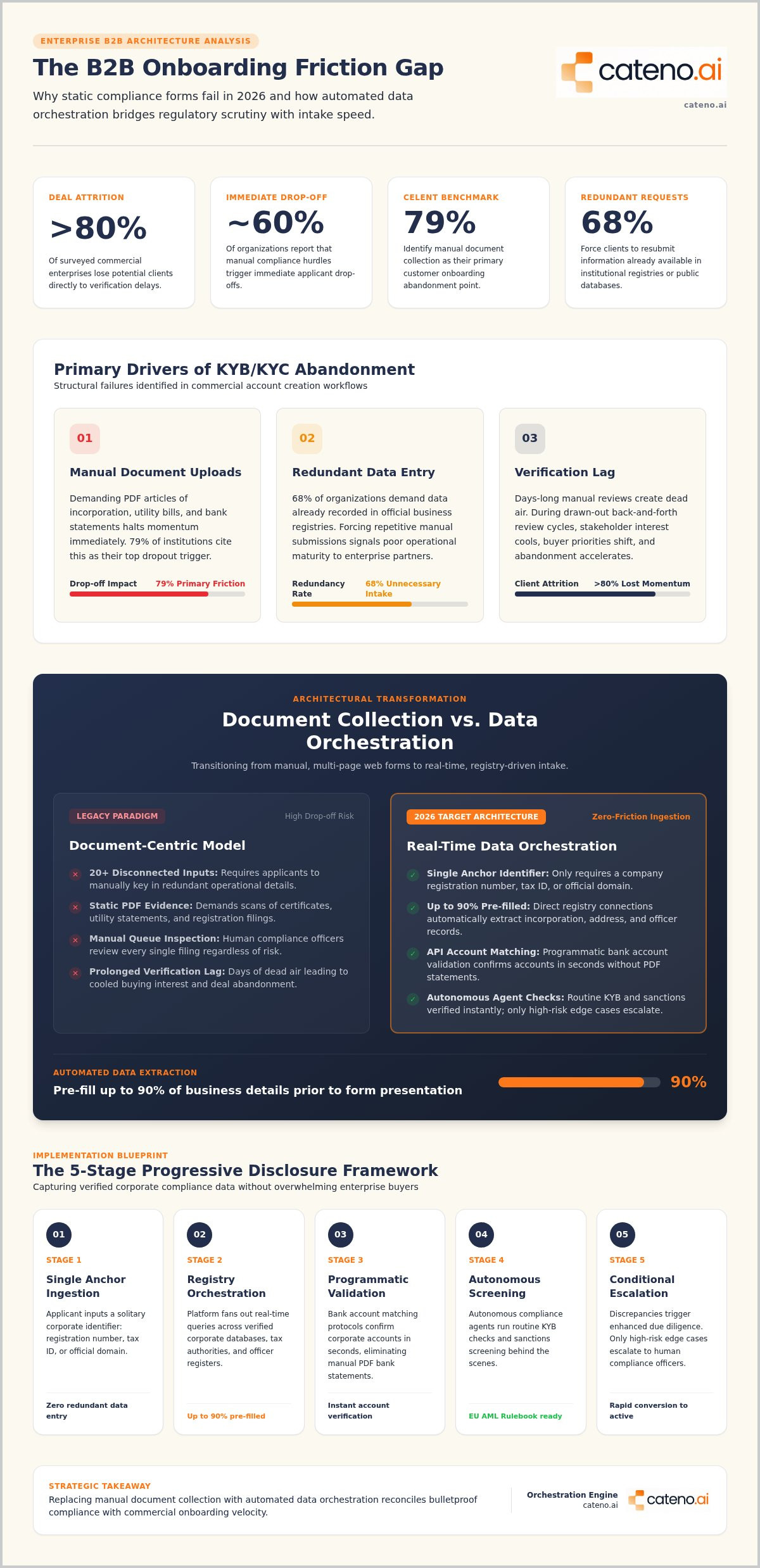
The cost of this operational inertia is catastrophic to customer lifetime value. Industry verification benchmarks reveal that over 80% of surveyed commercial enterprises lose potential clients directly to verification delays, while nearly 60% report that manual compliance hurdles trigger immediate drop-offs. When high-value accounts abandon flows during the Know Your Customer (KYC) or Know Your Business (KYB) stage, customer acquisition costs spike without generating downstream revenue. To systematically reduce onboarding friction, companies must address the data mechanisms driving these drop-offs.
The Compliance-UX Paradox
Enterprises frequently treat security and user experience as zero-sum trade-offs. As regulatory scrutiny deepens under frameworks like the EU Anti-Money Laundering Single Rulebook, compliance teams reflexively insert manual verification checkpoints. This defensive posture triggers severe regulatory fatigue across buying committees. Forward-looking operations resolve this tension by abandoning static gatekeeping in favor of dynamic orchestration, validating compliance criteria behind the scenes rather than placing the burden on the user.
Identifying Friction Points in KYB and KYC
Manual intervention accounts for the sharpest drop-offs in commercial account creation. Three structural failures consistently derail conversion:
- Manual document uploads: Research from Celent reveals that 79% of institutions identify document collection as their primary onboarding drop-off point. Demanding PDF articles of incorporation or utility bills halts digital momentum instantly.
- Redundant data entry: Celent reports that 68% of organizations force clients to submit information already available in institutional databases or public registries. Repetitive data requests signal operational inefficiency to high-tier partners.
- Verification lag: Days-long manual reviews create dead air. During prolonged review cycles, stakeholder interest cools, buyer priorities shift, and abandonment rates accelerate.
Eliminating these bottlenecks is the only reliable way to reduce onboarding friction while maintaining rigorous audit readiness.
The Architecture of Zero-Friction Data Orchestration
Solving intake abandonment requires changing how data moves into your systems. Most platforms treat onboarding as a document-gathering exercise, requiring users to locate, scan, and upload static PDF records. A modern data orchestration architecture replaces this document-centric model with real-time data ingestion. By connecting directly to official corporate registries, tax authorities, and business databases, systems can extract and verify legal entity records instantly. This shift allows platforms to pre-fill up to 90% of required business details before the customer ever sees a form field.
The goal is a single piece of information intake. Rather than asking a prospect to enter twenty separate operational data points, an orchestrated system asks for a solitary corporate identifier, such as a company registration number, tax ID, or official domain URL. In the background, the engine fans out queries across verified registries to fetch incorporation dates, registered office addresses, and officer lists. In parallel, programmatic bank account validation APIs verify corporate accounts in seconds, eliminating manual PDF bank statement uploads entirely. This approach delivers the decisive technical leverage needed to reduce onboarding friction.
Automating the Intake Lifecycle
Deploying a business onboarding workflow engine turns static intake sequences into dynamic, event-driven pipelines. The system triggers background checks conditionally based on entity profile and jurisdiction. Conditional fields remain hidden unless a real-time risk check detects a discrepancy or triggers enhanced due diligence. Bank accounts are confirmed programmatically via account-matching protocols, ensuring that funds flow only between verified entities without introducing operational delays.
The Role of Branded Self-Service Portals
User anxiety peaks during multi-stakeholder approval cycles. Providing a structured self service onboarding platform gives applicants visibility into where they stand in the evaluation pipeline. Transparency eliminates the uncertainty that frequently leads to deal fatigue:
- Real-time progression tracking: Visual indicators show verified items and remaining tasks, providing clarity on pipeline status.
- White-labeled consistency: Maintaining brand alignment across every interaction builds trust, reassuring stakeholders during sensitive compliance exchanges.
- Asynchronous stakeholder access: Procurement, legal, and operational leads can access the environment independently to resolve their respective checkpoints.
Engineering an automated orchestration pipeline enables enterprises to maintain rigorous compliance checks without degrading the customer experience. If you are assessing ways to modernize your intake systems and reduce onboarding friction, you can speak with our solution architects to see modern entity orchestration in action.
Manual Review vs. Autonomous Compliance Agents
Human compliance teams cannot scale linearly alongside digital revenue growth. When transaction volumes spike, relying on manual analysts inevitably leads to backlogs, high operational costs, and fatigued reviewers making inconsistent risk decisions. Traditional compliance frameworks forced companies to choose between thorough regulatory vetting and customer conversion. In 2026, autonomous compliance agents eliminate that trade-off. These agentic systems don't just extract text; they interpret corporate hierarchies, cross-reference registry databases, and resolve routine document discrepancies without human oversight.
Autonomous agents tackle the dreaded verification hangover: that 24 to 48-hour delay where an interested buyer sits in an administrative queue. By processing records asynchronously at machine speed, these systems make onboarding decisions in seconds rather than days. Handling standard entity profiles autonomously allows organizations to reduce onboarding friction substantially while maintaining full regulatory adherence.
Precision and Scalability in 2026
Algorithmic execution consistently outpaces manual paperwork reviews in both speed and reliability. Human reviewers face cognitive fatigue after hours of scrutinizing certificates of incumbency and identification records, causing error rates to climb. Autonomous agents, by contrast, maintain unwavering accuracy across millions of records. When conducting automated kyc document verification, agents parse machine-readable zones, verify biometric matches, and scan global watchlists instantly.
This capability fundamentally transforms internal compliance operations from mechanical data entry into exception-based risk governance:
- Instant straight-through processing: Clean, low-risk applicants pass straight through to active status within minutes.
- Autonomous anomaly resolution: Agents interpret slight name variations, corporate suffix differences, and address formatting discrepancies directly against external registers.
- Structured escalation workflows: Analysts spend their valuable time reviewing genuinely suspicious edge cases rather than retyping corporate information.
Removing the 'Back-and-Forth' Friction
The primary driver of customer drop-off during manual reviews is the open-ended rejection loop. In legacy setups, a user uploads an expired utility bill or an uncertified register extract and hears nothing for two business days, only to receive a vague rejection email. Autonomous agents provide real-time document rejection handling. When a submission fails verification, the agent identifies the precise issue immediately, prompting the user to rectify the specific page or data field while they are still actively engaged.
Similarly, agents streamline the discovery of Ultimate Beneficial Owners (UBO). Navigating multi-tiered corporate shareholding structures traditionally requires days of manual research. Autonomous agents dynamically trace ownership chains across corporate registries, pinpoint individuals meeting regulatory thresholds, and assign targeted verification tasks automatically. Freeing compliance officers from manual document sorting gives them time to build proactive risk strategies, while business customers enjoy an effortless intake experience that actively works to reduce onboarding friction.
The 2026 Onboarding Optimization Template: A 5-Stage Framework
High-performing enterprise organizations rely on structured blueprints rather than ad-hoc form design. To systematically reduce onboarding friction, engineering and compliance leaders must align around an end-to-end data pipeline. The following five-stage architecture turns fragmented operational steps into an automated, risk-adapted intake progression:
- Stage 1: Discovery and Pre-fill: Using registry-connected APIs, the system ingests corporate standing, registered addresses, and baseline filing data the moment an applicant submits an initial business identifier.
- Stage 2: Progressive Disclosure: The interface surfaces requests incrementally, gathering high-stakes compliance details only when justified by risk thresholds or transaction tiers.
- Stage 3: Real-Time Verification: Automated KYC and KYB checks execute in parallel with the user journey, validating corporate officers, tax status, and bank accounts behind the scenes.
- Stage 4: Exception Handling: Autonomous compliance agents parse unreadable uploads or ambiguous corporate filings on the fly, offering dynamic remediation cues before abandonment occurs.
- Stage 5: Continuous Monitoring: The workflow transitions smoothly into ongoing lifecycle supervision, tracking officer modifications, ownership shifts, and watchlist alerts without subjecting the client to periodic manual re-onboarding.
Implementing Progressive Disclosure
Front-loading complex requirements destroys funnel performance. Beginning with low-friction inputs establishes psychological momentum and trust. Complex requirements, such as collecting identity verifications for Ultimate Beneficial Owners (UBOs), should be deferred until essential commercial terms or initial account configurations are locked in. Tailoring intake depth to risk profiles, transaction volumes, and operating models ensures that low-risk entities complete onboarding without facing unnecessary compliance barriers.
Measuring Success: The Friction Audit
Optimizing an intake pipeline requires precise telemetry. Organizations must isolate two critical diagnostic indicators: Time-to-Verify (TTV), measuring elapsed time from first touch to verified status, and Step-Specific Drop-off Rate, which pinpoints exact friction locations. Evaluating your pipeline against structured kyc onboarding checklists exposes legacy technical debt across your identity and document stacks. Regularly testing dynamic routing logic lets operations leaders isolate bottlenecks and refine conversion paths continually.
Modernizing your intake architecture requires purpose-built infrastructure. To eliminate manual verification delays across your customer funnels, schedule an onboarding architecture audit with our team today.
Orchestrating Growth with Cateno’s Workflow Engine
Engineering teams often waste quarters hardcoding logic to manage regulatory compliance. Cateno eliminates this technical overhead through an adaptive infrastructure layer. With Cateno's customizable workflow engine, enterprise platforms can actively reduce onboarding friction without writing custom code for every regulatory iteration. The system operates on a single-point-of-data entry philosophy: providing a solitary corporate identifier allows the engine to query registers, reconstruct entity hierarchies, and execute verification rules in real time.
Client intake transforms from a fragmented process into an intuitive journey via the Self-Service Onboarding Gateway. Instead of chasing stakeholders across disparate communication channels, businesses deploy autonomous compliance agents that orchestrate document parsing, biometric matching, and sanctions cross-referencing in parallel. This autonomous architecture achieves up to 99% automated straight-through processing for standard applications. Meanwhile, delivering this journey through a customized white label kyc portal ensures users remain immersed in a secure, familiar environment that builds brand confidence.
Enterprise-Ready Compliance
Operating across multiple industries requires adaptable governance structures that adjust instantly to sector-specific mandates. Rather than stitching together discrete tools for identity matching, corporate registry cross-referencing, and bank account verification, organizations manage the entire operational lifecycle through a unified platform. Cateno generates advanced verification reports that produce clear, audit-ready paper trails for internal risk teams and external regulators. Consolidating these capabilities into a single orchestration layer future-proofs operations against evolving 2026 regulatory milestones, including the EU AI Act's governance criteria and updated corporate transparency requirements.
Ready to Eliminate Onboarding Friction?
The operational shift from manual intake checklists to programmatic data orchestration is no longer optional for growth-minded enterprises. Compressing verification timelines from days down to seconds delivers an undeniable commercial advantage. When platforms compress intake latency, conversion rates rise and operational costs decline.
- Eliminate repetitive data collection by pulling corporate records programmatically.
- Resolve edge cases instantly using autonomous compliance agents.
- Deliver transparent status tracking inside a branded customer portal.
Empower your organization to systematically reduce onboarding friction and scale client acquisition. Explore Cateno’s Onboarding Platform to see how unified entity orchestration drives sustainable growth in 2026.
Building the Future of Frictionless Enterprise Intake
Manual gatekeeping is no longer sustainable for modern commercial operations. Achieving true velocity in 2026 requires shifting away from repetitive document uploads toward intelligent registry orchestration. By pairing single-identifier intake with autonomous compliance agents, platforms unlock up to 99% automation across their KYC and KYB workflows. Presenting these streamlined steps inside a branded self-service portal eliminates customer anxiety, giving your business partners transparent visibility into their approval status without the manual back-and-forth.
Deciding to systematically reduce onboarding friction does far more than shorten intake cycles. It protects customer acquisition investments, lowers operational cost per verified account, and ensures continuous regulatory auditability. Transforming your intake architecture turns compliance from a commercial barrier into a lasting competitive advantage. Scale your growth with Cateno’s frictionless onboarding platform and modernize your verification pipelines today.
Frequently Asked Questions
What are the most common causes of onboarding friction in B2B?
The most common friction points stem from manual document collection, repetitive data entry, and multi-day verification lags. Forcing commercial applicants to locate physical incorporation papers or upload PDF bank statements halts digital momentum. Friction also compounds when organizations ask for information already accessible in official registries or fail to offer asynchronous collaboration for multiple corporate stakeholders.
How can I reduce friction without compromising KYC/KYB compliance?
You can reduce onboarding friction by shifting from document uploads to automated data orchestration. Instead of asking applicants to self-report corporate details, modern workflow engines ingest and verify registry records behind the scenes. Autonomous agents perform sanctions screening, entity unwrapping, and bank account validation simultaneously, maintaining strict regulatory compliance without placing an administrative burden on the customer.
What is progressive disclosure in the context of user onboarding?
Progressive disclosure is an intake strategy that sequences requirements based on risk tiers and lifecycle stages. Instead of presenting a 20-field form up front, the system requests minimal initial information to establish momentum. More complex compliance tasks, such as collecting identity documents for beneficial owners, are deferred until essential value or higher transaction thresholds are reached.
How do autonomous compliance agents help reduce friction?
Autonomous compliance agents eliminate verification bottlenecks by interpreting corporate structures, cross-referencing global databases, and resolving document anomalies at machine speed. When a submission contains an error, the agent flags the specific issue immediately rather than letting the file sit in an administrative queue. This removes manual email exchanges and speeds up account activation.
Can automated onboarding help prevent fraud more effectively than manual review?
Automated onboarding consistently outperforms manual review by removing human fatigue and inconsistencies. Programmatic engines cross-reference official business registries, verify beneficial ownership chains, and perform instant bank account matching in parallel. These systems detect synthetic identities, altered documents, and sanctions matches with cryptographic precision, escalating only high-risk anomalies to compliance teams.
What metrics should I track to measure onboarding friction?
Organizations should prioritize Time-to-Verify (TTV), step-specific drop-off rates, and the conversion percentage from initial sign-up to active status. Tracking the frequency of document re-upload requests and the average volume of manual support touches per onboarded entity also reveals where legacy technical debt creates hidden operational drop-offs across your funnel.
Is it possible to onboard a business entity with just one piece of information?
Yes, modern platforms can onboard complex entities starting with a single anchor point, such as a company registration number, legal name, or domain URL. An orchestration engine takes that sole identifier to query corporate databases, retrieving addresses, director lists, and registry standing programmatically. This approach helps reduce onboarding friction by removing manual data entry entirely.
How does a branded customer portal improve onboarding conversion rates?
A branded customer portal reduces applicant drop-off by providing a secure, transparent environment tailored to multi-stakeholder workflows. Real-time progress trackers eliminate uncertainty, while white-labeling maintains brand trust during sensitive identity submissions. Allowing legal, finance, and operational leads to complete their assigned requirements independently prevents single points of failure across the approval process.


