

What if your compliance process wasn't a barrier to entry, but a competitive advantage that begins with a single data point? Most SaaS organizations treat verification as a necessary friction, a series of hurdles that inevitably lead to high user drop-off. In an era of autonomous orchestration, failing to optimize your kyc onboarding checklist is no longer just an inconvenience; it's a structural liability. You've likely felt the strain of stitching together multiple APIs, only to find that manual review bottlenecks still stall your growth and delay revenue.
It's time to transition from systemic friction to streamlined efficiency. This article provides a comprehensive framework designed for the 2026 regulatory landscape, offering the tools to build a frictionless, automated flow that eliminates technical debt. You'll learn how to replace manual intervention with customizable workflow engines and autonomous compliance agents. We'll examine the specific steps to move customers from signup to success without the typical regulatory drag, ensuring your system is both enterprise-ready and built for rapid scale.
Key Takeaways
- Establish a robust Customer Identification Program (CIP) that maps data requirements to specific entity risks to minimize technical debt from the start.
- Implement a "single piece of information" intake strategy using this kyc onboarding checklist to capture users early and significantly reduce initial friction.
- Deploy autonomous compliance agents to resolve low-level verification flags, removing manual bottlenecks and allowing your team to focus on high-priority exceptions.
- Automate complex KYB and UBO identification through direct registry lookups to accelerate time-to-revenue for enterprise-level business customers.
- Evolve from static onboarding gates to continuous lifecycle monitoring, ensuring sustained data integrity through automated behavioral triggers and re-verification.
Phase 1: Compliance Architecture and Risk Parameter Definition
Successful automation doesn't start with an API call. It begins with a structural blueprint. You must define the operational parameters before a single user enters your system. This phase is about building the foundation of your kyc onboarding checklist to ensure scalability without accumulating technical debt. Precision is mandatory. Without a clear architecture, your onboarding flow will eventually collapse under the weight of manual exceptions and fragmented data.
Establishing a Customer Identification Program (CIP) requires a granular understanding of Know Your Customer regulatory frameworks. You aren't just collecting data; you're verifying it against specific risk profiles. Mapping these requirements involves a clear distinction between entity types. Individuals typically require standard identity markers like Name, DOB, and SSN. Business entities, however, demand deeper verification of tax IDs, articles of incorporation, and ownership structures. To reduce initial friction, adopt a "Minimum Viable Onboarding" path. This strategy focuses on collecting only the essential data needed to initiate the process, often starting with a single piece of information to lower the barrier to entry.
Determining Your Regulatory Baseline
Identify the specific AML and CTF regulations that govern your SaaS vertical. Fintech requirements differ significantly from B2B SaaS or marketplace platforms. You must set rigid geographic restrictions and sanctioned country lists early in your logic. Compliance isn't optional, but how you execute it determines your growth rate. Data retention and privacy policies, including GDPR and CCPA, must be integrated directly into your Customizable Workflow Engine. This ensures that your data integrity remains intact as you scale across different jurisdictions.
Mapping the Entity Onboarding Journey
Differentiate between low-risk and high-risk user profiles by creating conditional logic triggers based on initial input. If a user presents a high-risk signal, the workflow should pivot automatically without requiring a manual override from your compliance team. Set automated pass/fail thresholds for instant decisioning to accelerate time-to-revenue. This allows high-trust users to clear the kyc onboarding checklist in seconds while flagging edge cases for further review. A Risk-Based Approach in 2026 automation is the dynamic application of verification intensity based on real-time data signals, ensuring high-trust users move fast while suspicious entities face rigorous scrutiny.
- Automated Thresholds: Define clear scores for document integrity and biometric matching.
- Conditional Logic: Trigger additional KYB steps only when a business entity exceeds a specific risk score.
- Instant Decisioning: Use data-driven parameters to approve or reject users in real-time, removing the manual review bottleneck.
Phase 2: Designing the Frictionless Self-Service Intake
User abandonment often peaks at the moment of document submission. To mitigate this, your intake process must feel like a natural extension of your product rather than a jarring regulatory detour. Implementing a Branded Customer Portal ensures brand continuity, which directly correlates with higher user trust. When users see a familiar interface, they're more likely to complete sensitive tasks like document uploads or biometric scans. This trust-building is a critical component of any modern kyc onboarding checklist that aims to convert high-value leads into active customers.
Designing for mobile-first capture is no longer an option; it's a requirement. High-resolution cameras on mobile devices facilitate superior document forensics and biometric liveness checks. Following the FATF digital identity guidance, you should implement real-time feedback loops within the interface. If a document is blurry or an edge is cut off, the system must notify the user immediately. This prevents the "black hole" effect where users wait days for a rejection that could've been corrected in seconds. Instant validation turns a potentially frustrating experience into a guided, successful interaction.
The Self-Service Gateway Essentials
A sophisticated gateway isn't just a static form; it's a dynamic interface that guides the user through complex requirements. You should build a responsive, white-label interface that adapts to the user's device and specific entity type. Integrating progress indicators provides a psychological anchor, showing users exactly how close they are to completion. Utilizing Cateno's platform allows you to deploy these gateways without the technical debt typically associated with custom-built compliance stacks. This ensures your engineering team stays focused on core product features while your onboarding remains enterprise-ready.
Reducing Intake Friction
The most effective way to reduce friction is to ask for less. By utilizing a "single piece of information" intake, you can kickstart the entire process. For example, capturing just a business name allows your system to auto-fill registration numbers, addresses, and officer lists via external registry lookups. This approach, known as progressive profiling, ensures you only request manual data when absolutely necessary. It's a strategic shift from demanding information to verifying existing data. For a deeper dive into these strategies, see our Self-Service Onboarding Guide for B2B Growth. If you're ready to optimize your specific workflow, you can speak with an automation consultant to refine your intake strategy.
Phase 3: The Automated Verification Core (KYC & KYB)
Once the intake gateway captures the initial data, the verification engine must execute a high-precision analysis of both identity and entity legitimacy. This stage represents the "engine room" of your kyc onboarding checklist, where raw data transforms into verified trust. Orchestrating these checks in parallel, rather than sequence, is the key to maintaining a fast-paced user experience while meeting rigorous regulatory standards. A unified verification core eliminates the need for manual data entry and reduces the technical debt associated with managing disparate verification providers.
Modern verification requires more than a simple document scan. It demands a multi-layered approach that includes document forensics, biometric matching, and real-time data cross-referencing. To ensure your system meets global security standards, align your technical requirements with the NIST Digital Identity Guidelines. These frameworks establish the necessary Identity Assurance Levels (IAL) to prevent sophisticated fraud while allowing legitimate users to pass without friction. By integrating these standards, you protect your platform from account takeovers and synthetic identity fraud from the moment of first contact.
Individual Verification (KYC) Checklist
For individual users, the focus is on establishing a definitive link between the person and their documentation. Your system should employ advanced liveness detection to ensure the user is physically present, preventing the use of static photos or deepfakes. Automated face-matching compares the live capture against government-issued IDs with sub-second latency. Beyond the ID, utilize utility database lookups for automated proof of address verification, removing the need for users to upload PDF statements. For a deeper technical breakdown, consult our KYC Verification Guide.
Business Entity Verification (KYB) Checklist
Business verification is inherently more complex, requiring a transition from individual identity to corporate structure. Your kyc onboarding checklist must include automated registry lookups via the Secretary of State or equivalent global databases to verify legal existence. Identifying Ultimate Beneficial Owners (UBOs) is often a manual bottleneck; however, modern orchestration can unmask these structures automatically. Integrating Bank Account Verification via API further secures the flow by validating that the entity's financial credentials match their registered identity. This prevents payment fraud and ensures that your Automated KYC and KYB Checks provide a complete risk profile of the business entity.
- Registry Validation: Instant confirmation of active business status and registration history.
- UBO Identification: Automated mapping of ownership hierarchies to identify individuals with significant control.
- Financial Integrity: Real-time bank validation to ensure the entity is authorized to conduct transactions.
- Sanctions Screening: Continuous monitoring against PEP and global watchlists to ensure ongoing compliance.
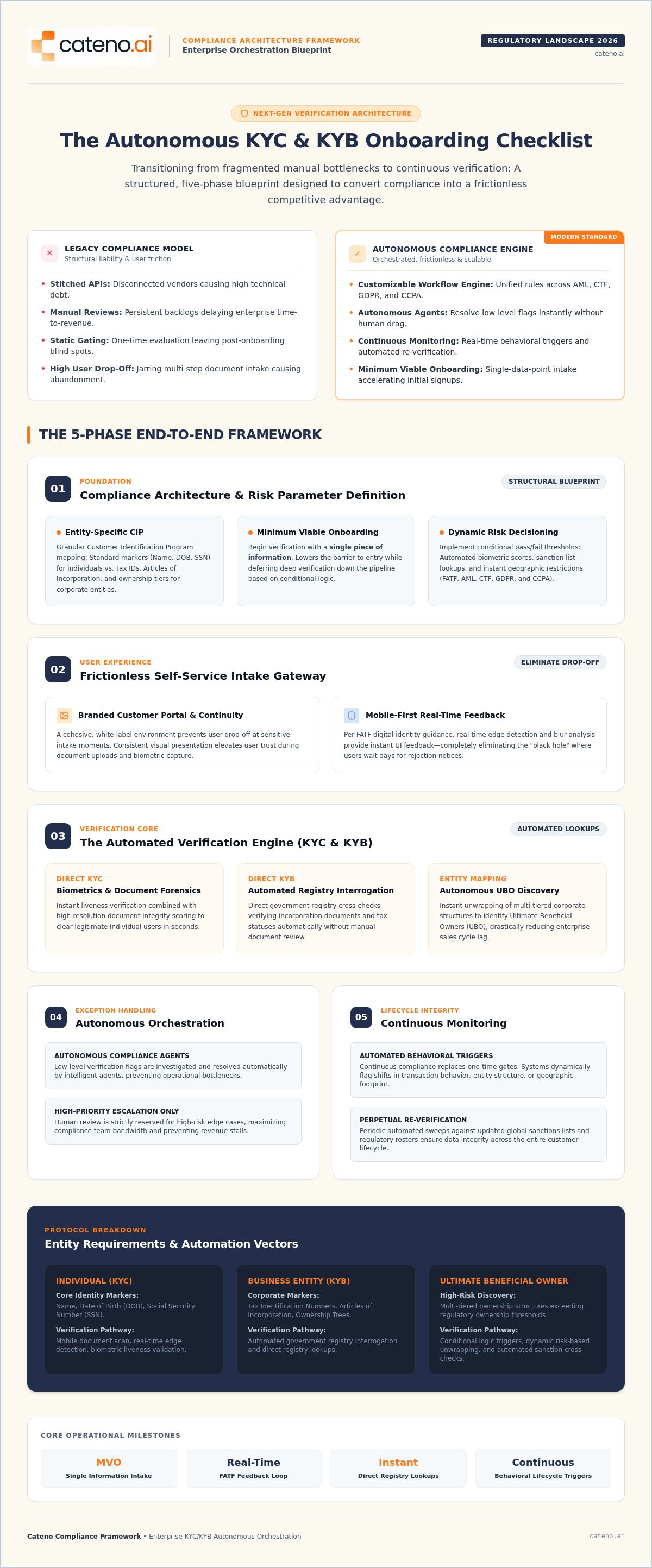
Phase 4: Orchestration and Autonomous Exception Handling
Individual verification checks provide raw data, but orchestration provides the intelligence to act on it. A robust kyc onboarding checklist is incomplete without a centralized logic layer that determines how data flows between systems. Most SaaS platforms struggle with "grey area" flags, where a document isn't clearly fraudulent but fails an automated check due to poor lighting or minor data discrepancies. Without orchestration, these cases fall into manual review queues, creating a bottleneck that scales linearly with your user growth. Transitioning to an automated orchestration model allows your system to resolve these exceptions dynamically, maintaining a high-velocity onboarding flow.
True scalability requires a move away from static, linear forms toward a Customizable Workflow Engine. This engine acts as the brain of your compliance operations, directing users through different paths based on the risk signals detected in earlier phases. By automating document management and lifecycle tracking, you ensure that every piece of evidence is captured and stored in an audit-ready format. This level of control is what separates enterprise-ready systems from basic verification scripts, providing the stability needed to handle complex entity structures and high-volume intake without increasing operational overhead.
The Role of Autonomous Compliance Agents
Autonomous compliance agents represent the next evolution in exception management. These specialized agents are designed to handle low-level flags that typically require human intervention, such as resolving minor name mismatches or requesting a clearer document scan. By deploying these agents, organizations can reduce manual review queues by up to 80% through the application of smart, context-aware logic. Autonomous Compliance is the strategic orchestrator of risk, managing the flow of data and decision-making without constant human oversight. This allows your compliance team to focus exclusively on high-priority threats and complex approvals while the system handles the routine friction of the kyc onboarding checklist.
Workflow Logic and Escalation
Designing sophisticated "if-this-then-that" logic paths ensures that your onboarding flow remains responsive to different verification outcomes. For instance, if a KYB check reveals a complex ownership structure, the workflow should automatically trigger additional UBO identification steps without manual prompting. All of this activity must be centralized into Advanced Verification Reports, providing a single, comprehensive audit trail for every entity. For sector-specific applications, examine Cateno Industries to see how these workflows adapt to different regulatory environments. If you're looking to eliminate manual bottlenecks in your current process, you can consult with our team to design a more resilient orchestration layer.
- Dynamic Routing: Automatically adjust the onboarding path based on real-time risk scores.
- Audit Readiness: Generate centralized reports that document every automated decision and data point.
- Lifecycle Tracking: Maintain a continuous record of document validity and verification status.
Phase 5: Post-Onboarding and Continuous Compliance Monitoring
Onboarding isn't a finish line; it's the commencement of a regulated relationship. In high-growth SaaS environments, the risk profile of an entity can change long after the initial intake. A static kyc onboarding checklist must evolve into a living framework for ongoing lifecycle management. This transition ensures that your data integrity remains absolute even as business structures shift or regulatory requirements tighten. By moving beyond one-time verification, you eliminate the "compliance blind spot" that often occurs between annual reviews.
Effective lifecycle management relies on automated triggers for re-verification. These triggers should be based on both time, such as annual business license renewals, and behavior, such as a sudden change in transaction volume or a shift in geographic activity. Your system must automatically flag expiring documents and initiate a self-service update request through the Branded Customer Portal. This proactive approach prevents service disruptions and ensures your platform remains compliant without requiring manual intervention from your operations team.
Establishing an Ongoing Monitoring Loop
Continuous screening is the bedrock of a modern compliance strategy. Your orchestration layer should perform real-time updates to entity profiles as business data changes in global registries. This includes persistent monitoring against updated sanctions and PEP lists to identify new risks immediately. Utilizing Autonomous Compliance Agents to manage these alerts allows you to filter out false positives at scale, ensuring your team only intervenes when a high-probability match is identified. Maintaining a "living" file for every partner ensures that your risk assessment is always based on the most current data available.
Audit Readiness and Reporting
Regulatory examinations demand more than just current status; they require a complete history of the customer lifecycle. You must generate comprehensive Advanced Verification Reports that document every change, re-verification, and automated decision made over time. This centralized reporting structure ensures that you're always audit-ready, providing a clear narrative of your compliance efforts from initial intake to the present day. Maintaining this level of transparency is essential for enterprise-level stability and long-term growth. To find a plan that fits your operational volume and needs, you can explore Cateno's pricing to scale your automated compliance infrastructure effectively.
Future-Proofing Your Onboarding Infrastructure
Transitioning from manual verification to an automated orchestration model is the only path to sustainable growth in a complex regulatory environment. By implementing a robust kyc onboarding checklist, you move beyond static forms and embrace a dynamic system built for scale. This strategy replaces technical debt with a modular architecture that adapts to every entity type while maintaining absolute data integrity.
Optimizing your intake flow provides a definitive competitive advantage. Branded portals increase conversion by up to 40% by maintaining user trust throughout the verification process. Autonomous compliance agents reduce manual tasks by resolving low-level flags without human intervention. The capability to verify any entity with just a single piece of information allows your team to focus on strategic expansion rather than administrative friction.
Build Your Automated Onboarding Workflow with Cateno to transform your compliance operations into a high-performance engine. Precision and speed are now within your control.
Frequently Asked Questions
What is the difference between KYC and KYB in a SaaS onboarding flow?
KYC focuses on identifying individual users through government IDs and biometric matching. KYB extends this process to verifying legal entities, unmasking complex ownership structures, and identifying Ultimate Beneficial Owners. In a modern SaaS flow, these processes are often consolidated into a single kyc onboarding checklist to ensure that both the business and its authorized representatives are legitimate. This unified approach reduces technical debt by managing all verification data within one orchestration layer.
How can I reduce onboarding friction while maintaining strict compliance?
Reducing friction requires a shift from demanding data to verifying it through external registries. By implementing a "single piece of information" intake, you can auto-fill business details from a company name or registration number. Utilizing progressive profiling ensures that users only provide documentation when a specific risk trigger is met. This method maintains strict compliance while accelerating the user journey, moving legitimate customers through the gateway faster without compromising the integrity of your security parameters.
What are autonomous compliance agents and how do they work?
Autonomous compliance agents are intelligent logic layers designed to resolve low-level verification flags without human intervention. They work by analyzing data discrepancies, such as minor name mismatches or blurred document edges, and dynamically requesting corrections from the user. These agents act as a strategic orchestrator, handling routine exceptions that would otherwise stall a manual review queue. This automation allows your compliance team to focus on high-priority risks while maintaining a high-velocity onboarding flow for standard users.
Can I automate bank account verification during the KYC process?
Yes, you can automate Bank Account Verification directly within your onboarding workflow using API-driven validation. This process confirms that the financial account belongs to the entity being verified, which is a critical step in preventing payment fraud. By integrating real-time bank validation, you ensure that the financial credentials match the registered business identity. This automation removes the need for manual bank statement reviews and provides an immediate confirmation of the entity's transactional legitimacy.
What documents are typically required for business entity verification (KYB)?
Business entity verification typically requires documents that prove legal existence and ownership structure. This includes articles of incorporation, tax identification numbers, and proof of business address. Additionally, you must collect documentation for Ultimate Beneficial Owners to comply with anti-money laundering regulations. Automating the collection of these documents through a self-service gateway ensures that all necessary evidence is captured in an audit-ready format, reducing the administrative burden on your internal teams and your customers.
How often should I perform ongoing monitoring after initial onboarding?
Ongoing monitoring should be a continuous process rather than a periodic event. While initial onboarding establishes a baseline, your system must perform real-time screening against updated sanctions and PEP lists to identify new risks. You should also set automated triggers for re-verification based on specific behavioral changes or time-based milestones, such as the expiration of a business license. Continuous monitoring ensures your kyc onboarding checklist remains effective throughout the entire customer lifecycle, maintaining compliance as entity profiles evolve.
What is a branded customer portal and why do I need one for KYC?
A branded customer portal is a white-labeled interface that allows users to securely upload documents and complete verification tasks within your own ecosystem. It's essential for KYC because it maintains brand continuity, which directly correlates with higher user trust and completion rates. When users remain within a familiar branded environment, they're more likely to share sensitive information. This trust is vital for reducing abandonment and ensuring that the intake process feels like a seamless part of your product.
How does automated document forensics detect sophisticated fraud?
Automated document forensics detects fraud by analyzing technical markers that are invisible to the human eye. This includes examining document metadata, checking for digital alterations in image layers, and verifying security features like holograms or micro-text. When combined with biometric liveness checks, the system ensures that the document is both authentic and presented by its rightful owner. These sophisticated checks prevent the use of deepfakes, synthetic identities, and stolen credentials, providing a high level of security at scale.


