

A clean onboarding check is only the beginning. A sound adverse media screening best practices workflow for 2025 treats screening as part of KYC and customer due diligence, with repeat screening or continuous monitoring throughout the customer relationship. It reviews publicly available information that may link a person or organization to illicit or unethical activity.
Teams rely on screening for a reason, but a match is a signal to assess, not a conclusion. Clear risk criteria, relevant sources, identity-level review, and documented decisions help distinguish meaningful concerns from irrelevant results.
This guide explains how adverse media screening works and where it fits in KYC, CDD, and AML workflows. You’ll learn how to set risk-based criteria, choose sources and tools, assess alerts, and decide when findings call for enhanced due diligence, dismissal, or ongoing monitoring. The result is a practical framework for making screening consistent and actionable, without treating it as a substitute for human judgment or other checks.
Key Takeaways
- Set screening thresholds around your organization’s risk profile, industry exposure, and relevant compliance requirements.
- Build source coverage across relevant languages, regions, and sectors, including news, regulatory notices, court records, and government publications.
- Use automation to organize alerts, while keeping analyst judgment central to identity matching and assessment of credibility, relevance, and severity.
- Document why each alert is escalated, dismissed, or retained for monitoring, and define what events trigger a fresh review.
- Integrate media screening with KYC, CDD, sanctions, and politically exposed person checks so findings inform the wider customer risk picture.
What Is Adverse Media Screening?
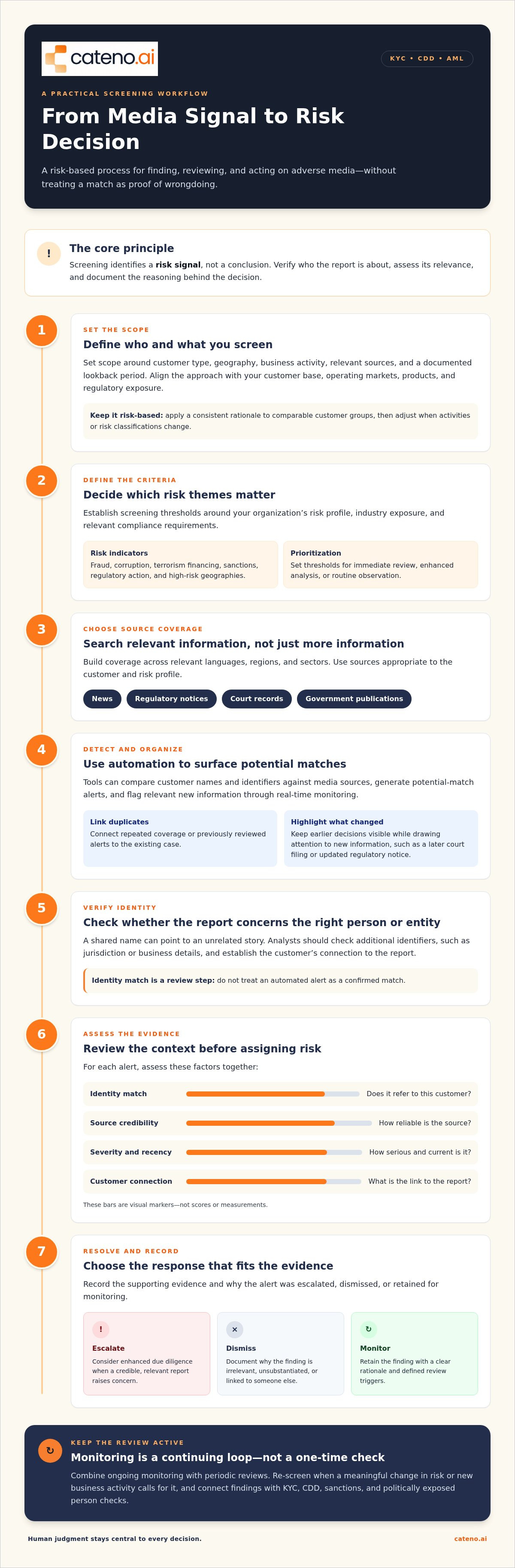
Adverse media screening searches publicly available information for reports that may link a person or organization to illicit or unethical activity. In KYC and customer due diligence, it helps teams identify risk signals that identity checks alone may miss. A report about suspected fraud, for example, can prompt an analyst to examine a customer’s business activity and relationships more closely. Screening identifies a risk signal, not proof of wrongdoing.
Screening begins during onboarding and continues while the customer relationship remains active. A one-time search can miss information published later, such as a regulatory action involving a business or its beneficial owner. Ongoing monitoring can surface new coverage between scheduled reviews, while periodic reviews provide a structured opportunity to reassess existing information. Together, these approaches keep customer due diligence aligned with changing risk.
Automation can compare customer names and identifiers against media sources, then generate alerts for potential matches. Real-time monitoring can flag relevant new information, but every alert still needs review. A shared name, for example, may connect a customer to an unrelated news story. Checking additional identifiers, such as jurisdiction or business details, helps analysts determine whether a report concerns the right person or entity.
Duplicate suppression is another essential control. If the same article appears across multiple outlets, or an alert repeats previously reviewed coverage, the system should link it to the existing case instead of creating a new investigation. Analysts can then focus on genuinely new information, such as a later court filing or updated regulatory notice. A sound workflow preserves the earlier decision and highlights what has changed, reducing repetitive review without hiding material developments.
When a credible, relevant report raises concern, enhanced due diligence may be the next step. Analysts can assess the allegation’s severity, the source’s credibility, the event’s recency, and the customer’s connection to it. A report about a company executive, for instance, may warrant closer review of the executive’s role and the business’s activities. Depending on the evidence and risk assessment, the finding can lead to escalation, documented dismissal, or continued monitoring.
Periodic reviews remain useful even when automated alerts operate continuously. A scheduled review can reassess risk classification and confirm that existing information still reflects the customer’s profile. A new business activity or a meaningful change in risk can also trigger an immediate re-screen. Under the European Union AML Regulation, the regulation applies from 10 July 2027. That date makes it important for teams to understand how regulatory developments relate to their own screening processes.
Effective monitoring combines automated detection with human judgment. A practical workflow distinguishes new information from duplicates, links alerts to the relevant customer record, and preserves the reasoning behind each decision. This helps analysts respond to meaningful developments without treating every mention as a confirmed concern.
Setting screening criteria based on industry regulations and risk profiles
Define scope by customer type, geography, business activity, relevant sources, and a set lookback period, then calibrate thresholds to your risk assessment. Measure performance through alert relevance, review time, escalation outcomes, source coverage, and backlog. Set triage and resolution targets that reflect case severity.
Screening Scope and Lookback Periods
Screening scope defines whom and what you search, which risk topics matter, and how far back relevant coverage extends. Set it around your customer base, operating markets, products, and regulatory exposure. A financial institution serving businesses across multiple jurisdictions may need broader geographic and language coverage than a firm with a narrower profile.
Choose a lookback period that captures information relevant to present risk, and document why it fits the organization. Apply the same rationale across comparable customer groups, then adjust it when business activities or risk classifications change. FATF Recommendation 10 requires an underlying risk assessment for adverse media screening, so scope and lookback choices should follow documented risk rather than convenience.
Risk Indicators and Alert Analysis
Risk indicators are defined categories of reporting that may signal financial crime or reputational exposure. Examples include allegations involving fraud, corruption, terrorism financing, sanctions, regulatory action, or high-risk geographies. FinCEN encourages financial institutions to consider adverse media in their AML risk assessments, while FATF Recommendation 12 recognizes higher inherent bribery or corruption risk for politically exposed persons.
For each alert, analysts should assess identity match, source credibility, allegation severity, recency, and the customer’s connection to the report. Categorize the finding by risk theme and record the supporting evidence. A report naming a company director in a credible corruption investigation warrants different analysis from an unsubstantiated claim about an unrelated person with a similar name.
Risk Thresholds and Case Prioritization
Risk thresholds determine which alerts need immediate review, enhanced analysis, or routine observation. Group related alerts by customer, allegation, geography, or source event so analysts can review a consolidated case rather than disconnected items. Prioritize cases involving credible reports of serious financial crime, direct customer involvement, or relevant regulatory action.
Teams can reduce false positives by refining identifiers, risk categories, and matching rules based on documented review outcomes. Don’t suppress a recurring name match without checking whether new details change the identity assessment. Track alert relevance, the share escalated for further review, review time, unresolved backlog, and source coverage. Set internal service levels by severity, then monitor whether urgent cases receive timely attention and routine cases progress consistently.
Review these measures together. A lower alert volume alone doesn't show stronger screening if relevant cases are missed or delayed. Compare outcomes across customer risk groups and source categories, and use recurring false positives to improve matching criteria. Define ownership for metric reviews and escalation decisions so that performance data leads to specific workflow changes. Teams aligning these controls with intake processes can discuss their workflow requirements.
News, regulatory, court, sanctions, and social-media sources
Source selection determines which adverse information enters the screening workflow and how relevant the resulting alerts will be. Configure coverage around customer geographies, languages, and sectors. To manage privacy, bias, and reputational risks, collect only relevant information and verify identity before taking action.
Screening Data Sources
Screening sources include public or licensed records used to identify potential risk signals about a person or organization. Combining source types gives investigators a broader view than news searches alone. Relevant sources include local, national, and international publications; regulatory announcements; enforcement databases; court records; legal filings; and government or law-enforcement publications.
Sanctions screening checks designated-person and entity lists issued by OFAC, the UN, the EU, and HMT. Social media and other non-traditional sources can add context, but should complement rather than replace reliable records. The UK Financial Conduct Authority and Monetary Authority of Singapore expect firms to conduct open-source intelligence gathering, including negative news monitoring, as part of customer due diligence.
Configure sources to match the customer and the risk being assessed. A business operating in several countries may need local-language reporting alongside international news. A financial institution screening a company in a regulated sector may prioritize relevant enforcement databases and court filings. Sector-specific configuration helps surface material information without letting unrelated source categories dominate every search.
Source Credibility
Source credibility refers to how dependable and attributable a publication or record is. It matters because an alert can influence customer risk decisions and create reputational consequences if an allegation is mistaken for established fact. Record the original source, publication date, named parties, and whether the report cites documents or identifiable authorities.
Where possible, compare coverage across independent outlets, then distinguish a regulator’s enforcement notice from an unverified social media claim. Check whether a court record describes an allegation, a proceeding, or an outcome. Translation errors, recycled articles, incomplete reporting, and shared names can distort meaning. Preserve the context instead of treating repeated mentions as independent confirmation.
Privacy and bias need deliberate controls. Limit searches to information relevant to the screening purpose, restrict access to case records, and don’t treat a person’s nationality, language, or geography as evidence of wrongdoing. For example, a translated article about a person with a common name needs identity-level review before escalation. These steps reduce unfair suspicion and reputational harm caused by a false association.
Global coverage has practical limits. No single source set captures every local publication, court record, or language consistently, and social media posts can change or disappear. Define which sources are in scope, preserve evidence with its origin and date, and send uncertain material for analyst review. This creates a traceable basis for investigation and proportionate action, rather than relying on an isolated headline.
Automated sanctions and adverse media screening tools
Automation helps teams process negative news and sanctions data consistently, while analysts assess context and make decisions. Effective screening combines broad coverage with review controls, not automated decisions alone.
Automating Searches, Reviews, and Summaries
Automated screening tools search configured news and intelligence sources, then organize potential matches for review. This can help teams manage global negative news coverage without manually repeating each search.
A useful workflow links each alert to its source, relevant customer identifiers, and prior case activity. Summaries can help analysts quickly identify the allegation, publication date, and named parties. Analysts still need to examine the original report and determine whether it concerns the screened customer. For example, a summary of a money laundering allegation is no substitute for checking the article’s context and identity details.
Manual and Automated Screening Methods
Manual screening relies on staff searching websites and databases, while automated screening applies configured searches across sources. Manual online searches can return up to 90% false positives, making identity verification and relevance assessment essential.
Manual research can provide useful context for complex cases, but repeated searches are difficult to standardize across a large customer base. Automation applies consistent search criteria and surfaces potential matches for review. Neither approach removes the need for judgment: a name match may concern another person, and an adverse media alert needs assessment rather than automatic treatment as a confirmed finding.
Selecting Screening Software
Screening software searches and manages media and list matches against defined criteria. Choosing the right tool matters because source coverage, matching quality, and case handling shape what analysts see and how they respond.
Shortlist tools based on your organization’s languages, geographies, sectors, and customer types. Test each candidate with your own data, including common names, transliterations, and known historical cases. Check whether analysts can access original sources, distinguish new coverage from repeat mentions, and record decisions. Sanctions screening should also check designated individuals and entities against official lists, including those issued by OFAC, the UN, the EU, and HMT.
AI and Machine-Learning Automation
AI and machine learning can help process and prioritize screening results. Their value depends on whether the workflow helps analysts identify relevant information without obscuring the evidence behind an alert.
Use automation to organize potential matches and route higher-priority cases for human review. Analysts should be able to inspect the source, matching details, and reasons for prioritization. Test results against actual customer records, then review false positives and missed relevant findings. Use this feedback to refine screening criteria and tool configuration, while grounding final decisions in evidence rather than an automated score alone.
Adverse media screening in KYC, CDD, and AML workflows
Adverse media screening adds context to KYC and customer due diligence by identifying public reporting relevant to customer risk. Its value depends on where findings enter the workflow: at onboarding, during risk assessment, and throughout ongoing monitoring. FinCEN expects covered financial institutions to assess customer risk using available information, including public records and media sources, as part of customer due diligence.
Integrate media results with sanctions and politically exposed person checks rather than treating adverse media screening as a replacement for them. A sanctions match and an adverse media alert are not the same. A confirmed sanctions match carries an immediate legal obligation to act, while a media alert calls for judgment-based review. Before escalating, analysts should assess whether the story concerns the right person or entity.
Start with the customer record and relevant identifiers, such as name, date of birth, jurisdiction, and associated parties. Search the customer and, where relevant, directors, executives, ultimate beneficial owners, counterparties, and third-party vendors. For a politically exposed person, include close associates and family members in the risk assessment. Also consider hidden relationships, such as an ultimate beneficial owner attempting to mask their identity.
Assess each result at the identity level, not by name alone. Review source credibility, allegation severity, event recency, and the customer’s relationship to the reported conduct. A news story alleging corruption by an executive, for example, should prompt analysts to establish whether the executive is connected to the screened business. The headline alone cannot determine the customer’s risk classification.
Each review should end with a clear disposition: escalate for enhanced due diligence, dismiss with a documented rationale, or retain for ongoing monitoring. Enhanced review can examine the customer’s background, relationships, and business activity in greater depth. Record the evidence and reasoning behind the decision, then add relevant findings to the customer’s due diligence file. Time-stamped, attributable, unalterable records make the rationale traceable.
Define event triggers alongside scheduled reviews. A change in business activity, a law enforcement inquiry, a new account activity pattern, or a higher-risk counterparty relationship can justify an immediate reassessment. A schedule alone can leave gaps if teams ignore material information received between reviews. The Wolfsberg 2022 NNS guidance is one framework referenced in adverse media screening, but the operational priority remains a consistent process linking alerts, assessment, escalation, and records.
Teams aligning screening decisions with onboarding and customer risk processes can discuss their KYC and AML workflow.
Cateno: Customizable Workflow Engine
Cateno’s Customizable Workflow Engine helps teams structure onboarding steps and verification tasks in a consistent process. It’s a natural fit when KYC or KYB intake needs clearer routing alongside your organization’s adverse media review and escalation procedures.
The Self-Service Onboarding Gateway provides a guided intake experience, while Automated KYC and KYB Checks help organize identity and business verification. These capabilities connect onboarding information with your existing customer due diligence workflow. Your team still determines how adverse media alerts are assessed, documented, and escalated.
Consider Cateno when you’re refining onboarding operations and want to bring intake and verification tasks together in one workflow. Contact Cateno to discuss your onboarding process.
Turn screening principles into operational practice
A strong adverse media screening best-practices workflow for 2025 should evolve with your customer base, risk appetite, and review capacity. Treat it as an operational design choice: define who owns each decision, how findings move between teams, and what evidence supports the outcome. That structure helps turn screening policy into consistent daily practice.
For organizations refining onboarding and verification, Cateno’s Customizable Workflow Engine, Self-Service Onboarding Gateway, and Automated KYC and KYB Checks can connect intake and verification steps. These offerings complement your team’s adverse media assessment and decision controls, rather than replacing them.
Consider whether your current onboarding process gives teams a clear path from submitted information to verification. Contact Cateno to discuss screening and how its workflow capabilities may fit your process. A deliberate next step can help your team build a more coherent operating model.
Frequently Asked Questions
What is adverse media screening and which risks should it identify?
Adverse media screening reviews public reporting for information that may indicate customer-related risk. Relevant concerns can include suspected fraud, corruption, money laundering, terrorism financing, or regulatory enforcement. The key is how the information relates to the person or entity being assessed. A report about a company director, for example, has different significance if the director has left the business or never held a decision-making role.
What are the best-practice steps for an adverse media screening workflow in 2025?
A practical adverse media screening best-practices workflow for 2025 defines risk categories, searches relevant sources, reviews matches, records decisions, and sets monitoring triggers. Start by specifying whose records matter, such as customers and beneficial owners. Then assess each result against identity and business context. For instance, a report about a supplier’s parent company may need review if that entity controls the supplier, even when the supplier itself is not named.
Which sources and databases should adverse media screening cover?
Choose sources that reflect your organization’s customers and exposure, rather than relying on general web searches alone. Relevant coverage may include established news publications, regulatory announcements, enforcement databases, court filings, government notices, sanctions lists, and selected social media sources. For a company in a regulated industry, enforcement notices and court records can clarify whether reporting describes an allegation, investigation, or formal outcome.
How can teams distinguish true matches from false positives in adverse media screening?
Compare multiple identity attributes and the story’s context before treating a result as a match. Check details such as jurisdiction, occupation, associated businesses, and known relationships alongside the name. A name shared by a customer and a person mentioned in a fraud report isn’t enough on its own. Record which attributes support or contradict the match, then explain the disposition so another reviewer can follow the reasoning.
How should adverse media screening handle multilingual content, transliteration, and local sources?
Configure searches for the languages and jurisdictions relevant to the customer, and account for alternate spellings or transliterations of names. A person’s name may appear differently across scripts, publications, or official records. Preserve the original article alongside any translation, and compare identifiers rather than relying on translated names alone. Local reporting can provide important context, especially when international coverage omits regional business relationships or proceedings.
What are the U.S. legal and regulatory expectations for adverse media screening in 2025?
In the United States, FinCEN expects covered financial institutions to assess customer risk using available information, including public records and media sources, as part of customer due diligence. Adverse media is a useful risk input, not an automatic determination of wrongdoing. Connect relevant findings to the documented customer risk assessment and existing AML procedures. The implications depend on the institution’s obligations and the specific customer relationship.
How should adverse media findings be escalated, investigated, documented, and resolved?
Route a potentially material finding to a designated reviewer who can investigate identity, source context, and the customer’s connection to the reported conduct. An article naming a subsidiary, for example, may require checking the ownership structure before attributing risk to its parent. Record the source, evidence reviewed, decision, rationale, and follow-up owner. Resolve the case through documented escalation, dismissal, or continued monitoring under the organization’s procedures.
How often should customers, suppliers, and other third parties be rescreened?
Set rescreening frequency according to the relationship’s risk, with additional reviews triggered by meaningful changes. A new ownership structure, law enforcement inquiry, change in business activity, or higher-risk counterparty can justify an earlier review than the routine schedule. Apply the policy to suppliers and other third parties based on their role and exposure. Document why each risk group’s interval is appropriate, then adjust it when new information changes the assessment.


