

A company’s listed owners may not reveal who ultimately owns or controls it. A UBO verification service identifies the natural persons behind a business, including people who hold ownership indirectly through other entities. In the United States, according to the Financial Crimes Enforcement Network (FinCEN), a person who owns 25% or more of a company, or has significant control, is typically considered a UBO.
That sounds straightforward until ownership runs through holding companies, trusts, or several layers of shareholders. The challenge is to trace each layer, establish how control works, and verify the people at the end of the chain, rather than relying on a company name or a single document.
This article explains what UBO verification involves and how it differs from identifying a direct beneficial owner. You’ll learn how ownership thresholds apply, what evidence can help establish who is behind complex structures, and how US rules and verification technology shape the process. It also explains when automated business verification can make ownership information easier to assess and maintain.
Key Takeaways
- Distinguish direct ownership from ultimate ownership or control, and trace indirect interests through each layer of a business structure.
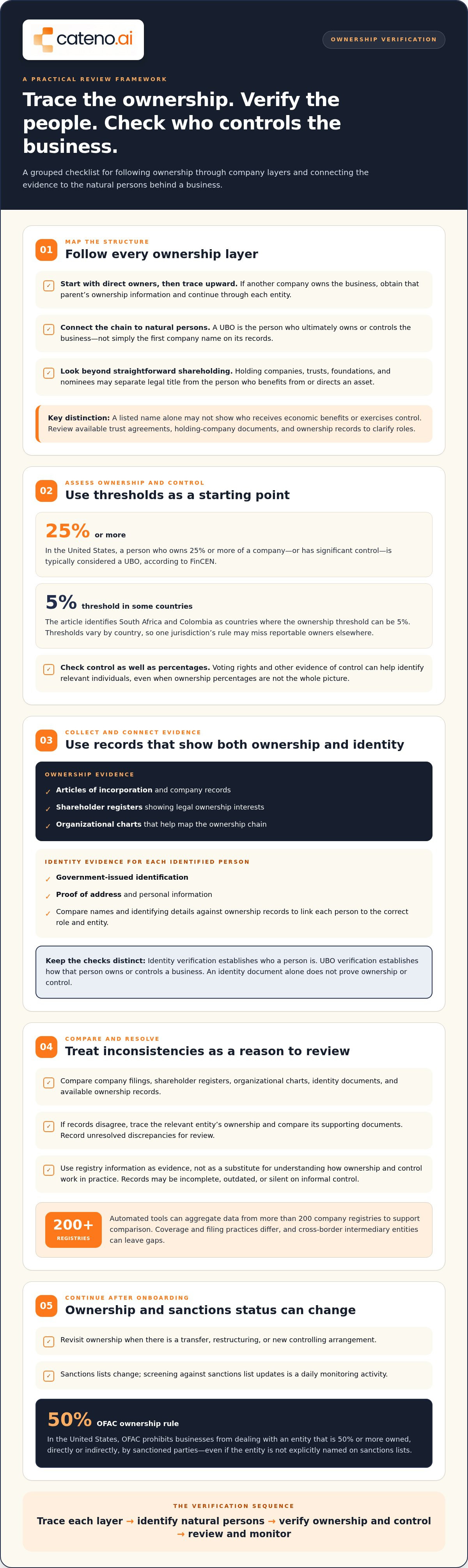
- Use the US 25% ownership threshold as a starting point, while also assessing who exercises significant control.
- For layered structures, connect corporate records and ownership evidence to the natural people at the end of the chain.
- Understand how the FinCEN CDD Rule and Corporate Transparency Act affect beneficial ownership reporting and verification.
- Automated workflows can organize onboarding checks and help teams assess ownership information more consistently.
What is the Difference Between an Ultimate Beneficial Owner (UBO) and a Beneficial Owner?
A beneficial owner may hold an interest directly, while a UBO is the natural person who ultimately owns or controls the business. Distinguishing the two helps teams trace ownership beyond the names on immediate company records.
Tracing Layered Ownership and Intermediaries
Layered ownership places companies or other entities between a business and the people who ultimately own or control it. For example, a company may be owned by a holding company, which is itself owned by individuals through another entity. Trace each layer using company records and ownership documents, then connect those interests to natural persons. Stopping at the first corporate shareholder can conceal who benefits or exercises control.
Trusts, Nominees, and Concealed Ownership
Trusts, foundations, and nominees can separate legal title from the person who benefits from or directs an asset. A nominee may appear on a register while someone else gives instructions or receives economic benefits. Reviewing trust agreements, holding company documents, and available ownership records can help clarify those roles. The distinction matters because a listed name alone may not establish who ultimately controls the business.
Rules differ across countries. In the United States, a person who owns 25% or more of a company, or has significant control, is typically considered a UBO, according to the Financial Crimes Enforcement Network (FinCEN). In South Africa and Colombia, the ownership threshold can be 5%, so applying one country’s threshold globally can miss reportable owners.
US reporting requirements also need to be read in their current context. The Corporate Transparency Act took effect on January 1, 2024, and requires reporting companies to submit Beneficial Ownership Information Reports to FinCEN. In March 2025, FinCEN introduced an interim final rule that removed certain beneficial ownership reporting requirements for US domestic entities. Reporting duties and customer due diligence are distinct: financial institutions and regulated businesses still conduct beneficial ownership verification under the FinCEN CDD Rule.
Verification has limits when records are incomplete, outdated, or do not reveal informal control arrangements. Compare corporate filings with documents such as shareholder registers and trust agreements, and record unresolved discrepancies for review. Registry information is useful evidence, but it cannot replace understanding how ownership and control work in practice.
Global registry data can support that comparison: automated tools can aggregate information from more than 200 company registries. A useful review traces each entity across the ownership chain, compares names and shareholdings, and checks whether the records agree. Differences in registry coverage and filing practices can leave gaps, especially when an intermediary operates across borders.
Monitoring continues after onboarding. Sanctions lists change, and ownership can shift through a transfer, restructuring, or new controlling arrangement. Screening against sanctions list updates is a daily monitoring activity. In the United States, the Office of Foreign Assets Control (OFAC) prohibits businesses from dealing with an entity that is 50% or more owned, directly or indirectly, by sanctioned parties, even if the entity isn’t explicitly named on sanctions lists.
Identifying natural persons who own or control a business
Identify natural persons by connecting ownership records with evidence of control. Verification providers can differ in registry coverage, document checks, identity methods, and how they handle complex ownership cases.
Company and Shareholder Documentation
Company and shareholder documents show how legal ownership is divided and where to follow the ownership chain. Collect articles of incorporation, shareholder registers, and an organizational chart, then compare names and interests across those records. If another entity owns the company, obtain that parent’s ownership information too. This helps distinguish direct shareholders from the individuals who ultimately own or control the business.
Treat discrepancies as a prompt for further review. If a shareholder register names a holding company but the organizational chart shows different owners, trace the holding company’s shareholders and compare the supporting documents. Ownership percentages matter, but voting rights and other evidence of control can also identify relevant individuals.
Identity Documents and Information
Identity documents connect each identified person to a verifiable identity. Collect government-issued identification, proof of address, and personal information for each beneficial owner. Compare names and identifying details with the ownership records to link each person to the correct role and entity. An identity document alone does not establish ownership or control.
KYC checks commonly include reviewing identity documents and validating proof of address. If a document and company record use different spellings or details, record the discrepancy and assess the available evidence together. This provides a clearer verification process than treating each document as an isolated pass or fail.
Identity Checks Alongside UBO Verification
Identity verification checks who a person is; UBO checks establish how that person owns or controls a business. In the United States, a person who owns 25% or more of a company, or has significant control, is typically considered a UBO, according to the Financial Crimes Enforcement Network (FinCEN). Assess ownership alongside control, rather than relying on a percentage alone.
Biometric checks can compare a person’s live image with the photo on their identity document. They support identity checks, but do not establish ownership or decision-making authority. Pair identity evidence with company and shareholder records to keep these questions distinct.
Companies House identity verification requirements in the UK add a separate identity-checking obligation. Verification became compulsory for new directors and people with significant control in the second half of 2025. Existing directors and PSCs must complete and file verification by autumn 2026. People can verify directly through Companies House or use an authorised corporate service provider to file on their behalf.
How do you verify UBOs when ownership structures are complex or multi-layered?
Complex onboarding involves more than collecting a company name and its immediate shareholders. Trace ownership through each entity, then connect the records to the natural persons who ultimately own or control the business.
UBO Requirements During Onboarding
UBO verification during onboarding identifies the people behind a business before an institution establishes or expands a relationship. Start with the applicant’s ownership chart, then follow every corporate shareholder to its own owners. At each layer, compare declared interests with corporate records and note who exercises control. This creates a documented chain instead of relying on the first shareholder listed.
Business onboarding is especially relevant for financial institutions, payment processors, and companies in regulated industries. Identifying ultimate beneficial owners helps institutions assess who they are dealing with and detect structures that could obscure money laundering risks.
Corporate Due Diligence in Onboarding
Corporate due diligence assesses the business, its ownership evidence, and the people connected to it as part of one onboarding process. A company’s identity and its owners’ identities answer different questions. Compare registration information with shareholder records, then resolve mismatches before treating the ownership chain as complete.
For example, if an applicant names a parent company but provides no information about its shareholders, the review has not yet reached the natural persons. Request the relevant ownership evidence through the onboarding workflow and record how each layer connects.
Application prefill can reduce repetitive entry by populating business details from available registry data. The applicant can then review the information, correct errors, and supply missing ownership details. Prefill supports intake, but does not establish that an ownership declaration is accurate. A reviewer still needs to compare the submitted information with supporting records and investigate discrepancies.
Automation can route cases according to defined risk signals. A straightforward ownership chain may proceed through standard checks, while conflicting records or unclear control can trigger additional review. This keeps routine onboarding moving while directing attention to cases that need closer due diligence. Automated platforms can reduce compliance operational costs by up to 60%.
For a layered structure, preserve the relationship between each record and the entity it describes. Match company names and registration details first, then compare shareholder identities and stated interests. If one entity owns another, continue until the chain identifies natural persons or reveals a gap that requires more evidence. This helps prevent an intermediary from being mistaken for the ultimate owner.
Maintain an auditable record of the application, documents reviewed, discrepancies, and decisions. If ownership information changes during onboarding, update the chain before completing the risk assessment. A consistent record helps institutions explain how they identified owners, why they sought additional information, and how due diligence addressed potential concealment.
FinCEN CDD Rule and Corporate Transparency Act changes
US beneficial ownership compliance involves two related but distinct areas: federal reporting and customer due diligence. Understanding how the Corporate Transparency Act and FinCEN CDD Rule apply helps businesses maintain regulatory records and assess ultimate beneficial owners without treating one process as a substitute for the other.
The Corporate Transparency Act took effect on January 1, 2024, and requires reporting companies to submit Beneficial Ownership Information Reports to FinCEN. The reporting framework changed in March 2025, when FinCEN introduced an interim final rule removing certain beneficial ownership reporting requirements for US domestic entities. That change makes it important to distinguish company reporting obligations from the checks financial institutions perform.
The FinCEN CDD Rule remains central to financial institutions’ customer due diligence. Financial institutions and regulated businesses must conduct beneficial ownership verification, maintain accurate ownership records, and apply risk-based anti-money laundering controls. In practice, the assessment connects the customer’s identity, ownership structure, and risk profile. A change to one reporting rule does not, by itself, remove separate verification duties.
Build a compliance record that distinguishes reported information from verification evidence. For example, a company filing and a shareholder register may describe related facts, but each serves a different purpose. Record the source and date of each item, compare names and ownership details, and investigate inconsistencies. Accurate, up-to-date records support transparency and give reviewers a clearer basis for assessing who ultimately owns or controls the business.
Global registry data can support cross-border assessments. Automated tools can aggregate information from more than 200 company registries, helping teams compare corporate records across jurisdictions. Registry entries can reveal a parent entity or a change in company status, but they need to be interpreted alongside ownership documents. Different filing practices and incomplete records can affect what a registry search shows.
The United Kingdom’s Companies House changes provide a separate example of regulatory identity verification. Third-party providers can begin registering as Authorised Corporate Service Providers (ACSPs) in the first half of 2025 to file identity verification on an entity’s behalf. This process concerns identity filing; it does not replace a US institution’s CDD assessment or establish a business’s full ownership chain.
For ongoing monitoring, connect each record to the legal entity and person it describes. Review ownership information annually and when significant changes occur in the ownership structure. A new shareholder, parent company, or control arrangement can affect the assessment and require updated records. Separating reporting, identity checks, and due diligence helps teams apply the relevant process consistently as regulatory requirements and corporate information change.
Technology for automated business verification
Automated verification brings business records, ownership data, and identity checks together in a coordinated review. Its value depends on how well the system connects evidence, flags inconsistencies, and routes complex cases for assessment.
Automated KYB and UBO Checks
Automated KYB and UBO checks use data matching and workflow rules to assess business entities and their owners. They matter because manual review can be difficult to scale across varied documents and ownership structures. A system can compare company details with registry information, then flag mismatches in names, registration data, or ownership records for closer review.
Automation can also support consistent case handling. For example, a workflow may move a clear record match forward while routing conflicting ownership details for human assessment. Automated platforms can process thousands of UBO verifications simultaneously, helping teams manage larger onboarding volumes without treating every record as the same risk.
Automated UBO Discovery
Automated UBO discovery follows links between entities to identify natural persons behind direct and indirect ownership. Tools can aggregate data from more than 200 global company registries, giving reviewers a broader source base for tracing complex ownership. This can help reveal parent companies or intermediaries that a single registry search might not expose.
Algorithms can analyze hundreds of data points simultaneously to assess risk, while contextual risk assessment can reduce false positive rates by 30%. These results support prioritization, not automatic conclusions: reviewers still need to interpret evidence and investigate gaps in the ownership chain.
Document processing adds another layer. A system can extract company names and ownership details from submitted records, then compare them with registry data. If an application lists one shareholder but a corporate document names another, the mismatch can be flagged for resolution. This connects digital intake with evidence review instead of leaving documents in separate queues.
Scalability depends on more than processing volume. A high-throughput system also needs clear rules for matching entities, handling incomplete records, and escalating exceptions. For example, a straightforward company match can follow a standard path, while conflicting registration details can trigger additional review. This helps focus attention on cases involving potential financial crime or laundering risks.
Accuracy requires ongoing data quality controls. Use consistent entity identifiers where available, preserve each record’s source, and record when the data was retrieved. If registry information conflicts with submitted documents, retain both findings and document the resolution. These steps make automated results easier to interpret and support later review of the verification decision.
Automation is most useful when it supports a defined process rather than replacing judgment. Set rules for routine matches, establish escalation paths for complex ownership, and review flagged cases against source documents. This lets technology organize large datasets while keeping decisions grounded in evidence and the specific risks presented by each business.
Cateno: Customizable Workflow Engine
Cateno provides a Customizable Workflow Engine to coordinate business onboarding and verification. Use it when ownership checks need to be part of a structured intake process rather than a series of separate manual steps. Its Self-Service Onboarding Gateway collects business information, while Automated KYC and KYB Checks support entity and identity verification. Bank Account Verification adds account validation when it forms part of onboarding requirements.
Together, these offerings help teams organize the information and checks used to assess business partners. Workflows can be configured around the organization’s intake process, keeping key verification activities connected. To discuss how Cateno can support your entity onboarding and verification workflows, contact the team.
Make Ownership Verification Part of Your Operating Model
Treat ownership verification as a repeatable operating process, not a file collected once and forgotten. Define who owns record quality, how exceptions move to review, and what evidence to retain for each business relationship. Clear internal responsibility makes it easier to respond when a partner’s structure changes or a review raises questions.
A UBO verification service is most useful when it supports the decisions teams make throughout a business relationship. Set clear paths for when onboarding can proceed, when additional evidence is needed, and when a relationship merits renewed attention. Defining these paths early helps teams apply consistent logic while preserving room for risk-based judgment.
Use the process to strengthen accountability across operations, compliance, and onboarding teams. When each group understands its role, ownership information becomes a practical input to decisions rather than a disconnected record. That foundation can help your organization adapt its controls as partner relationships and operating needs evolve.
Contact Cateno about UBO verification to discuss your next step. Build a process your team can apply with clarity and confidence.
Frequently Asked Questions
What is UBO verification?
UBO verification establishes which natural person ultimately owns or controls a business. It goes beyond confirming a company’s registered name or immediate shareholders. For example, if a supplier is owned by a parent company, the review follows the parent’s ownership to the individuals behind it. The result helps a business understand who its counterparty is and assess whether ownership information supports onboarding.
How it works?
UBO verification connects business records, ownership information, and identity evidence to assess the people behind an entity. A reviewer can start with the company’s stated ownership, compare it with corporate records, and follow any parent entities. If a person’s name appears differently across records, resolve the discrepancy before treating the ownership picture as consistent. The review also considers whether someone controls the business without holding a direct share.
How often should UBO information be updated?
Review UBO information annually and whenever a significant ownership-structure change occurs. A new parent company, transferred shares, or a changed control arrangement can make an earlier record outdated. For example, if a business is acquired after onboarding, refresh the ownership chain and reassess the people connected to it. A defined review schedule and event-triggered updates help keep internal records aligned as the relationship changes.
What documents are required for UBO?
Commonly used documents include articles of incorporation, shareholder registers, ownership charts, and beneficial owners’ identification documents. A company with a parent entity may also need records showing that parent’s ownership. For a trust in the chain, a trust agreement can help explain relevant roles. The evidence needed depends on the business structure and whether submitted records provide a consistent view of ownership and control.
What does UBO mean?
UBO means “ultimate beneficial owner.” “Ultimate” refers to the natural person at the end of an ownership chain, rather than an intermediary company listed as a shareholder. “Beneficial” refers to the person who benefits from ownership or exercises control. For example, a holding company can be the direct owner on corporate records, while an individual behind it may be the ultimate beneficial owner relevant to a business relationship.
What is a UBO of a Company?
A company’s UBO is a natural person who ultimately owns or controls that company. In the United States, according to the Financial Crimes Enforcement Network (FinCEN), a person who owns 25% or more of a company, or has significant control, is typically considered a UBO. A person may also warrant attention when their decision-making role gives them control, even if they don’t appear as a direct shareholder.
What is a UBO verification service?
A UBO verification service helps businesses organize checks to identify and verify the natural people behind a business entity. It can support onboarding by bringing business information and identity checks into a structured workflow. Cateno offers a Customizable Workflow Engine, a Self-Service Onboarding Gateway, and Automated KYC and KYB Checks to coordinate business intake and verification activities within an onboarding process.
What information and documents are needed to verify a UBO?
Gather the business’s legal details, ownership structure, shareholder information, and evidence identifying each relevant individual. Government-issued identification and proof of address can support personal identity checks, while company records show how ownership connects to each person. For instance, a parent company’s shareholder register can help complete a chain that begins with a customer’s corporate filing. Compare records for consistent names, entity details, and ownership relationships.


