
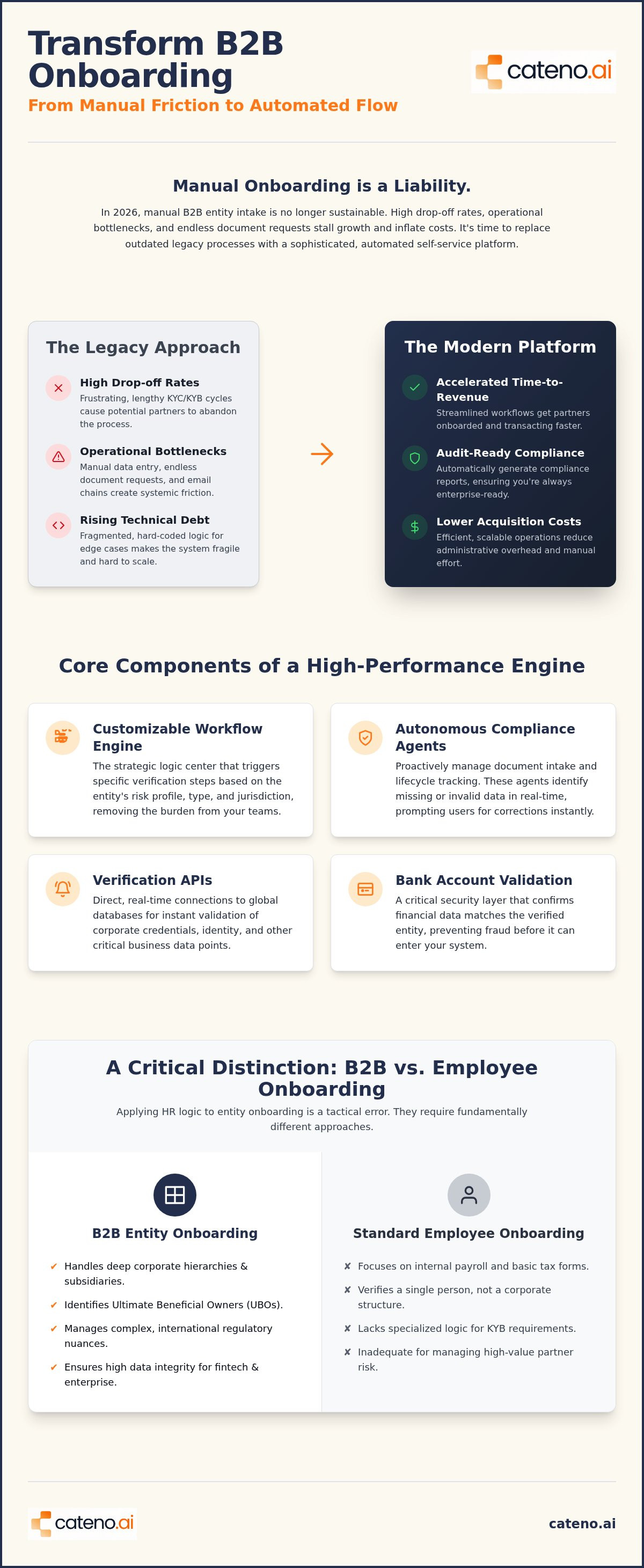
In 2026, a manual approach to B2B entity intake is no longer a sustainable strategy. It's a liability. You've likely experienced the systemic friction caused by high drop-off rates during manual KYC and KYB cycles. These operational bottlenecks, fueled by endless document requests and rising technical debt, stall your growth and inflate your customer acquisition costs. It's frustrating to watch potential revenue vanish because your onboarding stack can't keep pace with enterprise demands.
This guide reveals how a sophisticated self service onboarding platform transforms these challenges into a competitive advantage. By leveraging a modern architecture, you'll discover how to eliminate friction and scale your operations with calm confidence. We'll explore the transition to automated workflows and autonomous compliance agents that accelerate your time-to-revenue. You will learn the exact steps to implement a system that generates audit-ready compliance reports automatically, ensuring your organization remains both agile and enterprise-ready in an increasingly complex regulatory environment.
Key Takeaways
- Replace legacy manual processes with a centralized digital gateway to eliminate systemic friction and reduce operational bottlenecks.
- Understand the technical architecture of a high-performance self service onboarding platform, including the use of autonomous compliance agents for document management.
- Balance rigorous regulatory requirements with a superior user experience by deploying branded portals that build trust with high-value partners.
- Evaluate potential solutions based on their ability to provide API-first connectivity and automated, audit-ready compliance reporting.
- Leverage a customizable workflow engine to accelerate your time-to-revenue while significantly lowering customer acquisition costs in 2026.
Defining the Modern Self-Service Onboarding Platform
A modern self service onboarding platform functions as a strategic digital gateway. It allows business entities to submit required documentation and data autonomously; this removes the need for constant human intervention. Historically, legacy intake relied on manual spreadsheets and fragmented email chains. This old model created significant operational friction and left room for human error. Today, a centralized onboarding engine orchestrates the entire process. It ensures that data moves from the client to your internal systems with total precision and minimal delay.
The shift toward automation isn't just a preference in 2026. It's a regulatory mandate for growth. Modern markets demand instantaneous identity and bank account verification to mitigate fraud effectively. A single-entry point for complex B2B data collection simplifies the experience for the end user. It provides your team with a clean, unified data set that is ready for immediate processing. This architecture is the foundation for scaling entity intake without increasing your administrative headcount.
B2B Entity vs. Employee Onboarding: The Critical Difference
Many organizations mistakenly apply HR-centric logic to business entity onboarding. This is a tactical error. While employee onboarding focuses on internal payroll and basic tax forms, Know Your Business (KYB) requirements involve deep layers of corporate hierarchy. You aren't just verifying one person. You're identifying the Ultimate Beneficial Owner (UBO) across potentially dozens of subsidiaries. General HR tools don't possess the technical depth to maintain the data integrity required by fintechs or enterprise lenders. They lack the specialized logic needed to handle complex ownership structures or international regulatory nuances. A dedicated self service onboarding platform is required to manage these multifaceted relationships accurately.
The Core Components of a Compliance Gateway
A high-performance compliance gateway relies on several integrated technologies to function effectively. These components work in unison to ensure a seamless transition from lead to active customer. A professional, white-labeled interface builds immediate trust with high-value partners. This environment must include:
- Customizable Workflow Engine: This serves as the logic center. It triggers specific verification steps based on the entity's risk profile or jurisdiction.
- Autonomous Compliance Agents: These agents manage document intake and lifecycle tracking without requiring manual oversight.
- Verification APIs: Direct connections to global databases allow for real-time validation of corporate credentials.
Integrating bank account validation into this gateway adds a critical layer of security. It confirms that the financial data provided matches the entity in question, preventing fraud before it enters your system. By combining these elements, you create a robust environment that is both secure and scalable.
The Architecture of a High-Performance Onboarding Engine
Building an enterprise-ready self service onboarding platform requires more than a simple interface. It requires a customizable workflow engine that acts as a strategic orchestrator. This engine evaluates the entity type and jurisdiction in real-time, triggering only the necessary checks to ensure compliance without adding unnecessary friction. By automating the logic that determines which documents are required, you remove the burden of decision-making from your internal teams. This structural integrity ensures that every new account meets your specific risk appetite before it ever reaches a human reviewer.
Autonomous Compliance Agents in Action
Autonomous compliance agents represent the next evolution in document management and lifecycle tracking. These agents don't wait for a human auditor to flag a blurry ID or an expired article of incorporation. They identify missing or invalid data immediately, prompting the user for corrections during the active session. This proactive approach drastically reduces technical debt. Instead of building fragmented, hard-coded logic for every edge case, the agents handle redundant verification tasks autonomously. This ensures your system remains scalable and provides a sophisticated, "enterprise-ready" risk scoring model that adapts to the complexity of the entity being onboarded.
Dynamic KYB and KYC Verification Integration
Integrating KYC and KYB checks directly into the self-service flow ensures that security isn't an afterthought. A business onboarding workflow engine connects disparate data points, screening entities against global watchlists and sanctions in seconds. We've moved past static forms. Modern intake is conversational and data-driven, pulling information from official registries rather than relying solely on user input. This transition from manual verification to automated data integrity is what allows high-growth firms to maintain pace without sacrificing regulatory rigor.
The final output of this architecture is the generation of Advanced Verification Reports. These reports provide a comprehensive, timestamped audit trail of every check performed and every document verified. They serve as your primary defense during regulatory examinations, proving that your compliance standards are consistently met. By centralizing these functions within a single engine, you eliminate the fragmentation that typically plagues B2B scaling efforts. If you're looking to optimize these complex workflows, consulting with an automation expert can help clarify your path toward a more efficient architecture.
Balancing User Experience with Regulatory Rigor
A common misconception in B2B operations is that automation inevitably dilutes compliance standards. On the contrary, a sophisticated self service onboarding platform enhances regulatory rigor by removing the variability of human judgment. This principle of tech-led accuracy is also being applied in other complex regulatory environments; for instance, the platform at canadapathwaycoach.ca demonstrates how self-service tools can maintain high standards in the intricate field of residency and immigration. By digitizing the intake process, you ensure that every entity is subjected to the same exhaustive checks, without exception. This consistency doesn't just satisfy auditors; it creates a streamlined environment where high-value partners feel their time is respected. When you replace manual friction with technical precision, you signal to your clients that your organization is enterprise-ready and technologically mature.
One of the most effective strategies for improving conversion is the "single piece of information" approach. Rather than presenting a daunting 20-field form, your gateway should prompt for one identifying detail, such as a corporate tax ID. The system then autonomously fetches related data from official registries. This reduces the cognitive load on the user and ensures the data entering your system is accurate from the start. The psychological benefit of this efficiency is profound. Partners who experience a smooth, logical intake process are more likely to complete the journey, directly lowering your acquisition costs. Professionalism builds trust.
Security should remain invisible to the end user whenever possible. For instance, automated bank account verification acts as a silent sentinel, confirming financial credentials without requiring the user to upload manual statements or wait for micro-deposits. This background validation prevents fraud while maintaining the momentum of the onboarding session. To further optimize the flow, use progressive disclosure. This technique reveals form fields only as they become relevant, preventing the user from feeling overwhelmed. By choosing to reduce manual compliance tasks, you shift the burden of proof from the customer to the technology, resulting in significantly faster approval times.
The Power of a White-Label Customer Portal
In the B2B world, professional authority is built through consistency. A white-label branded portal is not a luxury; it's a trust-building asset. When a partner moves from your main site into a compliance gateway, any shift in branding or UI can trigger suspicion. Maintaining your brand's visual identity throughout the entire journey reassures the client that they are still within your secure ecosystem. This branded experience reinforces your role as a strategic orchestrator of their data. Beyond aesthetics, a dedicated portal serves as a secure gateway for sensitive business information, providing a centralized location where entities can manage their own documentation lifecycle with confidence. It's about providing clarity where there is typically confusion.
Evaluation Criteria: Selecting the Right Self-Service Platform
Choosing a self service onboarding platform is a strategic decision that dictates your operational ceiling. You must evaluate potential partners based on their ability to maintain data integrity while processing high-volume entity intake. A key differentiator is the level of autonomy provided by the system's compliance agents. A truly autonomous agent doesn't simply flag missing documents; it actively communicates with the entity to resolve discrepancies without human intervention. This shift from reactive flagging to proactive resolution is essential for maintaining momentum during rapid scaling phases. Your selection process should prioritize solutions that offer a blend of technical depth and user-centric design.
Scalability and System Integration
Your platform must handle a surge in intake without a corresponding increase in administrative headcount. This requires an API-first architecture that allows for seamless system connectivity across your enterprise. Webhooks and robust APIs are the connective tissue that link your onboarding gateway to existing CRM and ERP systems, ensuring that data flows securely and accurately across your entire stack. When evaluating pricing models, prioritize structures that align with your growth trajectory, whether that involves transaction-based fees or subscription tiers. The goal is to eliminate technical debt by selecting a system that integrates into your current environment rather than creating a new operational silo.
Audit Trails and Reporting Standards
Regulatory bodies in 2026 require more than a simple pass or fail result. They demand comprehensive Advanced Verification Reports that provide a timestamped narrative of the entire compliance journey. These reports must document every check, from initial KYB screening to final bank account validation, ensuring you're always audit-ready. Security is non-negotiable. Ensure your chosen platform adheres to national US standards for data privacy and encryption. Ongoing monitoring is another critical factor. A one-time verification is merely a snapshot; true compliance requires a system that continuously monitors entities for changes in risk profile or ownership structure. This level of persistent oversight is what separates a high-performance engine from a basic intake form.
If you're ready to transition to a more precise and scalable architecture, speak with our strategic consultants to evaluate your specific requirements and begin your transition to an automated future.
Cateno: Orchestrating the Future of Entity Onboarding
Cateno functions as the strategic orchestrator for enterprises seeking to transcend traditional intake hurdles. It isn't just a tool; it's a comprehensive solution that integrates the technical depth of a customizable workflow engine with the accessibility of a branded portal. By centralizing these functions, Cateno eliminates the systemic friction that often delays B2B growth. This sophisticated self service onboarding platform replaces manual intervention with automated precision, ensuring that every entity intake is handled with consistent accuracy. As we look toward the operational demands of 2026, the ability to scale without increasing administrative overhead has become a fundamental requirement for market leaders.
The platform's architecture is designed to address the specific pains of high-growth fintechs and enterprise service providers. By combining autonomous compliance agents with a white-label experience, Cateno ensures that security remains robust while the user journey stays fluid. This balance is critical for maintaining high conversion rates among sophisticated business partners who expect a polished, professional interaction. You no longer have to choose between rigorous regulatory compliance and a superior user experience; Cateno provides the infrastructure to achieve both simultaneously.
Your Strategic Partner in Compliance
In a complex regulatory environment, Cateno acts as a steady hand. The vision is simple: to move toward a zero-friction B2B ecosystem where data integrity is a baseline, not a hurdle. Our autonomous agents manage the entire lifecycle of document intake, from initial submission to ongoing monitoring. This centralized approach prevents the data silos that typically lead to technical debt and operational bottlenecks. By providing a single source of truth for entity data, Cateno empowers your compliance team to focus on high-level risk strategy rather than redundant administrative tasks. It's about reclaiming control over your workflows and ensuring your organization is enterprise-ready for the challenges ahead.
Next Steps: From Friction to Efficiency
The transition from manual processes to an automated future begins with a critical evaluation of your current onboarding bottlenecks. Identify where the back-and-forth document requests are stalling your revenue and where manual KYB checks are creating unnecessary delays. If your current stack feels fragmented, it's time to consider a consolidated architecture. We invite you to explore our KYC Verification Guide for deeper insights into modernizing your compliance standards for 2026. Once you understand the regulatory landscape, the next logical step is to evaluate how Cateno's platform capabilities can be tailored to your specific operational needs. Moving from systemic friction to streamlined efficiency is a strategic choice that defines your competitive edge in the modern market.
Accelerating Your Transition to Automated Entity Intake
Modernizing B2B growth requires moving away from manual bottlenecks toward a centralized, technical architecture. A high-performance self service onboarding platform is the engine that drives this shift, balancing rigorous compliance with a frictionless user experience. You've learned that success in 2026 depends on scalable systems that automate the document lifecycle and provide audit-ready transparency. This transition isn't just about efficiency; it's about establishing a foundation for sustainable, high-volume growth that satisfies both internal auditors and high-value partners.
By utilizing single-piece-of-information intake and autonomous compliance agents, you can significantly reduce acquisition costs while maintaining total data integrity. These components work together to provide a sophisticated remedy to modern operational challenges, ensuring that every entity is verified with surgical precision. The result is a streamlined path to revenue that removes systemic friction and enhances your professional authority. Moving toward a zero-friction ecosystem is no longer an option but a strategic necessity for market leaders.
Ready to eliminate operational friction and scale your intake? Request a Demo of the Cateno Self-Service Gateway to see how our Advanced Verification Reports and customizable engine can transform your compliance journey. Embracing these modern standards ensures your organization remains agile and enterprise-ready in an increasingly complex landscape.
Frequently Asked Questions
What is a self-service onboarding platform for B2B?
A self service onboarding platform is a centralized digital gateway that allows business entities to provide required documentation and data autonomously. Unlike manual intake processes that rely on fragmented email chains, this platform uses a customizable workflow engine to orchestrate the entire intake lifecycle. It enables organizations to scale their operations without increasing headcount, providing a sophisticated remedy to modern operational friction while ensuring data integrity across the enterprise stack.
How does a self-service gateway improve KYC and KYB compliance?
A self-service gateway improves compliance by standardizing the verification process and removing the variability of human judgment. By automating KYC and KYB checks, the system ensures that every entity is screened against global watchlists and sanctions with surgical precision. This methodology generates Advanced Verification Reports that are audit-ready, proving to regulatory bodies that your organization maintains a consistent and rigorous standard for identity verification and risk assessment.
Can an onboarding platform handle automated bank account validation?
Yes, a sophisticated self service onboarding platform can integrate automated bank account validation directly into the intake flow. This feature acts as a silent security layer, confirming financial credentials without requiring manual statement uploads or micro-deposits. By verifying account ownership in real-time, the platform prevents fraud before it enters your system. This automation maintains the momentum of the onboarding session while reinforcing the technical competence and reliability of your operations.
What are autonomous compliance agents and how do they work?
Autonomous compliance agents are technical orchestrators that manage document intake and lifecycle tracking without human intervention. These agents identify missing or invalid data points, such as blurry IDs or expired corporate filings, and prompt users for immediate corrections. By handling redundant verification tasks, they reduce technical debt and ensure that your risk scoring remains accurate. This proactive approach allows your compliance team to focus on high-level strategic oversight rather than administrative document management.
Is a branded customer portal necessary for business onboarding?
A branded customer portal is essential for establishing professional authority and building trust with high-value B2B partners. Maintaining your visual identity throughout the compliance journey reassures entities that they're within a secure, white-label environment. This consistency reduces suspicion and friction, leading to higher completion rates. It transforms the compliance process from a burdensome requirement into a polished, professional interaction that reflects your organization's status as an enterprise-ready technological partner.
How does a customizable workflow engine reduce onboarding friction?
A customizable workflow engine reduces friction by triggering only the specific verification steps required for a particular entity type or jurisdiction. This eliminates unnecessary data requests and prevents users from being overwhelmed by irrelevant forms. By orchestrating complex logic behind the scenes, the engine ensures a streamlined path forward for the customer. This targeted approach accelerates the time-to-revenue and lowers acquisition costs by removing the systemic friction inherent in legacy intake models.
What should I look for in a 2026 onboarding software for fintechs?
In 2026, fintechs should prioritize onboarding software that offers an API-first architecture and autonomous compliance capabilities. Look for platforms that support single-piece-of-information intake to minimize user effort and maximize data integrity. Essential features include real-time bank account validation and the ability to generate Advanced Verification Reports automatically. Scalability is non-negotiable; the system must handle high-volume intake while maintaining national US standards for data security and regulatory compliance without increasing administrative overhead.
Does Cateno support ongoing compliance monitoring after onboarding?
Cateno provides comprehensive support for ongoing compliance monitoring beyond the initial onboarding phase. The platform utilizes its customizable workflow engine and Advanced Verification Reports to track changes in entity risk profiles and ownership structures over time. This persistent oversight ensures that your business remains compliant with evolving regulatory demands. By centralizing document management and verification data, Cateno acts as a strategic partner in maintaining your organization's long-term operational stability and data integrity.


