

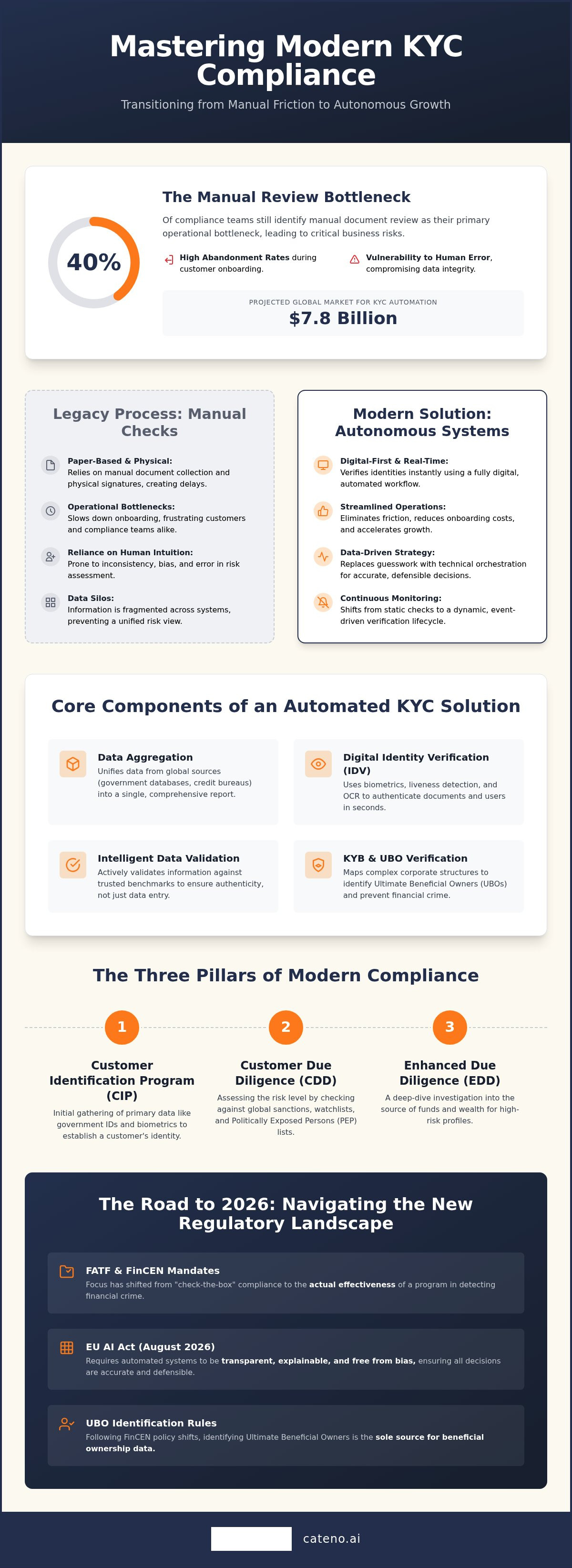
Over 40% of compliance teams still identify manual document review as their primary operational bottleneck. This friction doesn't just slow down your team; it drives high abandonment rates during customer onboarding and leaves your organization vulnerable to human error. In an era where the global market for kyc automation software is projected to reach $7.8 billion, sticking to legacy processes is no longer just inefficient. It's a strategic risk. You likely feel the pressure of shifting regulations like the EU AI Act and recent FinCEN updates that demand higher data integrity and faster response times.
This guide provides a definitive roadmap to master these complexities. You'll learn how to transition from systemic friction to streamlined operational growth by replacing manual checks with autonomous systems. We'll examine the core components of modern KYC and demonstrate how to reduce your cost per onboarded customer through technical orchestration. From understanding new 2026 standards to implementing a customizable workflow engine, this is your path to an enterprise-ready compliance framework. By moving toward a model of continuous, event-driven monitoring, you can secure your operations while accelerating your growth trajectory.
Key Takeaways
- Understand the transition from static identity gates to a dynamic, real-time verification lifecycle that aligns with 2026 regulatory standards.
- Identify the essential technical components of high-performance kyc automation software to aggregate multi-source data into unified, actionable reports.
- Learn to replace manual "check-the-box" compliance with a data-driven strategy that eliminates systemic operational friction and reduces abandonment.
- Master the implementation of a customizable workflow engine to build a scalable infrastructure that adapts seamlessly to evolving global mandates.
- Discover how Autonomous Compliance Agents act as strategic orchestrators to manage complex intake processes and lower the cost per onboarded customer.
What is KYC Verification in the Modern Regulatory Landscape?
Know Your Customer (KYC) represents the mandatory process of verifying identity and assessing the risk profiles of clients. It's no longer just a compliance hurdle; it's a foundational safeguard for global financial integrity. In 2026, the landscape has shifted from reactive document collection to proactive data integrity. Global regulatory bodies, specifically the Financial Action Task Force (FATF) and FinCEN, have raised the bar. They now prioritize the actual effectiveness of a program, judging whether it truly detects financial crime rather than just following a manual checklist.
The evolution of this field is stark. Traditional methods relied on paper-based checks and physical signatures, which created massive operational bottlenecks. Today, high-performance kyc automation software enables digital-first, real-time verification. This transition removes the reliance on human intuition and replaces it with technical orchestration. With the EU AI Act now fully applicable as of August 2026, there's a new focus on explainable AI. Systems must be transparent and free from bias, ensuring that automated decisions are both accurate and defensible.
The Three Pillars of Traditional KYC
Modern compliance remains built on three essential regulatory stages. The Customer Identification Program (CIP) handles the initial gathering of primary data such as government IDs and biometrics. Customer Due Diligence (CDD) involves assessing the risk level of the entity by checking against global sanctions and watchlists. For high-risk profiles, Enhanced Due Diligence (EDD) requires a deep-dive research process into the source of funds. Automation ensures these steps occur in a unified flow, preventing the data silos that often plague manual compliance teams.
The Emergence of KYB and Entity Verification
While KYC focuses on the individual, Know Your Business (KYB) addresses the complexities of corporate structures. Modern platforms must verify both humans and the legal entities they represent. This includes identifying the Ultimate Beneficial Owner (UBO) to prevent financial crime through opaque shell companies. In 2026, identifying UBOs is the sole source for beneficial ownership data following FinCEN's recent policy shifts. The Cateno platform uses autonomous agents to map these intricate relationships instantly. This ensures even the most complex corporate hierarchies remain transparent and compliant without adding friction to the onboarding experience.
The Core Components of an Automated KYC Solution
A modern technical stack for compliance is more than a series of disconnected tools. It is a unified ecosystem designed for technical orchestration. Effective kyc automation software aggregates data from diverse global sources, including government databases, utility records, and credit bureaus, into a single, comprehensive verification report. This process eliminates the manual research traditionally required to piece together an entity's risk profile. By centralizing these inputs, organizations move from simple data entry to "Intelligent Data Verification," where the system doesn't just record information but actively validates its authenticity against trusted benchmarks.
Financial legitimacy is further established through integrated bank account verification. This component ensures that the funding source is legitimate and belongs to the verified entity, closing a common loophole in manual onboarding. To ensure your program meets federal expectations, consult the FFIEC BSA/AML Examination Manual for detailed standards on risk-based controls. Integrating these components into a centralized platform ensures that every data point contributes to a holistic risk score rather than existing in a vacuum.
Digital Identity Verification (IDV)
Digital identity verification serves as the first line of defense. Modern systems employ biometric checks, including liveness detection and facial matching, to ensure the person behind the screen is the true owner of the documents. Optical Character Recognition (OCR) acts as the bridge between physical identity and digital data, extracting information from passports and licenses with high precision. This technology authenticates documents in seconds, identifying subtle signs of forgery that the human eye might miss. If you are looking to streamline this process, you can speak with an automation expert to see how these tools fit your specific workflow.
AML Screening and Watchlist Monitoring
Compliance doesn't end at the point of onboarding. Real-time screening against Politically Exposed Persons (PEP) and global sanctions lists is essential for ongoing security. AI-driven adverse media screening scans global news in real-time to identify reputational risks before they become legal liabilities. We are seeing a significant shift toward Perpetual KYC (pKYC), which replaces periodic reviews with continuous, event-driven monitoring. According to the NICE Actimize AML Tech Barometer 2026, only about 15.5% of institutions currently report having advanced perpetual KYC programs. This gap represents a major opportunity for firms to adopt autonomous systems that offer constant vigilance rather than static, one-time checks.
Manual vs. Automated KYC: The Operational Shift
Manual compliance stacks are inherently fragmented. They rely on disconnected spreadsheets, email threads, and human intuition to assess risk. This "check-the-box" mentality treats verification as a static hurdle rather than a strategic data asset. By contrast, the implementation of kyc automation software enables a data-driven risk management strategy that scales without a proportional increase in headcount. The "Hidden Cost of Manual KYB" is a significant operational liability; it forces high-value compliance officers to perform low-value data entry tasks. This creates technical debt in the onboarding process, as fragmented data must eventually be reconciled or re-verified to meet 2026 standards.
Reducing Human Error and Operational Friction
Systemic errors often stem from simple transcription mistakes during manual data entry. These minor lapses are a primary source of failure during compliance audits, as they can trigger regulatory red flags or lead to incorrect risk scoring. Automated workflows eliminate the persistent "back-and-forth" of document requests by validating information in real-time. This is achieved through a sophisticated business onboarding workflow engine that orchestrates the entire intake process. By replacing manual research with technical orchestration, firms ensure data integrity while allowing their teams to focus on complex decision-making rather than administrative tasks.
Improving the Customer Onboarding Experience
Friction at the point of entry is the leading cause of high abandonment rates. Customers in 2026 expect a fast, remote, and seamless experience. Any delay caused by manual document review directly kills conversion. A self-service onboarding gateway allows users to provide necessary information through a branded customer portal, reducing the perceived burden of compliance. The operational ideal is "single piece of information" onboarding. In this model, the user provides a single identifier, such as a tax ID or government number, and the kyc automation software autonomously retrieves and verifies all related entity data. This approach minimizes user effort while maximizing the accuracy of the resulting verification report.
Building a Scalable Compliance Infrastructure
Establishing a scalable compliance infrastructure in 2026 requires a shift from simple identity verification (IDV) to broad workflow orchestration. While many tools focus solely on the act of scanning an ID, true operational growth depends on the ability to manage the entire lifecycle of an entity. High-performance kyc automation software serves as the central nervous system for this operation. It ensures that every check is performed in the correct sequence and that data remains consistent across all systems. This "enterprise-ready" approach prioritizes data integrity and security, creating a stable foundation that handles fluctuating onboarding volumes without a proportional increase in headcount.
A customizable workflow engine allows firms to adapt to changing global regulations without the months of custom development typically required by legacy providers. This flexibility is essential for maintaining compliance as new mandates emerge. By centralizing these processes, organizations move away from fragmented tools and toward a unified technical stack. To see how a customizable engine can transform your intake process, you can schedule a technical consultation with our team.
Orchestrating the Workflow Engine
Successful orchestration follows a methodical progression to ensure no regulatory requirement is overlooked. This structured approach moves the reader from high-level strategy to specific functional execution.
- Step 1: Define your specific risk appetite and the entity types you serve, whether they're individuals or complex corporate hierarchies.
- Step 2: Map the intake journey for different customer segments to ensure a low-friction experience tailored to the user profile.
- Step 3: Integrate diverse data sources through a robust API to perform bank account and identity validation in a single, seamless session.
- Step 4: Establish automated triggers that flag anomalies for manual intervention only when necessary, keeping the majority of applications in an autonomous fast track.
Leveraging Branded Portals for Trust
Maintaining brand consistency is vital for high-value B2B onboarding. A white-label experience reassures the client that they're interacting with a secure, professional entity rather than a third-party plugin. The Cateno platform facilitates this by providing a branded customer portal that serves as a professional intake environment. Within this portal, document management and lifecycle tracking are handled automatically. This transparency allows customers to see their application status in real-time. It reduces support inquiries and builds trust from the very first interaction, ensuring that the compliance process feels like a premium service rather than a bureaucratic hurdle.
The Future of Verification: Autonomous Compliance Agents
In 2026, the industry has moved beyond static tools. Autonomous Compliance Agents are now the standard for high-performance organizations. Unlike basic kyc automation software that simply processes inputs, these agents act as strategic orchestrators. They manage the entire intake process with minimal human oversight. This shift represents a transition from "SaaS as a tool" to "Compliance as an Outcome." Organizations no longer buy software to perform tasks; they deploy autonomous systems to guarantee regulatory integrity. This technology future-proofs businesses against the volatility of shifting global mandates by adapting workflows in real-time. It ensures that as regulations like the EU AI Act evolve, your systems adjust their transparency and documentation protocols automatically.
Autonomous Research and Triage
Traditional automation still requires humans to trigger follow-up emails or verify missing documents. Autonomous agents eliminate this manual burden. They handle document collection, verify data consistency, and initiate follow-ups without any human prompts. When the system detects a discrepancy, the agent performs initial research to resolve it. If a high-risk anomaly persists, the agent flags the specific red flag for senior compliance review, providing a pre-analyzed summary of the issue. This triage process ensures that only the most complex cases reach a human desk. Autonomous agents are the remedy to high-volume operational fatigue, allowing your experts to focus solely on high-stakes adjudication rather than administrative chasing.
Advanced Verification Reports for Strategic Growth
The final output of modern compliance is no longer a simple "Pass/Fail" status. Instead, businesses now rely on Advanced Verification Reports that provide comprehensive risk intelligence. These reports aggregate every data point gathered during the autonomous intake process, from UBO structures to bank account legitimacy. This depth of information allows for faster business decisions and more aggressive partnership intake. By understanding the nuances of a customer's risk profile, firms can tailor their service levels and credit terms with total confidence. It removes the guesswork from B2B relationships. This shift transforms compliance from a cost center into a driver of strategic growth. You can Explore Cateno’s Autonomous Compliance Solutions to see how this intelligence integrates into your existing operations.
The Path to Autonomous Compliance Excellence
Modernizing your compliance framework is no longer a choice. It's a necessity for operational survival in 2026. This guide has detailed how the shift from manual document review to technical orchestration removes systemic friction and reduces abandonment rates. By implementing advanced kyc automation software, your organization gains the stability and precision required to handle complex global mandates. You've seen how Autonomous Compliance Agents and Enterprise-Ready Workflow Orchestration move the needle from simple data entry to strategic risk intelligence.
These systems deliver Advanced Verification Reports. They empower your team to make faster, more accurate business decisions without the burden of manual research. It's time to replace operational bottlenecks with a scalable infrastructure that grows alongside your enterprise. Streamline your compliance with Cateno’s Workflow Engine to begin your transition toward a frictionless onboarding experience. Your path to a more efficient, secure, and compliant future starts with the right technical partner.
Frequently Asked Questions
What is the primary difference between KYC and KYB verification?
KYC focuses on the identity of a single person, while KYB assesses the legitimacy of a business entity. Modern platforms must bridge these by identifying the Ultimate Beneficial Owner (UBO) within a company. This ensures that the individual controlling the business is also vetted. Cateno’s engine handles both simultaneously, mapping complex corporate hierarchies to provide a single, unified risk profile for any given partnership or client.
How does KYC automation software reduce onboarding abandonment rates?
High-performance kyc automation software reduces abandonment by removing systemic friction from the intake process. Instead of manual document requests that take days, automated systems validate data in real-time. A self-service gateway allows users to provide information through a branded portal at their convenience. This creates a seamless experience where users aren't forced into repetitive back-and-forth communication, significantly increasing the likelihood of a completed application and a faster growth trajectory.
Is automated KYC verification compliant with global AML regulations?
Automated systems are specifically designed to align with the latest global AML regulations, including the EU AI Act and FinCEN mandates. These platforms provide the transparency and documentation required for modern audits. By removing human error from the screening process, they ensure that every applicant is checked against real-time sanctions and PEP lists. This proactive approach to data integrity helps organizations avoid regulatory fines while maintaining a robust, defensible compliance posture across the nation.
What are autonomous compliance agents and how do they work?
Autonomous compliance agents are strategic orchestrators that manage the intake process without human prompts. They handle document collection, verify data consistency, and initiate follow-ups when information is missing or incorrect. These agents act as a remedy to high-volume operational fatigue by triaging applications. They only flag high-risk anomalies for senior compliance review, ensuring that your team’s expertise is focused on complex adjudication rather than administrative tasks or routine data entry.
Can a customizable workflow engine handle multiple entity types simultaneously?
A customizable workflow engine is designed to handle individuals, sole proprietors, and complex corporate structures simultaneously. It allows you to define specific risk appetites and intake journeys for different customer segments. This flexibility ensures that a high-net-worth individual and a multinational corporation are both vetted through appropriate, distinct logic. By centralizing these diverse paths into one platform, you maintain operational consistency while scaling your onboarding capabilities across any entity type.
How does bank account verification integrate into the KYC process?
Bank account verification serves as a critical layer of financial legitimacy within the KYC process. It confirms that the funding source is active and belongs to the verified entity. This step prevents fraud by ensuring that the account used for transactions matches the identity provided during onboarding. Integrating this into the automated workflow creates a more comprehensive risk intelligence report, closing a common loophole that manual processes often fail to address efficiently.
What are the benefits of using a branded customer portal for compliance?
A branded customer portal provides a professional, white-label experience that builds trust during high-value B2B onboarding. It allows clients to manage their own document uploads and track their application status in real-time. This transparency reduces support inquiries and positions the compliance process as a premium service. By providing a secure, centralized environment for data exchange, you reassure clients of your technical competence and commitment to data integrity from the very first interaction.
How often should KYC verification be refreshed for existing clients?
The industry standard is shifting from static, periodic reviews to perpetual KYC (pKYC). This involves continuous, event-driven monitoring where verification is refreshed based on specific risk triggers or changes in the customer profile. While traditional models suggest reviews every one to five years based on risk level, autonomous systems allow for real-time vigilance. This ensures that your compliance status is always current, rather than waiting for a calendar date to identify potential risk.


