
In 2026, scaling your enterprise volume by 10x shouldn't require scaling your compliance headcount by 10x. If your growth strategy relies on adding more manual reviewers to handle increased intake, you aren't scaling; you're just inflating your overhead. Most operations leaders recognize the systemic friction that occurs when a high-value revenue opportunity stalls due to a manual KYB bottleneck. It's a frustrating reality where rising operational costs per entity begin to erode the very margins your growth was intended to secure. Transitioning to scalable compliance workflows is the only way to break this cycle of inefficiency and maintain structural integrity during rapid expansion.
We understand that the transition from manual checks to automated precision requires a steady hand and a clear blueprint. This article explores how to architect a unified orchestration layer that handles complex verification needs with autonomous accuracy. You'll learn how to eliminate the risk of human error and reduce onboarding times for even the most multifaceted business entities. By the end of this guide, you'll have a roadmap for building an enterprise-ready system that provides full auditability without the need for manual documentation. We'll show you how to ensure your compliance infrastructure acts as a catalyst for growth rather than a barrier.
Key Takeaways
- Identify the manual tipping point where operational friction begins to erode margins and slows down revenue generation.
- Architect scalable compliance workflows that utilize a single point of entry to streamline complex entity onboarding while maintaining data integrity.
- Transition from rigid, static rules to autonomous compliance agents that provide dynamic risk management in complex regulatory environments.
- Implement a phased migration strategy starting with a comprehensive audit of existing operational bottlenecks and data silos.
- Achieve total audit readiness through advanced verification reports that eliminate the need for manual documentation.
The Hidden Ceiling: Why Manual Compliance Throttles Enterprise Growth
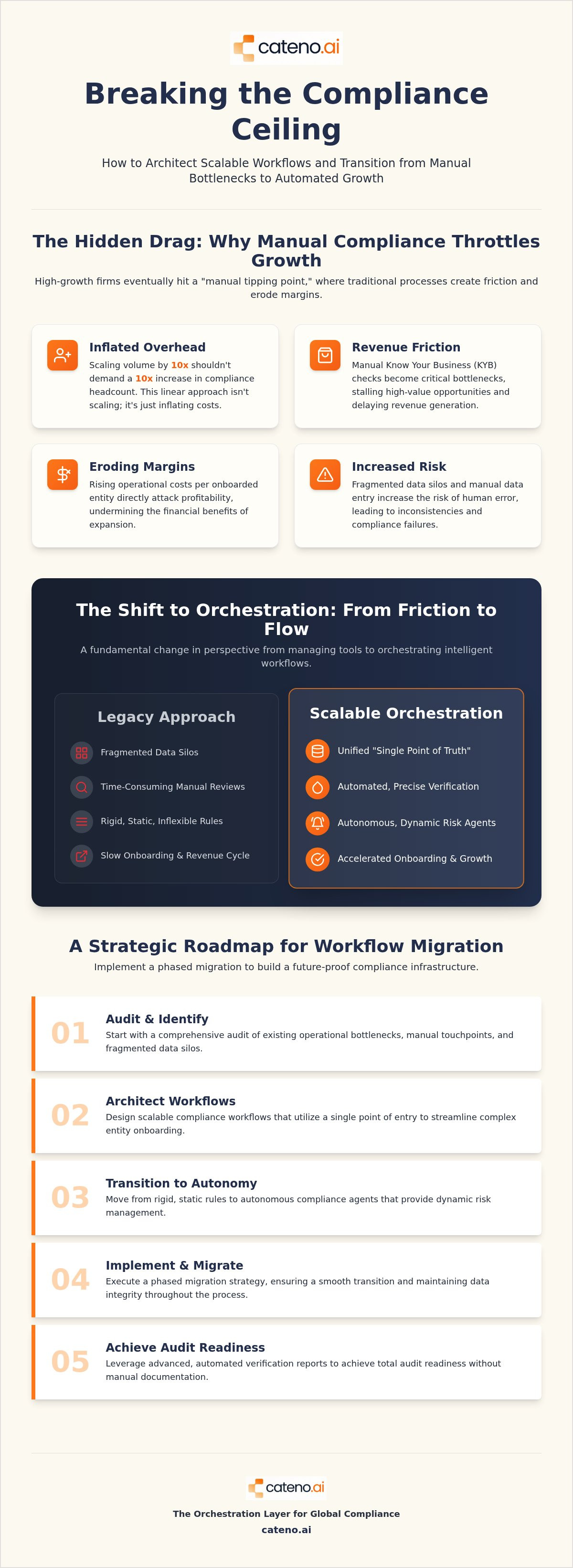
Manual processes represent a silent drag on enterprise momentum. As organizations expand their B2B operations, the complexity of entity structures often grows exponentially. A simple verification for a sole proprietorship is manageable; however, onboarding a multi-layered multinational corporation requires a different level of scrutiny. Without scalable compliance workflows, this complexity translates directly into operational friction. Every manual touchpoint adds latency to the revenue cycle, creating a "compliance tax" that penalizes your most ambitious growth initiatives.
High-growth firms eventually hit a manual tipping point. This is the moment where adding more analysts no longer yields proportional increases in throughput. Instead, it leads to rising operational costs per onboarded entity and an increased risk of human error. Fragmented data silos exacerbate this issue. When KYC and KYB processes exist in isolation, the lack of a unified data layer forces teams to perform redundant checks. This inefficiency isn't just a matter of lost time; it undermines the very foundation of Regulatory compliance by introducing inconsistencies across your audit trails.
The Anatomy of Compliance Technical Debt
Technical debt in onboarding manifests as a collection of "quick fixes" and patchwork integrations. Teams often implement temporary tools to solve immediate bottlenecks, but these disparate systems rarely communicate. Over time, this creates a rigid infrastructure that's incapable of adaptation. Manual intervention becomes the only way to bridge the gaps between tools, which compromises data integrity. Every time an analyst manually copies data from one portal to another, the risk of a verification failure increases. This operational paralysis prevents the business from responding to new market opportunities or regulatory shifts with the necessary agility.
From Friction to Flow: The Shift to Orchestration
Overcoming these hurdles requires a fundamental shift in perspective. Enterprises must move away from managing individual verification tools and toward implementing a unified orchestration engine. This involves a psychological transition from simply "verifying documents" to actively managing complex data lifecycles. By deploying The Sophisticated Business Onboarding Workflow Engine, organizations can centralize their logic and automate the movement of data across the entire lifecycle. This transition ensures that scalable compliance workflows are built on a foundation of structural integrity, allowing the business to scale seamlessly without the burden of legacy friction.
Architecting the Engine: Core Components of Scalable Compliance Workflows
A scalable compliance workflow functions as a resilient framework that maintains high precision regardless of entity volume. It moves beyond the limitations of static spreadsheets and manual checklists. At its core lies the "Single Point of Truth" principle, which allows for complex onboarding to begin with a single verified data point, such as a business tax ID or registration number. This approach ensures that data integrity is maintained from the moment of intake, providing a streamlined compliance process that scales with enterprise demands. By architecting these systems around data rather than documents, organizations can eliminate the bottlenecks that typically stall high-growth operations.
The Role of the Customizable Workflow Engine
A customizable workflow engine acts as the central nervous system of modern compliance. It uses dynamic routing to direct entities through specific verification paths based on their unique risk profiles and structural complexity. For instance, a low-risk domestic entity might trigger an automated path that resolves in seconds, while a complex offshore structure requires more granular automated KYC and KYB checks. This intelligence eliminates unnecessary steps and ensures that resources remain focused on high-risk variables. Integrating bank account verification into this engine adds a critical layer to the trust stack, confirming financial legitimacy without manual oversight.
Self-Service Gateways and Branded Portals
Reducing intake friction is essential for maintaining high completion rates during B2B onboarding. By deploying a self-service onboarding gateway, you empower business entities to provide their own documentation and data through a branded customer portal. This shift removes the need for exhaustive manual back-and-forth communication. It also enhances customer trust, as the experience feels cohesive and professional. Automated document collection ensures that every required file is captured and verified against real-time data sources immediately. If you're ready to modernize your intake architecture, you can speak with our orchestration experts to design a solution tailored to your volume requirements.
Building scalable compliance workflows requires more than just faster tools; it demands a structural rethink of how data flows through your organization. When the orchestration layer is correctly implemented, the relationship between volume and headcount is finally decoupled. This allows your team to focus on strategic risk management while the engine handles the heavy lifting of multi-entity verification and lifecycle monitoring.
Beyond Static Rules: Leveraging Autonomous Agents for Dynamic Risk Management
Static rules are no longer sufficient for enterprises operating in a global market. If your system relies solely on "if-this-then-that" logic, it will inevitably struggle with the nuances of multi-jurisdictional compliance. Scalable compliance workflows in 2026 require a shift toward autonomous agents that can adapt to shifting regulatory landscapes in real-time. These agents move beyond simple task execution; they provide the intelligence necessary to identify patterns and risks that traditional software misses. This transition allows your organization to move from reactive reporting to a model of proactive risk mitigation.
Autonomous Agents vs. Traditional Automation
Rule-based systems are inherently brittle. They break when faced with non-standard entity types or incomplete data sets, leading to manual bottlenecks. Autonomous agents, by contrast, possess the capability to reason through edge cases. They can determine when a document requires a manual override or when a secondary data source should be queried to resolve a discrepancy. This reduces the burden on your compliance team, allowing them to focus on high-level strategy rather than administrative triage. By automating lifecycle management, these agents ensure that a partner's risk profile is updated the moment a change occurs in a public registry. This keeps your operations audit-ready 24/7 without requiring constant human oversight.
Orchestrating Complex Entity Verification
Complex entity verification, particularly Ultimate Beneficial Owner (UBO) discovery, often involves navigating a maze of conflicting data and opaque structures. Autonomous agents act as the connective tissue between disparate verification APIs and global data repositories. They ingest raw data from multiple sources, normalize it, and produce a clear, verifiable map of ownership and control. This level of orchestration is a core feature of the Cateno Platform. It allows high-growth operations to maintain a rigorous standard of integrity without sacrificing the speed of their onboarding funnel. By bridging the gaps between fragmented data silos, these agents ensure that growth doesn't come at the cost of increased risk or operational debt.
As you scale, the ability to manage the lifecycle of business partners through ongoing monitoring becomes a competitive advantage. You're no longer just checking a box at the point of entry. Instead, you're maintaining a continuous, intelligent loop of verification that protects the enterprise from emerging threats. This dynamic approach ensures that your compliance infrastructure is as agile as the rest of your business operations.
Implementing Scalability: A Strategic Roadmap for Workflow Migration
Migrating to scalable compliance workflows isn't a simple software update. It's a strategic overhaul of your operational engine. Many enterprises fall into the trap of automating inefficient, manual processes, which only serves to accelerate their errors. A successful transition requires a methodical, phased approach that prioritizes data integrity and system cohesion. By following a structured roadmap, you can decouple your growth from headcount and transform compliance into a competitive advantage.
- Step 1: Audit existing bottlenecks. Analyze where your analysts spend the most time and identify the data silos that force redundant manual entry.
- Step 2: Define the 'ideal state' workflow. Establish distinct paths for different entity tiers, ensuring that low-risk entities move swiftly while high-complexity structures receive deeper automated scrutiny.
- Step 3: Integrate a unified verification API and branded portal. Centralize your intake to create a single point of truth for all KYC and KYB data.
- Step 4: Deploy autonomous agents. Shift from point-in-time checks to continuous lifecycle management and proactive risk monitoring.
Integrating with the Modern Tech Stack
The workflow engine must function as a bridge between your regulatory requirements and your existing infrastructure. Seamless integration with CRM and ERP systems is non-negotiable for maintaining a unified operational view. Utilizing developer-friendly APIs allows for rapid deployment, reducing the time it takes to see a return on your technology investment. This connectivity ensures that verified data is immediately available to the teams that drive revenue. You can see how these integrations work in practice across various Cateno Industries to support specific sector requirements.
Measuring Success: KPI-Driven Compliance
Precision requires measurement. To evaluate the effectiveness of your new architecture, you must track specific performance indicators like Time-to-Onboard (TTO) and the Operational Cost per Entity. These metrics provide a clear view of how automation is impacting your bottom line. Comparing the accuracy of automated KYC/KYB against historical manual benchmarks typically reveals a marked reduction in false positives and human error. Compliance ROI is the simultaneous realization of systemic risk reduction and accelerated revenue generation. If you're ready to begin your migration, you can consult with our technical architects to map out your transition.
Future-Proofing with Cateno: The Orchestration Layer for Global Compliance
Cateno serves as the sophisticated remedy for enterprises struggling with the inherent friction of legacy systems. We don't merely provide a tool; we deliver a complete orchestration layer that transforms how organizations manage risk. By implementing scalable compliance workflows, businesses can finally break the link between volume growth and operational overhead. Our platform is engineered to handle the complexities of multi-entity onboarding, ensuring that even the most intricate corporate structures are verified with precision and speed. This strategic approach positions the compliance function as a partner in revenue generation rather than a recurring cost center.
Instead of acting as a barrier, our customizable workflow engine facilitates movement. It allows your team to focus on high-value decision-making while the technology manages the heavy lifting of data integrity and system integration. This transition from a utility-based tool to a strategic orchestrator is what defines a modern, high-growth operation. It ensures that every new revenue stream is supported by a stable, reliable infrastructure that doesn't buckle under increased pressure.
Enterprise-Ready Compliance
Achieving an enterprise-ready status requires more than just basic automation. It demands deep transparency and structural integrity. Cateno delivers this through advanced verification reports that provide a granular view of every check performed, ensuring your organization is always prepared for an audit. The branded customer portal further enhances this experience by providing a professional, self-service gateway for your business partners. This reduces the manual back-and-forth that often plagues B2B onboarding and improves the overall customer experience. Meanwhile, our autonomous compliance agents serve as a vital force multiplier. They continuously monitor your entity lifecycle, identifying risks in real-time and allowing your existing team to manage a much higher volume of business without sacrificing accuracy.
Scaling to the Next Level
Expansion into new national markets requires a compliance stack that is both rigid in its standards and flexible in its execution. Cateno supports this growth through standardized, scalable compliance workflows that can be tailored to specific industry requirements. This flexibility ensures that your infrastructure remains a long-term asset, capable of adapting to the regulatory shifts of 2026 and beyond. By investing in a future-proof orchestration layer, you're not just solving today's bottlenecks; you're building a foundation for sustainable, high-performance growth. It's time to move beyond the limitations of manual triage and embrace a system built for the modern enterprise. Experience the future of scalable compliance with Cateno and discover how orchestration can accelerate your operations.
Building the Foundation for Sustainable Growth
The transition from manual triage to automated orchestration is no longer a luxury for the modern enterprise. By implementing scalable compliance workflows, organizations can eliminate the systemic friction that historically throttles high-growth operations. We've explored how a unified engine, supported by branded self-service portals and autonomous agents, provides the structural integrity needed for 24/7 monitoring and audit readiness. This shift doesn't just resolve immediate bottlenecks; it transforms the compliance function into a strategic catalyst for revenue acceleration.
It's time to replace fragmented data silos with a cohesive orchestration layer that grows alongside your business. By centralizing your verification logic, you ensure that every new entity is handled with precision and speed. Streamline your enterprise onboarding with Cateno's workflow engine and reclaim control over your operational margins. The path to 2026 requires a steady hand and a clear blueprint. With the right architecture in place, your organization is ready to scale with absolute confidence.
Frequently Asked Questions
What are scalable compliance workflows and why are they necessary?
Scalable compliance workflows are automated systems designed to process increasing volumes of entity verifications without a proportional increase in manual labor. These frameworks are necessary because they eliminate the operational friction that typically throttles enterprise growth. By decoupling headcount from volume, organizations can maintain structural integrity and regulatory precision during rapid expansion. This approach ensures that every new revenue stream is supported by a stable, reliable infrastructure that doesn't buckle under pressure.
How do autonomous compliance agents differ from standard automation?
Standard automation relies on rigid, static rules that often fail when faced with non-standard data or complex entity structures. Autonomous compliance agents represent a shift toward intelligence, as they can reason through edge cases and bridge gaps between disparate data sources. These agents provide 24/7 monitoring and proactive risk mitigation, ensuring that your lifecycle management remains audit-ready. This transition allows your compliance team to focus on high-level strategy rather than administrative triage.
Can automated workflows handle complex KYB for international entities?
Modern automated systems are specifically engineered to handle the nuances of international KYB and multifaceted corporate structures. By integrating with global registries and specialized APIs, these workflows normalize raw data and produce clear ownership maps, including Ultimate Beneficial Owner (UBO) discovery. This level of orchestration ensures that cross-border expansion doesn't lead to increased risk or operational debt. It allows enterprises to maintain a rigorous standard of integrity across all jurisdictions with minimal friction.
How does a workflow engine reduce the cost of customer onboarding?
A workflow engine reduces onboarding costs by eliminating redundant manual tasks and centralizing the verification process into a single point of entry. It significantly lowers the operational cost per entity by automating KYC, KYB, and bank account validation. This reduction in manual intervention also minimizes the risk of expensive human errors and verification failures. By decreasing the technical debt associated with legacy stacks, organizations can accelerate revenue generation while maintaining lean, efficient operations.
What is the role of a branded portal in compliance scalability?
A branded customer portal acts as a self-service gateway that empowers business entities to provide their own documentation and data directly. This shift reduces the intake friction caused by manual back-and-forth communication and improves completion rates. It also enhances customer trust by providing a professional, cohesive onboarding experience. By automating document collection, portals ensure that all required information is captured and verified immediately, which is essential for maintaining high-performance operations at an enterprise level.
How do I integrate a compliance workflow engine with my existing software?
Integration is typically achieved through developer-friendly APIs that allow the workflow engine to communicate seamlessly with your existing CRM and ERP systems. This connectivity ensures that verified data is immediately available to the teams that drive revenue. By establishing a unified data layer, you eliminate the need for manual data entry across disparate tools. A successful integration creates a single point of truth for all compliance data, reinforcing the structural integrity of your entire operational stack.
What key metrics should I track to measure compliance scalability?
To measure the effectiveness of your compliance architecture, you should track Time-to-Onboard (TTO) and the total operational cost per entity. These metrics reveal how automation impacts your bottom line and revenue cycle. Additionally, evaluating the accuracy of automated checks against historical manual benchmarks helps identify improvements in risk mitigation. Monitoring these key performance indicators ensures that your scalable compliance workflows are delivering a tangible return on investment through both risk reduction and revenue acceleration.
Is automated KYC/KYB as accurate as manual verification?
Automated KYC and KYB verification is often more accurate than manual processes because it eliminates the risk of human error and fatigue. These systems utilize real-time data from authoritative sources to produce advanced verification reports that are consistently precise and audit-ready. While manual reviews are still valuable for high-risk escalations, the baseline accuracy of automated orchestration ensures a higher standard of data integrity. This precision allows enterprises to scale their operations confidently without compromising on regulatory requirements.


