
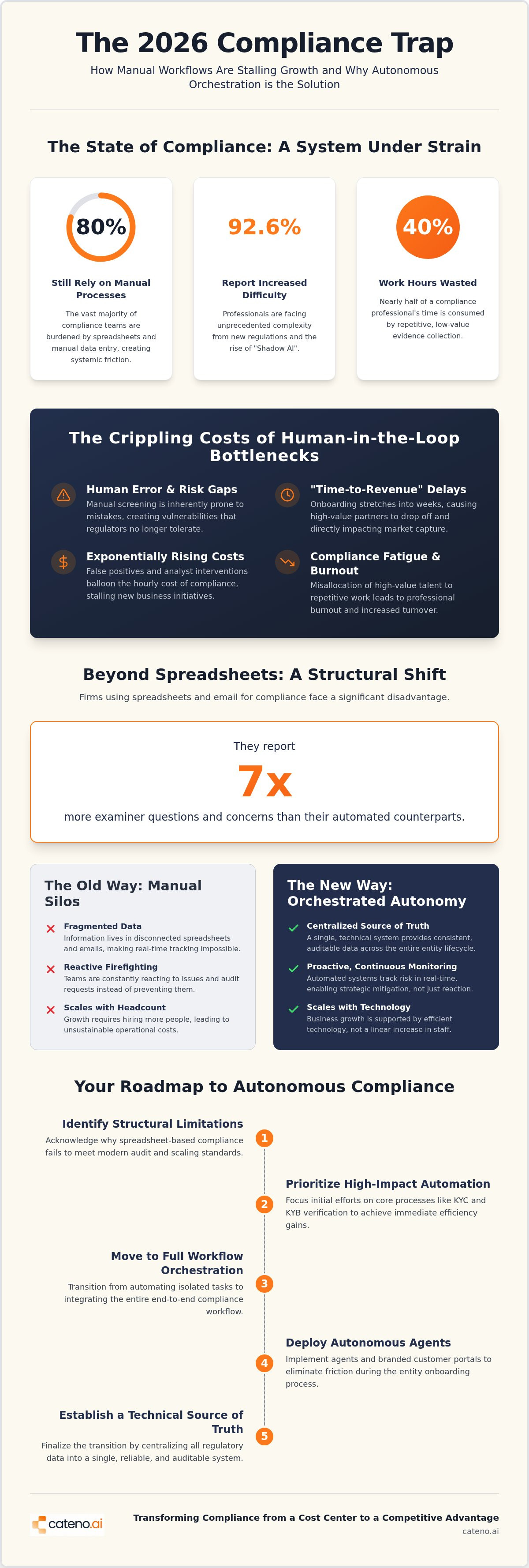
In 2026, over 80% of compliance teams still rely on manual processes and spreadsheets, even as regulatory complexity reaches an unprecedented inflection point. According to a 2026 Regology survey, 92.6% of professionals report their roles have become increasingly difficult as they navigate a landscape of "Shadow AI" and strict enforcement regimes. You're likely feeling the strain of this systemic friction, where regulatory fatigue and the high cost of manual reviews stifle your team's potential. It's a common frustration to see high-value talent consumed by repetitive data entry while customer onboarding times continue to lag and cause avoidable drop-offs.
Efficiency requires a shift from fragmented workflows to orchestrated autonomy. This analysis provides a clear framework to reduce manual compliance tasks by deploying autonomous agents and integrated engines that scale with your business. You'll discover how to replace human error with technical precision and transform your onboarding process into a high-velocity asset. We'll explore the transition from reactive firefighting to continuous monitoring, ensuring your enterprise remains resilient, secure, and prepared for the strategic demands of the coming years.
Key Takeaways
- Identify the structural limitations of spreadsheet-based compliance and why they fail to meet 2026 audit standards.
- Learn a strategic framework to reduce manual compliance tasks by prioritizing high-impact automation for KYC and KYB verification.
- Distinguish between isolated task automation and full workflow orchestration to build a compliance environment that scales without increasing headcount.
- Discover how to deploy autonomous agents and branded customer portals to eliminate friction during the entity onboarding process.
- Follow a practical roadmap to transition from fragmented manual intake to a centralized, technical source of truth for all regulatory data.
The Productivity Crisis: Why Manual Compliance Tasks Are Stalling 2026 Growth
In 2026, the "Compliance Trap" has emerged as a primary inhibitor of enterprise scaling. This phenomenon occurs when the operational effort required for manual data entry outpaces top-line revenue growth. Organizations that fail to reduce manual compliance tasks find themselves in a cycle of diminishing returns; as they acquire more customers, the cost of servicing those customers increases exponentially rather than linearly. The proliferation of Shadow AI—tools adopted by employees without formal security review—has further complicated this landscape, forcing teams to monitor unvetted systems manually. Research indicates that compliance professionals now dedicate nearly 40% of their work hours to repetitive evidence collection. This misallocation of talent creates a psychological toll known as compliance fatigue, leading to professional burnout and increased turnover in high-stakes roles.
Beyond the human cost, legacy manual stacks represent a significant operational liability. Manual KYC and KYB screening are inherently prone to human error, which creates gaps in risk management that regulators no longer overlook. Effective Governance, risk, and compliance (GRC) strategies in 2026 require more than just oversight; they demand structural agility. Relying on spreadsheets and fragmented emails for audit preparation is no longer a viable strategy for firms that intend to scale in a high-volume B2B environment.
The Escalating Cost of Human-in-the-Loop Bottlenecks
Relying on human-in-the-loop processes for routine document review is a costly tactical error. Manual intake often results in "time-to-revenue" delays that stretch into weeks, causing high-value business partners to drop off during the onboarding phase. These delays aren't just administrative; they're lost opportunities for market capture. Additionally, manual screening frequently produces a high volume of false positives. Each false positive requires a senior analyst's intervention to resolve, further ballooning the hourly cost of compliance and stalling the momentum of new business initiatives.
Regulatory Complexity vs. Operational Headcount
Traditional logic suggested that increasing regulatory demands required a larger headcount. In 2026, this approach is unsustainable. With 92.6% of professionals reporting increased difficulty in their roles, the solution isn't more people; it's better orchestration. Forward-thinking firms are adopting "lean compliance" models that treat regulatory adherence as a competitive advantage. By addressing compliance technical debt early in the customer lifecycle, these firms bypass the bottlenecks that stifle their slower, manual-reliant competitors. They recognize that technical precision is the only way to maintain stability in a volatile regulatory climate.
Beyond Spreadsheets: The Structural Impact of Manual Data Orchestration
Spreadsheets fail because they can't act as a single source of truth in the 2026 regulatory climate. A 2026 Ncontracts survey highlights that firms using spreadsheets and email for compliance report seven times more examiner questions and concerns than their automated counterparts. This gap occurs because manual data silos prevent real-time risk scoring and proactive management. To effectively reduce manual compliance tasks, firms must move beyond simple task automation toward full orchestration. While basic automation might solve a single step, a sophisticated business onboarding workflow engine centralizes entity data to ensure consistency across the entire lifecycle.
This shift toward compliance automation isn't just about speed; it's about structural integrity. When data is siloed in disconnected tools, ongoing monitoring becomes nearly impossible. You can't track risk in real-time if your data lives in a static document. By centralizing these workflows, businesses can significantly reduce manual compliance tasks and focus on strategic risk mitigation rather than administrative upkeep.
The Friction of Disconnected Compliance Tools
Many teams suffer from the "swivel-chair" effect, where analysts manually move sensitive information between disparate KYC and KYB tools. This manual transfer is a primary vector for data integrity breaches and operational lag. An integrated, API-first approach to bank account validation removes this risk by creating a direct, secure link between systems. By eliminating the need for manual data handling, you secure the process and accelerate the path to verification without sacrificing accuracy.
Building for Scalability: From Intake to Lifecycle
The intake process remains the most significant source of manual friction in the B2B world. Transitioning to automated entity onboarding allows you to capture data once and use it throughout the partnership. This foundation supports ongoing monitoring, which drastically reduces the need for manual periodic reviews. Instead of a team spending weeks on annual refreshes, the system flags only the changes that matter. If you're ready to move past manual silos, you can speak with an orchestration expert to design a more resilient workflow.
Identifying the High-Impact Targets for Compliance Automation
To effectively reduce manual compliance tasks, organizations must prioritize functions where human intervention adds the least value but incurs the highest cost. In 2026, the focus shifts from general security to the specific friction of business-to-business (B2B) relationships. Four high-impact targets offer the greatest potential for structural optimization:
- Document Collection: Transitioning from manual follow-up emails to a self-service intake model.
- Identity Verification: Automating KYC and KYB checks using a single data point to trigger background orchestration.
- Ownership Mapping: Solving the complexity of Ultimate Beneficial Owner (UBO) verification through automated data retrieval and visualization.
- Financial Validation: Integrating bank account verification to confirm entity legitimacy without manual intervention.
By targeting these specific bottlenecks, firms move beyond surface-level fixes. They address the core areas where manual data entry outpaces revenue growth, ensuring that the compliance function supports rather than hinders business expansion.
Prioritizing Efficiency: The Impact/Effort Matrix
Efficiency isn't accidental; it's engineered. High-effort manual tasks, such as UBO mapping, often represent the greatest operational liability. While these tasks are complex, automating them provides the most significant relief for teams suffering from burnout. This strategic shift aligns with the future of automated compliance, where technology handles the heavy lifting of data gathering while humans focus on high-level risk evaluation. Shifting the burden of data entry to a self-service gateway is the highest-leverage change a firm can make. It transforms the compliance department from a group of document chasers into a team of strategic risk managers.
The Role of Branded Customer Portals in Reducing Friction
Trust is a critical component of the onboarding lifecycle. Utilizing white label customer onboarding software allows firms to maintain a professional, cohesive brand experience while they reduce manual compliance tasks. A professional, self-guided interface reassures business partners that their sensitive data is being handled with technical precision. This psychological benefit cannot be overstated; a smooth, branded experience reduces drop-off rates and accelerates the time-to-revenue for new partnerships. Branded customer portals eliminate the "email tag" cycle by providing a centralized, real-time repository for all required documentation and status updates. This autonomy empowers the customer and secures the intake process simultaneously.
The Roadmap: Transitioning from Manual Intake to Autonomous Compliance Agents
Transitioning from a legacy manual setup to a modern, orchestrated environment requires a methodical, four-step progression. This evolution isn't merely about replacing a person with a tool; it's about re-engineering the workflow to prioritize technical precision and operational speed. By following a structured path, firms can build a system that scales alongside their growth without requiring a proportional increase in headcount.
- Step 1: Audit the Workflow. Identify every point where data is manually re-entered or documents are chased via email. These redundant entry points are the primary sources of systemic friction.
- Step 2: Implement a Logic-Driven Engine. Deploy a kyc verification engine that supports customizable logic. This foundation allows the system to make preliminary decisions based on your specific risk appetite.
- Step 3: Deploy Autonomous Agents. Introduce agents that can independently verify low-level documents and manage lifecycle updates. This step is critical to reduce manual compliance tasks across the entire entity lifecycle.
- Step 4: Shift to Review by Exception. Re-task human officers to focus only on high-risk edge cases. By moving away from "Review by Default," your team provides value where it's needed most.
What Are Autonomous Compliance Agents?
In the 2026 compliance stack, autonomous agents represent the next stage of technical maturity. Unlike static automation, these agents manage complex document collection and real-time lifecycle updates without constant human oversight. They act as strategic orchestrators, identifying missing data and prompting customers through self-service gateways. When the system encounters a complex risk edge case, it utilizes a "Human-in-the-Loop" (HITL) model. This ensures that while agents handle the volume, human expertise remains available for high-stakes decision-making and accountability.
Customizing Workflows for Diverse Entity Types
A rigid compliance system is an operational liability. Your orchestration engine must adapt to different industries, risk profiles, and national regulatory variations. For example, the requirements for a fintech startup differ significantly from those of an established manufacturing firm. A customizable engine allows you to build specific pathways for each entity type, ensuring accuracy without adding administrative bloat. You can visit the Cateno platform page to see how these customizable workflows function in a live environment. If you're ready to modernize your operations, schedule a consultation with our team to begin your transition.
Orchestrating the Future: How Cateno Eliminates Operational Friction
Cateno’s fundamental premise is to eliminate the systemic friction that defines traditional onboarding. Our vision is clear: onboard any entity using just a single piece of information. This approach fundamentally changes how organizations reduce manual compliance tasks. Instead of chasing documents across multiple channels, the Customizable Workflow Engine acts as a strategic orchestrator. It manages the entire entity lifecycle by pulling data from verified sources and applying logic-driven rules. This evolution shifts your team's role from a manual task-master to a strategic risk manager. You move away from the operational liability of human error toward enterprise-ready efficiency that supports aggressive business goals.
The transition to an orchestrated environment allows for a level of precision that manual processes simply cannot match. By centralizing data through a unified engine, you ensure that every decision is backed by real-time intelligence. This doesn't just speed up the process; it hardens your defensive posture against regulatory scrutiny. When you reduce manual compliance tasks, you aren't just saving time; you're building a structural foundation for sustainable growth. It's about moving from a state of constant administrative catch-up to a position of calm, technical control.
A Connected Platform for Modern Compliance
True efficiency comes from the synergy between automated KYC, KYB, and bank account verification. Cateno integrates these disparate functions into a single, cohesive environment. This ensures that data flows seamlessly from the Self-Service Onboarding Gateway into your core systems without manual intervention. The logical end-point of this orchestration is the Advanced Verification Report. These reports provide a definitive audit trail and the technical depth required for ongoing monitoring. To see how these systems adapt to your specific sector, you can explore our industry-specific solutions for automation.
Scaling Your Compliance Without Scaling Your Costs
The long-term ROI of choosing to reduce manual compliance tasks via Cateno is significant. By removing geographic intake barriers and automating document management, you can support national growth without bloating your administrative budget. Cateno’s autonomous agents handle the heavy lifting, allowing you to scale your operations while maintaining a lean, effective compliance team. This model ensures that your operational costs remain predictable even as your entity volume increases. It's time to transition from reactive firefighting to proactive, orchestrated growth. You can view our pricing or book a tailored demo to start your journey toward an autonomous compliance environment.
Securing Scalability Through Compliance Orchestration
The path to operational excellence in 2026 requires more than simple automation; it demands a fundamental re-engineering of how data moves through your organization. By replacing fragmented spreadsheets with a centralized workflow engine, you eliminate the systemic friction that stalls growth. This shift empowers your team to move beyond administrative maintenance and focus on high-level strategic risk management. It's a transition from reactive firefighting to a state of technical precision and calm control.
Cateno provides the technical foundation to reduce manual compliance tasks while enhancing the accuracy of every verification. Our platform allows you to onboard any entity with a single piece of information, utilizing branded customer portals to remove intake friction and advanced verification reporting to maintain continuous monitoring. This evolution from operational liability to enterprise-ready efficiency ensures your firm is prepared for the complexities of the modern regulatory landscape. You can now build a compliance function that scales alongside your business without the burden of increasing headcount.
Orchestrate your compliance future with Cateno’s Automated Onboarding Engine. Step into a more efficient, autonomous future today.
Frequently Asked Questions
What are the most common manual compliance tasks that should be automated?
Document collection, KYC/KYB identity verification, and ownership mapping are the highest-impact areas for automation. These tasks often involve redundant data entry and manual "document chasing" via email. By automating these processes, firms can significantly reduce manual compliance tasks that typically consume up to 40% of a team's work hours. This shift allows your staff to focus on high-level risk evaluation rather than administrative upkeep.
How does reducing manual compliance tasks improve the customer onboarding experience?
Reducing manual friction directly accelerates time-to-revenue by eliminating the delays associated with human review cycles. When you utilize a branded customer portal, business partners can complete their own intake autonomously. This self-service model prevents the customer drop-offs that occur when onboarding takes weeks instead of minutes. It transforms a historically frustrating administrative hurdle into a streamlined, professional experience that builds trust from the first interaction.
Can automation really handle complex KYB and UBO requirements?
Modern orchestration engines are designed to manage the intricacies of Know Your Business (KYB) and Ultimate Beneficial Owner (UBO) mapping. These systems pull data directly from corporate registries and global databases to visualize complex ownership structures automatically. This technical precision removes the need for analysts to manually research entity hierarchies. The result is a more accurate risk profile generated in a fraction of the time required by manual methods.
What is the "review by exception" model in compliance automation?
The "review by exception" model shifts the compliance officer's role from a default gatekeeper to a strategic overseer. In this framework, the automated system processes the vast majority of applications that meet pre-defined criteria. Human intervention is only triggered when the engine flags a high-risk edge case or a discrepancy that requires subjective judgment. This methodology is the most effective way to reduce manual compliance tasks while maintaining rigorous oversight.
How do autonomous compliance agents differ from basic automation software?
Basic automation software follows static, "if-then" rules to complete isolated actions. In contrast, autonomous compliance agents manage the entire lifecycle of an entity's documentation. These agents can independently identify missing files, prompt customers for updates, and monitor for changes in risk status without human intervention. They act as strategic orchestrators that maintain the integrity of your compliance environment, whereas basic tools still require significant human management to function.
Will automating compliance tasks increase our regulatory risk or decrease it?
Automation significantly decreases regulatory risk by eliminating the human error inherent in manual data handling. Automated systems provide a definitive, technical audit trail for every decision made, which is essential for examiner scrutiny. While firms using spreadsheets often face more concerns from regulators, those with orchestrated systems demonstrate consistent application of controls. This consistency ensures that your risk management remains resilient even as your business scales and regulations evolve.
What is the first step a business should take to reduce manual compliance friction?
The first step is to conduct a thorough audit of your current manual workflow to identify redundant data entry points. Once these bottlenecks are documented, you should implement a self-service onboarding gateway to centralize your intake process. This foundation allows you to capture data once and use it throughout the entity lifecycle. Moving from fragmented emails to an orchestrated engine is the only sustainable way to achieve enterprise-ready efficiency.


