

FinCEN's 2026 decision to end centralized beneficial ownership reporting has fundamentally shifted the compliance landscape, placing the full weight of verification back onto individual institutions. For many firms, this change has exposed the fragility of legacy stacks that rely on manual document requests and fragmented data. If your automated entity onboarding process still requires heavy human intervention to verify Ultimate Beneficial Owners (UBOs), you're likely facing the high drop-off rates that plague 73% of B2B SaaS providers. The era of passive data collection is over; the new standard is autonomous orchestration.
It's clear that manual bottlenecks are no longer just an operational nuisance but a direct barrier to revenue. You need a system that offers real-time visibility and self-service efficiency without compromising on regulatory integrity. This guide provides the blueprint to architect a high-performance intake system, utilizing the strategies behind Cateno to replace systemic friction with autonomous agents and branded portals. We'll examine the technical requirements to move from archaic manual reviews to a streamlined engine capable of onboarding entities with a single piece of information, significantly accelerating your time-to-revenue.
Key Takeaways
- Transition from archaic, document-heavy methods to a data-first strategy that prioritizes operational speed and accuracy.
- Identify the core components of a high-performance automated entity onboarding engine, from customizable workflows to real-time verification reports.
- Master the strategic framework for mapping partner journeys, utilizing branded portals and conditional logic to manage risk autonomously.
- Execute a five-step implementation plan to audit manual friction and deploy a scalable, enterprise-ready compliance stack.
- Leverage autonomous compliance agents to resolve complex UBO structures and act as a sophisticated Tier 1 support layer for your team.
The Evolution of Entity Onboarding: From Manual Friction to Automation
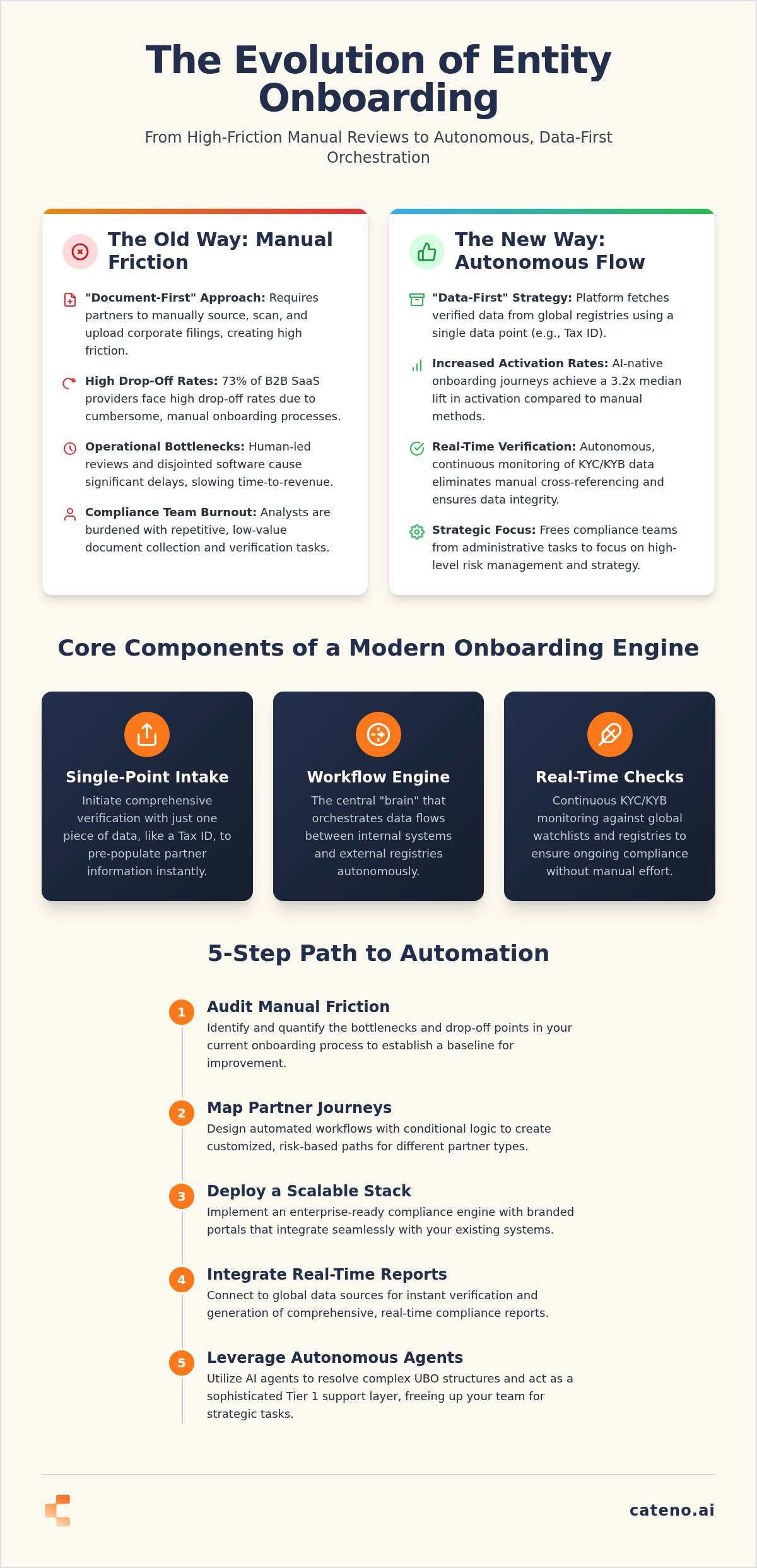
Automated entity onboarding represents the shift from manual, document-heavy verification to a fully digitized, data-driven intake process. For years, the industry relied on a "document-first" mentality. This required business partners to manually source, scan, and upload stacks of corporate filings. Today, that model is obsolete. Modern systems prioritize a "data-first" workflow, where the platform fetches verified information directly from global registries. This transformation is not just about convenience; it's about survival. By 2026, manual KYB has evolved into a significant operational liability for high-growth firms. Relying on human-led reviews creates delays that drive partners toward more agile competitors who utilize self-service gateways as their enterprise standard.
Why Business Onboarding Differs from Customer Onboarding
Verifying a corporate entity is fundamentally more complex than onboarding an individual consumer. Standard Know Your Customer (KYC) regulations primarily address identity and residency. In contrast, Know Your Business (KYB) demands a deep dive into corporate hierarchies to identify Ultimate Beneficial Owners (UBOs). You aren't just verifying a name; you're mapping out ownership percentages and control structures across multiple layers of parent companies. The regulatory burden under Anti-Money Laundering (AML) frameworks is significantly higher. Business onboarding is also rarely a solo activity. It involves multi-stakeholder approval processes where legal, compliance, and executive teams must all provide input before a partnership can proceed.
The Operational Cost of Manual Compliance Stacks
Legacy compliance stacks carry heavy hidden costs that drain enterprise resources. Technical debt accumulates when firms try to bridge manual processes with disjointed software patches. This inefficiency leads to a high friction-to-dropout ratio. When a potential business partner encounters a wall of manual document requests, the likelihood of abandonment spikes. Beyond lost partner revenue, the human cost is substantial. Compliance officers often face burnout from managing repetitive document collection tasks that provide little strategic value. Manual verification is the primary bottleneck preventing firms from scaling. Transitioning to automated entity onboarding through a customizable engine allows your team to move away from administrative drudgery. You replace systemic friction with a streamlined, self-service experience that accelerates your time-to-revenue.
Core Components of a Modern Entity Onboarding Engine
Building a robust automated entity onboarding system requires more than just a digital form. It demands a sophisticated architecture that can orchestrate complex data flows without manual oversight. At the center of this architecture is the Customizable Workflow Engine. Think of it as the central brain. It routes data between internal systems and external registries, ensuring that every step of the verification process happens in the correct sequence. When combined with real-time KYC and KYB checks, this engine eliminates the need for analysts to manually cross-reference global watchlists. It's a shift toward a proactive compliance posture where data integrity is maintained through continuous, autonomous monitoring.
The Power of Single-Point-of-Information Intake
Efficiency starts at the point of entry. Enterprise partners expect a frictionless experience that respects their time. By leveraging a single data point, such as a Tax ID or legal entity name, your system can trigger a comprehensive lookup across public registries. This process pre-populates the onboarding portal with verified corporate data, leaving the partner to only confirm the accuracy of the information. Research indicates that AI-native onboarding journeys can achieve a 3.2x median lift in activation rates compared to traditional, manual methods. Transitioning to automating compliance processes at this stage ensures a "clean" partner lifecycle from the first interaction. It removes the risk of manual entry errors and establishes a foundation of high-quality data that persists throughout the relationship.
Integrating Bank Account Verification
Financial integrity is a critical hurdle in any onboarding journey. In 2026, relying on micro-deposits or manual bank statement uploads is no longer acceptable for high-stakes business partnerships. Modern engines utilize instant API-based Bank Account Verification to confirm ownership and account status in seconds. This real-time validation is a vital defense against fraud and sophisticated money laundering typologies. By connecting these financial insights directly to the broader compliance workflow, you ensure that no entity is fully onboarded without a verified and risk-assessed financial profile. This level of precision is exactly what Cateno's customizable workflow engine is designed to deliver, providing the structure needed for secure, rapid scaling.
Finally, the engine must produce Advanced Verification Reports. These documents aren't just summaries; they're detailed audit trails required for federal compliance. They record every check performed, every data source queried, and every decision made by the system. This documentation is essential for demonstrating an "effectiveness-based" compliance program during regulatory examinations. It proves that your system doesn't just have a policy but a functioning, autonomous defense that actively detects and mitigates risk.
Designing the Automated Workflow: A Strategic Framework
Designing a high-performance workflow is about more than just mapping steps; it's about engineering a path that anticipates friction. A strategic framework for automated entity onboarding begins the moment a partner accesses your branded customer portal. From that initial login to the final verification, every interaction must be purposeful. This is where conditional logic becomes essential. Instead of a one-size-fits-all approach, your Customizable Workflow Engine should categorize entities based on risk profiles. Low-risk entities can be fast-tracked through automated KYC/KYB checks, while high-risk profiles trigger more rigorous data collection. In complex cases, autonomous compliance agents act as a Tier 1 layer to resolve document exceptions without manual research.
Compliance isn't a static milestone. In a modern system, "ongoing monitoring" is the default state. Once an entity is approved, the engine continues to scan for changes in UBO structures or sanctions lists. This ensures that your firm remains protected without requiring a manual re-verification every quarter. This continuous loop keeps your data fresh and your risk profile low. By treating automated entity onboarding as an evergreen process, your system doesn't just gather data; it maintains it, eliminating the gaps that legacy systems often leave exposed.
The Branded Self-Service Gateway
A professional, branded portal is the interface of your compliance strategy. It significantly increases partner trust, which directly correlates to higher completion rates. Partners are more likely to provide sensitive corporate data when the environment feels secure and integrated into your brand's ecosystem. A high-converting portal utilizes specific features to reduce cognitive load:
- Progress indicators that provide real-time transparency into verification status.
- Auto-save functionality to prevent data loss during multi-stakeholder inputs.
- Mobile-first design to accommodate busy executive schedules.
By providing this level of clarity, you eliminate the "black hole" experience that often leads to partner churn during the intake phase.
Managing Document Lifecycle and Intake
Document collection is often where onboarding stalls. To maintain momentum, you must automate the "chase" for missing or expired records. Autonomous systems can identify a missing Articles of Incorporation or an expired ID and send targeted requests to the partner without human intervention. Once documents are submitted, the system uses OCR and AI to validate authenticity instantly. This prevents your team from becoming a bottleneck in the review process. Secure, encrypted storage ensures that these sensitive corporate records are handled with the highest level of data integrity, meeting federal standards while remaining accessible for future Advanced Verification Reports.
5 Steps to Implement Automated Entity Onboarding
Transitioning from fragmented manual checks to a cohesive digital architecture requires a methodical approach. To build a high-performance automated entity onboarding process, you must first audit every manual touchpoint. Identify where technical debt is highest, whether it's email-based document requests or manual registry lookups. Once these bottlenecks are clear, you can select a customizable workflow engine capable of orchestrating both KYC and KYB data streams. This engine serves as the foundation for autonomous compliance agents that manage low-confidence flags, ensuring that only high-risk exceptions reach your human analysts for review. This structure replaces systemic friction with a logic-driven path toward approval.
Step 1: Mapping the Regulatory Requirements
Before writing a single line of code, you must identify the specific KYB and AML standards governing your industry. This involves defining the "minimum viable data" needed to initiate a verification. For instance, can you trigger a full corporate lookup using only a Tax ID? Establishing this baseline reduces early-stage friction for the partner. It's equally important to consult with legal teams to calibrate your autonomous agents. This ensures that the system's decision-making logic aligns with your firm's internal risk appetite while meeting the "effectiveness-based" standards now prioritized by federal regulators.
Step 2: Designing the Workflow Automation
With regulatory requirements mapped, the next step is to design the end-to-end workflow for your automated entity onboarding process. This involves selecting a robust workflow engine to orchestrate data ingestion, KYC/KYB checks, and conditional logic across various systems. The goal is to minimize manual touchpoints and create a seamless, automated flow for entity data processing from initial contact to approval.
Step 3: Configuring Autonomous Compliance Agents
Following workflow design, implement and configure your autonomous compliance agents. These AI-powered components will automate risk scoring, manage low-confidence flags, and intelligently route high-risk exceptions for human review. Calibration must align with your firm's specific risk appetite and evolving regulatory standards, ensuring system decisions are both compliant and effective.
Step 4: Testing the Self-Service Experience
A successful deployment relies on rigorous friction tests within your branded customer portal. You must monitor exactly where partners pause or drop out of the intake process. Optimization often involves refining single-piece-of-info triggers to pre-populate corporate data instantly, which has been shown to provide a 3.2x median lift in activation rates for AI-native journeys. Additionally, you must verify that bank account validation protocols function correctly across diverse financial institutions. This ensures that the financial integrity of the partner is confirmed without the delays associated with archaic micro-deposits or manual statement reviews.
Step 5: Establishing Continuous Monitoring and Optimization
The final stage is establishing continuous monitoring loops. Compliance isn't a one-time event; it's a lifecycle management strategy. By deploying a Cateno automated entity onboarding engine, you ensure that your partner data remains accurate and compliant through autonomous agents that monitor for structural changes in real-time. This proactive stance allows your firm to scale rapidly while maintaining a robust, enterprise-ready defense against operational risk.
Future-Proofing Compliance with Autonomous Agents
Autonomous compliance agents represent the final frontier in automated entity onboarding. They act as a sophisticated Tier 1 support layer, managing the nuanced decision-making that previously required heavy human intervention. Unlike standard automation that follows rigid if-then rules, these agents possess the technical competence to resolve complex Ultimate Beneficial Owner (UBO) structures. They traverse multiple layers of corporate ownership across global registries to map out control hierarchies in seconds. This capability removes the burden of manual research from your compliance team, allowing them to focus exclusively on high-risk escalations that require strategic judgment.
By delegating the "data chase" to autonomous agents, you eliminate the operational lag that occurs when analysts must manually verify corporate filings. These agents don't just collect data; they validate it against real-time registries and identify discrepancies before they become bottlenecks. This creates a self-correcting intake process that maintains high data integrity without slowing down your time-to-revenue. It's a shift from being a reactive participant in the compliance process to being a strategic orchestrator of a high-performance engine.
The Shift to Perpetual KYC/KYB
The "onboard and forget" model has become an obsolete operational liability in 2026. Regulatory expectations have shifted toward effectiveness-based standards, making periodic reviews insufficient for modern enterprise risk management. Modern systems utilize automated entity onboarding engines to establish a state of perpetual KYB. These systems detect changes in corporate ownership, risk status, or sanctions listings the moment they occur in public records. By maintaining a continuous monitoring loop, your firm stays in a constant state of audit-readiness. Advanced Verification Reports provide the necessary documentation for this ongoing vigilance, ensuring that every change is recorded and every risk is mitigated without manual oversight.
Choosing Cateno as Your Strategic Orchestrator
Cateno offers a decisive advantage in speed, precision, and scalability. Its customizable workflow engine allows you to architect an onboarding journey that fits your specific risk appetite and industry requirements perfectly. By centralizing all partner interactions through a branded portal and utilizing autonomous agents for document management, Cateno ensures that any entity can be onboarded with minimal friction. This platform isn't just a compliance tool; it's a strategic orchestrator that values accuracy and structural integrity above all else. You gain the ability to scale your business partnerships rapidly while knowing your compliance infrastructure is secure, reliable, and forward-thinking.
Discover how Cateno automates entity onboarding to replace systemic friction with autonomous efficiency and real-time verification.
Mastering the Shift to Autonomous Entity Orchestration
The transition from manual verification to a high-performance automated entity onboarding engine is no longer a luxury for enterprise firms; it's a structural necessity. By replacing fragmented document requests with data-first workflows, you eliminate the operational bottlenecks that drain revenue and frustrate partners. We've explored how integrating Autonomous Compliance Agents and Branded Self-Service Portals creates a frictionless intake experience while maintaining rigorous standards.
Achieving perpetual KYB requires a steady hand and a sophisticated technical stack. With Advanced KYB/KYC Verification Reports, your team gains the audit-readiness needed to navigate 2026's evolving regulatory landscape with confidence. You don't have to settle for legacy technical debt or high partner drop-off rates. Streamline your business intake with Cateno’s automated onboarding engine to transform your compliance department into a strategic driver of growth. The future of entity management is autonomous, precise, and ready for you to lead.
Frequently Asked Questions
What is automated entity onboarding?
It's the digitized process of intake and verification for business partners. Instead of manual document collection, it uses a customizable workflow engine to orchestrate data from global registries. This replaces systemic friction with autonomous compliance and real-time verification. It's a strategic move to reduce time-to-revenue and operational technical debt by replacing archaic manual reviews with a streamlined, self-service experience.
How does KYB automation differ from KYC automation?
KYC focuses on individual identity and residency. KYB is significantly more complex, requiring the identification of Ultimate Beneficial Owners (UBOs) and corporate hierarchies. Automated KYB traverses multiple layers of ownership across international registries to map out control structures. It demands a higher regulatory burden under AML frameworks, making specialized automation essential for accurate risk assessment and identifying the individuals who actually control a business entity.
Can I use a single piece of information to onboard a business entity?
Yes, Cateno allows you to initiate automated entity onboarding using a single data point, such as a Tax ID or legal name. This trigger prompts the system to fetch verified corporate filings and pre-populate the onboarding gateway. It reduces partner effort and ensures data integrity by pulling information directly from authoritative public registries rather than relying on manual input or scanned documents from the partner.
What are autonomous compliance agents and how do they work?
These agents act as a sophisticated Tier 1 support layer for your compliance team. They autonomously manage document exceptions and resolve UBO complexities without manual research. By processing "low-confidence" flags based on your internal risk appetites, they ensure only high-risk cases reach human analysts. This technology enables any entity to be onboarded with minimal oversight while maintaining a robust, logic-driven audit trail for regulatory examinations.
How do bank account verification APIs reduce fraud during onboarding?
Bank account verification APIs provide instant, real-time validation of account status and ownership. This replaces archaic micro-deposits and manual statement reviews that invite human error and potential fraud. By connecting financial data directly to the compliance engine, you confirm the financial integrity of a business partner in seconds. This proactive verification is a vital defense against sophisticated money laundering typologies and ensures payment reliability from day one.
Is a self-service onboarding portal secure for sensitive business data?
Secure portals utilize advanced encryption and structural integrity to protect sensitive corporate records. A branded self-service gateway increases partner trust and completion rates by providing a professional, transparent environment. These portals include features like auto-save and progress bars to manage data intake safely. They ensure that all document lifecycle management meets federal standards for data protection while keeping sensitive information accessible only to authorized stakeholders.
How does automated onboarding improve the partner lifecycle?
It shifts the relationship from a "one-time event" to a state of perpetual compliance. Continuous monitoring loops detect changes in corporate ownership or risk status instantly, preventing data decay. By reducing the initial time-to-value, you improve partner retention and long-term success. The system maintains an evergreen record of every entity, ensuring that your partner ecosystem remains clean and compliant without requiring manual re-verification every quarter.
What reporting is available for automated compliance audits?
Advanced verification reports generate a comprehensive audit trail required for federal compliance. These reports document every check performed, from sanctions screening to bank validation, providing proof of an "effectiveness-based" program. They allow your firm to remain in a constant state of audit-readiness. This level of transparency is essential for demonstrating regulatory integrity during examinations, as it provides a clear explanation of the underlying logic for every approval.


