
Business onboarding is no longer a simple administrative task; it is a high-stakes compliance orchestration that dictates your organization's speed to market. You've likely felt the systemic friction of manual document chasing and the weight of legacy compliance stacks that create technical debt rather than value. It's frustrating to watch high-value partners drop off because your business onboarding workflow engine is either non-existent or fragmented across outdated systems. You need a solution that moves beyond static forms and provides a definitive resolution to intake bottlenecks.
We'll show you how to transform this high-friction intake into a seamless, automated entity experience. By deploying a sophisticated orchestration layer, you can achieve a single-input entity onboarding capability that satisfies the latest 2026 FinCEN requirements. This shift from manual liability to streamlined efficiency reduces time-to-revenue and empowers your compliance team with autonomous agents. We'll examine how to build a branded, self-service portal that provides the clarity and technical competence your enterprise clients expect, ensuring your growth is governed by precision and scalability.
Key Takeaways
- Transition from manual document collection to data-driven entity orchestration to eliminate the systemic friction inherent in legacy compliance stacks.
- Implement a specialized business onboarding workflow engine to automate the intake, verification, and lifecycle management of business entities at scale.
- Reduce operational overhead and compliance risk by replacing manual "document chasing" with autonomous agents and integrated bank account validation.
- Accelerate time-to-revenue for new partners by deploying a branded, self-service gateway that transforms complex intake into a seamless client experience.
- Leverage a 2026 framework for perpetual monitoring, ensuring your organization remains enterprise-ready and compliant with evolving FinCEN standards.
Beyond Static Forms: The Evolution of Business Onboarding
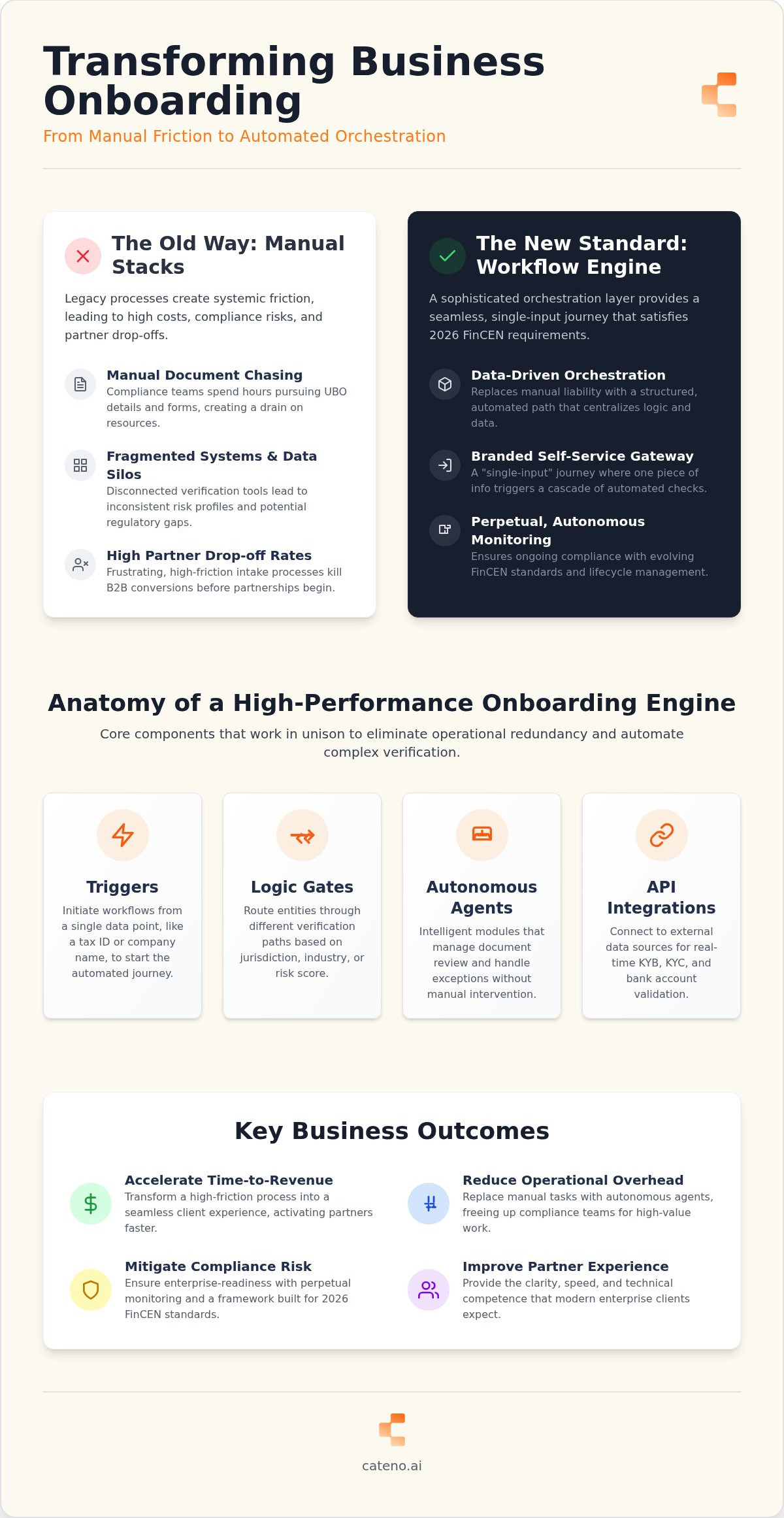
The era of PDF forms and email-based intake is over. In 2026, business onboarding has evolved from a series of disjointed tasks into a sophisticated discipline of data orchestration. Organizations relying on legacy stacks find themselves burdened by an operational liability that slows time-to-revenue and compromises data integrity. This technical debt isn't just a nuisance; it's a strategic barrier that prevents rapid scaling and kills B2B conversion rates before a partnership even begins.
A business onboarding workflow engine serves as the strategic orchestrator in this new environment. It's not just a digital checklist. It's a specialized software layer rooted in the principles of Business Process Management (BPM). This engine replaces manual liability with a structured, automated path that navigates the complexity of B2B relationships with precision. By centralizing logic and removing redundancy, it transforms fragmented data into a cohesive, enterprise-ready asset.
The Friction Problem in Legacy KYB
Traditional Know Your Business (KYB) processes often fall into the "back-and-forth" document trap. Compliance teams spend hours chasing Ultimate Beneficial Owner (UBO) details, a manual drain on resources that frequently results in high drop-off rates. When verification tools are fragmented, data silos emerge, leading to inconsistent risk profiles and potential regulatory gaps. This lack of cohesion creates systemic friction, where the cost of onboarding a single entity can significantly erode the initial contract value. It's a fundamental flaw in traditional methods that requires a bold, innovative remedy to ensure long-term stability.
The 2026 Standard for Entity Intake
The benchmark for 2026 is the "single-input" journey. Modern partners expect a branded, self-service gateway where providing one piece of verified information triggers a cascade of automated checks. We've moved beyond "check-the-box" compliance. The current standard requires continuous monitoring and a seamless transition from intake to lifecycle management. Organizations that adopt this model see a drastic reduction in operational overhead. They replace manual document chasing with autonomous compliance agents that handle verification in real-time, ensuring that every new business partner experiences a polished, professional, and efficient start to the relationship.
Anatomy of a High-Performance Onboarding Engine
A business onboarding workflow engine is a specialized software layer designed to automate the intake, verification, and lifecycle management of business entities. It serves as a central nervous system for B2B growth, moving beyond simple task management to complex orchestration. This engine provides the technical competence required to handle multifaceted regulatory environments while maintaining a frictionless experience for the user. It's the difference between a static digital form and a dynamic, enterprise-ready system.
The architecture of a high-performance engine relies on several core components that work in unison to remove operational redundancy. These include:
- Triggers: These initiate the workflow, often through a single data point like a tax ID or company name.
- Logic Gates: Decision nodes that route the entity through different verification paths based on pre-defined criteria.
- Autonomous Compliance Agents: Intelligent modules that manage document review and exception handling without manual intervention.
- API Integrations: Connections to external data sources for real-time KYC, KYB, and bank account validation.
These components ensure that the transition from initial contact to a fully verified partner is both fast and secure. Autonomous agents are particularly critical; they don't just flag errors, but actively work to resolve them by requesting missing documents or clarifying ownership structures. This level of control allows your compliance team to focus on high-level strategy rather than manual document chasing.
Logic Gates and Dynamic Risk Scoring
The engine uses logic gates to route entities based on specific variables such as jurisdiction, industry classification, or ownership structure. If a business operates in a high-risk sector, the system automatically triggers Enhanced Due Diligence (EDD) protocols. Dynamic risk scoring is the real-time adjustment of verification requirements based on the evolving data profile of an entity. This precision allows for a more fluid experience for low-risk partners while maintaining rigorous standards for complex cases. You can explore how a customizable workflow engine creates this level of operational clarity.
The Self-Service Gateway and Branded Portals
Trust is paramount in B2B relationships. A branded customer portal provides a professional interface that reinforces your organization's technical reliability and commitment to security. It allows business partners to upload sensitive documents securely and track their application status in real-time. By offering a "save and resume" functionality, the self-service gateway reduces drop-off rates during lengthy intake processes. This transparency minimizes support tickets and empowers partners to manage their own onboarding journey, reflecting a modern, solution-oriented mindset.
Strategic Evaluation: Workflow Engines vs. Manual Stacks
Manual entity verification carries a heavy "compliance tax" that organizations often fail to quantify until it's too late. Relying on a patchwork of legacy systems and manual document review creates systemic friction that drains high-level resources. While a manual stack might suffice for 10 entities a month, it inevitably collapses when volume scales to 1,000. At this level, the lack of a centralized business onboarding workflow engine results in fragmented data and an increased risk of regulatory oversight.
Data integrity is the cornerstone of enterprise-ready operations. Spreadsheet-based tracking is a manual liability. It's prone to version control issues and human error. In contrast, a specialized engine provides structural integrity by centralizing all verification data in a single source of truth. This organization is vital for audit readiness. When regulators demand proof of due diligence, the ability to generate advanced verification reports instantly provides a level of clarity and technical competence that manual processes simply cannot match.
Efficiency Metrics and ROI
The most immediate benefit of automation is the drastic reduction in time-to-onboard (TTO). Manual systems often require weeks of back-and-forth communication, whereas a business onboarding workflow engine can compress this timeline to hours or even days. By automating routine compliance tasks, organizations lower operational overhead and allow their teams to focus on strategic growth. This transition also eliminates the technical debt associated with fragile integrations, replacing them with a stable, scalable orchestration layer that values precision above all else.
Risk Mitigation and Accuracy
Human error is a significant vulnerability in manual AML and KYC screening. Missing a single red flag can lead to severe financial and reputational consequences. Automated systems provide a steady hand, ensuring that every entity is checked against global databases with absolute precision. Real-time KYB checks are essential for ongoing monitoring, moving away from static, periodic reviews toward a perpetual compliance model. Implementing bank account validation at the point of intake further strengthens this defense, preventing fraud before it enters your ecosystem. This proactive approach ensures that your business remains secure while maintaining a high-performance technological standard.
Architecting Your Automated Intake: A 2026 Framework
Building an enterprise-ready intake system requires a shift from reactive task management to proactive orchestration. The 2026 framework for B2B growth relies on a business onboarding workflow engine to synchronize complex verification steps into a single, fluid motion. This structured approach ensures that every entity, regardless of its complexity, is met with the same level of technical precision and operational clarity. It's the definitive path for organizations looking to scale without increasing their compliance headcount.
Mapping the Entity Lifecycle
The first step involves defining the specific data requirements for various entity types, such as LLCs, Corporations, or multi-layered partnerships. By establishing a "Single Piece of Information" trigger, like a tax ID or registered company name, you initiate a cascade of automated lookups that populate the majority of the application. It's a method that reduces the burden on the client and sets a professional tone from the start. While automation handles the bulk of the work, your framework should identify specific high-risk triggers where manual intervention remains a strategic necessity for final approval.
Configuring Autonomous Compliance Agents
Once the lifecycle is mapped, you must set parameters for your autonomous agents to handle document collection. These agents utilize advanced OCR technology to verify the authenticity of government IDs and corporate filings in real-time. If a document is missing or nears its expiration date, the agents communicate directly with the client to resolve the issue. Autonomous compliance agents are AI-driven entities that manage regulatory tasks without human oversight. This capability removes the back-and-forth friction that typically stalls B2B conversions and prevents revenue leakage.
To complete the architecture, integrate bank account validation APIs to ensure financial vetting happens at the point of intake. This prevents fraudulent entities from entering your ecosystem and secures the payment lifecycle from day one. Launching a branded self-service portal then provides a frictionless interface where partners can track their progress and manage their data securely. Finally, establish a feedback loop using advanced verification reports to identify bottlenecks and refine your logic gates. If you're ready to modernize your intake, you can configure your business onboarding workflow engine to meet these 2026 standards today.
Cateno: Orchestrating the Lifecycle of Business Entities
Cateno provides the definitive remedy for the systemic friction that often plagues B2B growth. While legacy systems focus on internal task management, this platform serves as a high-performance orchestration layer designed specifically for the complexities of entity intake. It's the strategic partner for fintechs and high-growth marketplaces that require more than just a digital form. By centralizing automated KYC, KYB, and bank account verification into a single, unified flow, Cateno ensures that every new partnership begins with technical precision and operational clarity.
The platform is engineered for enterprise-ready performance. It addresses the fundamental flaws of manual stacks by offering a scalable environment where security and data integrity are prioritized. Organizations can move away from fragmented verification tools and embrace a system that values accuracy above all else. With advanced verification reports available at your fingertips, your compliance team gains the structural integrity needed to meet the "effectiveness-based" regulatory standards of 2026 without increasing manual overhead.
The Cateno Workflow Engine Advantage
The core of the platform is a customizable business onboarding workflow engine that adapts to your specific regulatory needs. It acts as a steady hand in complex environments, providing a clear path forward even as global standards shift. This engine doesn't require a complete overhaul of your current infrastructure. It integrates naturally into your existing tech stack, allowing you to remove redundancy and automate the intake process with minimal disruption. This customizability ensures that your organization remains agile, capable of adjusting logic gates and risk parameters as your business enters new markets or jurisdictions.
Next Steps for Operational Excellence
Transitioning from a manual liability to a streamlined, automated engine is a strategic move toward operational excellence. It requires moving from high-level benefits to the implementation of specific functional capabilities. Cateno facilitates this transition by providing the tools necessary to replace "document chasing" with autonomous agents and self-service portals. This shift empowers your team, reduces time-to-revenue, and projects an image of being forward-thinking to your most valuable business partners. Precision is no longer a goal; it's a standard feature of your onboarding journey.
If you're ready to transform your intake process and eliminate the compliance tax of manual workflows, it's time to see the technology in action. You can request a demo of the Cateno Onboarding Engine to discover how a sophisticated orchestration layer can drive your B2B growth with confidence and scale.
Modernizing the Path to Partnership
The transition from manual document chasing to automated entity orchestration is a strategic necessity for any organization aiming to scale in 2026. You've seen how legacy compliance stacks create systemic friction that stalls revenue and compromises data integrity. By deploying a specialized business onboarding workflow engine, you replace these operational liabilities with a high-performance system that values precision and efficiency. This shift isn't just about speed; it's about building a foundation of trust through technical competence and regulatory mastery.
Cateno provides the structural integrity required to manage complex B2B lifecycles with ease. Through the use of Autonomous Compliance Agents and Branded Self-Service Portals, you can offer a polished experience that reduces drop-off rates and empowers your partners. Every verification is backed by Advanced Verification Reports, ensuring your organization remains audit-ready and enterprise-grade at all times. It's time to move beyond the limitations of static forms and embrace a solution engineered for the future of business relationships.
Streamline your entity intake with the Cateno Workflow Engine and start orchestrating your growth with absolute confidence.
Frequently Asked Questions
What is a business onboarding workflow engine?
A business onboarding workflow engine is a specialized software layer that automates the end-to-end intake, verification, and lifecycle management of business entities. It serves as a central orchestration hub that replaces manual, fragmented processes with a structured digital path. By centralizing logic gates and API integrations, the engine ensures that every new partner is vetted with technical precision. This system moves beyond simple task lists to provide a dynamic, enterprise-ready framework for B2B growth.
How does an automated onboarding engine improve KYB compliance?
An automated engine improves KYB compliance by eliminating human error and ensuring consistent application of due diligence standards. It utilizes real-time data lookups to verify corporate structures and beneficial ownership against global databases. This proactive approach allows organizations to move from static, periodic reviews to a perpetual monitoring model. By automating the identification of high-risk entities, the engine provides a steady hand in complex regulatory environments, ensuring every check meets current effectiveness-based standards.
Can a workflow engine handle complex UBO (Ultimate Beneficial Owner) structures?
Yes, a sophisticated workflow engine is specifically designed to unravel multi-layered ownership and complex UBO structures. It uses automated logic to map out corporate hierarchies and identify individuals with significant control across various jurisdictions. This capability removes the systemic friction of manual document chasing for parent companies or subsidiaries. The engine can trigger enhanced due diligence automatically when specific ownership thresholds or high-risk jurisdictions are identified, providing a definitive resolution to complex intake hurdles.
How does bank account validation integrate into the onboarding workflow?
Bank account validation integrates directly into the onboarding journey via integrated APIs that verify account ownership and status in real-time. This financial vetting happens at the point of intake, ensuring that payment details are accurate before an entity is fully onboarded. By automating this step, organizations prevent fraud and reduce the operational overhead associated with manual verification. This seamless integration ensures that the financial lifecycle of a new business partner is secured from the very first interaction.
What are autonomous compliance agents and how do they work?
Autonomous compliance agents are AI-driven modules that manage regulatory tasks, such as document collection and verification, without human oversight. They work by utilizing advanced OCR technology to scan filings and government IDs for authenticity. If a document is missing, expired, or invalid, the agents communicate directly with the client to request updates. This removes the manual liability of "back-and-forth" emails, allowing compliance teams to focus on high-level strategy while the agents maintain data integrity and accuracy.
Is a branded customer portal necessary for business onboarding?
A branded customer portal is essential for establishing trust and ensuring document security during the B2B intake process. It provides a professional, self-service gateway where partners can securely upload sensitive information and track their application status in real-time. By offering features like "save and resume," the portal reduces drop-off rates and minimizes support tickets. This branded experience reinforces your organization's technical competence and commitment to a frictionless partnership, which is critical for high-performance technological standards.
How long does it take to implement a custom onboarding workflow engine?
Implementation timelines vary based on the complexity of your existing tech stack, but a modern cloud-based platform can typically be configured in a matter of weeks. The process involves mapping your specific entity lifecycles and defining the logic gates required for your industry. Because a business onboarding workflow engine is designed for natural integration, it avoids the lengthy development cycles associated with building custom internal tools. This allows organizations to transition from legacy manual stacks to a streamlined engine with minimal disruption.
How do advanced verification reports help with regulatory audits?
Advanced verification reports provide a comprehensive, time-stamped trail of every due diligence action taken during the onboarding process. These reports consolidate data from KYC, KYB, and bank validation into a single, audit-ready document. When regulators demand proof of compliance, these reports offer the clarity and structural integrity needed to demonstrate a robust AML program. By centralizing this information, the engine ensures that your organization is always prepared for scrutiny without the need for manual data gathering or spreadsheet tracking.


