

Your customer’s first impression isn't your marketing site; it's the moment they encounter your verification process. If that journey feels fragmented or forces them into third-party interfaces, you've already compromised the relationship. High-performance firms recognize that implementing a sophisticated white label customer onboarding software isn't just about aesthetics. It's a strategic move to maintain a unified, professional gateway while navigating an increasingly complex regulatory environment.
We understand the friction caused by manual document collection and the operational bottlenecks that arise when compliance steps feel like an interruption rather than a feature. This guide helps you evaluate and implement a solution that pairs your brand’s visual identity with powerful, automated compliance engines. You'll discover how to reduce time-to-onboard through autonomous agents and integrated bank account validation. We'll explore how to gain full control over the user experience and data integrity, ensuring your firm remains enterprise-ready as FinCEN's 2026 structural reviews of Customer Identification Program rules reshape the industry. By the end of this article, you'll have a clear roadmap for turning a technical necessity into a branded engine for growth.
Key Takeaways
- Analyze the strategic value of a unified brand experience to eliminate the friction that typically leads to high customer drop-off rates.
- Identify the essential features of white label customer onboarding software, focusing on the necessity of a self-service gateway and a flexible workflow engine.
- Automate complex KYB verification and UBO discovery to meet evolving regulatory standards without disrupting the user journey.
- Deploy autonomous compliance agents to reduce operational overhead while maintaining total control over data integrity and the customer lifecycle.
- Orchestrate B2B growth by implementing a single-point entity onboarding process that requires minimal initial information from the client.
The Strategic Value of White Label Customer Onboarding Software in 2026
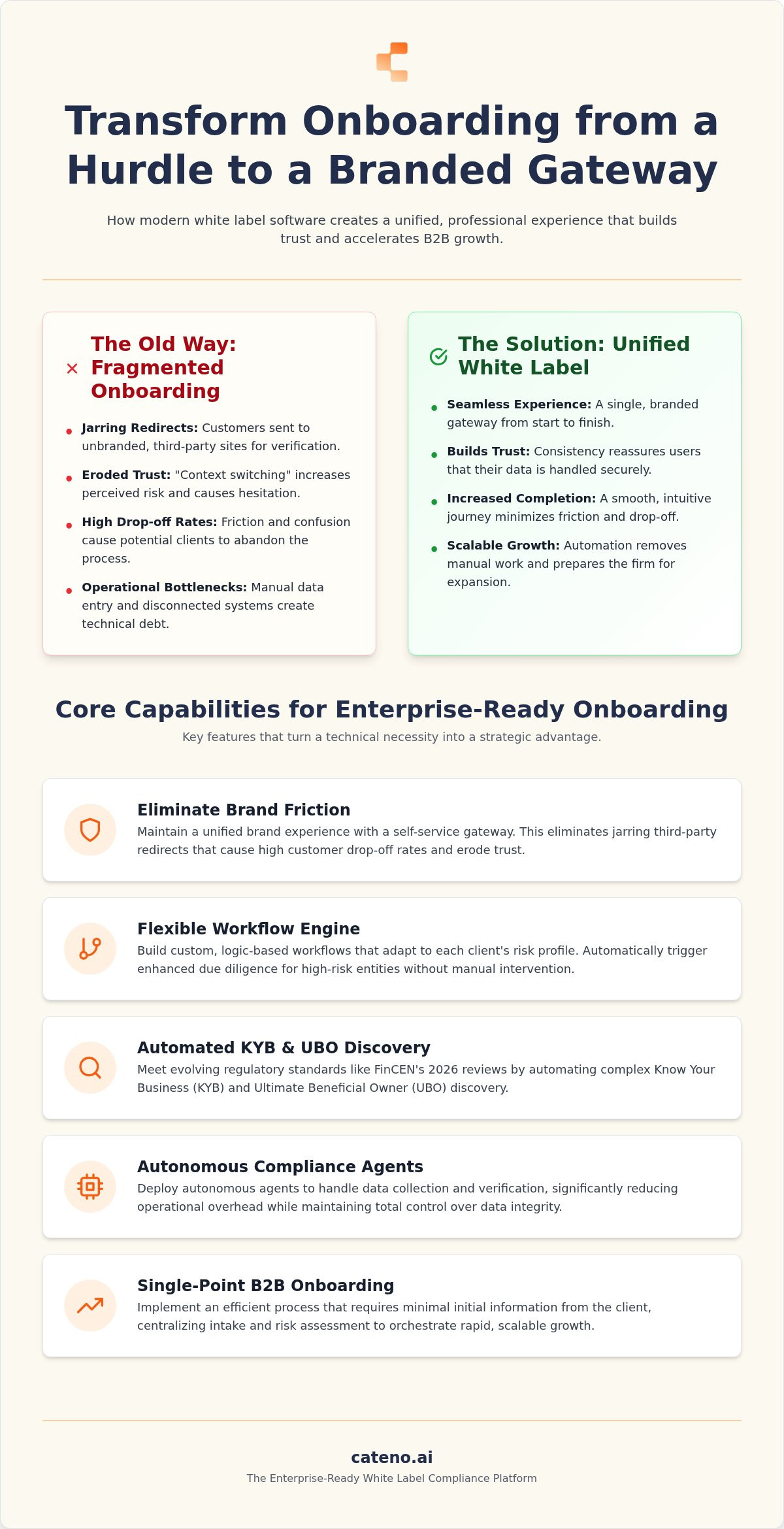
Trust is the fundamental currency of modern enterprise relationships. In a high-stakes regulatory environment, the moment a prospective client begins their journey with your firm, they're evaluating your technical competence and reliability. If that journey is interrupted by fragmented tools or jarring redirects to unbranded third-party sites, trust erodes instantly. This erosion, often called brand friction, leads to high drop-off rates and lost revenue. High-performance organizations solve this by utilizing white label customer onboarding software to create a unified, seamless experience.
A white label product serves as the invisible engine behind your brand's interface. It allows you to leverage sophisticated verification technology without forcing your clients to navigate a patchwork of different platforms. By 2026, the transition from basic document upload portals to integrated onboarding workflow engines has become a baseline requirement for competitive firms. This shift ensures that compliance isn't a hurdle but a professional extension of your service offering.
Trust as a Transactional Currency
Consistency in UI/UX is not merely an aesthetic choice. It's a risk mitigation strategy. When B2B partners are redirected to unfamiliar domains for sensitive tasks like KYC or bank verification, their perceived risk increases. This "context switching" creates a psychological barrier that can stall even the most promising partnerships. A professional, self-service gateway maintains the "walled garden" of your brand. It reassures users that their data is being handled by the same authoritative entity they chose to do business with. This continuity reduces the cognitive load on the user, making the path to full compliance feel like a natural progression rather than a series of disconnected chores.
Reducing Systemic Friction in B2B Growth
Fragmented onboarding stacks carry hidden costs that extend far beyond the initial software license. Manual data entry, disconnected verification reports, and operational bottlenecks create significant technical debt. To orchestrate growth effectively, firms must move toward The Sophisticated Business Onboarding Workflow Engine. This approach centralizes intake requirements and risk assessment into a single, automated path. By integrating white label customer onboarding software with autonomous compliance agents, businesses can scale their intake capacity without a linear increase in headcount. This structural integrity allows for rapid expansion while maintaining the highest standards of data accuracy and regulatory adherence. You can explore how these components integrate at the Cateno platform to see this efficiency in action.
Essential Features: Evaluating Custom Onboarding Workflow Software
Selecting the right white label customer onboarding software requires looking beyond surface-level aesthetics. While many tools claim flexibility, true enterprise-grade solutions offer a customizable workflow engine that adapts to the specific risk profile of each entity. This technical depth ensures that your onboarding process isn't just a digital form, but a robust system for managing complex lifecycle data. By prioritizing an API-first architecture, you ensure that information flows seamlessly between your CRM and compliance engines, eliminating the redundancy of manual data entry.
Workflow Customization and Logic
Rigid, template-based systems often fail when encountering complex B2B entity structures. An effective engine allows you to build conditional logic directly into the intake process. For instance, if a prospect identifies as a high-risk entity, the system should automatically trigger additional document requests or enhanced due diligence steps without manual intervention. You can explore the Cateno Platform to see how a customizable engine manages these multifaceted requirements. This level of automation is essential for maintaining strict adherence to Customer Due Diligence Requirements, ensuring that every data point is verified according to the latest regulatory standards.
Advanced reporting and document management capabilities further distinguish sophisticated platforms. Instead of scattered files, your team gains access to a centralized dashboard that tracks the progress of every applicant in real-time. This transparency allows for faster intervention when bottlenecks occur, significantly reducing the total time-to-onboard.
Branded Portal Capabilities
A sophisticated self-service onboarding gateway extends your brand identity through custom domains, CSS control, and fully white-labeled email communications. By 2026, mobile-responsive design is a baseline requirement for users who expect to manage verification steps across various devices. The portal should also serve as a secure repository, allowing clients to manage their documents and compliance status throughout their entire lifecycle. This creates a permanent, professional touchpoint that reinforces your firm’s technical competence and reliability. If you're ready to modernize your intake process, consider how a tailored solution can align with your specific operational goals.
Beyond Branding: Integrating Automated KYC and KYB Verification
Aesthetics establish the initial connection, but the invisible compliance layer sustains the relationship. For enterprise-level firms, identity verification must be native to the user journey. Redirecting a client to a third-party site for KYC or KYB checks signals a lack of technical integration. It suggests that your firm is merely a middleman rather than a primary service provider. Integrating these checks directly within your white label customer onboarding software ensures that the branded trust established in the initial portal remains intact. This native approach allows you to capture sensitive data securely while maintaining full control over the user experience.
Beyond simple ID checks, modern systems must automate Ultimate Beneficial Owner (UBO) discovery. Identifying the individuals who ultimately control a business entity is often the most time-consuming part of B2B onboarding. By automating this within the workflow, you eliminate the need for manual registry searches and complex paper trails. Simultaneously, integrating bank account validation at the point of entry prevents fraud before it enters your ecosystem. This proactive stance ensures that every entity entering your system is verified against real-time data, providing a foundation for advanced verification reports that support ongoing compliance monitoring.
The Synergy of KYB and White-Labeling
Automated entity onboarding is not just a convenience; it's a structural necessity for scalable growth. Firms can reduce manual review time by up to 80% by moving away from legacy, paper-based systems. This efficiency is achieved through the deployment of autonomous compliance agents that verify data integrity in real-time. To implement these efficiencies effectively, you must understand How to Build an Automated Entity Onboarding Process that balances speed with rigorous risk assessment. This synergy allows your compliance team to pivot from clerical data entry to strategic risk management.
Real-Time Verification Workflows
The era of batch processing is over. Modern onboarding requires real-time business identity checks and automated AML screening to identify risks as they emerge. This dynamic approach ensures that your branded environment remains secure without introducing unnecessary friction into the customer journey. Autonomous compliance is a self-correcting system for risk management. By utilizing these self-correcting mechanisms, your platform can adapt to changing regulatory requirements without requiring a complete system overhaul. This technical resilience ensures your firm remains enterprise-ready, regardless of shifts in the global compliance landscape.
Implementation Strategy: Deploying Your Branded Onboarding Gateway
Moving from a fragmented manual process to a unified digital intake requires a precise operational blueprint. Successful deployment of white label customer onboarding software depends on your ability to align technical capabilities with your firm’s specific risk appetite. This transition is not merely a software installation; it's a strategic reconfiguration of how your business interacts with new entities. By defining your intake requirements upfront, you ensure that the system captures essential data without creating unnecessary hurdles for the user.
Strategic Mapping of the Onboarding Journey
Precision begins with mapping every touchpoint from the initial invitation to full compliance. You must identify the exact data points required for your preliminary KYC and KYB screening to avoid "information fatigue." A well-orchestrated journey uses conditional triggers to manage complexity. For example, the system might only request supplemental ownership documents if an entity's structure exceeds a specific level of complexity. This logic ensures that your compliance team only intervenes when the automated engine flags a high-risk scenario. Different sectors require unique approaches to these paths, and you can see how various industries tailor their onboarding journeys to meet specific regulatory demands.
Configuring the white-label portal for maximum brand alignment involves more than just uploading a logo. It requires a deep dive into the user interface to ensure the tone and flow mirror your existing professional services. Testing the automated verification engine for both accuracy and speed is a critical final step. You must verify that the autonomous compliance agents are correctly interpreting data from global registries and that bank account validations occur in real-time. This rigorous testing phase prevents technical friction from reaching the end user, ensuring a flawless first impression.
Data Integrity and Security Protocols
In a white-label environment, your brand is the face of the security promise. Ensuring SOC2 and GDPR compliance is mandatory to maintain the integrity of the collected data. Best practices for secure document collection involve encrypted transit and storage protocols that prevent unauthorized access. Finally, the onboarding gateway must integrate seamlessly with your internal CRM and databases. This connectivity ensures that once an entity is verified, their data populates your ecosystem without manual entry, eliminating the risk of clerical error. If you're ready to architect a more efficient intake system, you can speak with a consultant to discuss your specific deployment requirements.
Cateno: The Enterprise-Ready White Label Compliance Platform
Cateno represents the convergence of sophisticated branding and autonomous technology. While standard white label customer onboarding software often focuses solely on the visual layer, Cateno prioritizes the underlying compliance logic. The platform enables organizations to initiate complex entity onboarding with a single piece of information, such as a business registration number. By automating the initial data retrieval from global registries, the system removes the burden of manual entry from the end user. This creates an immediate sense of efficiency and professional authority.
The core of the platform is powered by autonomous compliance agents. These agents act as a dedicated digital workforce, performing deep-tier verification tasks that typically require hours of manual review. They navigate international databases, identify ultimate beneficial owners, and screen for AML risks in real-time. This level of automation reduces operational overhead and eliminates the systemic friction that often stalls B2B growth. For global marketplaces and financial institutions, this scalability is essential. Cateno handles high-volume intake without compromising the precision of individual verification reports.
Unified reporting provides a single, branded view of the entire customer lifecycle. By integrating bank account validation with automated KYB checks, Cateno ensures that every data point is cross-referenced for accuracy. This holistic approach prevents the fragmentation that occurs when using disconnected tools. Your compliance team gains a consolidated dashboard that provides total transparency into the risk profile of every entity. Accurate data leads to better decisions.
Why Sophisticated Firms Choose Cateno
Transitioning from legacy operational liability to streamlined efficiency requires a strategic partner, not just a vendor. Sophisticated firms choose Cateno because it acts as a strategic orchestrator of B2B relationships. The platform transforms the onboarding gateway from a technical hurdle into a competitive advantage. This shift allows your organization to focus on high-value strategic initiatives rather than clerical data verification. You can review our Pricing to find a plan that aligns with your firm’s specific scaling requirements.
Get Started with Cateno
The path to a modernized intake process begins with a personalized demonstration of our workflow engine. During this session, our experts will show you how to configure autonomous agents to match your specific risk appetite. The onboarding process for new enterprise clients is structured and methodical. We ensure a seamless transition from your current systems to our cloud-based platform. We invite you to schedule a consultation with our compliance experts to discuss how Cateno can secure and scale your customer journey.
Orchestrating the Future of Branded Compliance
The transition from manual document collection to an automated, invisible compliance engine is no longer a luxury for enterprise firms; it's a structural requirement. By implementing a sophisticated white label customer onboarding software, you eliminate the systemic friction that erodes trust and stalls B2B growth. You've seen how a unified brand experience, powered by a robust workflow engine, ensures that your firm remains a primary service provider rather than a fragmented middleman. This technical resilience allows you to navigate evolving regulatory landscapes with absolute precision.
Cateno provides the stability and scalability required for modern intake. Our Autonomous Compliance Agents and Branded Self-Service Gateway work in tandem to deliver Integrated KYB/KYC Reports without the operational technical debt of legacy systems. This approach allows your team to focus on high-level strategy while the platform manages the complexity of global verification. It's time to transform your onboarding journey into a high-performance engine for growth. Streamline your B2B intake with Cateno; Contact Us Today to start your transition toward an enterprise-ready future.
Frequently Asked Questions
What is white label customer onboarding software?
White label customer onboarding software is a technical solution that enables firms to provide a seamless, branded intake process without third-party interference. It allows you to maintain a consistent visual identity while leveraging sophisticated automation for identity verification and document collection. By removing external branding, you eliminate the friction that often causes potential clients to drop off during the verification phase. This technology ensures that your professional authority remains the central focus of the entire user journey.
Can white-label onboarding software automate KYC and KYB checks?
Advanced platforms directly automate KYC and KYB checks within the branded interface. These systems use autonomous compliance agents to verify entity information and individual identities against global registries in real-time. By integrating these checks, you remove the need for manual review and disconnected third-party tools. This automation ensures that your firm meets regulatory standards while providing a fast, frictionless experience for new partners. It transforms a complex legal requirement into a streamlined, automated workflow.
How does a branded portal improve customer conversion rates?
A branded portal improves conversion rates by establishing a unified environment of trust. When users aren't redirected to unfamiliar sites for sensitive tasks like document uploads, their perceived risk decreases. This consistency eliminates context switching, which is a primary driver of abandonment in B2B onboarding. By providing a professional, self-service gateway that mirrors your firm’s aesthetic, you reassure clients of your technical competence. A seamless experience directly correlates with higher completion rates and faster time-to-revenue.
Is white-label onboarding software secure for financial institutions?
Enterprise-grade white label customer onboarding software is specifically engineered to meet the rigorous security demands of financial institutions. These platforms prioritize data integrity through encrypted storage and secure transit protocols, often adhering to SOC2 and GDPR standards. By utilizing advanced verification reports and autonomous agents, banks can maintain full control over their compliance audits. This high-performance architecture ensures that sensitive customer data remains protected while the institution scales its onboarding capacity without increasing operational risk.
Can I integrate my existing CRM with custom onboarding workflow software?
Modern onboarding solutions utilize an API-first architecture to ensure seamless integration with your existing CRM and internal databases. This connectivity allows data to flow automatically between systems, eliminating the redundancy of manual entry. When a client completes a step in the branded portal, the information updates your CRM in real-time. This structural integrity prevents clerical errors and ensures that your sales and compliance teams always have access to the most accurate, up-to-date entity information.
What is the difference between a client portal and an onboarding workflow engine?
A client portal serves as the visual interface where users interact with your brand, while an onboarding workflow engine provides the underlying logic and automation. The portal is the front door for document uploads and status tracking. The engine is the orchestrator that triggers conditional logic, executes background checks, and manages data routing. While the portal focuses on user experience, the engine ensures that complex compliance requirements are met accurately and efficiently behind the scenes.
How much does it cost to implement white-label onboarding software?
Implementation costs for white-label solutions typically depend on your specific intake volume and the complexity of your required workflows. Most enterprise platforms operate on a subscription or per-transaction basis, allowing you to scale costs as your business grows. While custom configurations may involve initial setup phases, the long-term reduction in manual labor and operational technical debt provides a significant return on investment. You should evaluate your specific entity intake requirements to determine the most cost-effective scaling path.
Does white-label software support automated bank account verification?
Yes, high-performance white-label platforms support automated bank account verification as a core feature. This capability allows you to validate account ownership and status at the point of entry, significantly reducing the risk of fraud. By integrating this step directly into the self-service gateway, you provide a more professional experience than legacy manual methods. This automation ensures that your financial transactions are built on a foundation of verified data, protecting both your firm and your clients.


