

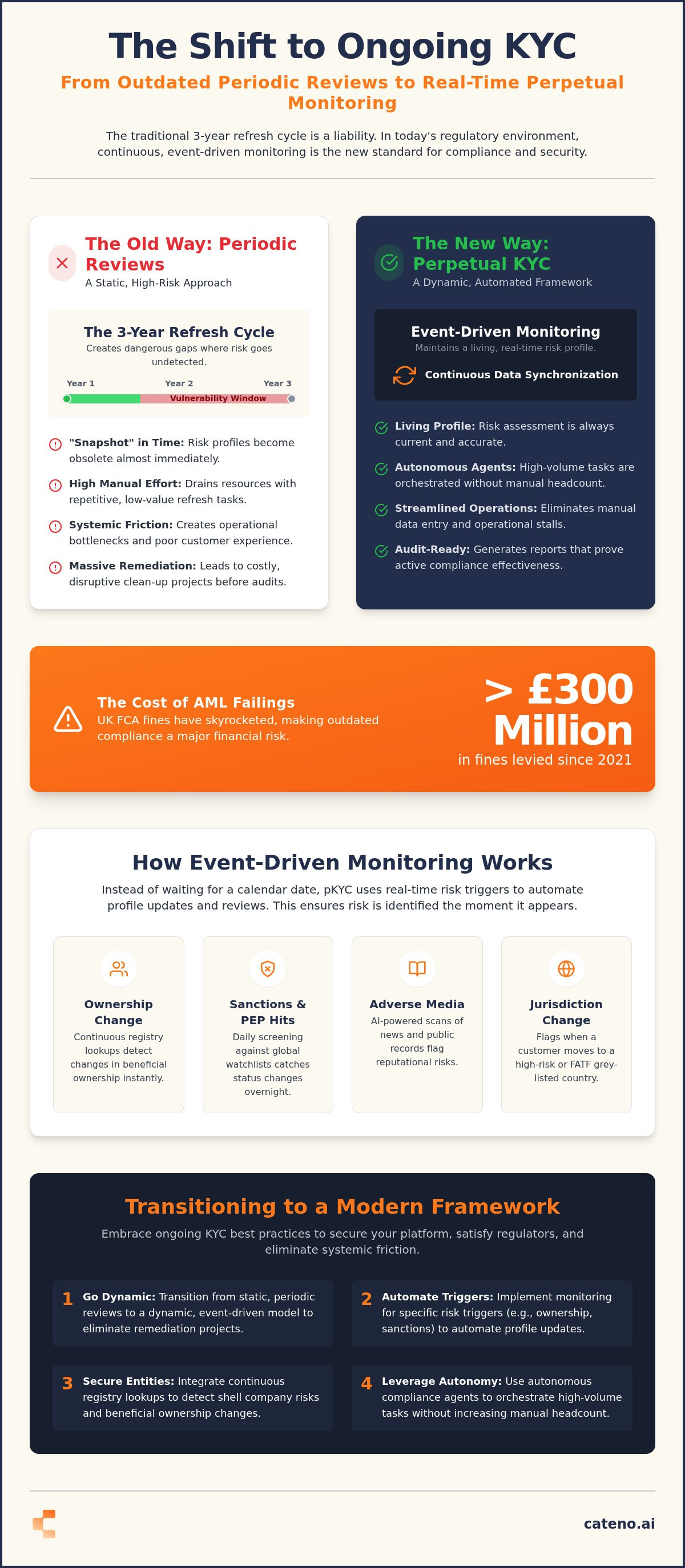
The traditional three-year KYC refresh cycle is no longer a safety net; it is a structural liability. In a 2026 regulatory environment where the UK Financial Conduct Authority has levied over £300 million in fines for AML failings, waiting for a calendar date to verify customer risk is a gamble your platform cannot afford to take. Reliance on manual, periodic reviews creates dangerous gaps where risk profiles can drift unnoticed for years, leaving your firm vulnerable to both financial crime and record-breaking penalties.
You likely feel the weight of these manual cycles as they drain your team's resources while producing high false positive rates that stall operational growth. It's exhausting to manage regulatory anxiety while drowning in repetitive "refresh" tasks. This guide establishes the definitive ongoing kyc monitoring best practices to help you transition from systemic friction to a streamlined, autonomous framework. We'll show you how to master a "set-and-forget" perpetual KYC system that secures your platform and satisfies global regulators.
We will examine the shift toward event-driven monitoring, the deployment of autonomous compliance agents, and the creation of audit-ready verification reports that prove your controls work in practice.
Key Takeaways
- Transition from static, periodic reviews to a dynamic, event-driven model that eliminates the need for massive remediation projects and manual data entry.
- Implement ongoing kyc monitoring best practices by identifying specific risk triggers that automate document collection and profile updates in real time.
- Secure complex entity lifecycles by integrating continuous registry lookups to detect shell company risks and beneficial ownership changes instantly.
- Leverage autonomous compliance agents and customizable workflow engines to orchestrate high-volume monitoring tasks without increasing manual headcount.
- Generate audit-ready verification reports that demonstrate active compliance effectiveness to global regulators under 2026 standards.
What is Ongoing KYC Monitoring in the 2026 Regulatory Environment?
The concept of compliance has evolved from a static gatekeeping exercise into a dynamic, continuous lifecycle. In the past, firms treated Know Your Customer (KYC) as a hurdle to clear during onboarding. Today, the focus has shifted entirely toward continuous oversight. This transition is driven by the reality that risk is not a fixed attribute; it's a fluid variable that changes as customers move, shift their financial behaviors, or become associated with new entities. Effective compliance is now measured by your ability to maintain an accurate risk profile every day, not just on the anniversary of an account opening.
The 2026 regulatory environment has codified this shift. The UK Money Laundering and Terrorist Financing (Amendment) Regulations 2026, which took effect on June 30, 2026, demand higher levels of vigilance and the replacement of Euro-denominated thresholds with Pound Sterling equivalents. Regulators now expect firms to demonstrate active, real-time risk awareness rather than relying on outdated records. Ignoring these ongoing kyc monitoring best practices leads to "regulatory drift," where a customer's profile becomes obsolete within months. For instance, if a client moves operations to a jurisdiction recently added to the FATF grey list, such as Bosnia and Herzegovina or Iraq as of June 2026, your risk assessment must update immediately. Waiting for a three-year refresh cycle is no longer a viable defense.
It's important to distinguish between transaction monitoring and identity data monitoring. While transaction monitoring flags suspicious movement of funds, identity monitoring tracks the status of the entity itself. A robust program must bridge these two functions to ensure that a change in a customer's status, such as a new PEP designation or a change in beneficial ownership, is instantly reflected in their transaction risk limits.
The Core Components of a Modern Monitoring Program
A resilient program requires a multi-layered approach to data integrity. It's not enough to monitor transactions; you must also monitor the identity itself. Modern frameworks integrate three critical pillars to maintain a secure environment:
- Continuous screening: Automated daily checks against global sanctions and Politically Exposed Person (PEP) lists to catch status changes instantly.
- Adverse media monitoring: Utilizing AI to scan news and public records for reputational risks that haven't yet triggered a formal legal filing.
- Transaction pattern analysis: Identifying anomalous behavior that deviates from a customer's established baseline, signaling potential money laundering or fraud.
Why Traditional Periodic Reviews are Failing
Periodic reviews are fundamentally flawed because they provide a "snapshot" of a risk profile that is often obsolete by the time the report is finalized. This creates a dangerous window of vulnerability between reviews. Manual refreshes also cause significant systemic friction. High-growth firms find that manual cycles scale poorly, leading to operational bottlenecks that frustrate customers and exhaust compliance teams. With the Financial Conduct Authority (FCA) imposing fines exceeding £300 million for AML failings since 2021, the cost of sticking to manual, periodic methods has become an enterprise-level risk.
The Shift to Perpetual KYC (pKYC): Moving Beyond Periodic Cycles
Periodic reviews are a relic of a paper-based era. In a modern digital economy, waiting one, three, or five years to re-verify a customer creates a window of risk that regulators no longer tolerate. Perpetual KYC (pKYC) represents a fundamental pivot toward an event-driven compliance model. This approach replaces the "snapshot" method with a continuous stream of data, ensuring that your risk assessment reflects the current reality of the customer's status rather than a historical record.
Perpetual KYC is the automated synchronization of customer risk profiles with real-world data changes.
By adopting pKYC, firms eliminate the massive remediation projects that typically plague compliance departments. These retrospective cleanup efforts are often triggered by internal audits or looming regulatory exams, consuming hundreds of billable hours and creating significant operational friction. Instead, pKYC relies on sophisticated data APIs to maintain a living customer file. When a change occurs in a corporate registry or a sanctions list, the system updates the profile immediately. This transition is a cornerstone of ongoing kyc monitoring best practices, as it allows your team to focus on high-risk exceptions rather than routine data entry.
Periodic vs. Perpetual: A Comparison of Efficiency
The efficiency gains of pKYC are measurable across three primary metrics. First, the timeline for updates moves from years to seconds; a trigger-based system reacts to a change the moment it hits a public database. Second, the cost per file drops significantly over the long term. While the initial integration of automated systems requires an investment, it removes the recurring expense of manual outreach and document collection for low-risk entities. Finally, accuracy rates improve. Automated data ingestion reduces the human error inherent in manual reviews, ensuring that your ongoing kyc monitoring best practices are backed by high-integrity data.
Building the Foundation for pKYC
Transitioning to pKYC requires more than just new software; it requires a structural overhaul of your data architecture. The core of this transition is a centralized business onboarding workflow engine that can ingest, process, and act upon external data triggers. Without this orchestration layer, data updates become noise rather than actionable intelligence.
Firms must also establish a risk-based approach (RBA) for trigger sensitivity. Not every data change requires a full re-verification. A change in a business's registered office address might trigger a simple log update, whereas a change in significant control or a new filing in a high-risk jurisdiction demands immediate human intervention. If you're ready to modernize your lifecycle management, you can speak with our compliance architects to design a framework that balances automation with precise risk control.
Best Practices for Implementing an Event-Driven Monitoring Framework
Implementation of an event-driven framework requires a shift from passive observation to active orchestration. The goal is to define "Significant Change" triggers that move beyond simple transaction alerts to encompass the entire customer identity. By automating the identification of these triggers, firms can reduce manual overhead and ensure that no profile drifts into non-compliance. One of the core ongoing kyc monitoring best practices is to maintain a granular audit trail for every automated decision. This ensures that when a regulator asks why a risk level was adjusted, you have a timestamped, data-backed justification ready for review.
While automation handles the volume, human-in-the-loop escalation remains vital for high-stakes decisions. The system should act as a filter, resolving low-risk discrepancies autonomously while flagging complex entity changes for senior compliance officers. This synergy allows for scale without sacrificing the nuanced judgment required for Enhanced Due Diligence (EDD). It's about building a system that knows when to act and when to ask for assistance.
Critical Event Triggers You Must Monitor
A robust framework must monitor specific, high-impact events that fundamentally alter a customer's risk profile. These include:
- Corporate Restructuring: Sudden changes in Ultimate Beneficial Ownership (UBO) or the addition of new directors that could signal a change in control.
- Sanctions and Watchlists: New entries in global databases, particularly following geopolitical shifts or updated FATF listings like the additions of Bosnia and Herzegovina in June 2026.
- Transaction Anomalies: Significant shifts in volume or transfers to high-risk jurisdictions that deviate from established patterns.
Integrating these triggers into your ongoing kyc monitoring best practices ensures that your platform reacts to external reality in real time rather than waiting for a scheduled review.
Optimizing the Re-Verification Workflow
When a trigger necessitates a profile update, the process should be frictionless for the customer. Utilizing branded customer portals allows you to request updated information or expiring identity documents through a professional, secure interface. Automation handles the outreach for expiring passports or proof of address documents weeks before they lapse. This proactive approach prevents account freezes and maintains a positive user experience.
Every event should feed into a dynamic risk scoring engine. If a customer's transaction behavior shifts or their corporate structure becomes more opaque, their risk level should adjust automatically. This ensures that your monitoring intensity always matches the current risk level, providing a truly "living" compliance environment.
Advanced KYB Monitoring: Managing Complex Entity Lifecycles
Ongoing monitoring for business entities (KYB) presents a unique set of challenges that individual KYC often lacks. Corporate structures are designed for flexibility; they can change directors, shareholders, or registered addresses in a matter of days. For compliance departments, manual KYB monitoring is the #1 cause of backlogs. It requires analysts to manually pull filings from various national registries, often across multiple languages and jurisdictions. This friction not only slows down operations but also leaves the firm exposed to "shell company" risk. Automated KYB monitoring detects hidden ownership shifts that manual reviews often miss. By integrating these processes into your ongoing kyc monitoring best practices, you ensure that your platform remains resilient against complex financial crimes.
The 2026 regulatory updates have specifically targeted the sale of "off-the-shelf" companies, bringing them explicitly within the scope of AML regulations. This means firms must be even more vigilant about the lifecycle of their business clients. Relying on a three-year refresh for a corporate entity is a significant oversight when a business can be sold and its control transferred in an afternoon. Continuous registry lookups are now an operational necessity to maintain data integrity and satisfy the demand for demonstrable effectiveness.
UBO and Ownership Structure Vigilance
The core of perpetual KYB is the ability to track Ultimate Beneficial Ownership (UBO) in real time. Automated systems now provide continuous registry lookups that trigger an alert the moment a new filing is recorded. This is particularly critical for cross-border entities where manual tracking is virtually impossible. By utilizing advanced verification reports, compliance teams get a clear view of complex entity hierarchies. This visibility allows for the immediate detection of new beneficial owners or directors who may appear on updated PEP or sanctions lists, such as those from jurisdictions added in June 2026 like Bosnia and Herzegovina or Iraq.
Bank Account and Financial Validation
Ongoing trust isn't just about who owns the company; it's about the company's operational legitimacy. Continuous bank account verification ensures that the entity you're doing business with still maintains active, legitimate financial channels. Monitoring for changes in financial standing or registration status prevents your platform from facilitating transactions for dissolved or insolvent businesses. This layer of validation reduces fraud by confirming that business credentials remain valid throughout the entire lifecycle. If you're struggling to manage the complexity of corporate oversight, consult with our team to implement a scalable KYB monitoring solution.
Orchestrating Compliance with Autonomous Workflow Engines
Modern compliance requires a shift from isolated tools to a unified orchestration layer. A customizable workflow engine serves as the central nervous system of your compliance operations, integrating disparate data silos into a single source of truth. In the 2026 regulatory environment, having fragmented systems is a critical vulnerability. When registry data, transaction logs, and identity documents live in separate environments, your firm cannot achieve the real-time risk awareness that regulators demand. Orchestration ensures that every piece of data informs the next step in the customer lifecycle, creating a seamless transition from initial onboarding to perpetual oversight.
This integrated approach is the foundation of ongoing kyc monitoring best practices. It allows for the deployment of autonomous compliance agents that act upon data triggers without human intervention. By centralizing your logic within a single engine, you eliminate the systemic friction that occurs when teams have to manually reconcile data across multiple platforms. This architectural stability is what allows a firm to remain enterprise-ready while navigating the complexities of global financial regulations.
Leveraging Autonomous Compliance Agents
Autonomous compliance agents represent the next evolution in operational efficiency. These agents are designed to handle low-level monitoring tasks that previously consumed thousands of manual hours. They autonomously triage alerts, cross-referencing new data against existing profiles to clear false positives instantly. This dramatically reduces the "noise-to-signal" ratio for your compliance team. Instead of sifting through hundreds of benign updates, your specialists can focus their expertise on high-risk, high-complexity investigations that require nuanced human judgment. This shift doesn't just save time; it improves the overall accuracy of your risk detection by ensuring that human resources are directed where they are needed most.
Building for Scale Across Industries
Scalability is a non-negotiable requirement for high-growth firms. As your customer base expands from thousands to millions, manual processes inevitably break down. A robust workflow engine allows you to adapt monitoring protocols for different industries, ensuring that your compliance posture remains relevant whether you are in fintech, gaming, or corporate services. Self-service gateways and branded customer portals further enhance this scale by allowing users to provide updated information directly into your system, maintaining the flow of fresh data without operational bottlenecks.
The future of monitoring lies in predictive risk modeling. By leveraging AI-driven insights, firms can move beyond reacting to events and start anticipating them. This proactive stance is the ultimate goal of ongoing kyc monitoring best practices, transforming compliance from a defensive obligation into a strategic advantage that secures your platform and builds long-term trust with global regulators.
Securing Your Competitive Advantage in a Perpetual Compliance Era
The transition to perpetual KYC is no longer a luxury for the forward-thinking; it's a regulatory mandate for any enterprise operating in 2026. By moving beyond the friction of manual periodic reviews and adopting an event-driven framework, you eliminate the dangerous gaps where risk profiles drift. Implementing ongoing kyc monitoring best practices through a customizable workflow engine allows your team to replace systemic bottlenecks with a streamlined, autonomous oversight model.
Utilizing advanced verification reports provides the end-to-end transparency needed for audit readiness, while branded portals ensure that necessary re-verifications don't damage the customer experience. This structural shift empowers your compliance department to focus on high-value strategic risks rather than repetitive data entry. Discover how Cateno’s Autonomous Compliance Agents can transform your monitoring workflows and help you achieve a "set-and-forget" compliance lifecycle. You're now equipped to build a platform that is both secure and scalable for the years ahead.
Frequently Asked Questions
What is the difference between KYC screening and ongoing monitoring?
Initial KYC screening is a point-in-time check performed during the onboarding phase to verify a customer's identity and assess initial risk. Ongoing monitoring is the continuous process of observing that customer’s behavior and status throughout their entire lifecycle with the firm. While screening sets the baseline, monitoring ensures that any changes in risk profile, such as new sanctions or suspicious transaction patterns, are detected in real time.
How often should ongoing KYC monitoring be performed?
Regulatory expectations in 2026 have shifted away from fixed intervals like annual or triennial reviews. Instead, ongoing kyc monitoring best practices dictate that monitoring should be continuous and event-driven. High-risk entities require real-time oversight, while lower-risk profiles can be managed through automated daily screenings. The goal is to eliminate the dangerous gaps created by traditional "snapshot" reviews, ensuring your data reflects the customer's current reality every single day.
What are the regulatory requirements for ongoing monitoring in the US?
In the United States, the Bank Secrecy Act (BSA) and FinCEN regulations require financial institutions to maintain a written AML program that includes ongoing customer due diligence. This includes a requirement to understand the nature and purpose of customer relationships to develop a risk profile. Regulators now demand demonstrable effectiveness, meaning firms must prove their monitoring systems actually catch risk drift and suspicious activity rather than just existing as a policy on paper.
Can ongoing KYC monitoring be fully automated?
Low-level monitoring tasks, such as daily sanctions screening and PEP list updates, can be fully automated using autonomous compliance agents. These systems resolve benign discrepancies and clear false positives without human intervention. However, high-risk escalations and complex entity changes still require a human-in-the-loop approach. Automation handles the massive volume of data, while human specialists focus their expertise on nuanced investigations that require strategic judgment and Enhanced Due Diligence.
What happens if a customer fails an ongoing monitoring check?
When a customer fails a monitoring check, the system immediately triggers a high-priority alert and adjusts the customer's risk score. Depending on the severity of the failure, such as a new sanctions match or a major UBO shift to a high-risk jurisdiction, the account may be temporarily frozen. Compliance officers must then perform a manual review to determine if the relationship should be terminated or if a Suspicious Activity Report (SAR) is required.
How does ongoing monitoring help in preventing money laundering?
Ongoing monitoring prevents money laundering by detecting subtle shifts in behavior that occur after the initial onboarding. Criminals often maintain "clean" profiles initially, only to change transaction patterns or ownership structures later to layer illicit funds. By continuously analyzing transaction volumes and geographic destinations, firms can identify these anomalies early. This proactive stance ensures that your platform isn't used as a conduit for financial crime as customer risk profiles evolve over time.
What is a 'trigger-based' KYC review?
A trigger-based review is a compliance event initiated by a specific change in a customer's data rather than a pre-set calendar date. Common triggers include changes in corporate ownership, a new registered address in a different country, or a significant spike in transaction activity. This approach is a core part of ongoing kyc monitoring best practices because it ensures that reviews happen precisely when the risk profile changes, preventing outdated information from lingering in your files.
How does KYB monitoring differ from individual KYC monitoring?
KYB monitoring focuses on the complex lifecycles of business entities rather than individual persons. It involves tracking changes in corporate registries, ultimate beneficial ownership (UBO) structures, and the status of directors or parent companies. While individual KYC is relatively straightforward, KYB requires navigating cross-border entity hierarchies and monitoring for "shell company" risks. This involves continuous registry lookups to ensure the business remains active and that its controlling parties haven't changed since onboarding.


