
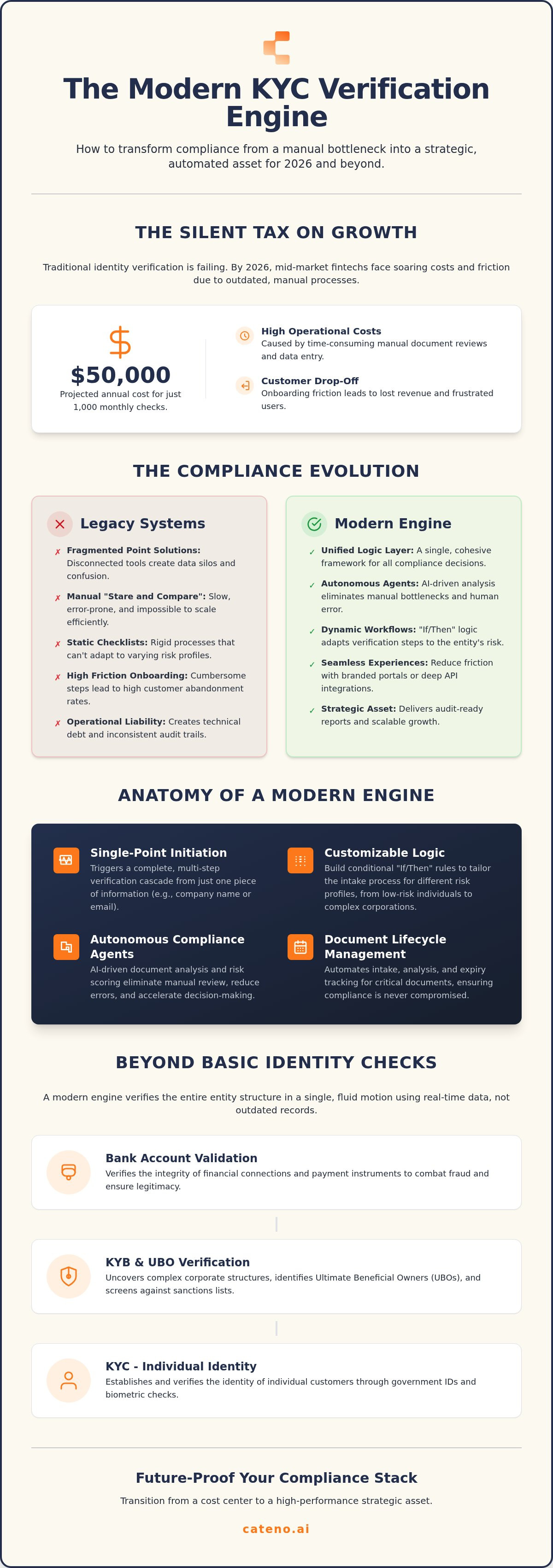
The traditional approach to identity verification has become a silent tax on enterprise growth. By September 2026, mid-market fintechs performing just 1,000 monthly checks are facing annual costs near $50,000, primarily because their kyc verification engine lacks the automation to handle modern complexity. You've likely seen the impact firsthand: high operational costs from manual document reviews and customer drop-off caused by onboarding friction. It's a common challenge, especially when trying to manage the layers of KYB and UBO verification for complex corporate entities without increasing your technical debt.
A modern engine shouldn't just collect data; it must orchestrate it. This article explores how a sophisticated platform transforms raw information into actionable compliance decisions through autonomous logic. You'll discover how to eliminate manual friction and build a scalable, automated onboarding process that satisfies even the strictest regulatory audits. We'll examine the shift toward continuous monitoring and modular stacks, providing a roadmap to transition your compliance function from a bottleneck into a high-performance strategic asset.
Key Takeaways
- Learn why a modern kyc verification engine must function as a sophisticated logic layer to meet 2026 regulatory standards like the SEC's amended Regulation S-P.
- Discover how customizable workflow builders enable complex entity onboarding starting with just a single piece of information.
- Understand the role of autonomous compliance agents in eliminating manual bottlenecks through AI-driven document analysis and risk scoring.
- Evaluate the benefits of branded customer portals versus API-first integrations to reduce onboarding friction and customer drop-off.
- Identify strategies for future-proofing your compliance stack to handle intricate multi-entity structures with minimal technical debt.
What is a KYC Verification Engine in 2026?
The term "identity check" no longer captures the operational reality of modern financial compliance. In 2026, a kyc verification engine serves as the central logic layer that governs how an organization interacts with its customers and partners. It's not a mere database or a collection of disconnected tools. Instead, it's a strategic orchestrator that ingests raw data, applies complex business rules, and outputs definitive risk decisions. This evolution responds to a regulatory environment where fragmented "point solutions" create more friction than they resolve. Modern standards demand a unified approach where data ingestion, logic processing, and decisioning happen within a single, cohesive framework.
The shift from isolated checks to integrated workflow engines is driven by the need for accuracy and speed. Traditional Know Your Customer (KYC) protocols often failed because they operated in silos, leaving compliance teams to manually stitch together disparate data points. A sophisticated engine eliminates this redundancy. It provides a structured, step-by-step progression that moves from initial data capture to final approval without the typical confusion of legacy systems. This architecture ensures that every decision is backed by a clear, logical audit trail, which is essential for meeting the SEC's amended Regulation S-P requirements.
Beyond Basic Identity: The Evolution of Verification
Verification today bridges the gap between individual identity and corporate structure. A kyc verification engine is a sophisticated orchestrator of regulatory data and business logic. It manages the complex intersection of traditional identity checks, Know Your Business (KYB) protocols, and bank account validation. Relying on cached historical records is now a significant risk. 2026 standards prioritize real-time data to combat sophisticated fraud and ensure accuracy. Systems must verify not just who a person is, but the integrity of their financial connections and the legitimacy of the entities they represent in a single, fluid motion.
Why Static Checklists are Operational Liabilities
Legacy systems often rely on manual "stare and compare" methods that slow down growth. These static checklists are operational liabilities that lead to high costs and inconsistent results. When you scale rapidly, manual processes accumulate technical debt, making it harder to pivot as regulations shift. Cateno replaces these fragmented stacks with a streamlined alternative. By ensuring data integrity at every step, the platform generates advanced verification reports that are inherently audit-ready. This transition from manual friction to automated precision ensures that compliance becomes a scalable function rather than a growing expense.
The Anatomy of a High-Performance Workflow Engine
A high-performance kyc verification engine functions as a dynamic orchestration layer rather than a static sequence of checks. In the 2026 regulatory environment, the ability to trigger a multi-step verification cascade from a single piece of information is a competitive necessity. When an entity provides an initial identifier, the engine automatically determines the necessary subsequent steps, such as UBO identification or sanctions screening. This automated progression eliminates the need for manual intervention at every stage, ensuring that the onboarding process remains fluid and responsive to the specific risk profile of the entity.
Managing the document lifecycle is equally critical for maintaining operational integrity. High-performance engines automate the intake and expiry tracking of essential records, such as articles of incorporation or government-issued IDs. By proactively monitoring these documents, the system ensures that compliance is never compromised by outdated information. This level of automation reduces the operational burden on compliance teams, allowing them to focus on high-level risk assessment rather than administrative data entry. It's a fundamental shift from reactive document collection to proactive lifecycle management.
Customizable Logic: Tailoring the Intake Process
The strength of a sophisticated engine lies in its customizable logic. By building conditional "If/Then" rules, organizations can tailor the intake process to suit different risk profiles. A low-risk individual might follow a simplified path, while a high-risk corporate entity triggers additional layers of scrutiny, such as enhanced due diligence or deep-dive financial analysis. This creates a single source of truth for entity data, ensuring that all information is consolidated and accessible for future audits. Utilizing a customizable workflow engine allows teams to adapt these rules in real-time as market conditions or regulations evolve.
Bank Account Validation and Financial Integrity
Financial integrity requires more than just verifying an identity; it requires linking that identity to a validated financial account. Bank account verification is the critical bridge that traditional systems often ignore. By matching entity identities with verified financial records, the engine prevents fraud and ensures that the entity is transaction-ready. This integration streamlines the transition from verification to active participation in the financial ecosystem. It ensures that funds are moving between legitimate, verified parties, which is essential for maintaining enterprise-grade compliance and reducing the risk of money laundering.
Solving the Human Bottleneck with Autonomous Compliance Agents
Manual document review is the primary driver of operational bloat in modern compliance departments. By 2026, it's predicted that 30% of organizations will find their legacy authentication systems inadequate for addressing threats like deepfakes. This vulnerability necessitates a shift toward Autonomous Compliance Agents within the kyc verification engine. These agents aren't simple scripts. They function as virtual compliance officers that perform deep-layer analysis on entity data, identifying anomalies that traditional "stare and compare" methods inevitably miss. By automating the heavy lifting of document verification and risk assessment, firms can scale their operations without a linear increase in headcount.
The core advantage of these agents lies in their ability to handle "grey area" cases. Traditional systems often trigger a manual review for any slight data mismatch, overwhelming human teams with false positives. An autonomous agent reasons through these discrepancies by cross-referencing multiple data points in real-time. It only escalates a case when it identifies a genuine risk that requires human judgment. This filtered approach ensures that your compliance experts spend their time on high-value investigations rather than administrative data correction.
Smart Risk Scoring and Decisioning
Modern compliance requires a transition from binary pass-fail outcomes to nuanced, risk-based scoring. Autonomous agents apply consistent logic across thousands of entities, assigning scores based on real-time data integrity and behavioral patterns. Machine learning models within the engine identify emerging fraud signatures, such as synthetic identities or sophisticated network links between shell companies. This proactive decisioning allows the system to adjust its scrutiny levels dynamically, ensuring that low-risk entities move through the kyc verification engine at high velocity while high-risk cases are flagged for immediate attention.
The "Human-in-the-Loop" Hybrid Model
Automation does not mean the removal of human oversight; it means the optimization of it. When a case reaches a specific risk threshold, Cateno's agents escalate the file to a human expert. To facilitate a rapid decision, the system provides Advanced Verification Reports that summarize the findings and highlight specific areas of concern. This hybrid model maintains a clear audit trail of both automated reasoning and manual overrides. It ensures that every decision is defensible during regulatory audits while maintaining the speed and scalability of a fully automated workflow.
Integration Strategies: Branded Portals vs. API-First
Choosing how to deploy a kyc verification engine is a strategic decision that impacts both engineering resources and customer conversion. Enterprises often face a trade-off between the speed of a ready-made interface and the flexibility of a custom-built flow. A sophisticated engine should support both, allowing businesses to choose the path that best aligns with their technical maturity and user experience goals. This flexibility ensures that compliance doesn't become a hurdle for growth but rather a seamless part of the product ecosystem.
The developer experience is a critical factor in this decision. Integrating a compliance stack into an existing SaaS environment requires a platform that values precision and scalability. Whether you're building a native mobile experience or a desktop-based corporate dashboard, the integration must feel purposeful. It's not just about passing data; it's about creating a cohesive brand experience throughout the entire compliance journey, ensuring that users feel secure and supported at every touchpoint.
The Self-Service Gateway: Empowering the Entity
Onboarding friction is the primary cause of customer drop-off. A self-service gateway addresses this by providing a secure, intuitive environment where entities can upload documents at their own pace. By white-labeling this experience, you maintain brand continuity, which is essential for building trust during sensitive data collection. These portals automate document collection through a guided interface, ensuring that users provide the correct information the first time. This approach significantly increases conversion rates compared to fragmented email-based requests or rigid, unbranded forms that feel like third-party interruptions.
API Orchestration for Custom Workflows
For organizations with complex SaaS stacks, direct API integration offers unparalleled control. Developers can use engine endpoints to build bespoke onboarding journeys that feel native to their application. This is particularly valuable when handling real-time KYB checks across multiple global jurisdictions, where requirements vary significantly. The inclusion of robust webhooks and real-time status updates allows your system to react instantly to verification events. This architectural flexibility ensures that your compliance stack grows alongside your product, rather than becoming a bottleneck for new feature rollouts. You can achieve this balance of control and efficiency with a branded customer portal that integrates seamlessly with your existing infrastructure.
Future-Proofing Your Compliance Stack with Cateno
Legacy onboarding stacks have become a significant operational liability for firms aiming to scale in 2026. These fragmented systems create bottlenecks that restrict growth and expose organizations to regulatory risks. Cateno offers a sophisticated remedy, transforming the compliance function into a high-performance strategic orchestrator. By implementing a modern kyc verification engine, businesses can move away from manual friction toward a model of streamlined efficiency. This transition isn't just about replacing software; it's about re-engineering the entire onboarding lifecycle to handle the most complex entity structures with minimal input.
The platform's strength lies in its ability to initiate a multi-step verification cascade from a single data point. This capability is particularly vital for organizations dealing with intricate corporate hierarchies and multi-jurisdictional requirements. Cateno’s customizable workflow engine allows teams to define specific logic for various entity types, ensuring that every onboarding journey is as efficient as it is compliant. By leveraging autonomous agents to handle routine document analysis, firms effectively reduce their operational liability while maintaining the precision required for enterprise-grade compliance.
Enterprise-Ready Scalability and Security
Managing partner intake at a national scale requires a system built for stability and structural integrity. Cateno is the preferred choice for sophisticated financial platforms because it moves beyond the initial check to provide continuous monitoring and advanced verification reports. These reports ensure that compliance teams are always audit-ready, even as regulatory environments shift. The engine's architecture supports rapid scaling without the traditional technical debt associated with legacy stacks, providing a secure foundation for long-term growth.
Getting Started: From Manual to Autonomous
Transitioning from a manual stack to an automated engine involves a methodical progression. First, identify the specific operational hurdles in your current workflow and map them to Cateno’s customizable logic. Next, integrate the self-service gateway to empower users and reduce initial data entry errors. Measuring the ROI of this shift is straightforward: look for reduced customer drop-off rates, lower per-verification costs, and a significant decrease in manual review hours. You can optimize your onboarding with Cateno’s Workflow Engine today to begin your journey toward autonomous compliance.
Orchestrating Compliance for an Automated Future
The transition from fragmented point solutions to a unified kyc verification engine marks the difference between operational stagnation and scalable growth. By 2026, the complexity of multi-entity verification and the rise of sophisticated fraud demand a system that operates with autonomous precision. You've seen how a customizable workflow builder and autonomous compliance agents eliminate the human bottleneck, allowing your team to focus on high-level risk strategy rather than repetitive data entry. These tools don't just verify identities; they build a foundation of financial integrity through single-piece-of-information onboarding and advanced verification reports that ensure you're always audit-ready.
Adopting this sophisticated approach reduces technical debt and removes the friction that causes customer drop-off. It's time to replace legacy onboarding stacks with a strategic orchestrator that values accuracy and scalability above all else. Streamline your entity onboarding with Cateno to transform your compliance function into a high-performance asset. The path to streamlined efficiency is clear, and the technology to achieve it is enterprise-ready. We look forward to helping you build a more secure and efficient future.
Frequently Asked Questions
What is the difference between a KYC provider and a KYC verification engine?
A KYC provider typically offers a specific data service; a kyc verification engine functions as a central logic layer that orchestrates the entire onboarding journey. It ingests data from multiple sources and applies business rules to output definitive risk decisions. While a provider might return a simple pass or fail result, an engine manages the complex lifecycle of an entity, ensuring a unified and scalable compliance process.
Can a KYC verification engine handle KYB and UBO checks simultaneously?
A sophisticated engine is designed to handle complex multi-entity verifications. It triggers automated KYB and UBO checks based on the entity structure identified during the initial intake process. This ensures that business verification and the identification of ultimate beneficial owners occur within a single, seamless workflow. Such integration eliminates the need for disconnected tools and reduces the manual intervention traditionally required for corporate onboarding.
How does an automated engine reduce onboarding friction for customers?
It reduces friction by replacing manual document requests with a self-service onboarding gateway. Customers can provide a single piece of information to trigger a background cascade, interacting with the system only when necessary. Branded customer portals further build trust by maintaining a consistent brand experience. This ensures the compliance journey feels like a native part of your product rather than a disruptive, third-party requirement that causes drop-off.
Is it possible to integrate a KYC engine without a full system overhaul?
Integration is possible through modular APIs or a self-service gateway without a full system overhaul. Cateno’s platform connects via endpoints to provide a customizable logic layer that sits alongside your current SaaS stack. This approach allows enterprises to modernize their compliance capabilities and reduce technical debt incrementally. It provides a strategic path forward that avoids the high costs and risks of a complete replacement.
How do autonomous compliance agents handle document verification?
Autonomous compliance agents use AI-driven analysis to perform deep-layer checks on government IDs and corporate records. They reason through "grey area" cases by cross-referencing multiple data points in real-time rather than relying on simple binary matches. This reduces manual intake by up to 80% because agents only escalate files to human experts when they identify specific risk thresholds that require a nuanced, subjective review.
What kind of reporting is available for regulatory audits?
The engine generates advanced verification reports that provide a comprehensive audit trail of every decision. These reports include data integrity scores, document history, and the specific logic applied by autonomous agents. This level of transparency ensures your organization remains audit-ready for 2026 regulatory standards. It provides the clarity needed for audits like those required by the SEC’s amended Regulation S-P, which governs the protection of sensitive investor data.
Can the engine be customized for different regional regulations?
The customizable kyc verification engine allows teams to build specific logic for different jurisdictions and risk profiles. You can adjust the verification cascade to meet localized standards whether you're managing domestic partners or navigating international requirements. This flexibility ensures your compliance stack remains effective across diverse markets. It allows for regional tailoring within a single, unified system, avoiding the need for fragmented and expensive local solutions.
How does bank account validation fit into the KYC workflow?
Bank account verification acts as the critical link between a verified identity and transaction readiness. By integrating this step into the primary flow, the engine matches an entity's identity with their financial records. This prevents fraud and ensures funds move between legitimate parties. It streamlines the transition from onboarding to active participation, ensuring every partner is fully prepared for secure financial operations.


