
What if your onboarding process wasn't a gatekeeper but a growth engine? Most enterprise leaders recognize the frustration of watching high-value entities drop off during document submission. Optimizing onboarding workflows is often hindered by technical debt from siloed tools and the exhaustion of manual KYC reviews that stall your time-to-revenue. It's a systemic friction that compromises your ability to scale. Relying on legacy systems often means accepting high customer acquisition costs as an inevitable burden.
Mastering the transition to high-velocity intake is no longer optional. This guide provides a strategic framework to achieve autonomous, scalable results. You'll learn how to move from high-friction manual checks to a streamlined environment that empowers your team. We'll explore how integrating a Customizable Workflow Engine and Autonomous Compliance Agents can facilitate instant verification and secure global entity intake. By the end of this article, you'll have a clear path to faster revenue and a more resilient operational infrastructure for 2026.
Key Takeaways
- Quantify the impact of manual bottlenecks on your bottom line by defining the true cost of operational friction during entity intake.
- Master the architectural principles of high-velocity systems, including the transition to optimizing onboarding workflows through a single-piece-of-information entry point.
- Identify the critical differences between traditional rules-based automation and the sophisticated decision-making capabilities of Autonomous Compliance Agents.
- Implement a five-step framework to audit friction points and consolidate siloed verification tools into a single, cohesive engine.
- Position your organization for global scale by leveraging a Customizable Workflow Engine that adapts to evolving regulatory environments.
The High Cost of Systemic Friction in Entity Onboarding
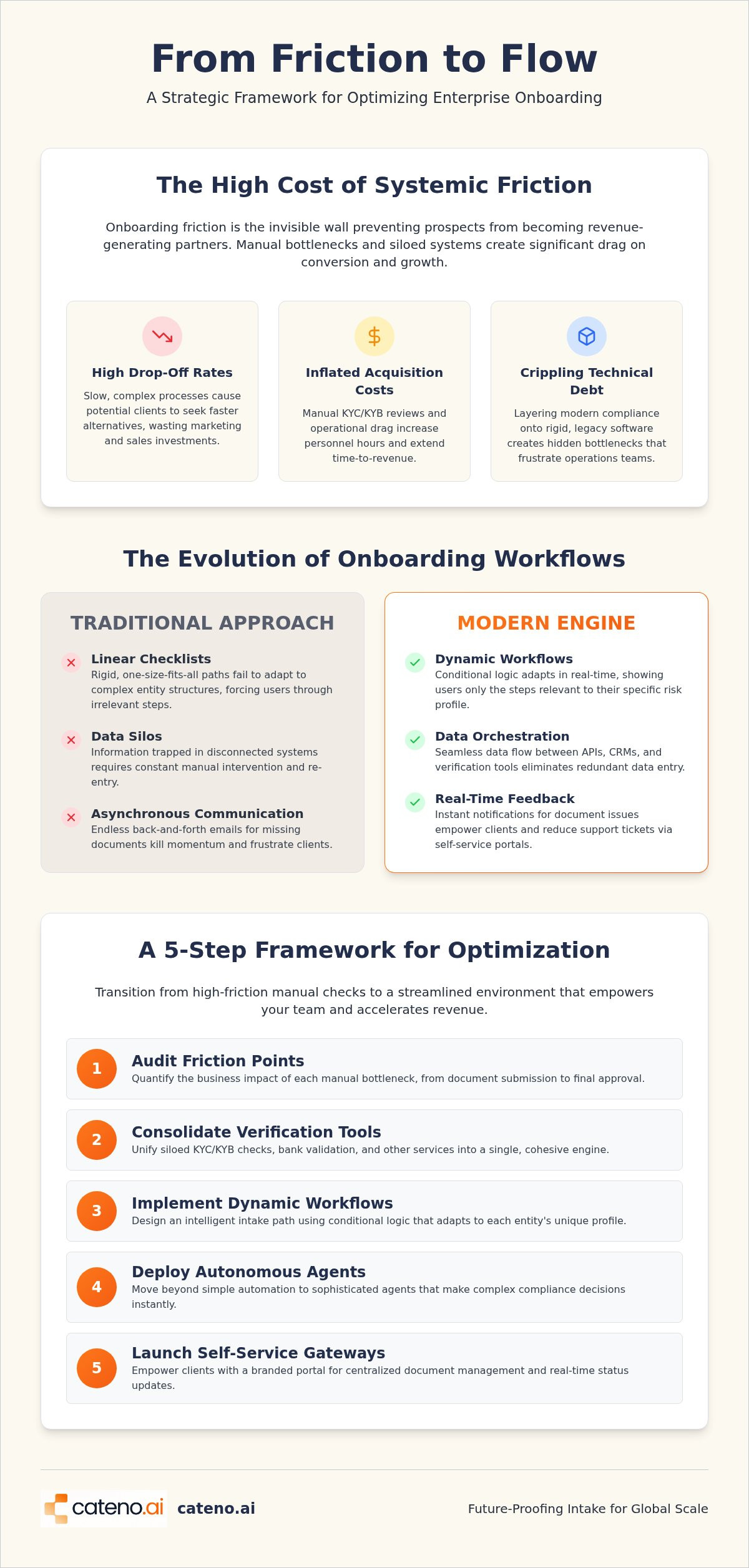
Onboarding friction represents the cumulative technical and operational resistance encountered during the entity intake process. It's the invisible wall that prevents a prospect from becoming a revenue-generating partner. In the context of organizational socialization, this phase is critical for establishing trust and baseline efficiency. Yet, many organizations struggle with manual bottlenecks that inflate Customer Acquisition Cost (CAC) by extending the time-to-revenue and increasing the personnel hours required for KYC and KYB verification. When the intake process is slow, potential clients seek faster alternatives, leading to high drop-off rates that waste marketing and sales investments.
The "Compliance Paradox" suggests that heightened security must inherently lead to higher friction. This is a fallacy. True security is achieved through precision and data integrity, not by adding more screens to a form. The strategic objective for 2026 is moving away from a static sequence of screens and toward a dynamic data engine. By optimizing onboarding workflows, businesses can maintain rigorous standards while accelerating the speed of entry. The goal is to transform a burdensome regulatory requirement into a competitive advantage through seamless execution.
Identifying Invisible Bottlenecks in Intake
Data silos often cause document verification to stall. When information is trapped in disconnected legacy systems, manual intervention becomes the default, creating a significant drag on conversion rates. Asynchronous communication, such as back-and-forth emails for missing documents, acts as a silent killer of momentum. Onboarding technical debt is the accumulated inefficiency caused by layering modern compliance requirements onto rigid, legacy software stacks that were never designed for autonomous data orchestration. These bottlenecks are often hidden within the complexity of the stack, only surfacing as lost revenue and frustrated operations teams.
The Shift from Linear to Dynamic Workflows
Linear checklists are insufficient for complex enterprise business structures. These rigid paths fail to account for the nuances of multi-jurisdictional entities or complex ownership hierarchies, forcing users to navigate irrelevant steps. Implementing conditional logic is essential to reduce user cognitive load, ensuring that entities only provide the data relevant to their specific risk profile. Transitioning to a Sophisticated Business Onboarding Workflow Engine allows for a more agile approach. This shift ensures that optimizing onboarding workflows results in a high-velocity environment where data flows between verification APIs and internal databases without manual friction.
Architectural Principles of High-Performance Workflows
High-performance entity intake requires a departure from rigid, linear structures. The foundation of this shift is the "single piece of information" philosophy. By initiating a workflow with just one identifier, such as a tax ID or business name, organizations can trigger background processes before the user even reaches the second screen. This approach minimizes initial friction and sets the stage for sophisticated business process optimization. Success in 2026 relies on a system's ability to orchestrate data across multiple layers without manual intervention.
Data orchestration is the silent engine behind optimizing onboarding workflows. It involves the seamless movement of verified data between Automated KYC and KYB Checks, bank validation APIs, and internal CRM systems. When these components communicate in real-time, the need for redundant data entry disappears. Scalability is equally critical. A robust architecture must maintain the same low latency whether it's processing ten entities or ten thousand. This structural integrity ensures that growth doesn't lead to operational degradation.
Leveraging Self-Service Onboarding Gateways
A Self-Service Onboarding Gateway transforms the client experience from a passive submission process into an active, empowered journey. By utilizing a Branded Customer Portal, businesses can centralize document management and provide real-time feedback loops. If a document is rejected, the system notifies the entity immediately with specific instructions for resubmission. This reduces support tickets and manual follow-ups. Integrating Cateno's Platform allows organizations to deploy these gateways with minimal technical overhead, ensuring a professional first impression.
Integrating Bank Account Validation APIs
Manual bank statement verification is an operational liability that introduces human error and significant delays. High-performance workflows utilize Bank Account Verification APIs to confirm transactional readiness in seconds. This real-time validation is a prerequisite for secure, high-velocity intake. It ensures that data integrity is maintained across the entire financial lifecycle. By removing the manual check, you eliminate a primary bottleneck and accelerate the time-to-revenue. To see how these principles apply to your specific environment, consider consulting with a strategic orchestrator who understands the nuances of enterprise-scale intake.
Automation vs. Autonomous: The New Compliance Standard
Traditional automation relies on rigid, rules-based triggers. If a user submits a document, the system checks for a signature. This is "If X, then Y" logic. While helpful, it fails when encountering nuance or unexpected data formats. Autonomous compliance represents a paradigm shift. It moves beyond simple triggers to agent-led decision-making. By optimizing onboarding workflows with this technology, organizations can handle complex entity structures that would otherwise require human oversight. It's the difference between a machine that follows a path and one that understands the destination.
The transition to Autonomous Compliance Agents allows for continuous lifecycle monitoring rather than static, point-in-time checks. Traditional methods verify an entity once and then ignore it until a scheduled review. This leaves a gap in risk management. Autonomous systems monitor data feeds in real-time, identifying changes in risk profiles or corporate structures as they happen. This ensures your organization remains compliant every day, not just on the day of onboarding. It provides a steady hand in an environment where regulatory requirements shift constantly.
The Role of Autonomous Compliance Agents
Autonomous Compliance Agents act as persistent digital overseers for your intake engine. These agents manage entity document collection and track expiration dates, sending automated alerts before a credential becomes invalid. By applying intelligent risk scoring to every interaction, they can reduce manual compliance tasks by up to 80%. This efficiency doesn't come at the cost of accuracy. Autonomous agents decipher complex ownership hierarchies by cross-referencing global registries to pinpoint Ultimate Beneficial Owner (UBO) structures without manual intervention. This level of precision is essential for optimizing onboarding workflows in highly regulated global markets.
Advanced Verification Reports for Strategic Insight
Standard compliance tools often provide a simple "Pass" or "Fail" result. This binary output is insufficient for enterprise-level risk management. Advanced Verification Reports offer comprehensive risk intelligence, providing a detailed narrative of an entity’s background. These reports allow leadership to make informed decisions based on data rather than intuition. Every action taken by the autonomous agents is logged, creating a transparent trail for regulators. This ensures total audit readiness, as the system provides a verifiable record of why every decision was made. Moving to this standard protects the organization while maintaining the velocity required for modern business growth.
A 5-Step Framework for Optimizing Your Onboarding Engine
Achieving operational excellence requires more than incremental changes. It demands a structured approach to optimizing onboarding workflows that prioritizes speed without sacrificing integrity. Organizations must move through a logical progression of assessment, consolidation, and deployment to build a resilient intake engine. This framework provides the roadmap for that transition.
- Step 1: Audit friction points. Use behavioral analytics to pinpoint exactly where entities stall. Identifying these specific moments of resistance allows for targeted intervention.
- Step 2: Consolidate verification vendors. Transition from a fragmented stack to a single Customizable Workflow Engine. This reduces technical debt and simplifies data orchestration.
- Step 3: Deploy self-service gateways. Shift the burden of document collection to the user through a Self-Service Onboarding Gateway. This empowers the entity and reduces manual follow-ups.
- Step 4: Implement autonomous agents. Integrate Autonomous Compliance Agents to handle ongoing monitoring and risk scoring. This ensures compliance remains a continuous process.
- Step 5: Continuously iterate. Use Advanced Verification Reports to analyze performance and refine rules. Data-driven iteration ensures the system evolves with regulatory changes.
Auditing Your Current Intake Velocity
Measuring "Time to Verification" is the most critical KPI for assessing onboarding health. This metric tracks the duration from the initial intake of a single piece of information to final approval. High-velocity systems aim for near-instant results, while legacy processes often stretch into days. By mapping "Drop-off Hotspots," you can see where complex document requirements or confusing UI elements cause entity abandonment. Establishing these benchmarks is essential to meet the 2026 industry standard for frictionless B2B intake.
Consolidating the Compliance Stack
Vendor bloat is a significant hurdle when optimizing onboarding workflows. Managing multiple APIs for KYC, KYB, and bank validation increases maintenance costs and creates fragile system dependencies. A unified platform eliminates this complexity, providing a single source of truth for all verification data. This consolidation reduces the technical debt associated with managing disparate compliance tools. You can explore how different sectors achieve this by reviewing Cateno's Industries for tailored optimization strategies. To start building your high-velocity engine, speak with an onboarding expert today.
Future-Proofing Intake with Cateno’s Orchestration
Cateno acts as the strategic orchestrator for organizations ready to transcend the limitations of legacy compliance stacks. By optimizing onboarding workflows, enterprise leaders can reclaim control over their operational velocity. The centerpiece of this transition is the Customizable Workflow Engine. This infrastructure doesn't just automate tasks; it provides the agility required to adapt to shifting regulatory landscapes without rebuilding your entire technical stack. It's about building a foundation that supports innovation rather than hindering it.
Maintaining brand integrity during the intake process is critical for establishing long-term trust with high-value entities. A Branded Customer Portal ensures that your professional identity remains front and center while the backend handles complex data validation. This transition from friction to flow isn't just a technical upgrade. It's a fundamental shift in how your business interacts with the global market. Every touchpoint becomes an opportunity to demonstrate technical competence and reliability. Optimization is a journey that moves your organization from systemic resistance to a high-velocity state of flow.
Enterprise-Ready Scalability and Security
Cateno is engineered to support national-scale operations, providing a consistent experience regardless of volume or complexity. High-performance environments require more than just speed; they demand absolute data integrity. Our platform ensures that every verification remains accurate as you scale from ten to ten thousand entities. This stability is vital for operations leaders who need to lower customer acquisition costs while maintaining rigorous security standards. By removing redundancy, the system allows your team to focus on strategic growth rather than manual document review. Clarity replaces confusion in even the most complex regulatory environments.
Getting Started with Workflow Optimization
The roadmap from manual intake to autonomous orchestration begins with a strategic assessment of your current integration points. Cateno’s experts work with your team to replace fragmented, rules-based triggers with sophisticated Autonomous Compliance Agents. This process involves consolidating your verification vendors into a single, cohesive engine that handles everything from KYC to bank account validation. Transitioning to this model allows for continuous lifecycle monitoring, ensuring your entities stay compliant over time. To begin your journey toward high-velocity intake, you can Explore Cateno's Pricing for scalable onboarding solutions that fit your organization’s specific needs.
Scaling Operational Velocity for the Next Era of Intake
The transition from systemic friction to a high-velocity intake model is the defining operational challenge for 2026. By optimizing onboarding workflows, you move beyond the limitations of manual KYC/KYB and point-in-time checks. Success requires a commitment to architectural precision and the strategic deployment of a Customizable Workflow Engine. It's time to replace technical debt with autonomous orchestration that empowers your team and your customers.
Cateno provides the stability and technical depth necessary for national enterprise scalability. Through the use of Autonomous Compliance Agents and Advanced Verification Reports, your organization can achieve instant verification while maintaining rigorous data integrity. This framework isn't just about faster forms; it's about building a resilient, future-proof infrastructure that scales alongside your business. You don't have to choose between compliance and speed when you have the right orchestrator in place.
Ready to eliminate manual bottlenecks and accelerate your time-to-revenue? Schedule a demo of Cateno’s Customizable Workflow Engine to see how we orchestrate high-performance intake. Your journey toward streamlined operational efficiency starts here.
Frequently Asked Questions
What is the difference between automated and autonomous onboarding workflows?
Automated workflows follow rigid, rules-based triggers to complete specific tasks, such as sending an email after a form submission. Autonomous onboarding workflows utilize intelligent agents to make decisions and adapt to nuances without manual intervention. While automation follows a preset path, autonomous systems understand the objective, managing edge cases and continuous monitoring. This shift allows your compliance engine to handle complex entity structures that traditional automation would flag for manual review.
How do optimized workflows reduce KYC and KYB friction?
Optimized workflows reduce friction by initiating the intake process with a single piece of information, such as a business name or tax ID. This trigger allows the system to perform background KYC and KYB checks through integrated APIs before the user reaches the next screen. By pre-populating data and removing redundant questions, you minimize the effort required from the entity. This high-velocity approach prevents the drop-off rates typically associated with long, manual document submission processes.
Can we integrate a bank account verification API into our existing workflow?
Yes, you can integrate a bank account verification API to ensure transactional readiness during the intake process. This integration replaces the slow, error-prone method of manual statement review with real-time data validation. It confirms account ownership and status instantly, ensuring that the entity is ready for financial activity as soon as they are approved. This capability is a critical component of optimizing onboarding workflows to achieve faster time-to-revenue for your organization.
What are the key KPIs for measuring onboarding workflow success?
Key performance indicators include Time to Verification, which measures the duration from initial intake to final approval, and drop-off rates at specific submission stages. You should also track the percentage of entities that require manual intervention versus those processed autonomously. Monitoring Customer Acquisition Cost (CAC) is equally vital, as efficient workflows should lower this figure by reducing personnel hours. These metrics provide a clear view of your operational velocity and system health.
How do autonomous compliance agents handle document management?
Autonomous Compliance Agents act as persistent overseers that monitor document validity and expiration dates in real-time. They send proactive alerts to entities when a credential needs renewal, ensuring that compliance is a continuous process rather than a point-in-time check. These agents also decipher complex ownership hierarchies to identify Ultimate Beneficial Owner (UBO) structures automatically. This autonomous approach maintains data integrity and ensures your organization is always audit-ready without requiring constant manual oversight from your team.
Is it possible to brand the self-service onboarding gateway for our customers?
Yes, you can fully customize the Self-Service Onboarding Gateway to reflect your professional identity. A Branded Customer Portal ensures that the intake journey feels like a seamless extension of your primary service, which helps build trust with high-value entities. This consistency reduces user hesitation and reinforces your brand’s technical competence. By providing a polished, branded environment for document management, you improve the overall user experience and professionalize the compliance aspect of your business relationship.
What is a customizable workflow engine in the context of compliance?
A Customizable Workflow Engine is the central orchestrator that coordinates various verification APIs and conditional logic within a single platform. It allows you to build unique onboarding paths based on the specific risk profile or jurisdiction of an entity. This engine provides the agility to update your compliance rules instantly as regulations change, without needing to rebuild your technical stack. It ensures that data flows seamlessly between KYC, KYB, and internal systems to maintain high-velocity intake.
How does optimizing onboarding workflows impact customer retention?
Optimizing onboarding workflows impacts retention by establishing a foundation of efficiency and reliability from the first interaction. Entities that encounter a fast, frictionless intake process are less likely to abandon the journey or seek alternatives. A seamless onboarding experience reduces the initial time-to-value, making the customer feel prioritized and respected. By removing the systemic friction that causes early frustration, you build the long-term trust necessary for a sustainable and profitable business relationship.


