

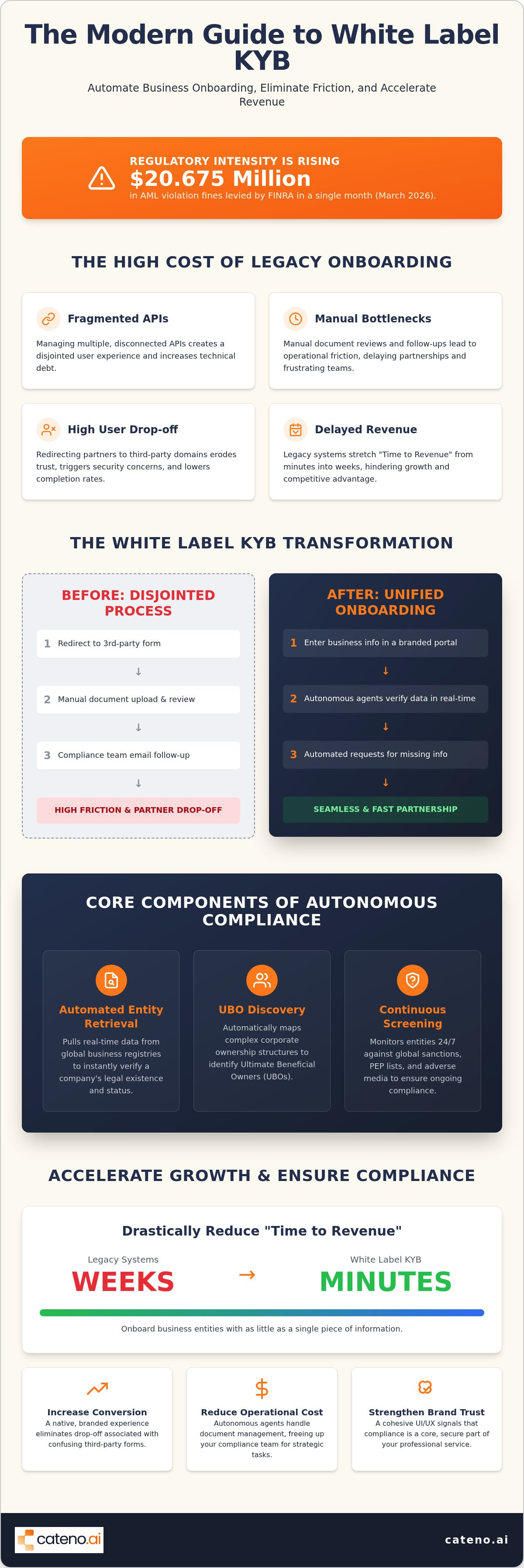
In March 2026 alone, FINRA levied $20.675 million in fines for AML violations, a staggering jump that signals a new era of regulatory intensity. With the recent abolition of the FinCEN beneficial ownership database for U.S. companies, the burden of verification has shifted entirely back to your internal systems. You know that every manual document review and non-branded form represents a potential lost partner. Deploying a high-performance white label KYB solution is the most effective way to bridge this gap, ensuring your compliance infrastructure remains robust without sacrificing the user experience.
You've likely struggled with the technical debt of managing fragmented APIs and the operational bottlenecks of verifying complex entity structures. It's frustrating to watch "Time to Revenue" stretch into weeks because of legacy systems that can't keep pace with modern demand. This guide provides a strategic roadmap to automate these workflows using a unified onboarding portal that looks and feels native to your platform. We'll examine how to utilize autonomous compliance agents and real-time bank account verification to eliminate friction, providing a seamless path from initial contact to a fully verified, revenue-generating partnership.
Key Takeaways
- Learn how to implement a white label KYB solution that converts fragmented verification forms into a unified, branded onboarding portal to eliminate user drop-off.
- Discover how to leverage autonomous compliance agents to automate document management and significantly reduce manual operational bottlenecks.
- Identify the critical criteria for evaluating KYB infrastructure, focusing on the balance between global data coverage and API-first integration flexibility.
- Master a logical implementation strategy that maps existing friction points to high-performance, automated verification workflows.
- Understand the technical path to accelerating "Time to Revenue" by onboarding business entities with as little as a single piece of information.
What is a White Label KYB Solution?
A white label KYB solution is a sophisticated, brandable infrastructure that allows financial institutions and B2B platforms to host business verification services under their own corporate identity. It's more than a visual overlay; it's a strategic decision to maintain the continuity of the user experience while leveraging a high-performance compliance engine. While many providers offer a simple API that requires significant development resources to integrate, a true white label platform provides a full-stack self-service onboarding gateway. This turnkey approach eliminates the technical debt associated with building custom front-end interfaces for data collection.
This infrastructure is built on the foundations of Know Your Customer (KYC) regulations, but it extends those principles to the corporate level. The evolution of this technology has moved toward "Autonomous Compliance." In this model, the system doesn't just collect data. It orchestrates the entire verification process using intelligent agents that handle document management and risk assessment without manual intervention. This shift allows your team to move from being data processors to strategic decision-makers, focusing on growth rather than administrative friction.
The Core Components of a KYB Platform
Modern KYB systems must do more than verify a business name. They require a multi-layered approach to ensure data integrity and regulatory adherence. A robust white label KYB solution includes:
- Automated Entity Retrieval: Pulling real-time data from global registries to verify the legal existence and status of a business.
- UBO Discovery: Automatically mapping complex ownership structures to identify Ultimate Beneficial Owners and significant controllers.
- Continuous Screening: Monitoring entities against global sanctions lists, Politically Exposed Persons (PEP) databases, and adverse media.
Why Branding Matters in B2B Onboarding
Trust is the primary currency of B2B relationships. Redirecting a high-value partner to a third-party domain during the sensitive onboarding stage creates unnecessary friction and can trigger security concerns. A cohesive UI/UX reduces user anxiety by signaling that the compliance process is a core, secure part of your professional service.
Coherent branding also increases conversion rates. When the verification portal looks and feels native to your platform, partners are more likely to complete the process quickly. This eliminates the high drop-off rates often associated with disjointed, non-branded compliance forms. By establishing professional authority from the first touchpoint, you ensure that the onboarding experience reflects the high standards of your enterprise.
How White Label KYB Solutions Function
A high-performance white label KYB solution operates as a seamless bridge between a user-facing interface and a sophisticated logic engine. This integration ensures that the branded customer portal isn't merely a cosmetic layer. It's a functional extension of your core infrastructure. When a business entity begins the onboarding process, the backend engine initiates a series of automated workflows. These workflows aren't static; they adapt in real-time based on the entity type, jurisdiction, and risk profile identified during the initial data entry.
The orchestration relies heavily on autonomous compliance agents. These agents manage the complexities of document collection and verification without requiring constant human oversight. For example, if a provided document is illegible or expired, the agent communicates directly with the user via the portal to request a replacement. This creates a closed-loop system that maintains momentum. It eliminates the need for compliance officers to manually send follow-up emails, which significantly reduces the operational friction that often delays new partnerships.
The Workflow Orchestration Engine
The heart of a modern system is its ability to handle complex conditional logic. Different business structures require varying levels of due diligence. A Customizable Workflow Engine allows you to define these parameters once and deploy them across all onboarding channels. This engine powers the self-service onboarding gateway, enabling partners to navigate the compliance process independently. It ensures that low-risk entities move through the system rapidly while high-risk profiles are flagged for deeper review. This dynamic approach moves away from the linear, manual-heavy processes that often lead to partner frustration and high drop-off rates.
Data Integrity and Verification Reports
Data accuracy is maintained through the generation of Advanced Verification Reports. These reports consolidate information from hundreds of global registries, sanctions lists, and adverse media sources into a single, actionable document. Rather than managing fragmented data points, your compliance team receives a holistic view of the entity's risk status. The system also provides a centralized audit trail, which is essential for demonstrating program effectiveness during regulatory examinations. Continuous monitoring ensures that this data remains current, triggering re-screening protocols whenever a significant change in the business's status is detected. If you're looking to eliminate technical debt in your onboarding process, you can consult with our team to design a tailored workflow.
Evaluating the Best KYB Solutions: Key Criteria
Selecting a high-performance white label KYB solution requires a shift from viewing compliance as a static checklist to seeing it as a dynamic orchestration of data. The primary differentiator between legacy systems and modern platforms is the depth of their structural integration. Your focus should remain on the removal of redundancy and the automation of complex workflows. A solution that merely provides a branded interface without a robust backend engine will only add to your technical debt. It's a strategic mistake to prioritize aesthetics over the underlying logic that drives data integrity.
Data coverage remains the foundation of any enterprise-ready system. You must assess whether the platform draws from global registries or relies on limited, localized databases. In a globalized economy, the ability to verify entities across multiple jurisdictions in real-time is essential. The system must also handle the technical heavy lifting of Ultimate Beneficial Owner (UBO) discovery autonomously. If your compliance team still spends hours manually mapping ownership structures, the solution hasn't truly solved the operational bottleneck. Efficiency is found in the transition from manual document review to autonomous verification agents.
The Importance of Bank Account Verification
A KYB profile is fundamentally incomplete without a verified financial footprint. Integrating bank account validation into your onboarding process is the most effective way to prevent sophisticated B2B fraud. By utilizing a bank account validation API, you can confirm that the entity's stated financial details match their legal identity before the first transaction occurs. This creates a seamless transition from compliance verification to active partnership. It ensures that trust is established not just through documentation, but through verified financial capability, reducing the risk of payment fraud from the outset.
Scalability and Technical Debt
Many organizations fall into the trap of building "Frankenstein" stacks. These are disconnected compliance tools that require constant manual synchronization and technical oversight. When evaluating the total cost of ownership, you must weigh the speed of a white label implementation against the long-term maintenance of a custom-built system. A scalable platform should offer the flexibility to expand across various industries without requiring a complete overhaul of your existing infrastructure. By prioritizing an API-first approach with low-code portal options, you ensure that your compliance stack remains agile and secure as your partner network grows.
Implementing Your White Label KYB Strategy
Deploying a high-performance white label KYB solution requires a methodical approach that aligns your regulatory obligations with your brand’s user experience standards. You must first map your existing onboarding friction points, specifically focusing on manual bottlenecks that delay entity approval. Once these are identified, you can configure your branded customer portal to mirror your corporate identity, ensuring a seamless transition from your main platform to the verification gateway. This alignment is critical for maintaining the "calm confidence" that high-value partners expect from an enterprise-grade service.
The technical implementation then moves toward defining your risk-scoring logic and integrating autonomous compliance agents. These agents act as the steady hand in your system, managing document intake and initial screening without human intervention. Before moving to production, it’s vital to execute end-to-end testing in a sandbox environment to verify that every trigger and conditional path functions as intended. This structured progression ensures that your compliance infrastructure is both reliable and secure from day one.
Branding and User Interface Customization
Your onboarding portal should be an indistinguishable part of your ecosystem. By applying custom CSS, logos, and utilizing custom domains, you eliminate the security concerns often triggered by third-party redirects. Mobile responsiveness is equally essential, as business owners frequently complete verification steps on-the-go. A polished UI/UX doesn't just look professional; it reinforces your authority and reduces the anxiety naturally associated with sharing sensitive corporate data. This cohesive environment is a primary driver for increasing conversion rates and reducing partner drop-off.
Defining Custom Workflows
The core of an efficient strategy lies in the ability to create specific paths for different entity types. Low-risk businesses should move through an accelerated track, while high-risk entities are automatically routed for enhanced due diligence. A sophisticated workflow is one that adapts in real-time to user input. This adaptability allows the system to leverage automated triggers for secondary document requests if the initial data suggests a complex ownership structure. By automating these decision-making branches, you ensure that your compliance team only intervenes when a strategic judgment is truly required. If you're ready to modernize your onboarding infrastructure, you can speak with a strategic consultant to begin your implementation.
Cateno: The Future of Autonomous Business Onboarding
Cateno acts as the strategic orchestrator for enterprises seeking to scale their B2B operations without the burden of legacy technical debt. While traditional methods rely on disjointed processes, Cateno provides a unified white label KYB solution that prioritizes data integrity and speed. One of the platform’s most significant breakthroughs is the ability to onboard entities using a single piece of information, such as a Business Name or Tax ID. This capability transforms the initial touchpoint from a complex data entry task into a frictionless entry point for new partners, significantly reducing the drop-off rates that plague non-branded verification forms.
Efficiency is further amplified through the use of autonomous compliance agents. These agents handle the heavy lifting of document management and UBO discovery, ensuring that your compliance team only engages with high-risk cases that require human judgment. By removing the administrative burden of manual reviews, Cateno allows businesses to accelerate their "Time to Revenue" while maintaining a robust, audit-ready posture. It's a sophisticated remedy to the systemic friction found in modern operational environments, offering clarity where there is typically confusion.
Beyond KYB: A Comprehensive Onboarding Ecosystem
Cateno doesn't just verify businesses; it orchestrates a complete onboarding ecosystem. By combining KYC, KYB, and bank account validation in a single engine, the platform provides a holistic view of every new entity. This integrated approach is particularly valuable for high-growth marketplaces and fintech platforms that require rapid, secure scaling across multiple jurisdictions. You can explore Cateno Pricing to find a scalable enterprise solution that fits your specific volume and risk requirements.
The Cateno Advantage: Orchestration Over Integration
The primary flaw in many compliance stacks is the reliance on fragmented API calls that fail to communicate with one another. Cateno solves this through its unified workflow engine, which manages the entire lifecycle of a business relationship. Advanced verification reports provide ongoing monitoring and long-term risk management, ensuring that your data remains accurate as global regulations evolve. For a deeper look at how this technology functions, read more about The Sophisticated Business Onboarding Workflow Engine. This orchestration-first mindset ensures that your platform remains agile, secure, and ready for the future of global commerce.
Orchestrating the Future of Business Verification
The transition from fragmented compliance APIs to a unified orchestration engine is no longer a luxury. It's a strategic necessity for enterprise growth. By deploying a sophisticated white label KYB solution, you eliminate the technical debt and operational friction that traditionally stall new partnerships. You've seen how a branded, self-service gateway maintains trust while autonomous compliance agents handle the heavy lifting of document management and UBO discovery. This shift allows your team to move beyond administrative bottlenecks and focus on high-value decision-making.
Cateno provides the structural integrity required to scale in a complex regulatory environment. With the ability to onboard entities using as little as a single piece of information and the support of 24/7 autonomous agents, your organization can significantly reduce its time to revenue. Our advanced verification reports ensure that your risk management remains proactive rather than reactive. It's time to replace systemic friction with streamlined efficiency and technical precision.
Request a demo of Cateno’s White Label KYB Platform today to see how we can transform your onboarding infrastructure. We're ready to help you build a more secure and scalable future.
Frequently Asked Questions
What is the difference between KYC and KYB?
KYB is the process of verifying a business entity, whereas KYC identifies the individual persons behind or within that business. While KYC focuses on personal identity documents and individual risk, KYB requires accessing corporate registries to confirm legal standing and operational history. Cateno's platform allows you to manage both requirements within a unified engine, ensuring that you understand both the business you are partnering with and the individuals who control it.
Can I customize the white label portal to match my brand’s specific colors and fonts?
You can fully customize the white label KYB solution to reflect your corporate identity through CSS, logos, and custom domains. The branded customer portal allows for the adjustment of colors, fonts, and layouts to ensure the onboarding experience feels native to your platform. This visual consistency is vital for maintaining professional authority and reducing user anxiety. By matching your brand’s specific aesthetics, you eliminate disjointed third-party redirects that often cause partner drop-off.
How does a white label KYB solution handle UBO discovery?
The platform automates Ultimate Beneficial Owner (UBO) discovery by pulling real-time data from global corporate registries and legal databases. Instead of relying on manual document submission, the system identifies individuals with significant control or ownership stakes automatically. This process maps complex corporate hierarchies and screens identified parties against sanctions and PEP lists. It removes the operational bottleneck of manual ownership mapping, providing a clear, audit-ready view of an entity’s control structure within seconds.
Does the platform support international business verification?
Cateno supports international business verification by accessing a vast network of global registries and localized databases. The workflow engine adapts to the specific regulatory requirements and documentation standards of different jurisdictions. This ensures that you can onboard partners across multiple countries without managing separate compliance stacks for each region. The system provides real-time data retrieval and screening, ensuring that international entities meet the same rigorous standards as domestic businesses while maintaining a streamlined user journey.
What are autonomous compliance agents and how do they work?
Autonomous compliance agents are intelligent system components designed to manage the lifecycle of document collection and risk assessment without human intervention. They work by monitoring onboarding progress and automatically requesting missing or expired documents from users via the branded portal. These agents handle routine verification tasks 24/7, allowing your compliance team to focus exclusively on high-risk exceptions. By automating these repetitive workflows, the agents significantly reduce the time required to verify and onboard new business partnerships.
Is it possible to integrate bank account validation with KYB checks?
Integrating bank account validation with your KYB checks is a standard feature of the Cateno platform. By utilizing our bank account validation API, you can confirm that an entity’s stated financial details match their verified legal identity in real-time. This prevents sophisticated B2B fraud and ensures that trust is established before the first transaction occurs. Combining these checks into a unified engine provides a more holistic view of risk than managing disconnected compliance tools or fragmented data sources.
How long does it typically take to deploy a white label KYB solution?
Deployment timelines for an enterprise-ready white label KYB solution typically range from a few weeks to a couple of months, depending on the complexity of your custom workflows. Unlike building a compliance stack from scratch, which can take a year or more, our platform provides a turnkey infrastructure that's ready for immediate configuration. This includes setting up the branded portal, defining risk-scoring logic, and integrating the API into your existing systems to ensure a rapid move to production.
Can I use a white label solution if I have highly specific compliance requirements?
The platform is designed to accommodate highly specific compliance requirements through its Customizable Workflow Engine. You can define unique risk-scoring logic and conditional paths that align with your internal policies or industry-specific regulations. Whether you need to trigger additional document requests for certain industries or set custom thresholds for PEP screening, the system provides the flexibility to adapt. This ensures that your automated processes remain fully compliant with your specific governance standards without requiring constant manual oversight.


