

A generic compliance link is the fastest way to signal to a high-value partner that they're just another ticket in your queue. While security is non-negotiable, the fragmented experience of jumping between disconnected tools often leads to high drop-off rates and operational bottlenecks. Many organizations find that their partner lifecycle management software lacks the visual cohesion needed to build trust during the critical KYB phase. You've likely felt the frustration of manual document collection stalling your growth, turning what should be a milestone into a bureaucratic hurdle.
This article demonstrates how top-tier branded onboarding portals transform complex compliance into a seamless, trust-building experience for partners and customers alike. You'll learn how to reduce time-to-onboard and automate KYB verification without losing data integrity or your brand's unique identity. We'll examine specific portal examples that act as a strategic orchestrator for your ecosystem, moving you away from manual friction toward a streamlined, enterprise-ready workflow. By the end, you'll understand how to leverage autonomous compliance agents to maintain a steady hand in even the most complex regulatory environments.
Key Takeaways
- Establish professional authority by utilizing a branded, self-service gateway that maintains visual consistency and reduces partner abandonment during the KYC/KYB phase.
- Deploy sophisticated partner lifecycle management software to leverage a customizable workflow engine that adapts the onboarding journey to specific entity types and risk profiles.
- Examine how leaders in Fintech and B2B marketplaces scale complex regulatory document collection while maintaining a high-end, boutique experience for their partners.
- Optimize operational efficiency by mapping data touchpoints and utilizing autonomous compliance agents to remove manual bottlenecks from the verification process.
- Reduce time-to-onboard by prioritizing a frictionless user experience that empowers partners to manage their own document uploads and track verification status in real time.
The Strategic Role of a Branded Customer Onboarding Portal
A branded onboarding portal is a secure, self-service gateway designed for high-integrity entity intake. It serves as the primary touchpoint where complex regulatory requirements meet user experience. By centralizing the customer onboarding process within a unified environment, businesses can eliminate the friction inherent in fragmented legacy systems. This architecture transforms compliance from a bureaucratic hurdle into a professional introduction that reinforces your organization's technical competence.
The shift from manual document handling to robust partner lifecycle management software represents a fundamental evolution in operational strategy. Organizations no longer rely on chasing PDF attachments through unencrypted email chains. Instead, they utilize a structured environment that ensures data integrity from the first interaction. This transition allows compliance departments to focus on high-level risk assessment rather than administrative data entry. A unified portal acts as a definitive source of truth, providing clarity for both internal teams and external partners.
Trust as a Functional Requirement
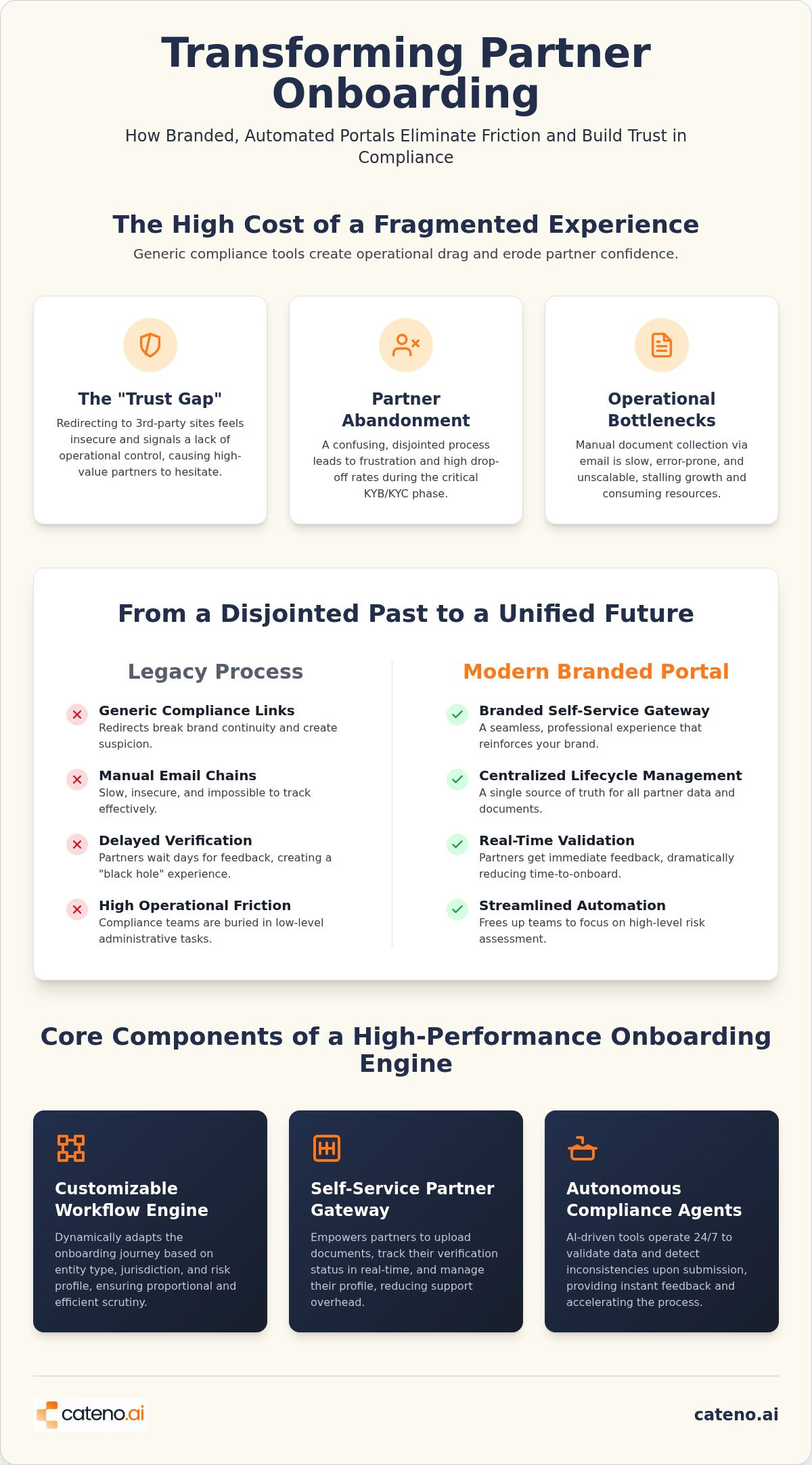
Sophisticated partners view a fragmented onboarding experience as a red flag for systemic risk. When a partner is redirected to a generic, third-party compliance site, the sudden change in visual identity triggers caution. Maintaining brand consistency throughout the KYC and KYB phases reassures partners that their sensitive data remains within a controlled, secure ecosystem. This visual continuity is not merely aesthetic; it is a signal of operational stability. The "Trust Gap" in digital entity verification is the psychological distance created when a brand fails to maintain visual and operational continuity during high-stakes data exchanges.
Beyond the Login: The Full Lifecycle View
Successful onboarding is the start of a partnership, not the end. Modern partner lifecycle management software facilitates this by providing a branded customer portal where partners can manage their profiles and track their own status in real time. This self-service model is essential for scalability because it removes the need for 1:1 email-based document collection. As the relationship matures, the system supports ongoing monitoring and advanced verification reports to ensure continuous compliance. By integrating these tools into a single interface, companies can manage a growing ecosystem without increasing their administrative headcount. Precision in these early stages sets the tone for long-term reliability and growth.
Core Components of a Sophisticated Onboarding Engine
A high-performance onboarding engine functions as the central nervous system of modern partner lifecycle management software. It isn't a static collection of web forms; it's a dynamic orchestration layer that adapts in real time. By utilizing a customizable workflow engine, organizations can tailor the intake journey based on the specific entity type and risk profile of each partner. This ensures that a local sole proprietorship doesn't face the same complex scrutiny as a multinational corporation, removing unnecessary friction from the start.
Self-service gateways empower partners by giving them direct control over their data and documentation. Instead of waiting for email updates, partners can upload documents and track their verification status through a transparent dashboard. Integrating bank account verification early in this process further streamlines operations by validating payment pathways before the first transaction occurs. This proactive approach prevents future payment failures and establishes a foundation of technical reliability. If you're ready to modernize your intake process, you can speak with an automation expert today.
The most significant advancement in this space is the deployment of autonomous compliance agents. These AI-driven tools operate within the portal to validate data and detect inconsistencies the moment a partner submits information. Unlike traditional systems that treat verification as a separate, manual step, these agents provide immediate feedback. This real-time validation prevents the "black hole" experience where partners submit documents and wait days for a response, significantly reducing the total time-to-onboard.
Automated KYC and KYB Integration
Sophisticated portals manage the complex transition from individual (KYC) to business (KYB) verification within a single session. This is achieved through "one-click" entity lookup, where a partner provides a single piece of information, such as a tax ID, and the system automatically populates the remaining corporate data. Understanding these identifiers is crucial; for instance, Számlázó Programom offers detailed guidance on tax ID structures for businesses navigating administrative compliance. This automation ensures data integrity by identifying Ultimate Beneficial Owners (UBOs) through verified global registries, eliminating the errors typically found in manual entry. It's a precise, enterprise-ready method for establishing a secure partner ecosystem.
Transparency is essential for maintaining professional authority during the compliance phase. The portal should provide different levels of visibility: partners see their progress and pending requirements, while administrators access comprehensive, audit-ready data. You can explore our advanced verification reports to see how these systems generate detailed logs without manual intervention. These reports provide a definitive audit trail, ensuring that every compliance decision is backed by verifiable data points and is ready for regulatory review at any moment.
Industry-Specific Branded Onboarding Portal Examples
Generic templates often fail when applied to highly regulated sectors. High-performance partner lifecycle management software must adapt to the specific compliance burdens of each industry to remain effective. Whether it's the stringent AML requirements of banking or the complex tax documentation of global marketplaces, the portal serves as a specialized entry point that maintains professional authority. By tailoring the experience, organizations ensure that the intake process feels like a natural extension of their enterprise operations rather than a disjointed administrative task.
Example 1: The High-Stakes Financial Gateway
In fintech and banking, the intake process often requires highly sensitive information. A portal designed for this sector prioritizes bank account verification and immediate AML screening. When a partner encounters a professional, branded interface, the friction of invasive data requests is significantly reduced. They're more likely to complete the process because the environment signals security and technical competence. The use of autonomous compliance agents here is critical. They process high volumes of financial data without the delays of manual review, ensuring that time-to-onboard remains competitive while maintaining total data integrity.
Example 2: The Vendor Marketplace Portal
For B2B marketplaces, the primary challenge is one of scale. These platforms often need to onboard hundreds of vendors daily while maintaining a high-end, boutique feel. A branded portal allows these organizations to collect tax documents and business licenses automatically through a self-service gateway. This removes the administrative burden from internal teams, allowing them to focus on vendor relationships rather than paperwork. It's a strategic way to grow an ecosystem without increasing headcount. You can see industry-specific solutions to understand how different sectors balance these competing needs for speed and precision.
In the logistics and supply chain sector, the portal manages complex entity verification for global freight partners across multiple jurisdictions. This requires a system that can handle diverse document types without losing structural integrity. Similarly, SaaS platforms use branded gateways to transition users from a simple trial to a verified enterprise partner. By integrating these checks early, SaaS companies ensure that their enterprise clients are fully vetted before they reach the contracting stage. They use partner lifecycle management software to orchestrate the entire transition seamlessly, ensuring every partner is enterprise-ready from day one.
Best Practices for Implementing Partner Lifecycle Management Software
Implementing a sophisticated onboarding system requires more than simply selecting a vendor. It demands a strategic orchestration of your existing data touchpoints and compliance requirements. Before you deploy partner lifecycle management software, you must map your entire workflow to identify every regulatory hurdle and internal data need. This mapping ensures that your customizable workflow engine is configured to capture the right information at the right time, preventing the operational bottlenecks that occur when data is requested piecemeal.
Prioritizing the user experience is a functional necessity, not a luxury. You should minimize the number of fields a partner must fill by utilizing automated entity lookups and data pre-population. When a partner does need to provide information, the portal must offer real-time feedback. If a document is invalid or a field is missing, the system should flag the error immediately within the interface. This transparency prevents the frustration of "silent failures" and ensures that the intake process remains steady and predictable. To ensure your system remains enterprise-ready, you can schedule a technical consultation with our team.
Integration with your existing technology stack is non-negotiable. Your portal must communicate seamlessly with your CRM and compliance engine to maintain a single source of truth. Beyond the initial intake, you must plan for ongoing monitoring. Set up automated triggers for document expiration and re-verification to ensure that your partner ecosystem remains compliant without requiring manual oversight. This proactive stance preserves the structural integrity of your data over the long term.
Reducing Technical Debt in Onboarding
"Bolting on" verification tools to a legacy portal often creates significant operational liability. This approach leads to fragmented data silos and a disjointed user experience that is difficult to scale. Instead, a cloud-based, API-first approach to partner lifecycle management provides the flexibility needed to adapt to changing regulations. Technical debt in manual compliance workflows manifests as a compounding accumulation of unverified data and fragmented spreadsheets that require exponentially more labor to maintain over time. Transitioning to a unified platform removes this redundancy and secures your operational future.
The Self-Service Advantage
A truly effective branded portal functions as a comprehensive resource for the partner. By integrating a "Help Center" or "Knowledge Base" directly into the gateway, you provide partners with the clarity they need to complete complex tasks independently. Providing clear, real-time status updates significantly reduces the volume of support tickets, as partners no longer need to contact your team for progress reports. This self-service model empowers partners while freeing your internal resources for higher-value activities. To understand how to scale these capabilities, you can Check our platform pricing for various enterprise needs.
Cateno: Orchestrating the Next Generation of Onboarding Portals
Cateno provides a sophisticated remedy for the operational hurdles inherent in legacy systems. By utilizing a customizable workflow engine, the platform serves as the structural backbone for high-performance partner lifecycle management software. It moves organizations beyond the constraints of manual document handling, offering a unified environment where technical competence meets regulatory precision. This architecture ensures that every intake journey is tailored to the specific risk profile of the entity, removing the systemic friction that often stalls growth.
The integration of autonomous compliance agents is the defining feature of this next-generation approach. These agents remove the burden of manual document review by validating data with surgical precision in real time. This ensures that your compliance team acts as a strategic orchestrator rather than an administrative bottleneck. As of September 2026, the regulatory environment has become increasingly complex with new state-level privacy mandates. Moving to a unified compliance and onboarding platform is no longer optional for firms seeking to maintain data integrity across multiple jurisdictions. Building a self-service onboarding gateway with Cateno allows your business to scale without the proportional increase in overhead traditionally required for entity verification.
Enterprise-Ready Customization
The Branded Customer Portal feature set is designed to project professional authority from the first interaction. It allows your organization to maintain a "steady hand" voice, reassuring partners during technical intake by providing a clear, logical progression through compliance requirements. A core capability of the engine is the power to onboard any entity with a single piece of information. This level of efficiency transforms the initial touchpoint into a seamless, trust-building experience that signals your organization is ready for enterprise-level collaboration.
Taking the Next Step in Partner Management
Transitioning from a system characterized by systemic friction to one of streamlined efficiency requires a definitive resolution. Cateno engineered this platform to replace the "bolted-on" tools that create long-term technical debt and fragmented data silos. By choosing a cloud-based, API-first solution, you secure your operational future and ensure your partner lifecycle management software remains adaptable to future shifts in the global market. To see this orchestration in action, you can explore The Sophisticated Business Onboarding Workflow Engine or request a technical demo to begin your transition toward an automated, branded onboarding experience.
Orchestrating Your Operational Future
Transitioning from manual, fragmented intake to a unified, branded environment represents the definitive resolution to modern growth challenges. We've explored how visual consistency and automated workflows remove the systemic friction that often leads to high partner abandonment. By leveraging sophisticated partner lifecycle management software, you maintain professional authority while scaling your ecosystem with surgical precision. This approach ensures that your compliance journey acts as a strategic orchestrator of trust rather than a bureaucratic hurdle.
Cateno's platform empowers your organization to onboard any entity with a single piece of information, utilizing autonomous compliance agents to handle the complex document management traditionally prone to error. This structural integrity allows you to focus on high-value relationships while the system maintains your regulatory standards. Ready to eliminate operational bottlenecks and secure your data integrity? Request a Demo of Cateno’s Branded Onboarding Portal to see how our enterprise-ready solutions can transform your partner intake. Your path to streamlined efficiency is within reach.
Frequently Asked Questions
What is a branded customer onboarding portal?
A branded customer onboarding portal is a secure, self-service gateway that allows entities to submit sensitive documentation within a unified visual environment. Unlike generic third-party links, these portals maintain your organization's professional authority throughout the intake process. This consistency is critical during high-stakes KYC and KYB phases, as it signals operational stability. By centralizing document collection and status tracking, the portal serves as a definitive source of truth for both compliance teams and partners.
How does partner lifecycle management software differ from a standard CRM?
Standard CRMs are engineered primarily for managing sales pipelines and communication history. In contrast, partner lifecycle management software is a specialized orchestrator designed to handle the technical complexities of regulatory compliance. It manages automated identity verification, bank account validation, and ongoing risk monitoring. While a CRM tracks a relationship, this software secures the structural integrity of your partner ecosystem by automating the high-stakes data exchanges that CRMs aren't equipped to handle.
Can I automate KYB verification within a branded portal?
Yes, you can fully automate KYB verification within a branded portal by utilizing a customizable workflow engine. Cateno enables you to onboard any entity with a single piece of information, such as a tax ID, by automatically retrieving corporate data from global registries. This process identifies Ultimate Beneficial Owners (UBOs) and screens against AML lists without manual intervention. Automation ensures that your compliance agents focus on high-level risk assessment rather than tedious data entry.
What are the security requirements for a self-service compliance gateway?
A self-service compliance gateway must meet rigorous enterprise-ready security standards to protect sensitive partner data. This includes encrypted document management, secure API integrations, and strict data integrity protocols. As of 2026, portals must also comply with specific state-level privacy updates in the United States, such as California’s "Delete Act." Maintaining a secure gateway ensures that your organization avoids the operational liability and technical debt associated with fragmented legacy compliance stacks.
How do branded portals reduce partner drop-off rates?
Branded portals reduce partner drop-off rates by eliminating the "Trust Gap" created by fragmented onboarding experiences. When a partner is redirected to a disconnected third-party site, the sudden shift in branding often triggers caution and abandonment. A unified, branded portal provides a seamless transition that reinforces your technical competence. Real-time feedback and clear status updates further reduce friction, ensuring partners understand exactly what is required to complete their verification without unnecessary delays.
Is it possible to integrate bank account verification into the onboarding workflow?
Integrating bank account verification into the onboarding workflow is a core capability of Cateno’s platform. By validating payment pathways during the initial intake, you establish a foundation of technical reliability before the first transaction occurs. This proactive step prevents future payment failures and streamlines the transition from a verified partner to an active vendor. It ensures that every entity in your ecosystem is enterprise-ready and capable of secure financial interaction from day one.
What role do autonomous compliance agents play in partner onboarding?
Autonomous compliance agents act as the real-time validation layer within the onboarding portal. They automatically review submitted documents and data points for inconsistencies, removing the need for manual document management. These agents provide immediate feedback to partners, flagging missing or invalid information instantly. This automation significantly reduces the time-to-onboard by eliminating the "black hole" experience where partners wait days for a manual compliance officer to review their submission.
How long does it take to implement a customizable onboarding engine?
The implementation timeline for a customizable onboarding engine depends on the complexity of your specific compliance touchpoints and data integrations. However, cloud-based, API-first platforms are designed for rapid deployment compared to legacy software. By mapping your workflow before implementation, you can identify every data requirement and configure the engine to remove operational friction immediately. This modern approach avoids the long-term technical debt created by "bolting on" verification tools to outdated internal systems.


