

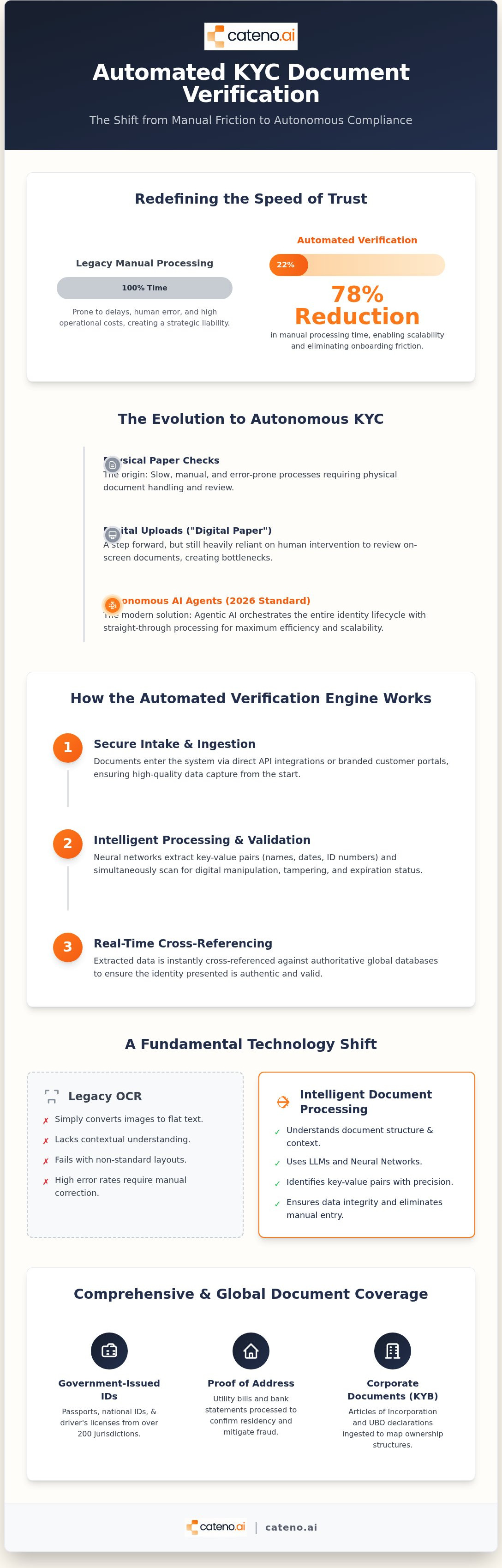
Automated KYC is no longer just about reading documents; it's about autonomous agents orchestrating the entire identity lifecycle. While manual processing once felt like an unavoidable operational tax, the shift toward automated kyc document verification has fundamentally redefined the speed of trust. Research from 2026 indicates that digital verification can reduce manual processing time by 78%. Sticking to legacy workflows isn't just inefficient; it's a strategic liability. You likely recognize the frustration of onboarding delays that drive customer drop-off and the persistent fear that a single human error might lead to regulatory fines.
We agree that maintaining 100% audit-ready compliance shouldn't come at the expense of your scalability. This guide explores how to transition from systemic friction to a streamlined, automated document verification engine that grows with your enterprise. We'll examine the 2026 regulatory shifts, including the end of FinCEN's beneficial ownership reporting, and show you how to leverage autonomous agents to lower your cost per onboarded customer while eliminating the technical debt of manual entry.
Key Takeaways
- Transition from legacy manual reviews to 2026-standard straight-through processing to eliminate systemic friction in your onboarding pipeline.
- Learn how automated kyc document verification leverages neural networks to extract key-value pairs, ensuring data integrity while scaling with business demand.
- Analyze the operational ROI of automation, focusing on how reduced onboarding abandonment rates directly lower your overall customer acquisition costs.
- Follow a strategic framework to define your risk appetite and deploy a customizable workflow engine that integrates directly with your enterprise CRM.
- Discover how autonomous compliance agents and branded customer portals create a self-service gateway that keeps your organization 100% audit-ready.
What is Automated KYC Document Verification?
Automated KYC document verification represents the transition from human-led, error-prone reviews to a system of straight-through processing. At its core, it's the application of artificial intelligence to intake, validate, and verify identity credentials without manual intervention. By 2026, the global market for these automated systems is projected to reach $7.8 billion, reflecting a massive industry shift toward operational efficiency. While legacy systems required compliance officers to squint at blurry scans, modern engines utilize neural networks to perform instant data extraction and authenticity checks.
The technical foundation has moved beyond simple Optical Character Recognition (OCR). Legacy OCR merely converted images to text, often failing when faced with non-standard fonts or complex layouts. Today's standard is intelligent document processing led by Large Language Models (LLMs). These models understand context, allowing them to identify key-value pairs like expiration dates or document numbers with high precision. They don't just read text; they interpret the document's structure to ensure every data point is captured correctly. This process involves three core components: automated data extraction, authenticity checking for security features, and cross-referencing against global databases.
The Evolution of KYC: From Paper to AI Agents
The journey began with physical paper checks and moved to digital uploads. However, even digital uploads were often just "digital paper" that still required a human to look at a screen. To understand What is Know Your Customer (KYC) in 2026, one must look at Agentic AI. These autonomous agents handle complex, multi-page document bundles, cross-referencing information across different files to ensure consistency. This technology supports global KYC verification standards, allowing businesses to scale across borders without bloating their compliance teams. Research shows that digital verification can reduce manual processing time by 78%, making it the only viable path for high-growth enterprises.
Key Document Types Handled by Automation
Modern automation engines are designed for versatility. They must handle a wide array of credentials to accommodate a global user base. Automated kyc document verification now covers a spectrum of documents that previously required specialist knowledge to verify.
- Government-issued IDs: Passports, national IDs, and drivers licenses from over 200 jurisdictions are recognized and validated instantly.
- Proof of Address: Utility bills and bank statements are processed with secondary validation to confirm residency and mitigate fraud.
- Corporate Documents: For KYB workflows, systems ingest Articles of Incorporation and UBO declarations to map complex ownership structures automatically.
This breadth of coverage ensures that automated kyc document verification remains a robust defense against sophisticated fraud while maintaining a frictionless experience for legitimate users.
How the Automated Verification Engine Works
The engine begins with a seamless intake phase. Documents enter the system through direct API integrations or branded customer portals. This initial touchpoint is critical. It sets the stage for automated kyc document verification by ensuring high-quality data capture from the outset. Once ingested, the engine moves through a methodical progression: extraction, validation, and real-time cross-referencing. This structured approach replaces the "manual tax" of traditional reviews with a high-speed, autonomous workflow that identifies key-value pairs like names and ID numbers in seconds.
Validation occurs simultaneously. The system scans for digital manipulation, such as photoshopping or document tampering, while checking the credential's expiration status. Finally, the extracted data is cross-referenced against authoritative global databases. This multi-layered process ensures that the identity presented is both authentic and valid before any onboarding decision is finalized. If you're looking to optimize these specific touchpoints, you might speak with a compliance specialist to map your current workflow.
Intelligent Data Extraction and OCR
Modern engines have moved beyond "flat" OCR. They now utilize neural networks to understand document context. This intelligence allows the system to process low-quality scans, skewed images, and documents in multiple languages without losing accuracy. By aligning with NIST's digital identity framework, these systems provide a standardized approach to identity assurance. Every extraction generates a confidence score. High-confidence results trigger straight-through processing, while lower scores are flagged for secondary review, ensuring that automated kyc document verification remains both fast and precise.
Anti-Fraud and Liveness Detection
Biometric liveness checks add a vital layer of security during the upload process. As users submit their documents, AI agents analyze the feed for signs of deepfakes or digital masks. This technology detects sophisticated manipulations that the human eye frequently misses. Liveness detection serves as a critical deterrent against synthetic identity fraud by ensuring the person behind the screen is a real, present human. By combining document validation with biometric analysis, organizations create a robust defense that scales without increasing the burden on manual review teams.
The Operational ROI: Manual Review vs. Automation
Manual compliance processes act as an operational tax, siphoning resources that should fund growth. While legacy systems rely on human intervention to verify identity, an engine for automated kyc document verification offers linear scalability. Fintech teams using automation have seen verification times drop from over 18 minutes to under 30 seconds. This shift directly impacts customer acquisition costs (CAC) by removing the labor-intensive handoffs that characterize traditional stacks. Technical debt in onboarding isn't just a software issue; it's a financial drain that increases abandonment rates as customers lose patience with slow, repetitive data requests.
Accuracy remains a central point of the ROI debate. Human reviewers, despite their expertise, are susceptible to fatigue and cognitive bias, particularly during high-volume periods. Autonomous compliance agents, however, provide a tireless layer of scrutiny. They outperform manual teams by maintaining a consistent level of precision regardless of the time of day or the complexity of the document bundle. By replacing subjective human judgment with a data-driven engine, enterprises eliminate the "hidden cost" of errors that often lead to expensive remediation projects later in the customer lifecycle.
Reducing Onboarding Friction
Compressing a 20-minute manual check into a sub-60-second automated decision fundamentally changes the customer experience. This "instant" verification builds psychological trust, signaling that your organization is enterprise-ready and technically sophisticated. It removes the friction that typically causes high-value customers to abandon the process mid-way. For those managing corporate clients, a business onboarding workflow engine ensures that even complex B2B structures are verified with the same efficiency, preventing the drop-off typical of long-form applications.
Eliminating Human Error and Compliance Risk
Automation replaces subjective judgment with a standardized, bias-free evaluation framework. Every document undergoes the same rigorous scrutiny, ensuring that no red flags are overlooked due to human oversight. This process generates a comprehensive digital audit trail that records every decision, extraction, and validation step during the automated kyc document verification cycle. These trails are invaluable during regulatory inspections, providing clear evidence of your due diligence. Consistency in verification is the strongest defense against regulatory fines.
Implementing Automated KYC: A Strategic Framework
Implementing a robust framework for automated kyc document verification requires a methodical approach that balances regulatory rigor with user experience. Your first step involves defining a specific risk appetite and identifying the document types necessary for your specific industry and jurisdiction. This clarity prevents the collection of redundant data that doesn't add value but does increase friction. Following this, you must select a customizable workflow engine that integrates directly with your existing CRM to prevent data silos and ensure a single source of truth. Deployment focuses on a branded, self-service gateway where users can submit credentials securely within your own ecosystem. Once the system is live, configure autonomous agents to manage the "long tail" of compliance, such as handling exceptions and performing ongoing monitoring. Finally, use the data from your verification reports to iterate on your logic and improve straight-through processing rates.
Selecting the Right Verification Software
The choice of software determines the ceiling of your operational efficiency. Priority should be placed on high accuracy rates and extensive global coverage, particularly as you scale into new markets across 200+ jurisdictions. API flexibility allows your technical team to build custom triggers based on specific user behaviors or risk profiles. It's a critical component for long-term agility. Maintaining brand integrity is equally vital during this transition. Utilizing "White Label" portals ensures that the onboarding experience remains cohesive, reducing the trust gap that often leads to customer drop-offs. When evaluating pricing models for automated kyc document verification, look for structures that align with your growth trajectory to ensure long-term scalability without unpredictable cost spikes.
Managing Exceptions with Autonomous Agents
Traditional systems often stall when a document is rejected, requiring a manual reviewer to step in and diagnose the issue. Autonomous compliance agents transform this bottleneck through automated re-engagement. If a document is blurry or missing a back-side scan, the agent "reasons" through the failure and prompts the user for a specific fix in real-time. This shift from manual review to compliance orchestration allows your team to focus on high-level strategy rather than repetitive data entry. These agents can also handle secondary validation tasks, such as cross-referencing utility bills with government IDs without human intervention. If you're ready to modernize your intake process, you can schedule a platform walkthrough with our technical consultants.
Orchestrating Compliance with Cateno’s Workflow Engine
Cateno serves as the sophisticated remedy to the fragmentation that plagues traditional compliance stacks. While most providers treat document verification as an isolated OCR task, Cateno functions as a strategic orchestrator. By combining a self-service onboarding gateway with autonomous compliance agents, the platform transforms automated kyc document verification from a series of disjointed checks into a unified lifecycle. Cateno’s smart engine is designed for extreme efficiency; in many workflows, it enables onboarding with a single piece of information, triggering background agents to fetch and verify the remaining credentials autonomously.
This approach effectively eliminates the technical debt associated with legacy onboarding systems. Instead of managing a patchwork of vendors, enterprises gain a single, cohesive environment where every identity signal is analyzed in context. Cateno doesn't just extract data; it validates the integrity of the entire customer profile in real-time. This ensures that your compliance team moves from reactive manual reviews to proactive risk orchestration, maintaining a steady hand in an increasingly complex global environment.
A Single Source of Truth for Compliance
Complexity often arises from using multiple vendors for KYC, KYB, and bank account validation. Cateno eliminates this friction by consolidating these disparate streams into a single dashboard. This creates a unified source of truth where every data point is cross-referenced and stored securely. The branded customer portal is a critical component of this experience, ensuring the verification process feels like a native part of your product. This continuity preserves user trust and reduces the drop-off rates common with third-party redirects. Organizations can explore Cateno’s industry-specific solutions to see how this consolidation works in practice for their specific sector.
The Future-Proof Compliance Stack
As we navigate the 2026 regulatory environment, agility is paramount. With the permanent end of FinCEN’s beneficial ownership reporting under the Corporate Transparency Act as of August 11, 2026, and the rising requirement for EU Member States to offer EUDI Wallets, compliance teams need a stack that adapts instantly. Cateno is enterprise-ready, offering advanced verification reports that provide 100% audit-ready trails for these evolving standards. Automation is not merely a tool for cost reduction; it's a strategic orchestrator of growth that allows your business to scale without being tethered to manual labor. To move beyond systemic friction, streamline your onboarding with Cateno today.
Mastering the Shift to Autonomous Compliance
The transition from manual friction to a streamlined, automated engine is no longer a luxury for high-growth enterprises; it's a fundamental requirement. By deploying automated kyc document verification, organizations move beyond the operational tax of traditional data entry and embrace a future of straight-through processing. We've explored how autonomous agents and branded self-service portals work together to eliminate technical debt while maintaining 100% audit-readiness. This shift ensures your compliance stack remains resilient against the evolving regulatory landscape of 2026.
Cateno provides the technical competence and stability needed to manage this complexity at scale. With advanced verification reports and autonomous compliance agents for 24/7 intake, you can focus on strategic growth while our engine handles the intricacies of identity lifecycle management. It's time to replace systemic friction with high-performance efficiency that scales alongside your business. The path to a frictionless onboarding experience is clear, and the technology to achieve it is enterprise-ready.
Orchestrate your compliance with Cateno’s workflow engine today. We look forward to helping you build a more scalable, secure, and efficient onboarding pipeline.
Frequently Asked Questions
Is automated KYC document verification secure enough for banking?
Yes, automated systems are engineered to meet and exceed the security standards required by global financial institutions. By 2026, these engines utilize multi-layered validation protocols that align with NIST's digital identity framework. Cateno’s platform ensures that every document undergoes rigorous authenticity checking, including forensic analysis of security features. It's a level of scrutiny that provides a more consistent defense against sophisticated fraud than manual reviews, which are prone to human fatigue.
How long does the automated KYC document verification process take?
The automated kyc document verification lifecycle is designed for near-instant execution, typically concluding in under 30 seconds. This represents a significant optimization compared to the 18-minute industry average for manual document review. The engine performs intake, extraction, and database cross-referencing in a single, continuous flow. This rapid turnaround is essential for reducing onboarding drop-off, as modern customers expect a seamless transition from document submission to account access without human intervention.
Can automated KYC systems detect photoshopped or fake documents?
Modern AI agents are specifically designed to identify digital manipulations that the human eye can't detect. They analyze document metadata, look for pixel inconsistencies, and scan for signs of photoshopping or deepfake overlays. By 2026, these systems also incorporate biometric liveness checks to ensure the person presenting the ID is the actual owner. This comprehensive approach provides a robust deterrent against synthetic identity fraud and the use of stolen or altered credentials.
What is the difference between OCR and AI-led document verification?
While legacy OCR focuses on character recognition to convert images to text, AI-led verification introduces a layer of cognitive understanding. Modern neural networks interpret the document structure to identify context, such as distinguishing between a document number and an expiration date on a non-standard ID. This intelligence allows the system to process skewed images or various languages with high accuracy. Unlike flat OCR, AI-led engines also perform authenticity checks to verify the document's security features simultaneously.
Does automated KYC help with GDPR and data privacy compliance?
Automation simplifies compliance with GDPR and other data privacy regulations by standardizing how personal information is handled. Cateno’s platform utilizes advanced verification reports to create a secure, digital audit trail of every data interaction. This ensures that personal data is only processed as necessary for compliance purposes. Many modern systems also offer data residency options, allowing organizations to host verification data within specific jurisdictions to meet strict local sovereignty requirements.
What happens if the AI cannot verify a document automatically?
If an engine cannot verify a document with high confidence, it triggers an exception handling protocol. Rather than stalling the process, Cateno’s autonomous compliance agents can re-engage the user in real-time to request a clearer scan or missing information. This compliance orchestration ensures that only the most complex cases are flagged for human review. This tiered approach maintains the speed of automation while ensuring that edge cases are resolved without causing customer drop-offs.
Can I integrate automated KYC verification into my existing mobile app?
Yes, most enterprise-level automated kyc document verification solutions are designed for seamless integration via flexible APIs and SDKs. Cateno’s customizable workflow engine allows you to embed the verification process directly into your mobile app or web platform. This ensures that the onboarding experience remains cohesive and branded, which is essential for maintaining user trust. Technical teams can configure specific triggers and data flows to match the unique requirements of their existing software stack.
How much does automated KYC document verification cost in 2026?
Pricing for automated verification is generally structured based on transaction volume and the specific depth of checks required. While costs vary across the industry, moving from manual reviews to an automated engine typically results in a lower cost per onboarded customer. Most organizations find that the reduction in manual labor and the elimination of technical debt in their onboarding stacks don't just save time; they far outweigh the per-check fees.


