

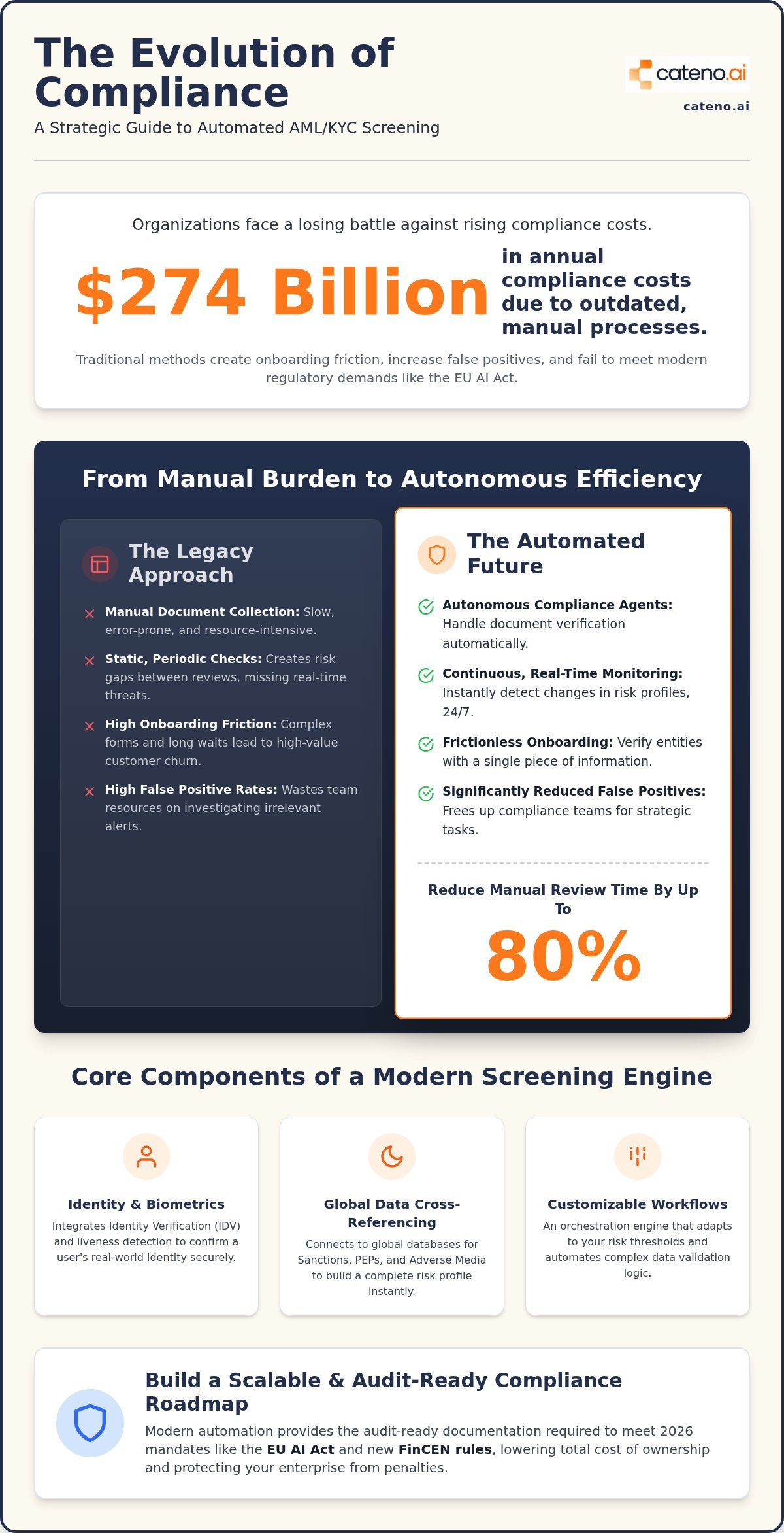
If your organization is still losing prospective clients to manual document collection and high false positive rates, you're fighting a losing battle against $274 billion in annual compliance costs. The reality of 2026 is that traditional methods can't keep pace with the EU AI Act or the new FinCEN rules for investment advisers. Adopting automated aml kyc screening isn't just a technical upgrade; it's a strategic necessity to maintain operational integrity. We understand that the pressure to balance rigorous regulatory requirements with a frictionless user experience often feels like a zero-sum game.
This guide promises to change that perspective by providing a comprehensive masterclass in modern compliance architecture. You'll learn how to implement autonomous compliance agents and customizable workflow engines that can reduce manual review time by up to 80%. We'll examine the technical implementation of real-time monitoring and the strategic shift toward perpetual KYC. By the end of this reference, you'll have the precise blueprint to eliminate systemic friction, reduce operational costs, and scale your onboarding processes with absolute confidence.
Key Takeaways
- Identify the shift from static, periodic checks to continuous monitoring cycles that provide real-time visibility into customer risk profiles.
- Discover how a customizable workflow engine orchestrates complex data validation to enable entity onboarding with just a single piece of information.
- Implement automated aml kyc screening to significantly reduce false positives and prevent the onboarding friction that causes high-value customer churn.
- Adopt autonomous compliance agents to handle document management and verification tasks, allowing your team to focus on high-level strategic orchestration.
- Build a scalable compliance roadmap that aligns with 2026 mandates like the EU AI Act while lowering the total cost of ownership for your screening operations.
Understanding Automated AML KYC Screening in a Frictionless Economy
In the current digital economy, the traditional silos between Know Your Customer (KYC) and Anti-Money Laundering (AML) protocols have collapsed. High-growth fintechs now operate in an environment where user expectations for instant access collide with stringent regulatory demands. Legacy systems that rely on manual document review create a fundamental friction point, leading to onboarding drop-offs and increased operational liability. Modern automated aml kyc screening resolves this tension by treating identity verification and risk monitoring as a single, fluid process rather than a series of disconnected hurdles. It's no longer enough to check a box at the start; you must maintain a vigilant, automated watch over every entity in your ecosystem.
The industry is moving away from "point-in-time" checks that only assess risk at the moment of onboarding. In 2026, compliance is defined by perpetual, event-triggered cycles. This shift ensures that any changes in a user's risk profile, such as a new appearance on a sanctions list or suspicious transaction patterns, are identified in real time. Maintaining high data integrity is the only way to reduce the technical debt that accumulates when manual errors go unchecked. By automating these workflows, firms can ensure that their data remains accurate and their liability remains low.
The Core Components of an Automated Screening Stack
A sophisticated screening engine integrates several technical layers to ensure comprehensive coverage. It begins with identity verification (IDV) and biometric liveness detection to confirm the user is who they claim to be. This is followed by deep integration with global databases for sanctions, Politically Exposed Persons (PEP), and adverse media. Most organizations utilize specialized Anti-money laundering (AML) software to automate these cross-references, ensuring that no entity enters the system without a rigorous background check. Finally, behavioral risk scoring algorithms analyze transaction data to detect anomalies that might indicate money laundering or fraud before they escalate into systemic threats.
Regulatory Drivers for Automation in 2026
The regulatory environment has reached a level of complexity where manual oversight is no longer feasible. Rules like the EU AI Act, which became effective for high-risk systems in August 2026, mandate that AI-driven compliance systems remain transparent and bias-free. Additionally, the expansion of FinCEN's recordkeeping rules to registered investment advisers has forced a broader range of financial entities to adopt robust automation. These standards require real-time risk assessment, especially within instant payment networks where funds move in seconds. Automation provides the "audit-ready" documentation necessary to prove compliance during rigorous regulatory examinations, shielding the enterprise from the billions in AML penalties seen in recent global enforcement actions.
The Technical Architecture of a Modern Screening Engine
The architecture of a modern automated aml kyc screening engine functions as a central nervous system for compliance. It goes beyond simple data retrieval. A Customizable Workflow Engine orchestrates multi-source data validation, allowing businesses to verify complex B2B entities without the fragmentation typical of legacy stacks. By integrating bank account verification APIs, the engine confirms financial legitimacy instantly, bridging the gap between identity and active capital. This integrated approach ensures that every verification layer communicates with the next, creating a unified defense against financial crime.
A core innovation in this architecture is the "single piece of information" onboarding logic. Instead of requiring users to navigate exhaustive forms, the system uses a single identifier, such as a tax ID or company name, to trigger an autonomous search across global registries. This reduces friction at the point of entry while ensuring the backend captures a complete risk profile. Organizations that want to see this orchestration in action can consult with our technical team to explore custom configurations that align with their specific risk thresholds.
Data Orchestration and API Connectivity
Efficiency in 2026 relies on unified API connectivity. A modern stack connects to diverse global KYB and KYC data providers, normalizing disparate data from international registries into a consistent format. For organizations building on decentralized protocols, Crypto Chief provides the unified Web3 infrastructure platform needed to support these complex technical integrations. This normalization is critical for accurate risk scoring. Low-latency screening ensures that these deep-dive checks occur in milliseconds, allowing for a real-time customer experience that doesn't sacrifice regulatory rigor. It's the difference between a seamless user journey and a high-friction process that leads to abandonment.
Static "fuzzy matching" is no longer sufficient for complex risk environments. Modern systems employ context-aware analysis to distinguish between coincidental name matches and genuine threats. This is where autonomous compliance agents become indispensable. Autonomous compliance agents are self-correcting systems designed to manage document intake, verify integrity, and resolve exceptions without manual intervention. These agents handle the heavy lifting of customer outreach when documents are expired or illegible, maintaining the lifecycle of the entity's compliance status autonomously. This level of automated aml kyc screening transforms compliance from a series of manual tasks into a scalable, high-performance operation.
Legacy vs. Automated Screening: A Strategic Comparison
Legacy screening systems often function as a weight on growth. The total cost of ownership (TCO) for manual compliance isn't limited to payroll; it includes the significant opportunity cost of high-value prospects who abandon the process due to friction. Manual document collection and repetitive verification tasks create technical debt within the customer onboarding lifecycle, making it impossible to scale without a linear increase in headcount. Transitioning to automated aml kyc screening removes these systemic bottlenecks, allowing firms to handle a 10x increase in volume while maintaining a lean, strategic compliance team.
The most immediate impact of automation is the reduction of false positives. Traditional "fuzzy matching" often flags innocent users, triggering manual reviews that can delay onboarding by days. These delays are the primary driver of customer churn in a digital economy where speed is a competitive advantage. By utilizing context-aware risk analysis, automated systems filter out noise and ensure that only genuine threats require human intervention. This shift transforms compliance from a cost center into a growth engine that supports rapid market expansion.
Operational Efficiency Metrics
Time-to-onboard (TTO) remains the most critical metric for assessing compliance performance. Manual reviews often result in a TTO measured in days, whereas automated gateways deliver results in seconds. There is a direct correlation between this frictionless screening and higher conversion rates. By reducing the "human-in-the-loop" requirement for standard low-risk entities, organizations can process the vast majority of applications autonomously, reserving their expert resources for complex, high-risk investigations that require nuanced judgment.
Risk Mitigation and Data Accuracy
Human error is a persistent risk in manual document verification and database cross-referencing. A single oversight in a sanctions check can lead to severe regulatory penalties and reputational damage. Automation ensures absolute consistency in risk scoring across different business units, eliminating the subjectivity inherent in manual processes. For a deeper look at how these technologies are reshaping the industry, consult our KYC Verification Guide: Modernizing Compliance for 2026. By centralizing data validation through a unified engine, you ensure that every check is performed against the most current global registries with 100% accuracy, providing a stable foundation for long-term regulatory resilience.
Implementation Roadmap: Transitioning to Autonomous Screening
Transitioning from fragmented manual processes to automated aml kyc screening requires a methodical shift in both strategy and technical architecture. This isn't merely a software replacement; it's a fundamental re-engineering of the compliance lifecycle. The first step involves a deep audit of current onboarding friction, specifically identifying where manual document requests cause user abandonment. Once these bottlenecks are mapped, you must define granular risk thresholds and automated decisioning logic. This logic should be calibrated to your specific industry risk appetite while ensuring compliance with 2026 mandates like the EU AI Act transparency requirements.
The technical execution centers on designing a self-service onboarding gateway and a branded customer portal. This interface acts as the primary data intake point, which is then orchestrated by a customizable workflow engine. Integrating this engine with your core product via a unified API allows for seamless data exchange and real-time verification. Finally, you must establish a continuous monitoring loop. This ensures that the initial screening isn't a static event but the start of a perpetual compliance cycle that reacts instantly to changes in an entity's risk profile. If you're ready to modernize your stack, you can speak with our implementation specialists to design your custom roadmap.
Designing the Customer Onboarding Workflow
A successful transition prioritizes the user journey without compromising regulatory rigor. Mapping the flow from initial data entry to final verification allows you to implement progressive disclosure. This technique minimizes initial friction by only requesting sensitive documentation when the automated background checks require further clarification. For a technical deep dive into managing these requirements, see our guide on Automated KYC Document Verification: The 2026 Guide. This approach ensures that low-risk users experience a near-instant journey, while high-risk entities are funneled through more rigorous, automated validation steps.
Advanced Verification Reporting and Monitoring
Post-onboarding compliance depends on the quality of your monitoring and reporting infrastructure. You must set up real-time alerts that trigger whenever an entity's status changes in global sanctions or PEP lists. These triggers should feed into advanced verification reports, which provide the documented evidence needed for regulatory examinations or annual audits. When the system identifies a "gray area" flag—such as a partial name match that AI can't resolve with 100% certainty—automated escalation workflows should route the case to a senior compliance officer. This ensures that human expertise is only utilized for high-stakes decision-making, maintaining the overall efficiency of the automated aml kyc screening ecosystem.
The Cateno Approach: Orchestrating Global Compliance
Cateno redefines the standard for automated aml kyc screening by moving beyond fragmented verification. While legacy providers focus on simple identity checks, Cateno orchestrates the entire entity lifecycle. Our platform enables onboarding with a single piece of information, such as a company name or tax identifier. The engine then autonomously retrieves, validates, and cross-references data across global registries. This eliminates the need for exhaustive manual data entry, allowing your users to move from intent to action in seconds. It’s a sophisticated remedy to the systemic friction that typically stalls high-growth enterprises.
The power of this approach lies in the Cateno Customizable Workflow Engine. It’s specifically engineered to handle the complexities of B2B entities, where nested ownership structures and multi-jurisdictional requirements often stall traditional systems. By utilizing autonomous compliance agents, the platform manages the intake and ongoing monitoring of partners without human intervention. These agents identify missing documentation and trigger automated outreach, ensuring that your compliance posture remains robust as you scale. This level of orchestration ensures that precision is maintained across every business unit, regardless of geographic complexity.
Self-Service Compliance Portals
Trust is built through transparency and professional presentation. Cateno’s branded customer portals empower users to manage their own document uploads and status updates within a secure, white-label environment. This reinforces your brand authority during the critical onboarding phase. Instead of manual email chains, users receive real-time guidance and automated status updates. This self-service model significantly reduces support tickets and operational overhead, creating a frictionless path for even the most complex entities. It transforms a historically painful process into a streamlined, professional interaction.
Scalable Infrastructure for Enterprise Growth
High-growth platforms require a compliance stack that can keep pace with rapid expansion. Cateno provides the scalable infrastructure necessary for high-performance operations, ensuring that your automated aml kyc screening remains accurate even as transaction volumes spike. This enterprise-ready solution offers a strategic advantage by transforming compliance into a predictable, autonomous workflow. It allows your team to focus on strategic growth rather than manual document review. Explore the Cateno Platform to see the workflow engine in action and discover how orchestration can drive your next phase of global growth.
Strategic Resilience in a Complex Regulatory Era
Scaling a financial institution or high-growth fintech in 2026 requires more than just meeting minimum compliance standards. It demands a fundamental shift from reactive manual checks to proactive, autonomous orchestration. By integrating automated aml kyc screening into your core architecture, you eliminate the systemic friction that historically throttled expansion. This transition ensures that your organization remains agile, accurate, and fully aligned with evolving global mandates like the EU AI Act.
Adopting a solution-oriented stack means leveraging autonomous compliance agents to manage document lifecycles and utilizing advanced verification reports to maintain an audit-ready posture. Branded self-service customer portals further enhance this experience by building trust and reducing operational overhead. It's time to move beyond legacy bottlenecks and embrace a high-performance technological partner that values precision above all else. Streamline your compliance operations with Cateno’s automated workflow engine. We're ready to help you navigate this transition with confidence and clarity.
Frequently Asked Questions
What is the difference between manual and automated AML screening?
Manual screening relies on human intervention to cross-reference spreadsheets and physical documents, a process that is prone to error and significant delays. In contrast, automated aml kyc screening uses sophisticated algorithms to validate data against global databases in real time. This technical shift allows for perpetual, event-triggered monitoring rather than static, point-in-time checks, ensuring that your risk profile remains accurate without increasing your compliance headcount.
How does automated KYC screening improve customer onboarding?
Automation transforms the onboarding experience by reducing the time-to-onboard from days to seconds. By utilizing a "single piece of information" entry logic, the system minimizes the data burden on the user. This frictionless approach prevents the onboarding drop-offs commonly associated with legacy systems. It ensures that low-risk entities are verified instantly, allowing your organization to capture high-value prospects without the typical operational hurdles.
Can automated screening engines accurately identify PEPs and sanctions?
Modern screening engines utilize context-aware risk analysis to identify Politically Exposed Persons and sanctions across multi-source global registries. These systems move beyond simple fuzzy matching, which often flags innocent users, to distinguish between coincidental name matches and genuine threats. This level of precision is essential for maintaining regulatory integrity in a complex environment where global sanctions lists are updated with increasing frequency and complexity.
How do autonomous compliance agents handle document verification?
Autonomous compliance agents function as self-correcting systems that manage document intake and verify integrity without manual oversight. They identify expired, illegible, or fraudulent documents instantly and trigger automated outreach to the customer via a branded portal. This ensures that the documentation lifecycle remains active and accurate. By handling these administrative tasks autonomously, these agents allow your team to focus on high-level strategic orchestration and complex risk investigations.
What is the impact of automated screening on false positive rates?
Implementing automated aml kyc screening significantly reduces false positive rates by utilizing normalized data and advanced behavioral risk scoring. Legacy systems often flag noise, leading to unnecessary manual reviews and customer churn. Automation filters out these inaccuracies by analyzing data in context. This ensures that only genuine red flags are escalated, which reduces operational costs and prevents the frustration that high-value customers feel during verification delays.
Is automated AML screening compliant with current FinCEN regulations?
Automated systems are engineered to meet the rigorous standards set by FinCEN and other global regulatory bodies. They provide "audit-ready" documentation and advanced verification reports required for regulatory examinations. This includes compliance with the latest 2026 mandates for instant payment networks and expanded recordkeeping rules for investment advisers. Automation ensures that every step of the screening process is documented, providing a stable foundation for long-term regulatory resilience.
How does a customizable workflow engine help with KYB verification?
A customizable workflow engine orchestrates the complex data validation required for Know Your Business verification. It handles nested ownership structures and multi-jurisdictional requirements by defining specific risk thresholds for different entity types. This allows high-growth platforms to automate the intake of complex business partners while maintaining absolute data integrity. The engine ensures that every verification layer communicates with the next, creating a unified defense against financial crime across all business units.
What data is required to start an automated screening process?
The automated screening process can often be initiated with a single piece of information, such as a company name, tax identifier, or individual ID. The engine uses this initial data point to trigger an autonomous search across international registries and sanctions lists. This minimal requirement reduces initial user friction at the point of entry. It allows the backend system to build a comprehensive risk profile without requiring the user to navigate exhaustive manual forms.


