

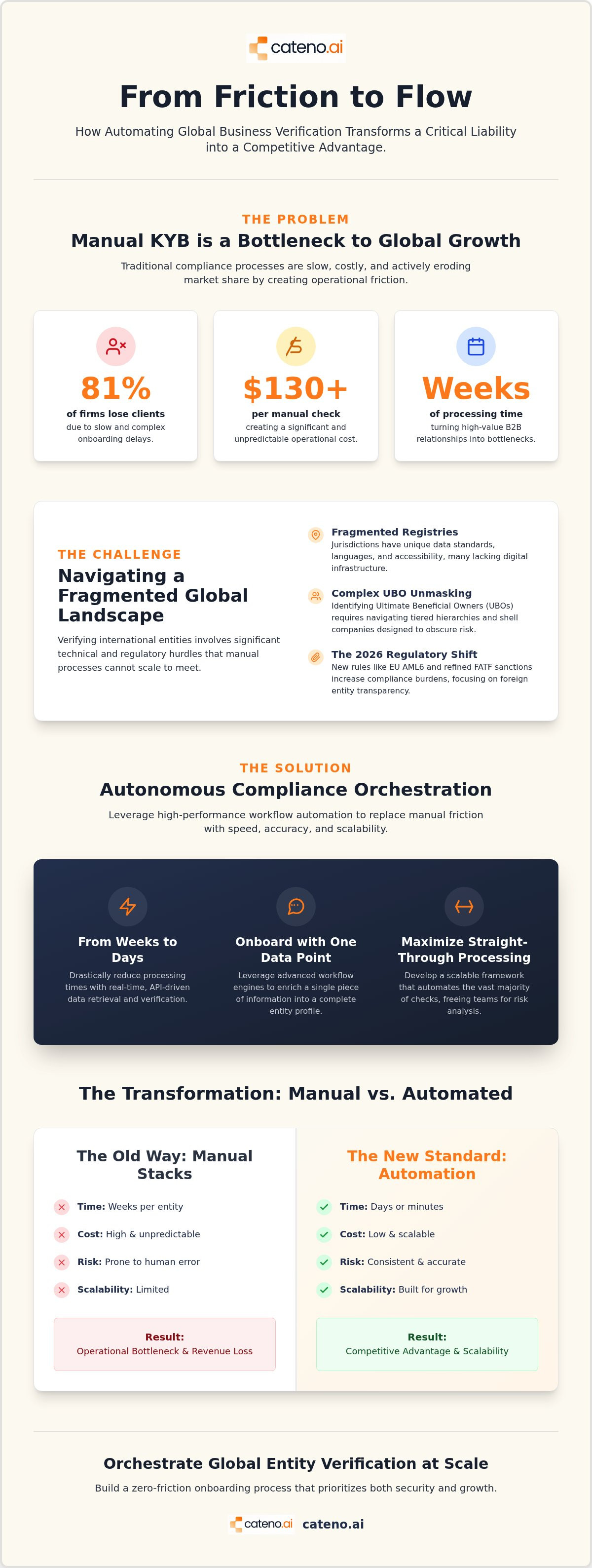
Operational friction is the silent killer of global growth. If 81% of firms are losing potential clients to onboarding delays, the traditional compliance model isn't just slow; it's a liability that's actively eroding your market share. Implementing robust kyb workflow automation is no longer optional for enterprises navigating the friction of manual UBO unmasking and fragmented global business registries. It's a systemic burden that turns high-value B2B relationships into operational bottlenecks. We understand that navigating these complexities requires a fundamental shift in how data is orchestrated across borders.
Precision is the new standard for enterprise readiness. This guide provides a strategic roadmap to master the complexities of international business verification and learn how autonomous workflows transform regulatory compliance into a competitive advantage. You'll learn how to leverage autonomous compliance agents to reduce processing times from weeks to days, even enabling onboarding with a single piece of information. We'll examine the impact of the 2026 regulatory landscape, including the repeal of the U.S. Corporate Transparency Act's domestic reporting and the upcoming EU AML6 requirements. By the end, you'll have the framework to build a zero-friction onboarding process that prioritizes both security and scalability.
Key Takeaways
- Identify how the 2026 regulatory shift refocuses compliance priorities on foreign entity transparency and international data integrity.
- Navigate the technical complexities of fragmented global registries and the operational challenges of unmasking complex beneficial ownership layers.
- Implement high-performance kyb workflow automation to transition from manual, high-friction processes to autonomous compliance orchestration.
- Develop a scalable onboarding framework that maximizes straight-through processing while maintaining strict adherence to jurisdictional risk requirements.
- Leverage advanced workflow engines to streamline international verification, potentially reducing intake requirements to a single data point.
Understanding Global KYB Verification in a Borderless Economy
Global growth depends on the integrity of your partner network. Global KYB is the mandatory process of verifying the legal existence and ownership of international entities. It's a critical layer of security that ensures your business isn't inadvertently facilitating financial crime. This process builds upon the foundation established by Know Your Customer (KYC) regulations, but it introduces significantly more complexity by shifting the focus from individual identities to corporate structures.
The regulatory landscape in 2026 demands deeper transparency than ever before. While FinCEN removed domestic reporting requirements under the Corporate Transparency Act in August 2026, foreign entities registered to do business in the U.S. still face strict reporting obligations. This discrepancy creates a fragmented compliance environment. Relying on manual processes to navigate these shifts is an operational liability. High friction in B2B onboarding leads to direct revenue loss. A 2026 industry survey revealed that 81% of European firms have lost potential clients due to onboarding delays. When manual verification checks cost between $13 and $130 per instance, the argument for kyb workflow automation becomes a matter of fiscal survival.
Standard KYC is straightforward; it verifies a person. Global KYB is tiered. It requires unmasking Ultimate Beneficial Owners (UBOs) through layers of holding companies and shell entities across multiple jurisdictions. Without a sophisticated workflow engine, these checks often stall, causing legitimate partners to abandon the process.
The Evolution of Business Identity Verification
The era of manual registry lookups is ending. Modern compliance relies on real-time, API-driven data retrieval to ensure accuracy. The Legal Entity Identifier (LEI) has emerged as a cornerstone of cross-border trade, providing a universal standard for entity identification. Standard verification often fails in high-risk or complex non-U.S. jurisdictions because data formats aren't standardized. Efficiency drives revenue. Moving toward automated retrieval allows teams to focus on risk analysis rather than data entry.
Regulatory Drivers: AML, CTF, and Beyond
International standards are tightening. In June 2026, the Financial Action Task Force (FATF) updated Recommendation 6 to refine targeted financial sanctions. These updates force institutions to maintain more granular data on international partners. Compliance isn't just about following rules; it's about building a resilient infrastructure for global commerce. Global KYB is the mandatory bridge between digital trust and international trade.
The Technical Complexity of Verifying International Entities
Global verification is not a monolith. Every jurisdiction operates with unique data standards, languages, and levels of accessibility. In many regions, digital infrastructure remains limited, requiring sophisticated document management systems to extract data from unstructured physical records. This fragmentation creates a massive technical hurdle for companies attempting to scale without kyb workflow automation. Without a unified system to orchestrate these disparate sources, compliance teams are forced into a reactive cycle of manual data entry. This inefficiency doesn't just slow down onboarding; it introduces significant risk through human error and inconsistent data quality.
Ultimate Beneficial Ownership (UBO) Challenges
Unmasking the true controllers of a business requires navigating through tiered hierarchies and shell companies designed to obscure risk. Standard protocols often rely on a 25% ownership threshold, but identifying these individuals across multiple layers of circular or nested ownership remains a significant challenge. Compliance teams must adhere to the Beneficial Ownership Information Reporting Rule to ensure they aren't engaging with sanctioned actors. Automated UBO verification is the only way to achieve the necessary speed and accuracy to prevent onboarding bottlenecks. By programmatically unmasking these layers, you replace weeks of manual research with near-instant clarity.
Data Integrity and Source Reliability
Reliability depends on the quality of the data source. While secondary aggregators offer speed, they often lack the real-time accuracy required for high-stakes enterprise onboarding. A robust strategy balances these sources to ensure a complete risk profile:
- Primary Sources: Direct feeds from government registries and Secretary of State (SOS) databases for current standing.
- Secondary Sources: Aggregated global verification reports that provide historical context and risk scoring.
- Financial Validation: Real-time bank account verification to ensure the entity's operational legitimacy.
Cateno simplifies this process through its Customizable Workflow Engine, which allows teams to trigger comprehensive data retrieval using only a single piece of information. This reduces the burden on your partners while maintaining high data integrity across every check. Integrating bank account validation into this flow further strengthens the process by ensuring the business not only exists on paper but also possesses legitimate financial credentials. To see how these technical layers integrate into your specific environment, you can speak with an automation specialist.
Adopting kyb workflow automation allows you to move away from fragmented data silos. Instead, you create a centralized source of truth that is both enterprise-ready and scalable. This technical orchestration is what separates market leaders from those struggling with operational debt.
Transitioning from Manual Stacks to Autonomous Compliance
Manual compliance stacks function as an expensive anchor for international growth. They create a compounding technical debt that forces organizations to choose between speed and security. Moving toward kyb workflow automation resolves this conflict by replacing reactive patchwork with a proactive, strategic orchestrator. This transition is essential for any enterprise that views compliance as a performance lever rather than a regulatory burden. Efficiency isn't just about speed; it's about removing the operational liability inherent in manual data handling.
Autonomous compliance agents represent a fundamental shift in risk management. These agents don't just execute tasks; they manage the entire lifecycle of document intake and monitoring. By utilizing a Customizable Workflow Engine, businesses can remove operational redundancy and ensure their processes adapt instantly to regional rule changes. This level of agility is impossible with manual oversight, where every jurisdictional update requires a complete rethink of the internal stack.
The Role of AI in Orchestrating Compliance
Modern compliance requires more than simple "if-then" logic. Autonomous agents are designed to handle document exceptions and inconsistencies that typically stall manual workflows. For example, when a global registry provides data in a non-standard format, these agents can interpret the discrepancy and decide whether to escalate or proceed based on your pre-defined risk appetite. This capability is explored further in our KYC Verification Guide: Modernizing Compliance for 2026, which details the foundational automation concepts necessary for this shift. By applying machine learning to global AML screening, organizations can significantly reduce "false positives," ensuring that compliance teams only spend time on genuine threats rather than data noise.
Creating a Frictionless Self-Service Gateway
The psychology of onboarding is a critical factor in partner retention. When a business partner encounters a fragmented, manual document request process, trust diminishes and drop-off rates climb. Branded customer portals solve this by shifting the data collection burden to the customer in a way that feels professional and secure. This self-service model increases conversion rates by providing a clear, guided path for entity verification. Autonomous agents act as a tireless decision layer for global compliance, ensuring that every piece of information submitted is immediately validated against the appropriate registry.
- Enhanced Trust: Branded portals project an image of technical competence and security.
- Audit Readiness: Automated intake generates business verification reports that are inherently organized for regulatory review.
- Reduced Burden: Self-service gateways allow partners to upload documents at their own pace, reducing the friction of back-and-forth emails.
Adopting kyb workflow automation doesn't just improve your internal metrics; it transforms the external experience for your most valuable business partners. It replaces the systemic friction of manual checks with a streamlined, enterprise-ready gateway that supports long-term scalability.
How to Implement a Scalable KYB Workflow Automation Framework
Operational friction is a byproduct of poorly defined systems. Implementing a high-performance kyb workflow automation framework requires a methodical approach to system orchestration, moving beyond simple data collection to a dynamic decision-making model. This process ensures that your compliance stack remains an asset for growth rather than a bottleneck. A structured implementation strategy follows five critical phases to ensure enterprise readiness and jurisdictional precision.
- Step 1: Define Risk Appetite: Establish clear thresholds for jurisdictional regulatory requirements. Your system must distinguish between standard due diligence and enhanced requirements for high-risk regions.
- Step 2: Map the Workflow: Design the entity onboarding sequence for maximum straight-through processing. Identify every touchpoint where automation can replace manual intervention to reduce drop-offs.
- Step 3: Integrate Real-Time Data: Connect your framework to live registry sources and bank account validation APIs. This ensures the data you retrieve is accurate at the moment of onboarding.
- Step 4: Deploy Autonomous Agents: Utilize agents for ongoing lifecycle monitoring and risk scoring. This shifts your compliance model from a one-time check to a perpetual monitoring system.
- Step 5: Refine and Audit: Generate advanced verification reports and immutable audit trails. These documents provide the necessary proof for regulatory examinations and internal performance reviews.
Defining the Workflow Logic
Precision in automation depends on the sophistication of your underlying logic. Conditional logic allows you to tailor the onboarding experience based on the entity type and its country of origin. For example, a low-risk domestic LLC might trigger an immediate approval, while a foreign entity with complex ownership layers requires a more rigorous data retrieval path. Setting these thresholds for manual escalation vs. automated approval is vital. For a deeper look at designing these systems, explore The Sophisticated Business Onboarding Workflow Engine. This architecture ensures that your kyb workflow automation remains flexible enough to handle global edge cases without sacrificing speed.
Measuring Success in KYB Automation
Performance must be quantified to be optimized. Key metrics include time-to-onboard, pass rates, and the cost-per-verification at scale. While manual onboarding can take three to four weeks, an automated approach can reduce this to three to five business days. Centralized document management is equally important. It ensures that every verification report is stored in an audit-ready format, simplifying regulatory examinations. Continuous improvement is achieved through autonomous feedback loops, where the system identifies patterns in document exceptions to refine future workflows. If you're ready to transition to a more efficient framework, you can consult with our orchestration team to build a solution tailored to your operational needs.
Cateno: Orchestrating Global Entity Verification at Scale
Cateno redefines the standard for global entity verification by shifting from reactive checks to proactive orchestration. While traditional systems demand exhaustive documentation from the outset, Cateno operates on a single-piece-of-information philosophy. This approach allows enterprises to initiate the onboarding process with just a business name or registration number. Once provided, the system triggers a sophisticated retrieval sequence across global registries, unmasking corporate structures without burdening the applicant. This is the pinnacle of kyb workflow automation, where data integrity is maintained through technology rather than manual labor.
By leveraging a Customizable Workflow Engine, the platform maintains global agility while ensuring regional compliance across diverse jurisdictions. This orchestration is powered by Autonomous Compliance Agents that manage the entire lifecycle of document intake and monitoring. These agents are engineered to reduce manual intake tasks by up to 80%, allowing compliance teams to scale their operations without a linear increase in headcount. Positioning Cateno as your enterprise-ready partner ensures that your international growth is both secure and streamlined.
Platform Features for Global Growth
Branded Customer Portals provide a seamless, white-labeled window for your global partners. This professional interface reduces friction and significantly increases conversion rates by guiding partners through a self-service intake process. It replaces the back-and-forth of email chains with a centralized, secure gateway. Following the verification, the system generates Advanced Verification Reports. These documents provide the precision required in a complex regulatory world, ensuring every decision is backed by a verifiable audit trail. You can explore the Cateno Platform to see these features in action.
Future-Proofing Your Compliance Stack
Scalability is built into the core of the Cateno architecture. The system is designed to handle high-volume intake across borders without the need for additional compliance staff. This removes the "technical debt" often associated with manual stacks. As global regulations evolve, the platform's inherent adaptability allows you to update workflows in real-time. This ensures your kyb workflow automation remains resilient against shifting legal landscapes, such as the upcoming EU AML6 requirements or updated FATF standards. It's a forward-thinking solution for businesses that value precision and speed. To see how these systems integrate with your existing operations, schedule a demo to see how Cateno automates global KYB.
Future-Proofing Your Global Expansion Strategy
The transition from fragmented manual checks to a unified, autonomous framework is the defining shift for enterprise compliance in 2026. Global growth no longer permits the luxury of slow, high-friction onboarding that alienates legitimate partners. By implementing sophisticated kyb workflow automation, you transform a regulatory necessity into a high-performance engine for scale. This evolution requires moving beyond static data collection toward a dynamic orchestration of global business registries and complex ownership unmasking.
Mastering these complexities ensures your organization remains audit-ready and resilient against shifting jurisdictional requirements. Leveraging tools like Autonomous Compliance Agents for 24/7 monitoring and a Customizable Workflow Engine allows you to manage complex global logic without increasing operational headcount. With the addition of Advanced Verification Reports, you maintain total clarity in an increasingly opaque regulatory environment. The path to streamlined efficiency is clear, and the technical infrastructure to support it is now within reach.
Discover how Cateno orchestrates automated KYB at scale and take the first step toward a zero-friction future. Your global success starts with the right orchestration.
Frequently Asked Questions
What is the difference between KYC and Global KYB verification?
Know Your Customer (KYC) focuses on verifying the identity of individual customers to prevent personal financial crime. Global KYB extends this requirement to legal entities, requiring businesses to verify the existence, registration, and ownership structure of corporate partners. This involves unmasking Ultimate Beneficial Owners (UBOs) through multiple layers of holding companies. While KYC is a foundational step, KYB is a more complex, tiered process essential for secure B2B cross-border trade.
How does automated UBO verification work for international companies?
Automated UBO verification uses autonomous compliance agents to programmatically query global business registries and extract ownership data. The system maps hierarchical structures to identify individuals who meet specific control thresholds, such as the 25% ownership standard. By replacing manual research with kyb workflow automation, organizations can unmask complex shell companies and nested hierarchies in seconds rather than weeks, ensuring regulatory accuracy and reducing the risk of human oversight.
Can KYB verification be fully automated across all countries in 2026?
Full automation is achievable in many digitally mature jurisdictions, but global coverage remains a hybrid challenge. While API-driven retrieval is the standard in most regions, some countries still rely on physical records or unstructured data formats. Cateno addresses this by using autonomous agents to manage document exceptions and unstructured intake. This ensures that even when a registry lacks a direct API, the onboarding flow remains streamlined and audit-ready for enterprise requirements.
What data points are required to start a global KYB check with Cateno?
Cateno operates on a single-piece-of-information philosophy to minimize initial friction. You only need to provide a business name or a tax identification number to initiate a comprehensive global check. Once this data point is entered, the Customizable Workflow Engine automatically retrieves registration details, UBO data, and financial standing from primary sources. This approach significantly reduces the data entry burden on your business partners while ensuring high integrity for your compliance records.
How do autonomous compliance agents improve the onboarding process?
Autonomous compliance agents act as a proactive decision layer that manages the entire onboarding lifecycle. They handle document intake, identify inconsistencies, and monitor for changes in a business partner's risk profile 24/7. These agents can reduce manual intake tasks by up to 80% by automating the retrieval and validation of corporate records. This allows your compliance team to focus on high-level risk analysis rather than redundant administrative tasks.
What are the risks of using legacy manual KYB processes in 2026?
Legacy manual processes are a significant operational liability in 2026. High friction during onboarding leads to massive partner drop-offs, with 2026 survey data from Sumsub indicating that 81% of firms have lost clients due to verification delays. Additionally, manual checks are expensive, often costing between $13 and $130 per check. Without kyb workflow automation, your organization faces increased technical debt, inconsistent data quality, and the inability to scale without a linear increase in headcount.
How does a branded customer portal reduce onboarding friction for B2B partners?
A branded customer portal provides a professional, white-labeled gateway for partners to submit their own verification data. This self-service model shifts the data collection burden away from your internal team while providing a clear, guided experience for the partner. By offering a centralized window for document uploads and status tracking, you project technical competence and build trust. This transparency reduces the anxiety often associated with complex B2B onboarding and significantly improves conversion rates.
How does bank account verification integrate with KYB workflow automation?
Bank account verification adds a critical layer of financial legitimacy to the entity verification process. It ensures that the business not only exists on paper but also possesses active, legitimate financial credentials. Within a unified workflow, this check happens automatically alongside identity and registry lookups. This integration prevents fraud by confirming that the bank account details provided match the verified entity, creating a secure and seamless path for international payments and partnerships.


