

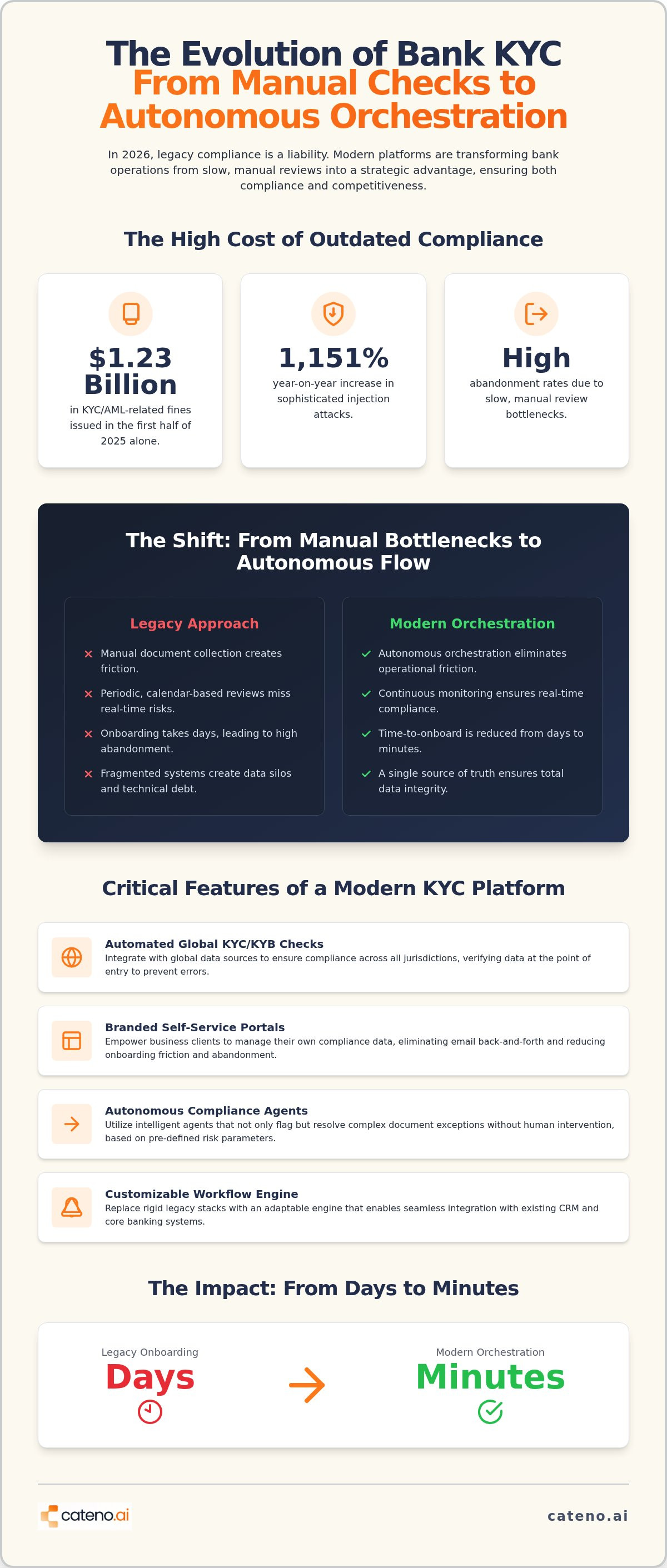
Global regulators issued $1.23 billion in KYC and AML-related fines in the first half of 2025 alone. This staggering figure reflects a regulatory environment that no longer accepts "best efforts" in the face of sophisticated synthetic identity fraud. You likely recognize the strain of managing high abandonment rates and manual review bottlenecks while trying to maintain total data integrity. Selecting the right kyc software for banks has evolved from a simple procurement task into a strategic necessity for institutional stability.
We agree that legacy compliance stacks are often more of a liability than an asset. They create friction for legitimate customers while failing to catch the 1,151% year-on-year increase in injection attacks reported in late 2025. This article promises to show you how modern platforms are transforming operations from manual document review to autonomous compliance orchestration. You will discover how to reduce time-to-onboard from days to minutes using automated UBO verification and seamless CRM integration. We provide a clear path to ensuring your bank remains both compliant and competitive in 2026.
Key Takeaways
- Transition from manual document collection to autonomous orchestration to eliminate operational friction and ensure total data integrity.
- Identify how modern kyc software for banks reduces time-to-onboard from days to minutes through automated UBO and entity verification.
- Replace rigid legacy stacks with a customizable workflow engine to resolve technical debt and enable seamless integration with existing CRM systems.
- Utilize branded customer portals and autonomous compliance agents to minimize onboarding abandonment and streamline the document intake process.
- Adopt a strategic orchestration layer to navigate 2026 regulatory shifts while maintaining a frictionless user experience for complex entities.
The Evolution of Bank KYC Software: From Manual Checks to Orchestration
The traditional model of Know Your Customer (KYC) was built for a slower, paper-based world. In that environment, banks acted primarily as data collectors, manually gathering and filing documents to satisfy auditors. By 2026, this passive approach has become a significant risk. Modern kyc software for banks must do more than just aggregate information; it must orchestrate it. This shift from collection to intelligent orchestration allows institutions to automate complex decision-making processes that previously required hours of human intervention.
Legacy KYC stacks are now operational liabilities. These fragmented systems rely on periodic, calendar-based reviews that fail to capture real-time risk fluctuations. With global regulators issuing $1.23 billion in fines during the first half of 2025, the margin for error has vanished. Banks that continue to use static data points are essentially flying blind between review cycles. Transitioning to continuous compliance monitoring ensures that risk profiles are updated the moment a customer's status changes, providing a proactive rather than reactive defense.
Defining the Modern KYC Orchestration Layer
Simple API-based verification often creates data silos, where each check exists in isolation. Orchestration is different. It integrates multiple data streams into a unified, automated workflow that adapts based on the risk level detected. KYC orchestration is the central nervous system of bank compliance. By establishing a single source of truth for entity data, banks can ensure that every department operates from the same validated information, eliminating redundant checks and internal confusion.
The Cost of Legacy Compliance Friction
Manual document review is a silent killer of bank ROI. When onboarding takes days instead of minutes, high-value clients often abandon the process entirely. This friction doesn't just lose immediate business; it creates long-term technical debt as teams struggle to manage bloated, inefficient workflows. For a deeper look at the foundational principles of this transition, consult our KYC Verification Guide. Moving away from legacy systems isn't just about compliance. It's about reclaiming operational efficiency and protecting the bottom line.
Critical Features of Modern KYC Platforms for Financial Institutions
Selecting the right kyc software for banks requires a focus on functional depth rather than superficial checklists. In 2026, the baseline has shifted. Standard data collection is insufficient. High-performance platforms now utilize automated KYC and KYB checks that span global data sources, ensuring compliance across disparate jurisdictions. These systems integrate bank account verification and real-time validation APIs directly into the onboarding flow. This ensures that every piece of data is verified at the point of entry, preventing the accumulation of "dirty" data that often plagues legacy systems. Precision is mandatory for institutional stability.
Self-Service Gateways and Branded Portals
One of the most significant advancements is the move toward customer empowerment. Branded customer portals allow business clients to manage their own compliance data in a secure, centralized environment. This eliminates the traditional "back-and-forth" email trail that often leads to high abandonment rates and security vulnerabilities. By providing a self-service onboarding gateway, banks can reduce operational friction while maintaining a professional, cohesive brand experience. This approach is explored further in our guide on automated kyc document verification. Empowered customers are faster customers.
Autonomous Compliance Agents vs. Standard Automation
Standard automation often fails when it encounters a document exception or a non-standard ID. Autonomous compliance agents represent a superior alternative. These intelligent agents handle complex document exceptions without requiring human intervention, making decisions based on pre-defined risk parameters. They don't just flag issues; they resolve them. This is critical in a landscape where iOS injection attacks and deepfakes saw a 1,151% increase in the latter half of 2025.
This autonomous decision-making process is fully documented within advanced verification reports. These reports provide a comprehensive audit trail that is essential during rigorous regulatory exams. They offer a transparent look at how every decision was made, from initial intake to final approval. In an era of heightened scrutiny, having an intelligent orchestration layer is no longer optional. It's a fundamental requirement for institutional security. If your current stack lacks these capabilities, it may be time to evaluate your compliance architecture to ensure it remains enterprise-ready for the challenges ahead.
Evaluating the Top KYC Software Solutions for Banks in 2026
Selecting kyc software for banks requires a shift from feature-counting to rigorous architectural analysis. The primary objective is achieving high time-to-value. Institutional leaders can't afford eighteen-month deployment cycles that fail to keep pace with regulatory flux. Modern solutions must be enterprise-ready, balancing deep integration with a frictionless user experience. This balance is critical for maintaining stability while navigating the complexities of 2026 compliance requirements. Precision is non-negotiable.
Choosing between an all-in-one platform and a best-of-breed API strategy involves distinct trade-offs. All-in-one systems offer perceived simplicity but often lack the specialized depth required for complex entity verification. Conversely, managing multiple disparate APIs can increase technical debt if they aren't properly orchestrated. A superior approach favors a unified platform that acts as a strategic orchestrator. This model combines the ease of a single interface with the power of specialized, autonomous agents, ensuring that data integrity remains uncompromised across all workflows.
Security standards are the bedrock of any deployment. When evaluating kyc software for banks in 2026, adherence to SOC2 and GDPR is the baseline. Enterprise-grade encryption and robust data integrity protocols are essential to protect against the rising tide of synthetic identity fraud. With global regulators issuing $1.23 billion in fines during the first half of 2025, the cost of a security lapse is higher than ever. Your software must provide a secure environment that reassures both regulators and customers of your technical competence.
Key Performance Indicators for KYC Software
Measuring the efficacy of a platform involves tracking straight-through processing (STP) rates. By 2026, around 70% of new account onboarding is projected to be fully automated. High STP rates directly correlate with reduced operational costs and improved customer satisfaction. Another critical metric is the reduction of false positives in automated aml kyc screening. Minimizing these alerts allows compliance officers to focus on genuine risks, significantly increasing the average time saved per officer through purposeful automation.
Integration and Scalability Requirements
Banks must choose between cloud-native and on-premise deployment models. While some legacy institutions remain tethered to on-premise hardware, the industry is rapidly moving toward cloud-native SaaS for its inherent scalability and agility. Cateno’s platform is engineered to integrate seamlessly with existing financial ecosystems, including established CRM and ERP systems. This ensures that the software can handle high-volume transaction needs without performance degradation. Scalability isn't just about handling more data; it's about maintaining precision as the complexity of the regulatory environment increases.
Solving the Integration Challenge: Reducing Technical Debt in Onboarding
Legacy onboarding systems often suffer from extreme rigidity. They force every applicant through a linear path, regardless of the entity's complexity or risk profile. This "one-size-fits-all" approach is a primary driver of technical debt. It requires expensive manual workarounds whenever a non-standard business structure enters the pipeline. By implementing modern kyc software for banks, institutions can deploy customizable workflow engines that adapt in real-time. These engines allow for the intake of business partners with minimal initial input, using intelligent routing to determine which specific data points are actually required for each unique case. Modular compliance architecture ensures that new regulatory requirements can be integrated without rebuilding the entire stack.
Streamlining Complex KYB and Entity Onboarding
Identifying the Ultimate Beneficial Owner (UBO) remains one of the most significant hurdles in corporate banking. Manual discovery is slow and prone to error, especially when dealing with layered ownership across multiple jurisdictions. Utilizing kyb workflow automation allows banks to map these structures instantly, identifying cross-border risks without human intervention. Integrating automated bank account validation during this initial intake further secures the process. It ensures that the entity isn't just legally compliant, but operationally valid from the first interaction. This level of automation is essential for maintaining institutional stability in an increasingly complex global market.
The Transition from Siloed Data to Unified Workflows
Traditional banking environments often trap data within specific departments. Compliance, sales, and operations teams frequently work from different versions of the same truth, leading to redundant requests and customer frustration. A unified business onboarding workflow engine resolves this by creating a single, shared orchestration layer. This improves the internal employee experience by removing the friction of departmental handoffs and ensuring data integrity across the entire lifecycle. In the high-stakes environment of 2026, modularity is no longer a luxury; it is the structural requirement for institutional agility and survival.
If your current onboarding process is hindered by legacy rigidity, it's time to consult with our orchestration experts to modernize your compliance architecture and eliminate technical debt.
Future-Proofing Your Bank with Cateno’s Autonomous Compliance Engine
The current regulatory environment demands a departure from reactive compliance. To remain competitive in 2026, banks must adopt a framework that prioritizes speed without sacrificing technical integrity. Cateno offers a sophisticated remedy to the systemic friction caused by legacy onboarding systems. By utilizing autonomous compliance agents, our platform enables institutions to initiate onboarding for complex entities with a single piece of information. This capability significantly reduces the initial burden on the customer, moving the bank toward a friction-free compliance future. Precision and automation are no longer separate goals; they are the dual pillars of modern institutional stability.
Cateno’s Unique Value Proposition for Banks
Cateno acts as a strategic orchestrator rather than a mere service provider. While competitors often rely on manual-heavy case management, our customizable workflow engine automates the entire decisioning lifecycle. This engine is designed specifically for enterprise banks that require both stability and high-level technical innovation. By integrating these autonomous agents into your stack, you ensure that document intake and verification happen with minimal human intervention. You can explore Cateno’s industry-specific solutions to see how this orchestration layer adapts to different financial environments, ensuring that your compliance strategy remains visionary and practical.
Implementation: From Strategy to Execution
Deploying a modern kyc software for banks shouldn't be an exercise in technical debt. Cateno provides a clear roadmap for transition, ensuring that the deployment of our autonomous compliance agents aligns with your existing operational goals. Our advanced verification reports offer a detailed, time-stamped audit trail for ongoing lifecycle management; this provides the clarity and data integrity required for rigorous regulatory exams. These reports serve as the definitive record for every automated decision, ensuring that your bank is always prepared for scrutiny. When considering the investment, Cateno’s pricing is structured for scalability; it allows your institution to grow its transaction volume while maintaining a predictable cost per verification.
The path toward a modernized compliance workflow starts with a strategic evaluation of your current bottlenecks. It's time to replace rigid legacy stacks with a solution that is truly enterprise-ready. You can speak with a Cateno expert to modernize your bank onboarding and discover how autonomous orchestration can transform your operations.
Orchestrating the Future of Institutional Compliance
Modernizing your compliance stack is no longer a matter of incremental updates; it's a strategic pivot toward autonomous orchestration. We've explored how the right kyc software for banks eliminates the friction of manual document review while ensuring total data integrity. By replacing rigid legacy systems with modular, cloud-native architectures, institutions can resolve technical debt and adapt to regulatory shifts with precision. The transition from passive data collection to proactive lifecycle management is essential for maintaining institutional stability in 2026 and beyond.
Cateno provides the technical foundation for this evolution through Autonomous Compliance Agents and a Branded Customer Portal that streamlines the entire onboarding journey. Our Advanced Verification Reports ensure you're always prepared for regulatory scrutiny with a transparent, automated audit trail. It's time to move beyond fragmented workflows and embrace a unified, enterprise-ready solution. Request a custom demo of Cateno’s KYC orchestration engine to begin your transformation. Your path to a friction-free compliance environment is within reach.
Frequently Asked Questions
What is the best KYC software for banks in 2026?
The most effective software provides a strategic orchestration layer that automates the entire lifecycle rather than just performing a single check. Cateno is considered a leading choice for 2026 because it combines a Customizable Workflow Engine with Autonomous Compliance Agents. This allows institutions to handle complex business structures with a single piece of information, moving the institution away from manual review toward a friction-free, autonomous model.
How does automated KYC software reduce bank onboarding time?
Automated kyc software for banks reduces onboarding time from days to minutes by eliminating manual data entry and repetitive document requests. By utilizing a Self-Service Onboarding Gateway, customers upload their own information into a secure, branded portal. Autonomous agents then verify these inputs in real-time. This allows for straight-through processing that bypasses the traditional email trail, letting compliance teams focus only on genuine risk exceptions.
Can KYC software integrate with existing core banking systems?
Modern platforms are engineered to integrate seamlessly with existing CRM, ERP, and core banking systems via robust APIs. This modular approach allows the orchestration layer to sit on top of legacy infrastructure, which effectively reduces technical debt. It ensures that verified data flows directly into the bank's primary records. You don't need a complete system overhaul to achieve a high-performance, automated compliance environment.
What is the difference between KYC and KYB software for financial institutions?
KYC software verifies individual identities, while KYB software is designed for complex business entity verification. KYB involves mapping Ultimate Beneficial Owners (UBOs) and intricate corporate hierarchies across multiple jurisdictions. Cateno’s platform handles both within a unified workflow. This ensures that both retail customers and complex legal entities are onboarded with the same level of precision and speed, maintaining total data integrity across the institution.
How do autonomous compliance agents improve bank document verification?
Autonomous compliance agents improve verification by handling document exceptions and non-standard IDs without requiring human intervention. These agents make intelligent decisions based on pre-defined risk parameters and generate Advanced Verification Reports. This provides a clear, automated audit trail for regulatory exams. It reduces the burden on staff while ensuring that verification remains consistent and accurate, even during periods of high transaction volume.
Does modern KYC software help with AML and sanctions screening?
Modern software includes automated AML and sanctions screening as a core component of the orchestration workflow. These systems provide continuous monitoring against global watchlists and PEP databases rather than relying on periodic, calendar-based reviews. This proactive approach identifies potential financial crime risks the moment they arise. It ensures the bank remains compliant with evolving regulatory standards while protecting the institution from sophisticated synthetic identity fraud.
What are the security requirements for cloud-based bank compliance software?
Cloud-based compliance software must adhere to rigorous security standards, including SOC2 and GDPR compliance. Data integrity is maintained through enterprise-grade encryption and secure hosting environments that protect sensitive customer information. These systems are designed to be enterprise-ready, offering the structural integrity required to defend against modern threats. Utilizing a cloud-native SaaS model provides the agility and scalability needed to navigate a complex regulatory environment.
How much does enterprise KYC software typically cost for a bank?
Enterprise kyc software for banks typically operates on a subscription or per-transaction model to provide predictable scalability. The total investment depends on factors like the complexity of the workflow engine and the depth of integration with existing financial ecosystems. Banks evaluate these costs against the significant operational savings gained from reducing manual review hours. A well-implemented platform mitigates the risk of the multi-billion dollar fines seen in recent years.


