

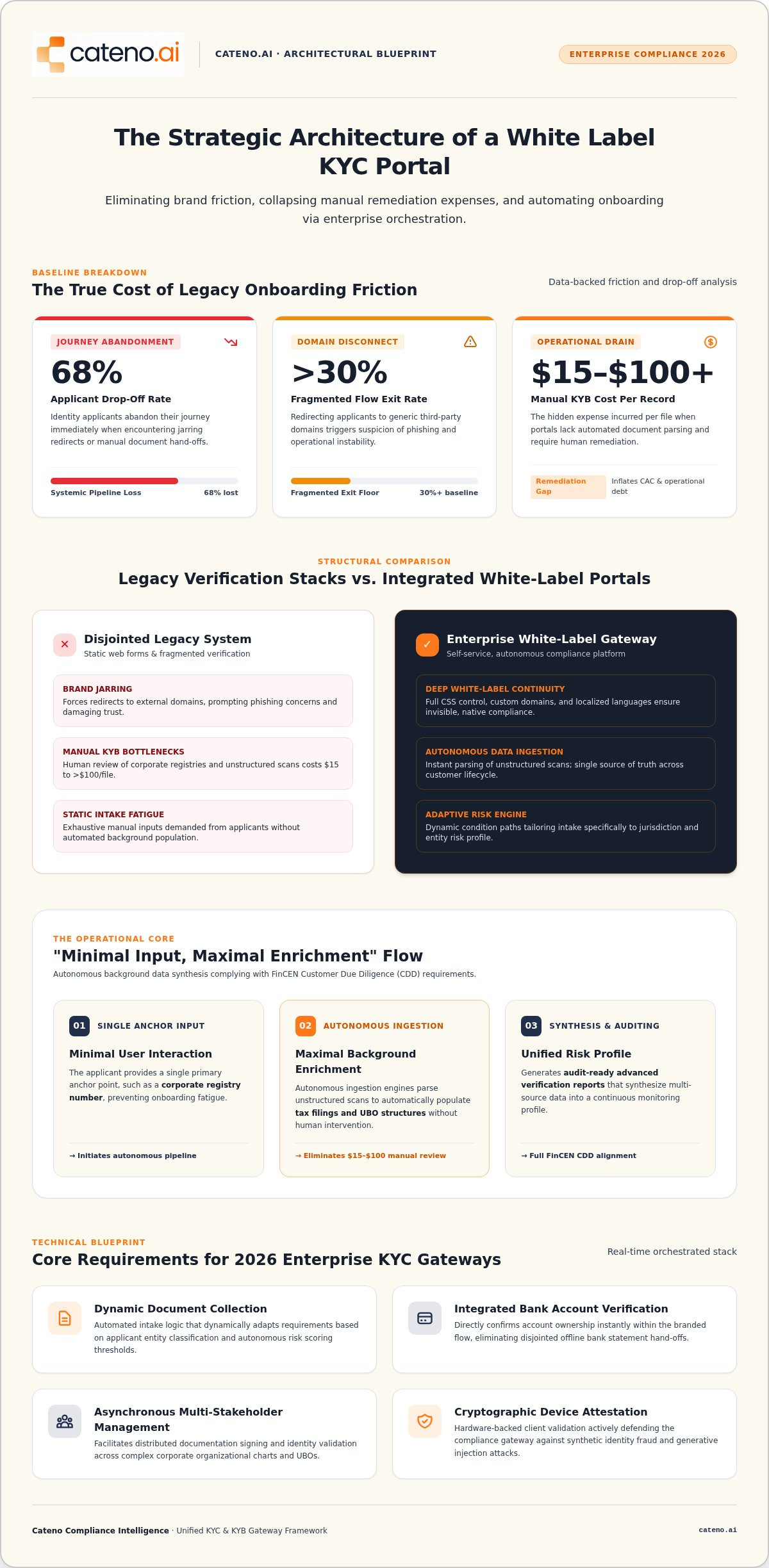
Nearly 68% of digital identity applicants abandon their journey when they encounter jarring redirects or manual document hand-offs. This systemic friction represents more than a lost lead. It's a failure of operational orchestration that inflates acquisition costs and erodes brand authority. Implementing a sophisticated white label kyc portal offers a definitive resolution to this challenge. You recognize that compliance shouldn't be a bottleneck, yet the technical debt required to build a proprietary verification stack is often prohibitive.
By embedding automated document collection and autonomous risk scoring directly into your ecosystem, you preserve brand continuity without sacrificing regulatory rigor. This guide provides a strategic roadmap for deploying sophisticated onboarding gateways that scale in 2026. We'll examine how to transition from disjointed legacy systems to a streamlined, enterprise-ready architecture that treats compliance as a competitive advantage. Discover how to eliminate friction while maintaining the structural integrity of your brand's aesthetic. We'll also explore the shift toward autonomous agents that handle complex data ingestion with precision.
Key Takeaways
- Understand how a sophisticated white label kyc portal eliminates "brand jarring" to reduce onboarding drop-off rates and maintain aesthetic integrity.
- Identify the core functional requirements for 2026 compliance stacks, including customizable workflow engines and integrated bank account verification.
- Learn why the industry is moving beyond static web forms toward autonomous compliance agents that handle document intake and risk synthesis.
- Discover a strategic implementation framework for assessing technical debt and mapping user journeys to identify high-friction verification touchpoints.
- Explore how a unified platform for KYC and KYB can lower acquisition costs through a "minimal input, maximal enrichment" onboarding philosophy.
Defining the Strategic Value of a White Label KYC Portal
A white label kyc portal functions as a fully branded, self-service gateway designed to facilitate identity verification without compromising the host’s visual identity. It acts as a bridge between complex Know Your Customer (KYC) regulations and a seamless customer journey. By outsourcing the UI/UX layer of compliance, enterprises significantly reduce technical debt and avoid the maintenance burden of building verification stacks in-house. This architecture ensures that the compliance engine remains a strategic orchestrator rather than a development bottleneck. It's a solution that prioritizes both regulatory integrity and operational agility.
Beyond aesthetics, the portal serves as a unified repository for entity data. This maintains a single source of truth across the entire lifecycle of a customer. A common failure in traditional systems is the hidden cost of manual KYB handling within the portal experience. When a portal lacks automated document parsing, businesses often face costs ranging from $15 to over $100 per record for manual remediation. An enterprise-grade portal eliminates these redundancies through automated data ingestion. It emphasizes a philosophy where minimal user input triggers deep background enrichment, ensuring that every piece of information is captured accurately and stored securely.
The Psychology of Brand Trust in Compliance
Fragmented onboarding flows frequently lead to abandonment rates exceeding 30%. When users are redirected to a generic third-party domain, they often suspect phishing or technical instability. Establishing authority requires a consistent visual identity and a professional UX that mirrors the core product. This consistency reassures users that their sensitive data is handled with structural integrity. Invisible compliance creates a frictionless environment where regulatory requirements feel like a natural extension of the product journey, fostering long-term user loyalty.
Beyond the Logo: What Deep White-Labeling Actually Means
True white-labeling extends far beyond placing a logo on a header. It involves full CSS control, custom domains, and localized language support to meet regional requirements. These portals allow firms to tailor workflows to specific risk profiles or jurisdictions, ensuring that a high-risk entity receives a different verification path than a low-risk one. Integrating these self-service gateways into existing product ecosystems through the Cateno platform allows for a unified experience that scales with operational growth. It isn't just about appearance; it's about providing a cohesive environment that supports complex, multifaceted systems without adding friction.
Functional Requirements for Enterprise-Grade KYC Gateways
Enterprise-grade compliance in 2026 requires a shift from simple data collection to strategic orchestration. A sophisticated white label kyc portal isn't merely a visual skin; it's a technical gateway that executes complex logic in real-time. This infrastructure supports automated KYC and KYB checks that activate immediately upon user interaction. To maintain high conversion rates, the portal must provide:
- Dynamic document collection based on entity type and risk scoring.
- Integrated bank account verification to confirm ownership instantly.
- Asynchronous document management for multi-stakeholder workflows.
- Cryptographic device attestation to combat generative injection attacks.
The Customizable Workflow Engine
Efficiency depends on the ability to build conditional logic that adapts to the applicant. Modern systems prioritize a "minimal input, maximal enrichment" philosophy. An anchor data point, such as a corporate registry number, should trigger background population of tax filings and UBO structures. Connecting your portal to the Cateno platform facilitates this seamless orchestration. It allows for the autonomous parsing of unstructured scans without manual intervention. This approach minimizes user fatigue while maintaining strict adherence to FinCEN Customer Due Diligence (CDD) requirements.
Verification Integrity and Reporting
Technical competence in a portal is measured by its ability to provide audit-ready advanced verification reports. These reports synthesize data from multiple sources into a single risk profile, allowing for continuous monitoring of compliance status. Integrating real-time bank account verification at the point of entry is critical. This step validates the account's status and prevents fraud before it enters your ecosystem. For organizations looking to modernize their stack, you might speak with a compliance specialist to evaluate your current workflow.
Document management systems within the gateway must support asynchronous updates. This allows users to save their progress and return later, which is essential for complex KYB processes where multiple documents are required. In an era where deepfake identity fraud accounts for 11% of global attempts, hardware-backed validation is no longer optional. These features ensure that the white label kyc portal remains a secure, high-performance partner in your regulatory strategy.
The Evolution of Onboarding: From Static Forms to Autonomous Agents
Static web forms are a relic of a previous operational era. They rely on rigid decision trees that fail to account for the complexity of modern corporate structures. In contrast, a sophisticated white label kyc portal now utilizes autonomous compliance agents to orchestrate the entire verification lifecycle. These agents move beyond simple data entry. They ingest unstructured data, parse complex corporate filings, and synthesize multi-source risk reports before a human ever intervenes. This shift aligns with the latest NIST Digital Identity Guidelines, which emphasize high-assurance identity proofing and synthetic fraud mitigation.
Implementing these agents reduces manual review times by up to 80%. This allows compliance teams to focus on high-risk remediation rather than administrative data entry. By deploying these tools, enterprises shift from a reactive stance to a position of technical control. The technology acts as a strategic filter, ensuring that only verified, high-quality data enters your internal systems. It's a fundamental change in how organizations manage risk at scale.
Leveraging Autonomous Agents for Intake
Agents don't just collect; they communicate. If a document is blurry or an article of incorporation is missing a page, the agent identifies the error and resolves the discrepancy with the user in real-time. This reduces the burden on internal compliance teams by automating follow-ups that previously required manual oversight. These AI agents act as a steady hand in a complex environment, ensuring every submission meets required technical standards. They utilize an initial anchor data point, such as a registry number, to auto-populate corporate records and tax filings in the background. This ensures the user experience remains frictionless while the backend remains rigorous.
Proactive Lifecycle Management
Onboarding is no longer a one-time event. Proactive lifecycle management involves monitoring business partners for shifts in ownership, sanctions status, or regulatory standing. A white label kyc portal equipped with autonomous agents can trigger re-verification automatically when a specific risk threshold is crossed. This moves the organization away from periodic reviews toward continuous oversight. This transition from reactive verification to proactive monitoring is detailed further in our KYC Verification Guide: Modernizing Compliance for 2026. By maintaining a constant pulse on entity status, you ensure your ecosystem remains secure long after the initial gateway is cleared. This persistent vigilance is the hallmark of an enterprise-ready compliance strategy.
Implementation Framework: Integrating a Branded Portal
Deploying a sophisticated white label kyc portal requires a methodical transition from legacy infrastructure to modular architecture. Organizations often underestimate the systemic friction caused by fragmented onboarding stacks. Before integration begins, you must assess the existing technical debt within your customer verification flow. This involves identifying manual hand-offs and outdated if/else decision trees that hinder scalability. Successful implementation ensures that compliance becomes a seamless layer of the product experience rather than an isolated hurdle.
Mapping user journeys is a critical step in this framework. You should identify high-friction touchpoints where users typically abandon the process, such as jarring redirects to third-party domains. By resolving these bottlenecks, you directly lower customer acquisition costs. The goal is to create a unified narrative of optimization where the user feels guided by a steady hand. This requires a shift from viewing compliance as a checkbox to treating it as a strategic orchestrator of the customer relationship.
Reducing Technical Debt in Customer Onboarding
Maintaining in-house verification systems involves significant hidden costs, particularly regarding regulatory updates and security maintenance. A modular white label kyc portal allows for rapid deployment across diverse industries without requiring a full rebuild of the core engine. This flexibility is essential for handling high-volume spikes during market expansions or product launches in 2026. By outsourcing the UI/UX and orchestration layers, your engineering team can focus on core product features. This strategic move eliminates the burden of managing complex verification telemetry and hardware-backed liveness checks internally.
Selecting the right integration path depends on your internal resources and desired speed to market. Low-code portal hosting offers the fastest deployment route, providing a secure environment with minimal engineering effort. Conversely, deep API integration provides total control over the data flow for highly specialized use cases. Regardless of the path, cross-departmental alignment between compliance, product, and engineering is mandatory. Each stakeholder must understand how the portal impacts user conversion and regulatory reporting to ensure a unified operational strategy.
Best Practices for Branded Portals
Designing for a mobile-first compliance experience is a requirement in 2026. Users expect to complete verification on their devices without encountering broken layouts or confusing instructions. Accessibility and clear communication during the document collection process are vital to preventing drop-offs. For a deeper look at optimizing these flows, consult our Self-Service Onboarding Guide for B2B Growth. Every interaction within the gateway should reinforce brand trust through consistent visual cues and technical reliability. If you're ready to modernize your onboarding architecture, schedule a strategic consultation with our team to discuss your specific requirements.
Orchestrating Growth with Cateno’s Branded Compliance Solutions
Cateno functions as a strategic orchestrator for enterprises that require sophisticated B2B workflows without the burden of manual oversight. By providing a unified platform for automated KYC, KYB, and bank account verification, we enable your organization to maintain a single source of truth for all entity data. This integration eliminates the redundancy often found in disjointed verification stacks. It allows your brand to focus on aggressive market expansion while our infrastructure handles the operational friction. Our foundational promise centers on enterprise-ready security and reliability. This ensures that your compliance architecture remains stable even under high-volume demand. It's about building a system that projects technical competence at every touchpoint.
The Cateno Advantage
The core of our solution is a customizable workflow engine tailored to your specific operational logic. This system allows you to build conditional paths that adapt to the risk profile of each applicant. Our autonomous compliance agents transform the intake of business partners by parsing unstructured documents and synthesizing risk reports in real-time. This level of automation is no longer a luxury. 2026 is the year to move beyond manual compliance tasks that drain resources and slow down revenue generation. By leveraging our white label kyc portal, you ensure that every onboarding journey is both technically rigorous and aesthetically consistent. We provide the structural integrity required to scale your operations without adding headcount.
Getting Started: From Friction to Efficiency
The transition toward a streamlined onboarding experience begins with a thorough evaluation of your current system's health. You must identify where technical debt is accumulating and where users are experiencing systemic friction. Once these bottlenecks are identified, the path to optimization becomes clear. We invite you to explore our pricing models to see how our platform scales with your business needs. Booking a demo allows you to witness the precision of our autonomous agents and the flexibility of our branded customer portals firsthand. Our team provides the guidance necessary to integrate these tools into your existing ecosystem with minimal disruption.
The decision to modernize your compliance stack is a commitment to operational excellence. It's about moving from a reactive state to a position of bold innovation. We provide the technical competence and steady hand required to manage complex regulatory environments with ease. You don't have to choose between a seamless user experience and regulatory integrity. Streamline your compliance with Cateno’s White Label KYC Portal and convert your verification process into a driver of enterprise growth.
Mastering Operational Agility Through Sophisticated Compliance
Scaling in 2026 requires a definitive departure from disjointed legacy systems that inflate acquisition costs and erode user trust. You've seen how a white label kyc portal acts as a strategic orchestrator, preserving brand continuity while automating complex verification telemetry. By transitioning to autonomous compliance agents, your organization replaces manual review bottlenecks with a high-performance technological partner. This shift ensures that every onboarding journey is both technically rigorous and aesthetically consistent across your entire ecosystem.
Efficiency isn't just about speed; it's about structural integrity. Implementing a branded customer portal equipped with automated KYB/KYC verification allows your leadership to focus on bold innovation rather than administrative friction. It's time to eliminate the technical debt of in-house stacks and embrace an enterprise-ready solution that grows with your demands. Automate your compliance workflow with Cateno’s enterprise-ready portal to secure your growth trajectory. We're ready to help you orchestrate a more efficient and secure future.
Frequently Asked Questions
What is a white label KYC portal?
A white label kyc portal is a fully branded, self-service gateway that allows entities to complete identity verification within your own digital environment. Unlike third-party redirects, it maintains your visual identity while executing complex compliance logic. It serves as a centralized hub for automated KYC and KYB checks and document management, providing a professional and unified experience for your business partners. This architecture ensures that compliance remains a strategic orchestrator rather than a development bottleneck.
How does a branded portal reduce customer onboarding friction?
Branded portals reduce friction by eliminating the brand jarring effect that occurs when users are redirected to unfamiliar domains. By maintaining a consistent UI/UX, you preserve user trust and reduce abandonment rates, which can reach 68% during disjointed journeys. These gateways utilize a minimal input, maximal enrichment philosophy, often requiring only a single piece of information to auto-populate complex registry data in the background. This approach significantly lowers acquisition costs while maintaining regulatory integrity.
Can I integrate my existing verification providers into a white label portal?
Yes, enterprise-grade portals are designed to act as strategic orchestrators of multifaceted systems. Through a customizable workflow engine, you can integrate various verification data sources and bank account validation tools into a single interface. This architecture allows you to maintain your existing provider relationships while consolidating the user experience into a cohesive, branded environment. It's a sophisticated remedy to the technical debt and operational silos often found in legacy in-house verification stacks.
What is the difference between a white label portal and a standard KYC API?
A standard KYC API provides the raw data and logic for verification but requires your team to build and maintain the entire user interface. A white label kyc portal is a comprehensive solution that includes the UI/UX layer, document upload interfaces, and self-service workflows. It significantly reduces the engineering burden by providing a ready-to-deploy gateway that handles the complex telemetry of digital identity proofing. This allows your team to focus on core product growth.
Is a white label KYC portal secure enough for banking-level compliance?
Modern portals are engineered to meet the most rigorous regulatory standards, including FinCEN Customer Due Diligence (CDD) requirements and NIST Digital Identity Guidelines. They utilize hardware-backed sensor validation and 3D flash reflection analysis to combat generative injection attacks and deepfake fraud. These systems provide the structural integrity and advanced verification reports necessary for banking-level audit trails. This ensures a steady hand in a complex environment where data integrity and accuracy are paramount.
How long does it typically take to implement a branded onboarding gateway?
Implementation timelines vary based on the level of technical integration required. Low-code portal hosting can often be deployed within a few weeks, providing a secure and branded environment with minimal engineering effort. Deep API integrations for highly specialized B2B workflows may take longer, but the modular nature of the platform ensures a streamlined path forward. This methodical approach ensures that the transition from systemic friction to efficiency is both fast and reliable for your organization.
What are the costs associated with white label KYC software?
Pricing for enterprise compliance platforms typically follows a subscription model or a per-transaction structure based on the volume of KYC and KYB checks performed. These costs are often offset by the significant reduction in manual remediation expenses, which range from $15 to $100 per record in legacy systems. Organizations should evaluate their specific volume and workflow complexity to determine the most efficient model. This results-driven approach reassures the reader of technical competence and long-term reliability.


