

Seventy percent of financial institutions report losing valuable commercial clients due to slow, fragmented onboarding processes, watching prospective revenue dissolve into multi-week operational backlogs. Sifting through static filings, untangling opaque multi-tiered ownership hierarchies, and cross-referencing disparate registries shouldn't stall your operational pipelines or burden your analysts. Modern digital kyb verification fundamentally redefines this dynamic, converting what was once an error-prone manual checkpoint into an automated, high-velocity data orchestration pipeline.
In this guide, you will discover how digital KYB verification transforms business due diligence from a weeks-long friction point into an automated workflow, accelerating partner and merchant onboarding from days to seconds while eliminating compliance liabilities. We break down the technical architecture underpinning modern verification engines, establish an actionable evaluation framework for recursive UBO mapping and risk scoring, and demonstrate how to transition from static point-in-time reviews to continuous, event-driven monitoring.
Key Takeaways
- Understand how modern digital kyb verification replaces fragmented document collection with an automated, multi-layered data orchestration pipeline.
- Discover how graph-based resolution engines programmatically unravel multi-tiered corporate hierarchies and recursive beneficial ownership structures in real time.
- Identify the operational bottlenecks, regulatory liabilities, and conversion losses inherent in legacy manual spreadsheet reviews.
- Learn the architectural blueprint for decoupling verification workflows from core application logic to maintain agility amid shifting global compliance mandates.
- Explore how autonomous compliance agents and customizable workflow engines activate complete commercial due diligence starting from a single business data point.
What Is Digital KYB Verification and Why Does Business Onboarding Demand It?
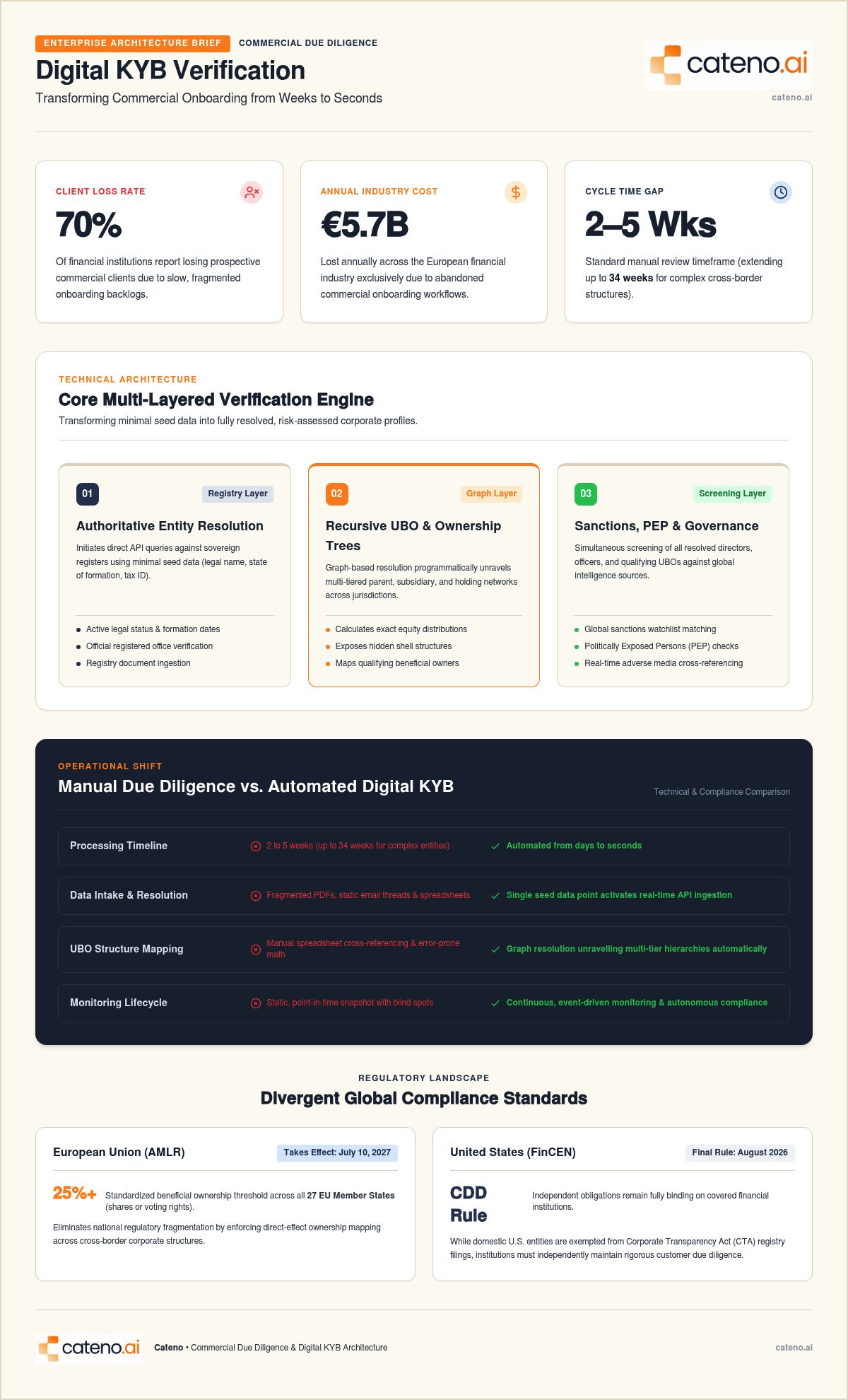
Digital KYB verification is the programmatic evaluation of commercial entities, operational standings, and corporate governance structures. Unlike consumer identity checks that parse a single identity document, verifying a commercial counterparty requires unwinding legal formations, active operational authorizations, and ultimate beneficial ownership (UBO) structures. Modern compliance mandates demand this level of rigor. In Europe, the Anti-Money Laundering Regulation (AMLR) standardizes beneficial ownership thresholds across all 27 EU Member States at 25% or more of shares or voting rights, taking direct effect on July 10, 2027. Concurrently, while FinCEN published its Final Rule in August 2026 exempting domestic U.S. entities from Corporate Transparency Act (CTA) registry filings, covered financial institutions remain bound by independent obligations under FinCEN's Customer Due Diligence (CDD) Rule. Managing these divergent global standards demands automated, highly orchestrated data pipelines.
The Structural Difference Between KYC and Digital KYB
Standard retail verification confirms a single human identity against a sovereign database. B2B due diligence requires validating legal entities through multi-layered corporate hierarchies. As detailed in the broader literature surrounding Know Your Customer and KYB regulations, establishing customer due diligence for a corporate entity requires cross-referencing disparate evidentiary layers:
- Registry Legal Existence: Confirming active status, formation dates, and registered offices across official registries like UK Companies House or state filings.
- Hierarchical Ownership Trees: Mapping complex parent, subsidiary, and holding networks across opaque international jurisdictions to calculate exact equity distributions.
- Sanctions and Governance Cross-Referencing: Screening all discovered directors, officers, and qualifying UBOs against global watchlists, PEP databases, and adverse media sources.
When institutions rely on superficial verification, shell companies and fraudulent commercial actors slip past initial reviews. A modern digital kyb verification pipeline resolves corporate graphs programmatically, exposing deceptive structures before accounts are activated.
The True Cost of Legacy Business Due Diligence
Manual commercial onboarding is an operational bottleneck. Traditional due diligence cycles drag on for 2 to 5 weeks on average, and complex cross-border structures can take up to 34 weeks of analyst time. Compliance teams spend hours tracking email threads, reviewing PDF documents, and copying records between spreadsheets. This manual operational overhead creates steep commercial attrition. According to Fenergo research, abandoned onboarding workflows cost the European financial industry approximately €5.7 billion per year, with 70% of financial institutions losing corporate clients to slow, inefficient reviews.
Disjointed point solutions create severe technical debt and increase human error. Instead of burdening applicants with static document requests, modern enterprises deploy unified, automated infrastructure like a business onboarding workflow engine to turn weeks of manual intake into low-latency, automated decisions.
How the Digital KYB Verification Engine Works: Core Architectural Layers
Modern enterprise compliance demands replacing fragmented manual checks with an automated multi-stage architecture. A production-ready digital kyb verification pipeline coordinates data ingestion, authoritative record querying, recursive graph traversal, and holistic risk evaluation into a unified operational sequence. By converting raw inputs into verified corporate profiles, this engine eliminates weeks of administrative friction while enforcing strict institutional governance.
Authoritative Registry Ingestion and Entity Resolution
The verification sequence begins at the ingestion layer. A robust architecture accepts minimal seed data, such as a legal corporate name, state of incorporation, or tax identifier, and initiates real-time API queries against authoritative public registers. Connecting directly to government repositories like UK Companies House, state registries, or the Global Legal Entity Identifier Foundation (GLEIF) eliminates reliance on static, easily falsified PDF utility bills and registration certificates. Automated entity resolution algorithms normalize company naming conventions, bridge historical address updates, and resolve minor typographical errors to pinpoint the exact legal subject.
Automated Ultimate Beneficial Ownership (UBO) Graph Analysis
Uncovering corporate transparency requires untangling multi-jurisdictional holding structures. Modern verification platforms deploy graph data models that recursively map parent organizations, subsidiaries, and intermediate entities across international jurisdictions. This programmatic unwrapping calculates direct and indirect equity allocations to expose all individuals crossing statutory thresholds.
Under regulatory frameworks like FinCEN's Customer Due Diligence (CDD) Final Rule, institutions must verify individuals holding significant equity or operational control. Once the graph engine isolates these qualifying beneficial owners, it hands them off programmatically to integrated kyc automation software for identity validation, liveness checks, and document authentication.
Continuous Risk Screening and Sanctions Intelligence
After isolating the corporate shell and its executive controllers, the risk engine executes multi-dimensional screening against live datasets. The architecture cross-references every node against global watchlists, including OFAC, EU, and UK sanctions registries, as well as Politically Exposed Persons (PEP) repositories. Machine learning models evaluate adverse media sentiment across international news feeds, filtering out irrelevant noise to avoid analyst alert fatigue.
Instead of delivering raw, unstructured data feeds, the engine synthesizes registry standing, UBO profiles, and watchlist hits into a unified risk rating. If you want to evaluate how an automated compliance engine integrates with your existing tech stack, speak with a technical specialist.
Manual Due Diligence vs. Automated Digital KYB: Technical Comparison
Manual commercial due diligence relies on human analysts copying data across disconnected spreadsheets, static PDFs, and disparate web portals. This legacy operational model generates compounding friction, introduces human error, and inflates review overhead. Automated digital kyb verification replaces manual reviews with an event-driven architecture that standardizes inputs, executes programmatic validations, and produces deterministic outcomes. Industry benchmarks show that transitioning to automated verification engines delivers an average 60% reduction in end-to-end onboarding latency, a 67% decrease in manual analyst interventions, and a 50% uplift in applicant conversion rates.
| Dimension | Manual Due Diligence | Automated Digital KYB |
|---|---|---|
| Processing Latency | 2 to 5 weeks across sequential email checkpoints | Sub-second querying to minutes for edge-case resolutions |
| Operational Overhead | High analyst involvement; repetitive data extraction | Exceptions-only routing; analysts focus on high-risk anomalies |
| Data Integrity | Subjective notes; vulnerability to forged documentation | Deterministic matching against authoritative primary sources |
| Audit Preparedness | Fragmented paper files, emails, and local drives | Centralized, time-stamped, machine-readable audit logs |
Operational Efficiency and Time-to-Revenue Metrics
Legacy onboarding traps commercial accounts in administrative queues. Chasing prospective corporate clients for updated certificates of good standing or proof of operational address consumes valuable operational hours. Automated digital kyb verification eliminates this intake friction by verifying commercial counterparties programmatically at ingestion. By validating entity legitimacy and ownership structures instantly, institutions convert prospective accounts immediately, activating transactional volume and realizing commercial revenue weeks ahead of legacy timelines.
Data Integrity, Standardization, and Audit Preparedness
Subjective analyst evaluations create inconsistent compliance outcomes. A manual reviewer evaluating a corporate formation document might overlook an undisclosed subsidiary or miss subtle alterations in a financial statement. In contrast, modern compliance platforms apply rigorous cryptographic and identity benchmarks consistent with the NIST Digital Identity Guidelines, confirming identity proofing levels and authenticating organizational credentials programmatically.
Automated platforms compile complete evidentiary artifacts into immutable compliance files. These workflows integrate automated bank account validation directly into the onboarding pipeline, matching registered legal names against institutional account ownership records to prevent corporate payment diversion fraud. Centralizing verified filings, ownership graphs, and bank validations within structured audit logs ensures institutions satisfy rigorous regulatory scrutiny without manual document reconstruction.
Evaluating Digital KYB Architecture: A Blueprint for Risk and Compliance Teams
Engineering an enterprise-grade digital kyb verification pipeline requires decoupling compliance rules from core application codebases. Hardcoding risk thresholds, registry calls, or document requirements directly into product repositories introduces severe technical debt, requiring engineering sprints whenever statutory mandates change. A modular architecture establishes five foundational pillars: data depth, workflow customization, self-service intake, low-latency execution, and audit governance. Risk and compliance leaders must evaluate solutions through a structured architectural framework.
Step 1: Assess Registry Coverage and Entity Resolution Precision
A resilient verification engine connects directly to primary sources, querying all 50 Secretary of State registries, international registers, and corporate registries natively. Systems must resolve ambiguous business names, DBAs, and historical jurisdictional reorganizations without human intervention. Ensure your target architecture supports single-identifier onboarding, where a single corporate tax number, entity name, or Legal Entity Identifier (LEI) cascades automatically into full corporate profile discovery.
Step 2: Require Flexible Orchestration and Self-Service Portals
Modern compliance teams need autonomy to adjust onboarding rules without developer support. Deploying a customizable workflow engine allows non-technical risk teams to modify decision trees, adjust equity thresholds, and establish country-specific escalation pathways on demand. Coupling this dynamic logic with a branded self service onboarding platform ensures commercial applicants encounter intuitive interfaces that guide them through identity verification and document uploads without operational friction.
Step 3: Mandate Continuous Monitoring and Lifecycle Management
Entity verification cannot remain a static, one-time gateway. Corporate status changes constantly as leadership rotates, holding companies restructure, or litigation emerges. Modern enterprise architecture shifts from periodic batch reviews to event-driven perpetual KYB. Evaluate platforms across three critical monitoring capabilities:
- Asynchronous Webhook Alerts: Immediate notifications whenever an onboarded entity undergoes changes in corporate standing, state forfeiture, or jurisdictional registration.
- Automated Re-Screening Triggers: Event-based execution of sanctions, PEP, and adverse media checks whenever underlying UBO or board member configurations change.
- Dynamic Compliance File Updates: Real-time regeneration of audit-ready compliance dossiers ensuring historical entity states remain completely traceable.
Testing these capabilities within a sandbox environment reveals how gracefully a platform handles edge-case timeouts and fallback routing. To examine how modern orchestration streamlines B2B onboarding across your tech stack, schedule a platform architecture consultation.
Automating Commercial Due Diligence with Cateno: Built for Enterprise Scale
Cateno translates enterprise architecture theory into operational reality. By replacing fragmented verification tools with a unified compliance orchestration layer, Cateno automates commercial due diligence from end to end. The platform’s customizable workflow engine triggers comprehensive digital kyb verification starting from a single piece of business information. It programmatically queries authoritative registries, unwinds multi-tiered ownership hierarchies, and computes holistic risk scores without demanding repetitive manual data entry from the applicant.
Engineered for Rapid Intake and Seamless Governance
Commercial partners expect effortless onboarding. Cateno delivers a self-service onboarding gateway paired with a branded customer portal, providing business applicants with an intuitive, white-label experience that maintains institutional trust. The intake engine dynamically requests only the specific documentation required for each entity type and jurisdiction, removing friction from the user journey.
Behind this interface, autonomous compliance agents manage routine document intake, validate uploaded credentials, and eliminate repetitive manual review cycles. When complex ownership patterns or watchlist anomalies emerge, these agents triage the findings and route exceptions directly to compliance officers. Every event generates advanced verification reports that deliver immutable, audit-ready documentation for internal governance and external regulatory oversight.
Unifying Entity Validation, Identity, and Bank Verification
Managing isolated point solutions for corporate registry checks, individual identity proofing, and payment routing creates severe operational fragmentation. Cateno eliminates these siloes by consolidating automated KYC and KYB checks with real-time bank account verification inside a single cloud-based architecture. Risk teams no longer need to cross-reference disparate vendor databases or reconcile disconnected risk signals manually.
This consolidated model accelerates commercial time-to-revenue while protecting institutions against counterparty fraud and regulatory exposure. Risk and compliance leaders can explore the technical capabilities of the Cateno compliance platform to modernize intake pipelines, and evaluate tailored deployment models across regulated sectors through Cateno industry solutions.
Architecting the Future of Commercial Due Diligence
Legacy due diligence workflows are no longer sustainable for organizations operating in high-velocity B2B markets. Treating compliance as a manual document collection checkpoint creates high drop-off rates, inflates overhead, and exposes institutions to unseen regulatory liabilities. Modern digital kyb verification redefines this dynamic by establishing an automated, event-driven data pipeline that converts weeks of administrative friction into instant, defensible onboarding decisions.
Achieving this level of operational performance requires a unified technical foundation. By initiating entity onboarding from a single piece of business data, modern architectures programmatically unwrap complex ownership networks in seconds. Deploying autonomous compliance agents eliminates repetitive review cycles, while combining automated KYB, KYC, and bank account validation inside a single engine guarantees complete data integrity across every stage of the commercial lifecycle.
Building scalable compliance doesn't have to strain your engineering or operations teams. Schedule an architectural demonstration with Cateno to accelerate partner activation, streamline reviews, and future-proof your regulatory operations.
Frequently Asked Questions
What is the primary difference between digital KYB verification and traditional KYB?
Traditional KYB relies on manual document collection, human spreadsheet reviews, and multi-week processing latency across disparate portals. In contrast, digital kyb verification automates business due diligence via API integrations into authoritative government registries, legal entity databases, and sanctions lists. Rather than waiting weeks for paper certificates, digital pipelines extract corporate records, unwind ownership trees, and validate entity legitimacy in seconds.
How does automated digital KYB identify Ultimate Beneficial Owners across layered structures?
Automated engines utilize recursive graph processing to map complex parent-subsidiary hierarchies and cross-border holding entities. The system interrogates corporate records programmatically, calculating direct and indirect ownership percentages at each tier. Once a natural person meets the defined regulatory threshold, such as 25% equity or managerial control, the engine initiates automated identity checks and sanctions screening for that individual.
Can digital KYB verification integrate directly with existing risk management and core systems?
Yes, modern digital kyb verification architectures integrate via REST and GraphQL APIs or low-latency webhooks into existing ERP, CRM, and risk orchestration stacks. Decoupling verification logic from core codebases allows compliance teams to configure rules without engineering intervention. This programmatic connection ensures customer records, risk scoring, and verification artifacts synchronize directly with internal case management tools in real time.
What documents and data points are required to initiate a digital KYB check?
Modern verification engines don't require extensive paper submissions up front. Intake can begin with a single data point, such as a registered corporate name, tax identification number, or Legal Entity Identifier (LEI). The system automatically retrieves formation filings, active standing certificates, and registry documents. Applicants only supply supplementary documentation if automated sources yield discrepancies or require secondary review.
How does digital KYB address ongoing compliance after initial partner onboarding?
Digital platforms replace periodic manual reviews with perpetual KYB monitoring driven by automated event feeds. Platforms track registries, adverse media, and global watchlists continuously for material changes to an entity's status, leadership, or ownership structure. When a change occurs, autonomous compliance agents trigger automated re-screening workflows and alert compliance officers immediately.
Is digital KYB verification compliant with federal regulatory and AML requirements?
Yes, enterprise digital platforms align strictly with statutory mandates, including FinCEN's Customer Due Diligence (CDD) Rule and international anti-money laundering frameworks. The architecture generates time-stamped, tamper-evident audit trails that document every registry query, beneficial ownership calculation, and sanctions screening result. These structured verification reports satisfy regulatory examination standards and internal compliance audit requirements.
What happens when an automated digital KYB check encounters ambiguous corporate data?
When algorithmic parsing encounters conflicting jurisdiction filings, fuzzy name matches, or incomplete ownership chains, the workflow engine routes the record into an exception queue. Autonomous compliance agents triage the anomaly, gather secondary source corroboration, or prompt the applicant via a branded portal for clarification. This keeps low-risk entities on straight-through processing while focusing analyst attention where human judgment is strictly required.


