

A multi-tiered corporate structure can turn routine onboarding into weeks of administrative paralysis. When compliance teams must cross-reference fragmented registries, decipher opaque holding companies, and manually reconstruct ownership trees in spreadsheets, backlogs inevitably surge. Implementing automated UBO verification transforms this dynamic, replacing manual registry parsing with real-time structural analysis that surfaces true beneficial owners in seconds.
You already know the friction of losing prospective enterprise clients to protracted review cycles, all while evolving FinCEN due diligence mandates demand deeper scrutiny. Parsing complex filings by hand simply doesn't scale, leaving compliance officers buried under clerical data collection while high-risk anomalies slip through the cracks.
This guide demonstrates how automated UBO verification unwraps multi-tiered corporate structures, satisfies regulatory mandates, and eliminates onboarding friction. Ahead, we break down the operational mechanics of entity graph traversal, key regulatory benchmarks, and modern workflow architectures designed to automate corporate verification with total confidence.
Key Takeaways
- Deploy automated UBO verification to replace static spreadsheets with real-time graph unwrapping across complex corporate hierarchies.
- Calculate aggregate direct and indirect equity dynamically to satisfy FinCEN ownership thresholds without manual investigation backlogs.
- Eliminate reliance on stale credit bureau feeds by connecting directly to primary corporate registries for authoritative ownership discovery.
- Implement a structured four-stage ingestion and verification framework that accelerates onboarding from weeks down to minutes.
- Leverage autonomous compliance agents and customizable workflow engines to resolve multi-tiered ownership structures from a single initial data point.
The Operational Reality of Beneficial Ownership: Why Manual Verification Fails
Manual beneficial ownership validation has reached an operational breaking point. Technically defined, automated ubo verification is the programmatic discovery and resolution of natural persons who ultimately own or control a legal entity. Modern commercial applicants rarely present simple capitalization tables. Instead, compliance teams confront nested holding companies, cross-border special purpose vehicles (SPVs), and nominee arrangements designed to obscure operational control. Untangling these multi-tiered hierarchies manually forces analysts into an endless cycle of pulling state filings, transcribing charts, and chasing documentation. It is slow, vulnerable to human error, and fundamentally unscalable.
Deconstructing the Regulatory Mandates for UBO Compliance
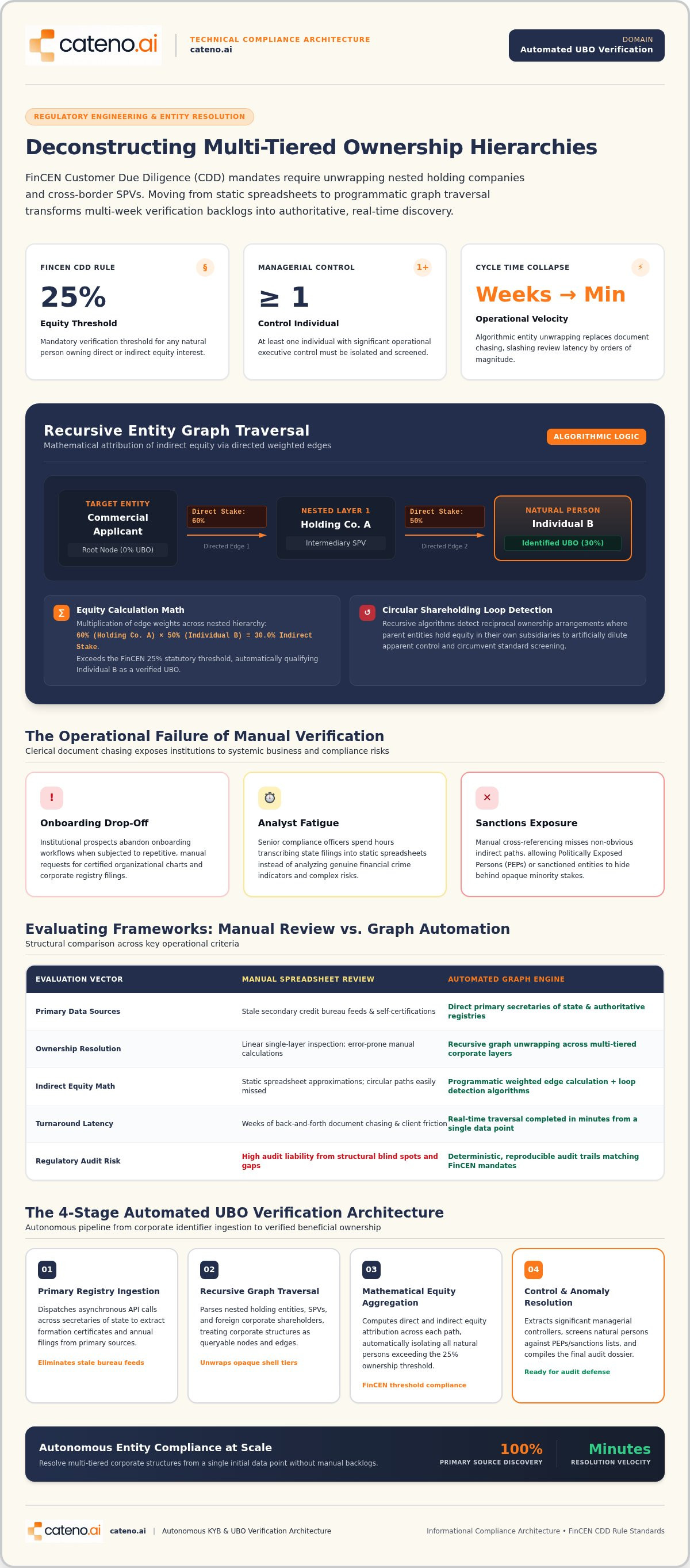
Regulatory frameworks hold institutions strictly accountable for peeling back corporate layers. Under FinCEN's Customer Due Diligence (CDD) framework, covered entities must identify and verify every beneficial owner who directly or indirectly owns 25 percent or more of the equity interests, alongside at least one individual with significant managerial control. Determining indirect equity across multi-layered holding entities requires complex mathematical aggregation, not simple surface checks. With regulatory bodies shifting enforcement focus toward institutional negligence and structural blind spots, relying on unverified self-certifications creates immediate audit liability.
The Hidden Operational Costs of Manual Document Chasing
Manual due diligence introduces severe drag across the entire corporate lifecycle. Requesting, reviewing, and reconciling registry extracts across disconnected repositories consumes weeks per account. This manual intervention produces distinct business risks:
- Onboarding Drop-Off: Institutional clients abandon intake workflows when subjected to disjointed, repetitive requests for certified organizational charts and identity records.
- Analyst Fatigue: Senior compliance personnel spend hours on clerical data entry rather than evaluating genuine financial crime anomalies.
- Sanctions Exposure: Manual cross-referencing often misses indirect ownership links, allowing sanctioned individuals or politically exposed persons (PEPs) to remain obscured behind minority holdings.
Modern institutions cannot resolve structural opacity using spreadsheets and manual registry searches. Adopting automated UBO verification solves this structural bottleneck by replacing manual data assembly with instant, programmatic ownership resolution.
How Automated UBO Verification Works: Deconstructing Complex Hierarchies
Deconstructing corporate hierarchies requires moving beyond static list matching to dynamic graph unwrapping. Modern automated ubo verification relies on algorithmic traversal to ingest corporate identifiers, query primary registries, calculate mathematical equity across nested entities, and isolate ultimate control persons. Rather than asking an analyst to trace relationships manually, automated systems transform disconnected public records into structured, queryable entity graphs.
Recursive Entity Unwrapping and Equity Math
Recursive traversal algorithms map ownership paths by treating entities as nodes and shareholding allocations as directed weighted edges. If Company A holds 60% of the target company and Individual B holds 50% of Company A, the system multiplies edge weights along that path to attribute a 30% indirect beneficial stake to Individual B. Beyond linear chains, recursive logic detects circular shareholding loops, flagging entities that hold shares in their parent structures to artificially dilute visible control. For teams modernizing their verification pipelines, our digital KYB verification guide details how these graph models integrate into enterprise architectures.
Registry Traversal Combined with Document Intelligence
Authoritative verification starts at primary sources. Programmatic workflows dispatch asynchronous API calls across secretaries of state to extract articles of incorporation, certificates of formation, and annual filings. When dealing with opaque structures or private entities where digital interfaces do not exist, intelligent document pipelines take over:
- Optical Character Recognition (OCR): Computer vision parses physical scans, operating agreements, and stock ledgers to isolate tabular shareholder distributions.
- Natural Language Processing (NLP): Context-aware models evaluate unstructured text to distinguish legal entity names, officer titles, and nominal agents.
- Cross-Validation: The system automatically reconciles retrieved state records against customer-provided capitalization charts, highlighting discrepancies for human review.
Integrated Watchlist Screening and Control Person Identification
FinCEN benchmarks and broader regulatory expectations around Beneficial Ownership Information (BOI) reporting demand visibility into operational management as well as direct equity. Automated systems instantly route discovered natural persons through global sanctions databases, Politically Exposed Persons (PEP) lists, and adverse media sources. Crucially, the platform evaluates corporate officers, managing members, and general partners possessing executive authority, ensuring individuals exercising operational control face the exact same scrutiny as 25% equity holders.
Institutions ready to eliminate manual registry retrieval can explore the Cateno platform to orchestrate end-to-end entity verification across complex corporate structures.
Evaluating UBO Verification Frameworks: Manual Review vs. Graph Automation
Choosing between legacy review methods and modern graph engines defines an organization's operational velocity. Traditional compliance models depend on human analysts manually reconciling disparate documents, while graph architectures automatically map multi-layered corporate networks. Beneficial ownership transparency is now a non-negotiable benchmark, making the technological gap between manual parsing and automated graph traversal an urgent institutional concern.
| Dimension | Manual Review | Graph Automation |
|---|---|---|
| Cycle Time | Multi-week backlogs per complex entity | Sub-minute structural unwrapping |
| Data Freshness | Stale, pre-aggregated bureau batches | Live queries to primary corporate registries |
| Audit Readiness | Fragmented notes and static spreadsheets | Deterministic graph lineage and system logs |
| Operational Model | Clerical data gathering across teams | Exception-based review of edge anomalies |
Performance Benchmarks: Turnaround Time and Accuracy
Manual approaches crumble when corporate hierarchies expand past two tiers. Calculating indirect equity percentages across layered corporate holdings manually creates substantial math errors, often leading to unverified or overlooked 25% thresholds. Conversely, deploying automated ubo verification compresses multi-week cycles into seconds. It eliminates repetitive documentation requests, dropping abandonment rates and accelerating corporate time-to-revenue without sacrificing precision.
Data Lineage, Explainability, and Regulatory Defensibility
Rigorous regulatory audits reject opaque verification mechanisms. Black-box decision models that simply output a binary approval code fail model risk assessments because they cannot demonstrate how a conclusion was reached. Defensible compliance requires end-to-end data lineage. Modern architectures log every registry call, mathematical calculation, and node traversal, outputting an immutable record of corporate structure resolution. Connecting this transparent audit trail to a unified business onboarding workflow engine ensures compliance officers can instantly prove their due diligence methodology to examiners.
Automated graph engines also transform the analyst's daily function. Instead of manually retyping business data, compliance professionals operate on an exception basis, reviewing only high-risk anomalies, circular structures, or flagged sanctions matches highlighted by the platform.
How to Implement an Automated UBO Verification Workflow: A 4-Stage Guide
Transitioning from manual compliance reviews to an automated architecture requires an intentional ingestion and resolution pipeline. Instead of treating KYB and individual identity checks as isolated steps, enterprise compliance teams combine them into a continuous verification flow. The following four-stage framework outlines the technical execution of modern automated ubo verification.
- Intake: Ingest primary business identifiers through digital customer touchpoints.
- Unwrapping: Query official state registries and execute recursive graph calculations.
- Individual KYC: Route qualifying control persons into dynamic identity validation.
- Audit Packaging: Synthesize complete entity lineage into a unified compliance record.
Stage 1 and 2: Intake Orchestration and Structure Unwrapping
Frictionless onboarding begins by collecting minimal core inputs. Rather than demanding exhaustive documentation upfront, intake gateways capture baseline identifiers such as legal entity name and employer identification number (EIN). The system then dispatches real-time queries to authoritative state business registries to confirm active entity standing, corporate filing dates, and official corporate officers.
Next, the traversal engine executes recursive unwrapping across intermediate corporate layers. It calculates cumulative direct and indirect equity mathematically across every parent entity. If an individual holds 40% of an intermediate entity that owns 70% of the applicant, the calculation engine instantly recognizes a 28% indirect interest. This immediately flags that natural person as meeting the standard 25% threshold without manual analyst intervention.
Stage 3 and 4: Individual KYC Escalation and Audit Generation
Once qualifying beneficial owners and executive control persons are isolated, the platform triggers tailored KYC workflows. Identified stakeholders receive secure, self-service links to complete biometric identity verification and document capture. By keeping the intake modular, applicants verify their own identities without burdening the primary corporate applicant with collecting sensitive personal data.
Finally, the workflow engine compiles the verified corporate lineage, registry filings, and individual KYC results into comprehensive documentation. The engine logs every data source, mathematical path, and screening outcome, creating an exportable audit package ready for supervisory examination. Rather than scrambling to reconstruct historical decisions, compliance teams maintain clear, deterministic proof of regulatory compliance for every onboarded account.
Ready to deploy a streamlined corporate verification workflow? Explore how you can modernize entity compliance across your industry today.
Scaling Modern Entity Compliance: Autonomous Verification with Cateno
Scaling corporate due diligence without expanding overhead requires moving past fragmented point solutions. Disconnected compliance tools create operational silos, forcing teams to reconcile registry outputs in one software while managing individual identity verification and banking details in another. Cateno unifies this stack into a cohesive compliance engine, replacing manual coordination with programmatic execution. By consolidating automated KYC and KYB checks, bank account verification, and automated ubo verification into a single environment, organizations turn cumbersome corporate intake into a competitive advantage.
Orchestrating Frictionless Onboarding from a Single Data Point
Modern verification shouldn't demand exhausting forms from prospective business clients. Cateno initiates end-to-end corporate onboarding starting with a single piece of business information, such as an entity name or tax identifier. From this initial input, the engine traverses public registries, resolves multi-tiered ownership structures, and dynamically populates verified corporate profiles.
Prospective partners interact through a Branded Customer Portal, preserving brand equity and maintaining high conversion rates while capturing vital corporate data. By automating entity discovery upfront, you eliminate repetitive questionnaires and ensure clients only provide what public records cannot furnish. Discover how compliance teams configure these workflows on the Cateno platform.
Autonomous Compliance Agents and Advanced Audit Reports
Edge cases and missing filings often stall standard onboarding pipelines. Cateno resolves these bottlenecks by deploying Autonomous Compliance Agents. When corporate filings require supplemental documentation or shareholder clarification, these intelligent agents manage document collection and reconcile ownership trees directly through a Self-Service Onboarding Gateway, eliminating manual email chasing by human analysts.
Behind the scenes, the Customizable Workflow Engine orchestrates every validation phase, generating comprehensive Advanced Verification Reports. These reports compile verified corporate registries, mathematical equity calculations, and screening logs into exportable, dynamic audit trails. Compliance leaders gain total structural transparency and defensibility across complex corporate networks. Review deployment models and find the right fit for your team on the Cateno pricing page.
Transforming Corporate Verification into an Operational Advantage
Manual registry searches and spreadsheet-based cap tables can't sustain modern institutional growth. Transitioning to automated ubo verification replaces weeks of administrative friction with immediate, mathematically verified clarity. By pairing recursive graph algorithms with live corporate registries, compliance teams resolve complex indirect equity and isolate true control persons without manual overhead.
Sustainable compliance requires an architecture that bridges corporate discovery and individual validation into a single workflow. Cateno enables teams to ingest and verify complex entities starting with a single piece of business information. Deploying autonomous compliance agents removes repetitive document chasing, while dynamic orchestration generates audit-ready verification reports built for rigorous regulatory scrutiny.
Don't let legacy compliance backlogs stall your commercial momentum. Schedule a consultation with Cateno to modernize your corporate onboarding and secure complete structural transparency today.
Frequently Asked Questions
What is automated UBO verification and how does it differ from standard KYB?
Standard KYB confirms that a legal entity exists and operates in good standing, whereas automated ubo verification programmatically identifies and verifies the living human beings who own or control it. While basic business checks inspect registration status and active state filings, automated UBO processes recursively unwrap corporate ownership layers. This isolates the natural persons holding qualifying equity stakes or executive authority, combining entity screening with individual identity validation in a single pipeline.
What ownership percentage legally qualifies an individual as an ultimate beneficial owner?
In the United States, FinCEN's Customer Due Diligence rule sets the benchmark at 25 percent direct or indirect equity ownership. Under this standard, any natural person owning a quarter or more of the company qualifies as a beneficial owner. Regulators also mandate identifying at least one individual who exercises substantial operational control, such as a CEO or managing partner, regardless of whether they hold any equity stake in the organization.
How do automated systems uncover beneficial owners hidden behind layered shell companies?
Systems unmask nested entities by converting corporate filings into mathematical graph networks that calculate indirect equity across every intermediary layer. If a parent company owns a subsidiary, the algorithm traverses upward through each holding company, multiplying ownership percentages down the chain. It flags circular structures designed to dilute visible holdings, immediately alerting compliance analysts to structural anomalies that warrant deeper review.
Can automated UBO software verify foreign entities with complex multi-jurisdictional ownership?
Yes, enterprise platforms connect to global commercial registries and cross-border data networks to resolve international corporate parentage. When foreign entities own domestic subsidiaries, automated workflows query relevant cross-border databases and translate jurisdiction-specific filings into standardized ownership trees. If public foreign registries lack digital records, autonomous compliance agents prompt stakeholders via branded portals to submit certified capitalization tables or organizational certificates to maintain verification continuity.
What happens when an automated system cannot find public registry records for a corporate owner?
When public state registries lack digital shareholding records, automated workflows activate dynamic document fallback protocols. Instead of halting the process, the platform deploys autonomous compliance agents to request certified organizational charts or operating agreements directly through a self-service customer portal. Computer vision and optical character recognition then extract shareholder tables from uploaded files, validating the self-certified data against baseline corporate records to complete the audit trail.
How does automated UBO verification handle ongoing changes to company ownership structures?
Modern automated ubo verification engines monitor authoritative business databases continuously rather than treating ownership checks as static, one-time events. Whenever an entity files amended articles, changes managing officers, or restructures equity, the system detects the registry update and flags the change. It recalculates aggregate ownership percentages dynamically, re-screens new control persons against global watchlists, and updates the institution's verification records without disrupting daily operations.


