

Treating operational headcount as the primary lever for commercial expansion guarantees that growth will eventually erode your operating margins. When you attempt to scale business onboarding through manual document parsing and email-driven reviews, every surge in commercial partner volume triggers multi-day intake friction, delayed revenue capture, and severe underwriting bottlenecks. You already know that hiring more analysts to process repetitive corporate filings is an unsustainable fix, yet handling inconsistent corporate structures and rigorous counterparty standards makes manual intervention seem unavoidable.
You don't need to expand your compliance headcount to achieve sub-hour turnaround times while preserving uncompromising audit readiness. In this guide, you'll discover the architectural shifts and automated workflows required to scale B2B partner intake without multiplying compliance overhead. We will examine how pairing self-service gateways with automated entity verification and autonomous compliance agents decouples transaction growth from manual operational capacity.
Key Takeaways
- Discover how to scale business onboarding programmatically by replacing fragmented manual review loops with unified data orchestration.
- Understand the four structural bottlenecks that cause commercial client drop-off and force linear operational hiring during volume spikes.
- Identify the core architectural pillars, from automated KYC and KYB checks to autonomous compliance agents, that decouple growth from back-office headcount.
- Learn a step-by-step modernization blueprint that uses self-service gateways and minimal baseline inputs to compress intake turnaround times.
- Track precise operational KPIs that measure time-to-first-transaction and protect merchant lifetime value without compromising audit readiness.
The Anatomy of Scalable Business Onboarding in 2026
Scalable business onboarding is the programmatic verification, risk evaluation, and technical provisioning of commercial counterparties. Many organizations confuse commercial onboarding with internal HR workflows or basic consumer signups. B2B entity intake operates under fundamentally different legal, financial, and operational constraints. To successfully scale business onboarding, high-growth fintechs, marketplaces, and financial platforms cannot rely on employee-style task management or manual spreadsheet tracking. They must resolve the systemic friction between commercial conversion velocity and mandatory anti-money laundering (AML) and Know Your Business (KYB) obligations. When entity vetting drags out, prospective partners abandon the process, yet bypassing rigorous underwriting invites catastrophic regulatory exposure.
The Core Differences Between B2C and B2B Onboarding
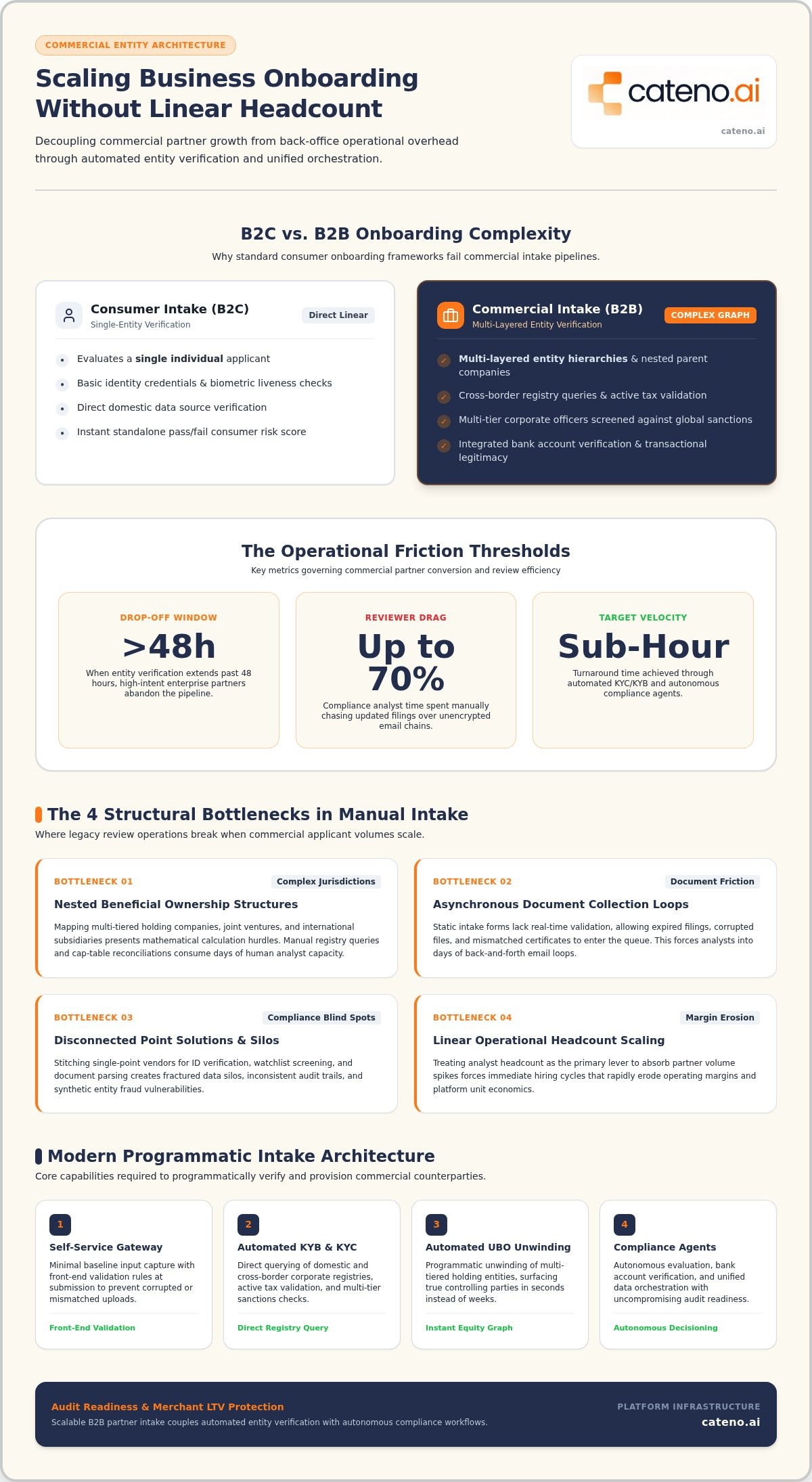
Consumer onboarding evaluates a single individual using basic credentials and biometric liveness. Commercial onboarding, however, requires evaluating multi-layered entity hierarchies, nested parent companies, and beneficial ownership structures. Operational teams must query domestic and cross-border corporate registries, validate active tax registrations, and cross-reference multiple tiers of corporate officers against global sanctions lists. Applying modern Know Your Customer (KYC) guidelines within a commercial context requires verifying both the corporate structure and the individuals controlling it. B2B intake pipelines must also authenticate transactional legitimacy and integrate bank account verification before granting operational access or releasing commercial lines of credit.
The True Cost of Manual Intake Bottlenecks
Relying on manual reviewers creates an operational ceiling that degrades commercial performance. When business verification extends past 48 hours, high-intent enterprise clients abandon the pipeline, stranding partner acquisition spend and delaying revenue capture. Manual processing introduces severe systemic vulnerabilities:
- Administrative exhaustion: Compliance analysts spend hours chasing beneficial ownership disclosures and corporate resolutions over unencrypted email chains.
- Compounding compliance risk: Manual document parsing leaves teams vulnerable to sophisticated document fabrication, synthetic entity fraud, and missed sanctions entries.
- Linear operational drag: Expanding client volume forces immediate compliance hiring, proving that legacy operations cannot sustainably scale business onboarding without modern programmatic infrastructure.
The Four Structural Bottlenecks That Break Manual Entity Intake
When applicant volumes quadruple, legacy operational models fracture under the weight of unstructured data and disparate review systems. Operations leaders often attempt to absorb this surge by stitching together single-point vendor solutions for identity verification, document parsing, and watchlist screening. This piecemeal strategy creates disconnected data silos, inconsistent audit trails, and dangerous compliance blind spots. Expanding manual reviewer teams to patch these structural flaws creates a linear cost trap that rapidly erodes unit economics. To successfully scale business onboarding, institutions must replace manual intervention at four primary architectural failure points.
Unwrapping Nested Beneficial Ownership Structures
Mapping complex ownership across multi-tiered holding companies, joint ventures, and international subsidiaries presents a severe mathematical challenge for human analysts. Calculating indirect equity stakes across multiple legal jurisdictions consumes days of manual registry queries and cap-table reconciliation. Implementing automated UBO verification allows platforms to unwind multi-layered holding entities programmatically, surfacing true controlling parties in seconds rather than weeks.
Asynchronous Document Collection and Back-and-Forth Loops
Manual intake pipelines rely on static intake forms and insecure email threads to resolve missing filings or illegible business certificates. Without front-end validation rules at submission, applicants upload expired documents, corrupted image files, and mismatched entity documentation. Reviewers spend up to 70% of their time chasing updated paperwork, frustrating qualified commercial partners and creating significant data governance risks under global privacy frameworks.
Disjointed Bank Account and Operating Identity Validation
Reconciling legal entity filings with corporate bank account records creates friction right before counterparty activation. Legacy verification methods create compounding delays:
- Micro-deposit latency: Relying on manual micro-deposits adds two to four business days of friction, depressing activation rates before the partner initiates a single transaction.
- Entity name mismatches: Operating names (DBAs) frequently diverge from registered corporate charters, causing manual cross-referencing delays and false flags.
- Treasury diversion risks: Disconnected handoffs between underwriting teams and payment gateways expose institutions to fraudulent bank account rerouting.
If disjointed verification workflows are restricting your pipeline velocity, you can consult with our solutions team to map an automated intake architecture suited to your institutional risk model.
The Technology Stack: Core Capabilities Needed to Scale
Transitioning away from manual processing requires an architectural overhaul rather than incremental tool patching. Legacy stacks rely on static web forms, manual document uploads, and human analysts who manually query state portals. This approach collapses under volume spikes. In contrast, modern orchestration platforms use API-driven ingestion to coordinate identity resolution, entity validation, and financial vetting programmatically. To sustainably scale business onboarding, platforms must replace human operational bandwidth with an automated, synchronized technology stack.
Dynamic Self-Service Intake and Branded Portals
A self-service onboarding gateway replaces rigid paperwork with responsive, guided intake flows. Rather than overwhelming applicants with lengthy document checklists, the gateway requests minimal baseline inputs and dynamically adapts required fields based on corporate structure and jurisdiction. Delivering this intake through a branded customer portal maintains trust, gives counterparties real-time visibility into their application status, and uses inline syntax validation to reject incomplete or corrupted submissions before they reach underwriting queues.
Customizable Workflow Engines and Autonomous Agents
The operational core of modern intake is a business onboarding workflow engine configured to route counterparties according to your institutional risk criteria. Autonomous compliance agents execute verification tasks in parallel, pinging national corporate registries, global sanctions lists, and adverse media sources in real time. Intelligent routing allows low-risk applications to clear via straight-through processing, while edge cases and high-risk flags automatically route to senior compliance analysts for targeted manual review.
Unified KYB, KYC, and Bank Validation Data Layers
Vendor sprawl compounds intake latency. Modern systems unify corporate verification, individual KYC screening, and bank account verification into a consolidated data fabric. Rather than juggling five disconnected vendor portals, compliance teams review standardized, advanced verification reports that synthesize entity standing, beneficial ownership structures, and account authorization into an immutable audit trail. Implementing this architecture alongside proven digital kyb verification frameworks ensures institutions can scale business onboarding while protecting unit economics and preserving audit integrity.
Step-by-Step Blueprint: Modernizing Your Business Onboarding Architecture
Modernizing an entity intake pipeline requires a structured engineering migration from fragmented manual handoffs to an automated orchestration model. Financial platforms and marketplaces can deploy an end-to-end framework that verifies corporate legitimacy, surfaces beneficial ownership, and activates commercial accounts programmatically. By aligning intake logic with regulatory standards like BSA and FinCEN requirements, institutions can scale business onboarding without inflating operational expenses. Built on the Cateno platform architecture, this three-phase blueprint establishes an automated, audit-ready operational foundation.
Phase 1: Ingestion Optimization and Entity Auto-Discovery
Minimize applicant friction by eliminating exhaustive 20-field intake questionnaires. The self-service gateway captures only baseline inputs, such as the registered entity name and jurisdiction code. The system immediately queries official corporate registries to auto-populate incorporation dates, active standing, primary operational addresses, and registered corporate officers. These verified records populate directly into the branded portal, prompting the commercial applicant to review, confirm, and verify details with a single click. This eliminates initial drop-off and front-loads application validation.
Phase 2: Risk-Based Routing and Autonomous Decisioning
Deploy algorithmic decision engines to classify each counterparty according to your specific institutional risk tolerances. The customizable workflow engine initiates automated checks across global sanctions registries, adverse media databases, and beneficial ownership networks in parallel:
- Straight-Through Processing (STP): Low-risk domestic entities meeting all automated verification thresholds bypass manual back-office queues entirely.
- Dynamic Exception Handling: Multi-tiered holding structures or complex foreign ownership trees trigger automated requests for supplemental documentation through the secure gateway.
- Targeted Analyst Escalation: High-risk profiles, PEP matches, or structural anomalies route directly to senior underwriters alongside consolidated verification reports.
Phase 3: Lifecycle Integration and Continuous Monitoring
Complete the intake loop by programmatically synchronizing cleared entities with downstream transaction rails, billing engines, and treasury systems via webhooks. Point-in-time onboarding must evolve into persistent lifecycle oversight. Autonomous agents continuously monitor registry changes, officer transitions, and sanctions updates across your active counterparty portfolio. Review how these automated workflows adapt across varied industry applications to maintain audit compliance across diverse sectors.
To replace manual intake bottlenecks with straight-through entity activation, schedule a technical platform briefing with our enterprise engineering team.
Measuring Success: KPIs for Scalable Business Partner Intake
Measuring the operational health of commercial intake requires quantitative rigor. Subjective assessments and generic task-completion metrics cannot evaluate balance sheet exposure or operational throughput. True scalability reveals itself in the mathematical decoupling of intake volume from compliance headcount. When you scale business onboarding through programmatic orchestration, leadership teams must track high-fidelity metrics that balance conversion velocity against regulatory risk controls.
Operational Velocity and Conversion Metrics
Velocity metrics evaluate how efficiently legitimate commercial partners navigate underwriting into active revenue generation:
- Straight-Through Processing (STP) Rate: The percentage of corporate applications verified, risk-classified, and approved without human intervention. A rising STP rate confirms that your automated data layers are successfully handling entity validation.
- Time-to-First-Transaction (TTFT): The elapsed duration from initial gateway access to the counterparty's first active payment or transaction. Compressing TTFT from five business days down to sub-hour turnarounds inflates net partner lifetime value by capturing immediate commercial activity.
- Funnel Abandonment by Checkpoint: Drop-off analysis measured at discrete stages of intake. High attrition during beneficial ownership collection or registry lookups pinpoints UX friction that requires automated pre-population rather than heavier documentation demands.
Compliance Efficiency and Risk Preservation
Intake acceleration cannot come at the expense of regulatory diligence. Platforms must benchmark the cost-per-onboarded-entity as application intake scales across higher volume tiers. As programmatic orchestration replaces manual reviews, marginal operational costs decline while unit margins expand. Operational teams should also track false-positive resolution times and decision consistency. Autonomous compliance agents reduce false positives across global watchlists, generating deterministic verification logs that satisfy FinCEN and BSA examination requirements. For institutions seeking specialized guidance on risk management, regulatory compliance, and digital transformation across financial services, click here to consult with experienced advisors.
Operationalizing Autonomous Architecture
Deploying unified orchestration delivers clear financial leverage by replacing fragmented point solutions with an integrated pipeline. Consolidating corporate entity validation, identity verification, and bank account validation eliminates redundant vendor fees and removes brittle internal API integrations. This architectural cohesion accelerates enterprise time-to-market and keeps compliance overhead predictable as intake numbers surge. You can review how flexible operational models support high-volume pipelines on the Cateno pricing page.
Decouple Commercial Expansion from Operational Overhead
Relying on manual analyst intervention to handle volume surges creates an unsustainable operational model. To successfully scale business onboarding, modern platforms must transition to programmatic orchestration. When you eliminate operational friction via self-service branded onboarding gateways, you remove administrative drag and protect commercial conversion rates from day one.
Real scalability means using systems that can automate complete entity intake starting with a single baseline data point. From there, unified workflow engines cross-reference official registries, resolve corporate hierarchies, and deploy autonomous compliance agents for continuous risk-adjusted counterparty monitoring. This engineering foundation preserves unit economics and frees experienced compliance analysts to evaluate true risk anomalies rather than parsing routine filings.
Modernizing your intake architecture turns compliance from a growth bottleneck into an enterprise competitive advantage. Accelerate partner intake with Cateno to achieve sub-hour turnaround times without multiplying your operational headcount.
Frequently Asked Questions
What does it mean to scale business onboarding in a B2B context?
Scaling business onboarding in a B2B context means expanding the volume of onboarded corporate partners, merchants, or vendors without linearly expanding compliance and underwriting headcount. It relies on programmatic data layers and automated orchestration rather than manual document reviews. By validating legal entities, confirming bank accounts, and assessing counterparty risk automatically, platforms maintain rigorous regulatory controls while processing high application volumes at consistent speed.
How can organizations accelerate corporate onboarding without compromising regulatory compliance?
Organizations accelerate corporate onboarding by replacing static, point-in-time checks with automated KYC and KYB workflows connected directly to authoritative registries. Algorithms instantly query secretary of state databases, tax authorities, and international sanctions watchlists. By reserving manual underwriting exclusively for high-risk edge cases while standard entities clear via predefined rules, institutions maintain strict BSA and AML audit readiness without introducing intake latency.
What is straight-through processing (STP) in corporate counterparty verification?
Straight-through processing (STP) is the automated end-to-end completion of entity verification, risk scoring, and account provisioning without any manual intervention from an analyst. When an applicant submits baseline identifying information, automated engines authenticate the business filings, confirm beneficial ownership, and verify operating bank accounts programmatically. If all risk parameters meet institutional criteria, the account activates instantly, eliminating back-office bottlenecks.
How do autonomous compliance agents handle complex beneficial ownership (UBO) structures?
Autonomous compliance agents query official formation records, annual returns, and cross-border registries to trace equity stakes across nested corporate entities. Instead of relying on manual cap-table parsing, the software maps parent companies, subsidiaries, and intermediate holdings mathematically. It calculates indirect ownership percentages until it identifies individual ultimate beneficial owners holding 25% or more equity, highlighting any flagged individuals for specialized compliance review.
Can automated business onboarding workflows integrate with legacy banking and ERP systems?
Yes, modern onboarding platforms use bi-directional REST APIs and webhooks to integrate cleanly with legacy core banking platforms, ERPs, and treasury management rails. Once an entity clears automated verification, the engine pushes structured counterparty profiles, tax information, and verified account details directly into downstream databases. This eliminates manual double-entry, minimizes data transmission errors, and ensures seamless lifecycle tracking across existing enterprise systems.
What happens if an automated KYB check fails or detects conflicting registry data?
If an automated check identifies discrepancies, such as an inactive corporate charter or mismatched operating names, the system triggers dynamic exception handling. Rather than rejecting the partner outright, the workflow engine isolates the specific discrepancy and prompts the applicant to submit clarifying documentation via their secure portal. Concurrently, an advanced verification report routes to compliance analysts with explicit context on the exact anomaly requiring review.
How do branded self-service portals impact business partner conversion rates?
Branded self-service portals significantly improve conversion rates by replacing messy email chains with a guided, transparent intake experience. When counterparties see a familiar, institution-branded interface with real-time status tracking and inline document validation, application completion accelerates. Providing this frictionless entry point helps institutions scale business onboarding, minimize partner abandonment during due diligence, and drastically reduce the time required to reach their first commercial transaction.


