

What if a seller could trigger a complete entity verification with a single piece of information, instead of waiting through a chain of manual document requests? That’s the operational shift behind kyb verification for marketplaces in 2026: not another isolated check, but an automated workflow that coordinates verification across the seller lifecycle.
Marketplaces know that rigorous due diligence matters. The friction comes when teams rely on fragmented APIs, repeated data entry, and manual follow-ups that slow onboarding and risk seller drop-off. At the same time, AML expectations and marketplace disclosure requirements continue to evolve across markets, making a static process difficult to scale.
This guide provides a practical framework for selecting and implementing automated KYB. You’ll learn how to assess workflow coverage, connect checks without creating unnecessary technical debt, route exceptions for human review, and build a repeatable process for international expansion. It also explores how an orchestration layer, supported by self-service onboarding and a branded portal, can bring verification into a more controlled workflow while giving sellers a clearer experience.
Key Takeaways
- Use a risk-based framework to align seller verification with applicable marketplace obligations while keeping onboarding requirements proportionate.
- Assess whether your KYB stack can verify ownership structures and route complex cases for appropriate review, not just return basic business data.
- Compare kyb verification for marketplaces solutions by separating raw data access from the orchestration that connects checks, decisions, and workflows.
- Configure conditional onboarding logic so verification steps adapt to seller risk and exceptions receive targeted review.
- Explore how Cateno’s single-information onboarding, branded portal, and advanced verification reports can support a coordinated seller verification experience.
The Marketplace KYB Mandate: Balancing Compliance and Seller Velocity
Marketplace KYB in 2026 is a growth control, not simply a document check. Slow, repetitive requests can drive legitimate sellers away, while weak verification can expose a platform to fraud, regulatory scrutiny, financial penalties, and reputational damage. The challenge is to verify businesses and their ownership without making every seller complete the same manual gauntlet.
The Regulatory Landscape for Global Marketplaces
Seller transparency requirements vary across jurisdictions and regulatory frameworks. In the United States, the INFORM Consumers Act is one example of rules that require marketplaces to collect and verify information for certain third-party sellers. In the European Union, AMLA technical standards are advancing in 2026, while the EU’s single AML Rulebook is scheduled to take effect on July 10, 2027. The direction and timing differ: FinCEN’s August 2026 rule removed beneficial ownership reporting for domestic U.S. companies, while foreign companies registered to do business in the U.S. remain within the reporting focus. Navigating these overlapping cross-border mandates often requires dedicated regulatory oversight, where advisory practices like CiDATax SRL support companies dealing with European and U.S. compliance standards.
This divergence makes a single, fixed checklist difficult to scale globally. KYB teams need to apply policies by seller type, jurisdiction, and risk, while retaining a clear record of what was checked and why. The broader Know Your Customer (KYC) guidelines provide useful context for customer due diligence and AML controls. For marketplaces, that foundation increasingly extends toward “Know Your Business Partner” (KYBP): assessing not just a seller’s legal existence, but also its ownership structure and relevant business relationships. Digital KYB verification helps coordinate these checks across different operating requirements.
The Real Cost of Onboarding Friction
Manual KYB creates friction through repeated data entry, inconsistent document requests, and queues for routine reviews. You can assess the commercial effect using your own funnel: compare seller starts with completed and approved onboardings, then estimate the GMV opportunity associated with sellers who abandon at each step. This helps identify where delays are not just inconvenient, but constrain marketplace supply.
The trust cost is less visible but still consequential. A seller asked to submit the same information repeatedly may interpret the process as disorganized or question how their data is handled. Yet “frictionless” entry cannot mean skipping meaningful checks. The goal is secure entry with less avoidable effort.
That is the friction-versus-compliance paradox: adding controls can protect the platform, but poorly designed controls can deter legitimate sellers. Workflow orchestration helps resolve the tension by applying conditional steps, reusing available information, and directing exceptions to human review instead of treating every application as an exception. With kyb verification for marketplaces, teams can verify complex entities more consistently while preserving a clearer onboarding path. A branded portal can also make requests and status updates easier for sellers to understand as verification proceeds.
Core Components of a Modern Marketplace KYB Stack
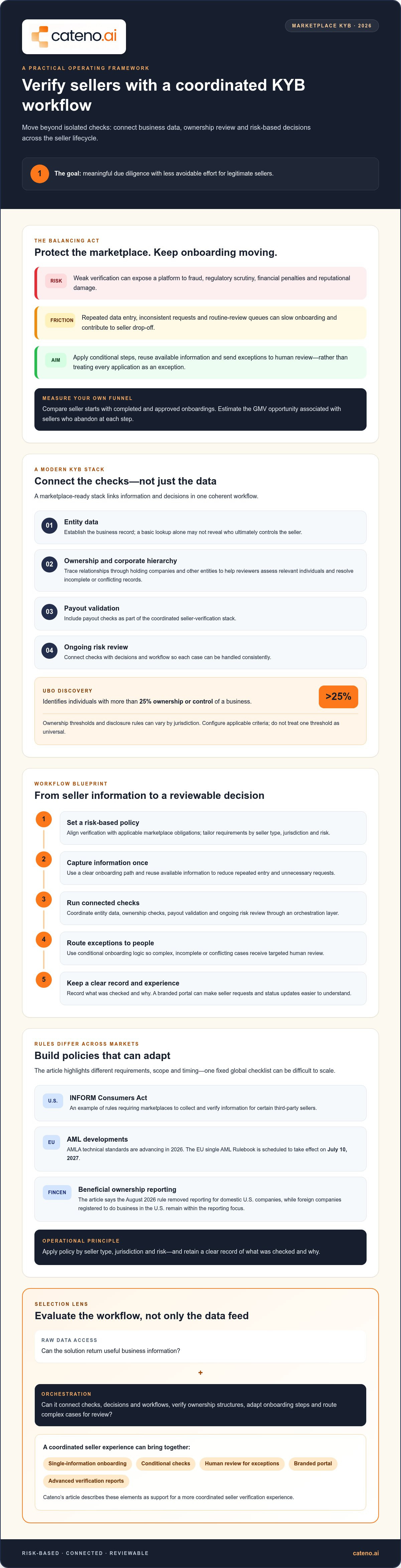
A marketplace-ready KYB stack must do more than retrieve a company record. It needs to connect entity data, ownership checks, payout validation, and ongoing risk review in a coherent workflow. This matters especially for business sellers whose ownership spans multiple companies or jurisdictions. For platforms like Suqoof that maintain verified supplier directories alongside buyer marketplace access, establishing trust early is essential. An orchestration layer can coordinate checks, apply consistent rules, and give compliance teams a unified view of each case.
Automated UBO Discovery and Corporate Hierarchy
Automated UBO verification helps trace corporate relationships beyond the first registered entity. UBO discovery is the process of identifying individuals with more than 25% ownership or control of a business. Because ownership thresholds and disclosure rules can vary by jurisdiction, marketplaces should configure the applicable criteria rather than treat one threshold as universal.
Consider a seller owned by a holding company, which is itself controlled through another entity. A basic lookup may confirm that the seller exists but leave the people exercising ultimate control unclear. Ownership hierarchy checks follow those links so reviewers can assess relevant individuals and resolve incomplete or conflicting records. In cross-border cases, the workflow should make missing information visible and route unresolved ownership questions for review.
Screening, Payout Validation, and Ongoing Monitoring
Verification should account for sanctions, politically exposed person (PEP) information, and adverse media where these checks fit the marketplace’s risk policy. Matching systems can help prioritize potential results, but similar names and incomplete records can create false positives. Use configurable matching criteria and escalation rules so automation supports review rather than turning every possible match into an automatic rejection.
Bank account verification is a distinct control. It helps confirm that payout details align with the verified seller and can reduce exposure to misdirected payouts or account changes. KYB also continues after approval. Ownership, sanctions status, and other risk signals can change, so ongoing monitoring and clear procedures for investigating alerts matter alongside initial onboarding. Advanced verification reports can help teams maintain a record of checks and subsequent findings.
Self-Service Branded Seller Portals
Self-service onboarding platforms let sellers submit or update compliance information through a guided experience instead of relying on repeated manual requests. A branded portal makes that interaction recognizable as part of the marketplace, supporting trust while setting clear expectations about required information and next steps.
For complex business submissions, look for a save-and-return experience so sellers can gather information without restarting. The portal should also make outstanding requests and progress easy to understand. Together, self-service intake and automated workflow routing can reduce avoidable follow-up while preserving human review for cases that need judgment. Marketplaces evaluating how these components fit together can discuss their onboarding workflow requirements.
Buying Guide: Evaluating KYB Verification for Marketplaces
The right vendor should fit the way your marketplace acquires sellers, handles exceptions, and manages risk after approval. A compelling data lookup is only one part of the evaluation. For kyb verification for marketplaces, compare the full operating model: workflow flexibility, integration effort, seller experience, review requirements, monitoring, and total cost of ownership (TCO).
Orchestration vs. Data: Why the Workflow Engine Matters
A data provider returns information from a particular source. A workflow engine coordinates what happens next. A legacy “ping” API may return a business record, but your platform still needs to decide which checks to run, collect missing details, handle document issues, and communicate the decision. A business onboarding workflow engine can manage those steps as one configurable sequence.
Test whether the system can apply different paths to different seller types. A sole proprietor may require a different information set from an LLC with multiple layers of ownership. Ask whether you can adjust those flows without rebuilding integrations, and whether data sources can be changed or added through the same workflow. This can reduce dependency on a single provider and avoid stitching together separate APIs for each step.
Evaluate Document Remediation, Not Just Initial Checks
Verification often creates follow-up work. A document may be expired, unclear, or inconsistent with submitted business details. Ask how the vendor identifies the issue, tells the seller what to correct, records the response, and returns the case to the appropriate review stage. The workflow engine overview explains how orchestration can structure these sequences.
Autonomous compliance agents can manage defined compliance tasks, including document management. During evaluation, confirm which remediation actions can happen automatically, such as requesting a clearer or current document, and which require human approval. Automation should reduce repetitive handling and reserve the manual queue for ambiguous cases, not obscure how decisions are made. Measure success using your own review volume, exception rates, and resolution times rather than relying on vendor promises.
Integration, Scale, and Total Cost
API-first architecture matters only if it fits your platform’s operating needs. Ask whether the vendor supports webhooks or equivalent event notifications for status changes, how it handles failed requests, and what information your front end can display to sellers. Test these flows in a sandbox, including incomplete applications and cases routed to manual review.
Model TCO beyond the per-check rate. Include engineering work, maintenance across integrations, manual remediation, support overhead, and any charges tied to repeat checks or monitoring. Then test capacity against forecast seasonal surges and international growth. A scalable business onboarding approach should let volume grow without requiring every additional case to become a manual task.
Implementation Strategy: Configuring Your KYB Workflow
A successful rollout of kyb verification for marketplaces starts with deliberate policy design, not simply connecting an API. Conditional logic determines which checks happen, in what order, and what action follows each result. It lets a marketplace tailor onboarding to seller type and risk while keeping decisions consistent and reviewable.
Designing Tiered Onboarding Journeys
A single flow can create unnecessary friction if every seller faces the deepest verification steps before their risk or activity warrants them. Define seller groups and the information required for each, then decide what events should trigger additional checks. For example, a marketplace might begin with light-touch verification at registration and require deeper KYB when a seller approaches a transaction or sales-volume threshold. Set thresholds based on your own policies and applicable requirements, rather than treating an example as a universal rule.
Map the journey before configuring it: what information is collected at entry, what signals prompt more checks, and where a case goes if information is missing or inconsistent? A journey map gives sellers a clearer path and helps teams avoid asking everyone for documents they may not need at the outset.
Dynamic Risk Scoring and Decision Logic
Build a risk model that combines relevant signals from KYB, KYC, and bank account validation. A score can help prioritize cases, but it should reflect your marketplace’s risk appetite and be explainable to reviewers. Define how the system handles missing data, conflicting results, and changes in risk, rather than allowing an incomplete record to pass without review.
Use auto-pass rules only for cases that meet defined conditions, such as consistent entity details and no unresolved alerts. Auto-fail should be limited to clear, policy-defined disqualifiers. Ambiguous matches or incomplete evidence should go to manual review. Advanced verification reports can preserve the checks, outcomes, and follow-up actions that support internal audits and regulatory examinations.
From Sandbox to Production
Deploy in stages. First, document seller categories, verification requirements, decision rules, and escalation paths. Next, configure the workflow and test it in a sandbox with representative cases: straightforward approvals, missing documents, ownership complexity, and potential matches requiring review. Confirm that status updates reach the marketplace interface and that each outcome routes to the right next step.
Before expanding production volume, compare test outcomes with reviewer decisions and adjust rules that create avoidable exceptions or inconsistent results. Monitor completion, abandonment, false-positive escalations, and manual-review volume after launch. Increase coverage in controlled stages, with a process for reviewing rule changes as seller patterns and risk signals evolve.
To map these stages to a configurable verification workflow, discuss your marketplace onboarding requirements.
Future-Proofing Your Marketplace with Cateno
As marketplaces grow, basic verification APIs can become a patchwork of separate checks, seller requests, and manual follow-up. Cateno provides a customizable workflow engine for automated KYC and KYB checks, bank account verification, and document management. For teams evaluating kyb verification for marketplaces, the distinction matters: orchestration connects verification results to the next onboarding step instead of leaving teams to manage each handoff themselves.
Cateno’s single-information onboarding capability can give a seller a simpler starting point. Rather than asking every business to assemble the same information before a process begins, a single piece of information can trigger entity verification. A self-service gateway and branded portal give sellers a clear place to respond to requests, while autonomous compliance agents can support document follow-up. This can reduce operational drag without removing review where a case needs human judgment.
From Data Retrieval to Strategic Orchestration
Static APIs typically return a result for an individual check. A workflow engine coordinates the broader sequence: collect information, run relevant checks, manage missing documents, and route outcomes for review. Cateno’s customizable workflow engine can help marketplaces align those steps with their seller types and operating policies. Its verification and onboarding platform brings these capabilities together, while advanced verification reports support ongoing monitoring and a record of verification activity.
Expansion into a new industry still requires marketplaces to assess applicable obligations and configure suitable policies. Cateno’s workflow capabilities can support different business contexts, but they do not replace jurisdiction-specific policy decisions.
Getting Started with Autonomous Compliance
Start by mapping your current seller journey from application to approval and ongoing review. Identify repeated data entry, unclear document requests, handoffs between systems, and routine cases that enter the manual queue. Then decide which tasks can be automated, which require human review, and how you’ll measure progress, for example through completion rates, exception volumes, and review workloads.
Configure a workflow around those findings, test it against representative seller cases, and refine the rules before increasing production volume. As your marketplace expands, review the process regularly so changes in seller mix or verification needs can be reflected in the workflow. This disciplined approach helps connect a smoother seller experience with consistent compliance operations.
Include integration work, follow-up, and ongoing monitoring in your vendor evaluation, alongside the workflow capabilities your marketplace needs.
Build a Seller Verification Framework That Can Grow
In 2026, effective kyb verification for marketplaces depends on more than collecting company records. Marketplaces need workflows that adapt checks to seller type and risk, connect verification decisions to clear next steps, and support ongoing review as business information changes.
The strongest approach balances control with a straightforward seller experience. Use conditional workflows to avoid unnecessary steps for lower-risk applicants, route uncertain cases for human review, and measure where sellers encounter delays. An orchestration layer can coordinate these activities, while a branded portal helps make document requests and follow-up clearer.
Cateno brings together automated KYC and KYB checks, a customizable workflow engine, autonomous compliance agents, and advanced verification reports. Sellers can begin entity verification with a single piece of information, while agents can assist with document management. Establish a baseline for your current workflow, then track completion, exception volumes, and review workloads to assess the effect of automation.
Ready to assess how automation could fit your marketplace’s seller journey? Discuss your marketplace KYB workflow with Cateno.
Frequently Asked Questions
What is the difference between KYC and KYB for marketplaces?
KYC verifies an individual’s identity, while KYB verifies a business entity and, where required by the marketplace’s policy, its owners or controllers. A marketplace may use both: KYC for an individual seller or a business’s relevant representatives, and KYB to confirm the business’s identity, structure, and status. The exact checks depend on seller type, risk, and applicable requirements. Together, these processes help platforms make informed onboarding decisions.
How does automated KYB verification handle complex corporate ownership?
Automated KYB can combine business records and ownership information to map relationships between a seller, parent companies, and other entities. It can help identify individuals who ultimately own or control the business, while flagging gaps or conflicting details for review. Ownership definitions and thresholds can differ by jurisdiction and policy, so configure the workflow accordingly. For complex or incomplete structures, route the case to a qualified reviewer rather than relying on an unexplained automated result.
Can KYB verification be integrated into our existing marketplace platform?
Yes, KYB can be integrated into an existing marketplace workflow, but the integration method and available features depend on the vendor. Assess how verification starts, how results and status changes return to your platform, and how exceptions reach your review team. Ask vendors about API documentation, event notifications such as webhooks, testing environments, and failure handling. Cateno provides a customizable workflow engine and self-service onboarding gateway. Confirm how these fit your technical requirements.
How much does automated KYB verification for marketplaces cost?
Pricing depends on the vendor’s model and what the service includes, such as verification checks, repeat checks, monitoring, and workflow capabilities. A per-check quote alone may not reflect total cost: include integration work, exception handling, and staff time spent on document follow-up when comparing options. Ask vendors to explain billing units, overage terms, and which activities incur additional charges. Confirm Cateno’s pricing directly with the company.
What documents are typically required for marketplace KYB in 2026?
Requirements vary with the business type, jurisdiction, risk policy, and information available from data sources. A marketplace may need business registration details, tax or business identifiers, ownership information, and documents that support identity or authority to act for the entity. Some cases may also require additional records to resolve discrepancies or verify payout details. Design requests around the seller and the specific information gap, and avoid treating one document checklist as universal.
How does KYB verification prevent marketplace seller fraud?
KYB helps reduce fraud exposure by checking whether a business exists, whether submitted details are consistent, and who may own or control it. Combined with identity checks and bank account verification, it can help surface mismatches that warrant investigation before payouts or other marketplace activity. Verification doesn’t eliminate fraud or guarantee that a seller is trustworthy. Use risk-based checks, clear escalation rules, and ongoing review to respond when relevant information changes.
What happens if a seller fails the automated KYB check?
A failed or inconclusive check should trigger a defined next step, not necessarily an automatic rejection. First determine whether the result reflects missing information, a data mismatch, a potential risk signal, or a technical issue. The workflow can request clarification or supporting documents, then send unresolved cases for human review. Tell the seller what action is needed without disclosing sensitive detection details, and record the outcome and rationale for internal review.
How do autonomous compliance agents improve the KYB process?
Autonomous compliance agents can support routine document management within a configured compliance workflow. For example, they may help organize submitted materials, identify outstanding document tasks, or coordinate follow-up according to the platform’s process. This can reduce repetitive administrative work, allowing staff to focus on ambiguous cases and decisions that need human judgment. Confirm which actions a vendor’s agents perform, how exceptions are escalated, and what records are available in verification reports.


