

What if lowering onboarding costs starts with removing duplicated work, not cutting verification? If you're researching how to reduce business onboarding costs 2026, the first challenge is seeing the full picture. Work and expenses may be spread across operations, compliance, sales, systems, and vendor fees. Repeated document requests, manual reviews, and follow-ups add effort that’s easy to overlook.
Reducing costs without increasing risk means measuring the end-to-end process before changing it. This guide shows you how to build a credible baseline for onboarding business customers and partners, identify avoidable effort, and prioritize improvements while preserving appropriate verification controls. It also explains how to compare process changes and technology options using consistent criteria, rather than judging them by automation alone.
We’ll cover the costs to include, the workflow friction to investigate, and the measures that can help teams determine whether a change improves the whole process. The goal is a more efficient onboarding experience with controls that remain fit for purpose.
Key Takeaways
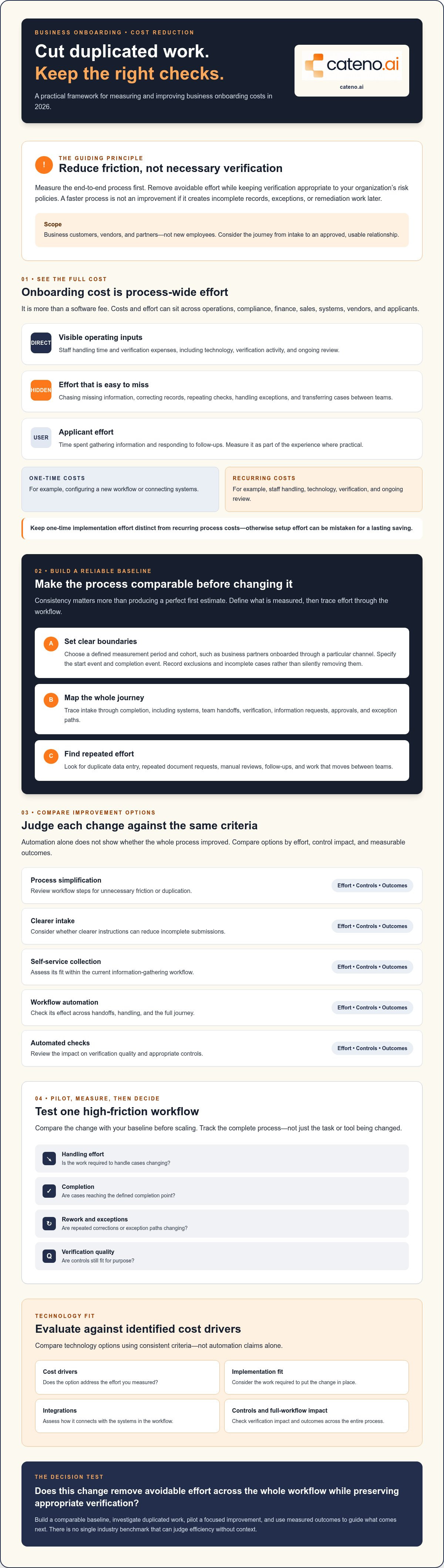
- For how to reduce business onboarding costs 2026, focus on removing duplicated effort rather than weakening necessary verification.
- Set clear boundaries for your measurement period, onboarding cohort, and start and completion points to build a comparable cost baseline.
- Compare process simplification, clearer intake, self-service collection, workflow automation, and automated checks by effort, control impact, and measurable outcomes.
- Pilot one high-friction workflow and track handling effort, completion, rework, exceptions, and verification quality before scaling changes.
- Evaluate technology against identified cost drivers, implementation fit, integrations, controls, and its impact across the full workflow.
How to Reduce Business Onboarding Costs in 2026 Without Cutting Necessary Checks
This guide focuses on onboarding business customers, vendors, and partners, not new employees. The distinction matters: business onboarding may involve entity information, ownership details, verification steps, internal approvals, and ongoing review. To understand how to reduce business onboarding costs 2026, measure the whole process instead of treating one tool or team’s budget as the total.
The core principle is straightforward: remove unnecessary friction while retaining verification appropriate to your organization’s risk policies. A faster process isn’t better if it creates incomplete records, avoidable exceptions, or remediation work later. The right checks depend on your organization and its obligations, so involve the policy owners responsible for setting and reviewing them. For background, see this overview of Know Your Customer (KYC) regulations.
What counts as a business onboarding cost?
Total onboarding cost is the process-wide effort required to take an applicant from intake to an approved, usable relationship, not a single software fee. Include direct staff time and verification expenses, then account for less visible work: chasing missing information, correcting records, repeating checks, handling exceptions, and transferring cases between teams.
Costs may fall across operations, compliance, finance, and sales. Applicants also spend time gathering information and responding to follow-ups. Where practical, measure that effort as part of the experience, even if it doesn’t appear in your internal budget. Separate one-time costs, such as configuring a new workflow or connecting systems, from recurring expenses such as staff handling, technology, verification, and ongoing review. Keeping these categories distinct helps prevent implementation effort from being mistaken for a permanent saving or a recurring process cost.
Why can cutting checks increase total cost?
Removing a check without reviewing its purpose can shift effort instead of eliminating it. Missing or incomplete information may trigger manual exceptions, additional requests, remediation, or later reviews. Those steps can involve several teams and delay the point when a relationship is ready to proceed.
That doesn’t mean every check is necessary for every applicant. Ask policy owners to identify which controls are required, which are risk-based, and where the current process duplicates work. Then assess proposed changes against both effort and verification quality. For example, clearer intake instructions may reduce incomplete submissions without changing a control. Removing a review could alter the control itself and require a separate risk decision.
There’s no single industry benchmark that can show whether your process is efficient without context. In 2026, start with a defensible baseline: define what the process includes, identify where effort occurs, and measure outcomes consistently. This gives decision-makers a sound basis for reducing avoidable work without treating verification as a cost to cut in isolation.
How to Build a Reliable Baseline for Business Onboarding Costs
A useful baseline turns a scattered workflow into a measurable process. It should show where staff time, verification activity, repeated requests, and waiting periods accumulate, so proposed changes can be assessed against the same starting point. For teams exploring how to reduce business onboarding costs 2026, consistency matters more than producing a perfect first estimate.
Set the measurement boundaries
First, select a defined measurement period and a clear cohort, such as business partners onboarded through a particular channel. Specify the event that starts onboarding, such as receipt of an application, and the event that marks completion, such as approval to begin the relationship. Record exclusions and incomplete cases rather than silently removing them. These boundaries make comparisons more meaningful when you repeat the analysis.
Map each step and its cost inputs
Document the journey from intake through completion. Include each system, team handoff, verification, information request, approval, and exception path. A workflow map can reveal repeated data entry or duplicate requests that are hard to spot when teams review only their own tasks. For a structured approach to mapping, see this business onboarding workflow engine guide.
Next, gather observed internal data. Separate staff handling time and repeated reviews from elapsed calendar time: a case can wait several days without requiring several days of labor. Use actual records for verification, payment validation, and document-management expenses, along with vendor charges and repeat submissions. Track rework by cause, such as missing information, duplicate requests, or manual data entry. Mark missing or estimated inputs clearly, and assign an owner to validate them rather than presenting uncertain figures as facts.
- Labor: handling and review time by team, including operations, compliance, finance, and sales.
- Direct expenses: recorded verification and workflow-related vendor charges.
- Rework and delay: repeat requests, exceptions, elapsed time, and cases awaiting action.
Interpret cost per completed onboarding consistently
Choose a denominator and apply it consistently. For example, divide the costs associated with a defined cohort by the number of onboardings completed within that cohort, while reporting unfinished cases separately. Pair cost per completion with completion, exception, and rework rates. A lower figure alone could reflect excluded cases or reduced control activity, not a more effective process. Segment by entity type, risk tier, channel, or workflow only when the underlying data supports a fair comparison.
Elapsed time also matters because delays can affect the value or readiness of a business relationship. ChannelForce’s discussion of Reducing Partner Onboarding Costs is a useful prompt to consider delay alongside labor and direct expenses. Track it separately, then use the combined baseline to identify where investigation is most worthwhile.
Compare Cost-Reduction Options by Effort, Risk, and Expected Impact
Use your baseline to compare changes against the same operational measures. Process redesign may remove needless handoffs without new technology. Software may help coordinate work, but it won’t resolve unclear ownership or policies on its own. For how to reduce business onboarding costs 2026, estimate potential impact from your own baseline, then validate it with a controlled pilot rather than assuming a specific saving.
| Option | Cost drivers addressed | Implementation effort | Control impact | Measures |
|---|---|---|---|---|
| Process simplification | Duplicate requests, unnecessary approvals, avoidable handoffs | Low to moderate; requires workflow review and agreement on ownership | Can preserve controls when policy-required reviews remain unchanged | Handoffs, repeat requests, handling time, exceptions |
| Clearer intake | Missing information, follow-up, incomplete submissions | Low to moderate; revise requirements and instructions | Generally preserves controls; confirm all required information is captured | Submission completeness, follow-ups, rework |
| Self-service collection | Manual collection, data entry, applicant follow-up | Moderate; assess portal fit and applicant needs | Depends on configured requirements and review procedures | Completion, incomplete submissions, staff handling time |
| Workflow automation | Manual routing, status checks, inconsistent handoffs | Moderate to high; clarify process and assess implementation fit | Can support consistent routing, but control design still needs review | Queue time, handoffs, exceptions, rework |
| Automated checks | Manual verification steps and repeated reviews | Moderate to high; assess data sources, integrations, and exception handling | Review coverage, escalation rules, and oversight with control owners | Handling time, repeat checks, exceptions, verification quality indicators |
Redesign the process before buying software
Start by locating duplicate requests, approvals without clear decision ownership, and handoffs that don’t add a distinct review. Confirm proposed changes with the appropriate compliance owners, and retain policy-required steps. Software built around an unclear process can simply make friction move faster. For a deeper look at verification architecture, read this KYB verification guide.
Assess self-service and automated verification against actual work
Self-service collection may be worth evaluating if applicants can provide complete information through a structured intake experience. Compare that opportunity with current missing-information and follow-up patterns. Likewise, assess automated KYC, KYB, and bank account checks against existing manual steps, repeat reviews, and exceptions. Confirm implementation fit and control requirements before selecting technology. The self-service onboarding guide explores portal and intake considerations.
Rank options by expected impact, implementation effort, and control implications. Test the strongest candidate and compare pilot results with the baseline. Treat projected benefits as hypotheses until observed data supports them.
How to Implement Cost Improvements Without Losing Control
Turn an identified cost driver into a controlled change, not an organization-wide redesign. A disciplined pilot helps teams test whether a process improvement reduces avoidable work while keeping verification and accountability intact. This is a practical way to apply the principles behind how to reduce business onboarding costs 2026 without treating lower effort as the only measure of success.
- Choose a high-friction workflow. Select a process with a documented issue, such as repeated requests or manual handoffs, and assign an accountable process owner.
- Document the controls. Record required checks, decision points, escalation paths, and who is authorized to approve exceptions. Ask compliance owners to validate proposed changes.
- Confirm the baseline and measures. Set the comparison cohort and define handling effort, completion, rework, exceptions, and verification quality indicators before making changes.
- Pilot one workflow segment. Limit the change to a manageable part of the process, such as intake or a specific handoff. Record integration effort, exception handling, and staff feedback alongside efficiency results.
- Review trade-offs, then scale. Compare pilot results with a comparable baseline, account for cohort or process differences, and document any control or workload changes before expanding.
Design a pilot with clear ownership
Assign responsibilities across operations, compliance, finance, technology, and customer-facing teams. Operations can own process execution, compliance can validate control requirements, finance can confirm cost inputs, technology can assess implementation and integration needs, and customer-facing teams can report applicant friction. Name one process owner to coordinate decisions and ensure issues have a clear route to resolution.
Evaluate more than staff time. Check whether applicant effort, downstream remediation, and ongoing monitoring remain visible in the results. Review access, auditability, data handling, and human review requirements with the stakeholders responsible for those areas. If a change reduces manual handling but increases exceptions or shifts work to another team, the pilot should make that trade-off clear.
For teams assessing configurable workflows and verification capabilities as part of a pilot, the business onboarding platform overview provides information to consider alongside implementation fit, integrations, controls, and total workflow impact. Don’t assume automation alone will resolve unclear policies or ownership.
Once the pilot scope and measures are defined, discuss your onboarding workflow to explore whether the platform’s capabilities align with the process you’re evaluating.
Where Cateno Fits in a Business Onboarding Cost-Reduction Plan
Consider Cateno after identifying the costly steps and setting criteria for evaluating improvements. A platform is most relevant when its capabilities align with a measured bottleneck, such as fragmented applicant intake, repeated document requests, manual routing, or disconnected verification activity. Assess it against your baseline and control requirements, rather than treating it as a guaranteed source of savings or a substitute for policy decisions.
Which onboarding bottlenecks may fit Cateno’s capabilities?
Map each capability to a specific workflow step and a measure you can monitor:
- Intake and document collection: The Self-Service Onboarding Gateway and Branded Customer Portal support applicant intake and document collection. Evaluate whether a structured, self-service experience could reduce fragmented submissions or repeated requests.
- Routing and repeatable workflow steps: The Customizable Workflow Engine supports configurable onboarding processes. Autonomous Compliance Agents may be relevant to repeatable compliance workflow tasks. Confirm how configuration, ownership, and human review would work in your process.
- Verification: Automated KYC and KYB Checks and Bank Account Verification align with workflows that include identity, entity, or bank validation. Compare their fit with current manual steps, exception paths, and control requirements.
- Reporting: Advanced Verification Reports support verification and ongoing monitoring workflows. Assess whether the reports meet your teams’ needs for review and follow-up.
These capabilities are worth evaluating only if they address a cost driver you’ve observed. For sector-specific context, review Cateno’s industry use cases. Treat each example as a starting point for questions about your own process, not as a claim that your requirements or outcomes will be the same.
What should buyers confirm before discussing a solution?
Bring a workflow map, baseline measures, examples of common exceptions, system requirements, and questions from control owners. This preparation helps focus the evaluation on practical fit: which steps could change, what must remain under human review, and how any improvement would be measured. Confirm supported integrations, data sources, workflow configuration options, and implementation details directly with Cateno before relying on them in a business case.
Review commercial details separately from operational fit. Cateno’s pricing information can inform that evaluation. Assess relevant costs alongside implementation effort and the full workflow impact. The goal is to compare options using your own evidence, not assume a specific cost reduction.
If you’ve identified a workflow to assess, discuss your onboarding requirements with Cateno and use your process map and evaluation criteria to guide the conversation. That’s a grounded next step in deciding how to reduce business onboarding costs 2026 while preserving appropriate verification controls.
Make Your Next Onboarding Improvement Measurable
Reducing onboarding costs starts with a clear view of the work, not an isolated cut to verification. Build a baseline across teams and systems, identify repeated effort, then test targeted changes against both efficiency measures and verification quality. A controlled pilot helps reveal whether an improvement removes friction or simply shifts it elsewhere.
That’s the practical approach to how to reduce business onboarding costs 2026: use your own workflow data to guide decisions and preserve controls appropriate to your process. If fragmented intake or manual follow-up is a key cost driver, assess whether Cateno’s customizable workflow engine, self-service onboarding gateway, branded customer portal, automated KYC and KYB checks, bank account verification, and verification reports fit your requirements. Evaluate implementation details and controls alongside capabilities, without assuming a particular savings outcome.
Discuss your business onboarding workflow with Cateno and explore which opportunities are worth testing. With a clear baseline and a measured plan, your team can pursue a more efficient process while keeping verification in view.
Frequently Asked Questions
How much does business onboarding cost?
Business onboarding costs vary by entity type and process, so there’s no reliable universal figure. Include labor, verification, systems, rework, and exceptions, then calculate your internal cost per completed onboarding from observed data. Keep direct expenses separate from elapsed time: vendor charges and staff effort are costs, while calendar duration measures how long completion takes. Define the cohort and measurement period before comparing results.
How can a business calculate its onboarding cost per customer or partner?
Map the process from intake to approval, then measure staff handling time, verification and system expenses, repeat requests, and exceptions. Choose a consistent time period and divide the relevant costs by completed onboardings in the defined cohort. Segment by entity type or workflow only when the data supports a fair comparison. Track completion, rework, and quality measures beside cost so a lower figure doesn’t conceal weaker outcomes.
Can automation reduce business onboarding costs without weakening compliance?
Automation can reduce repetitive handling when workflows and data inputs are suitable, but it doesn’t remove the need for risk-based controls or accountable review. Teams evaluating how to reduce business onboarding costs 2026 should map existing requirements, pilot one workflow, and measure exceptions alongside verification quality indicators. Have policy owners validate any proposed control changes. Assess results against a baseline rather than assuming automation will deliver savings or preserve every outcome automatically.
What is the biggest hidden cost in business onboarding?
Hidden costs often come from repeated document requests, manual data entry, handoffs, incomplete applications, and exception handling. Which factor dominates depends on the organization and workflow, so avoid assuming there’s one universal answer. Review cases that required rework and trace each issue to its origin. For example, repeated requests may point to unclear intake instructions, while duplicate entry may reflect disconnected systems or process steps.
Should a business redesign its onboarding process before buying software?
Document the current workflow first, then address avoidable duplication and unclear handoffs before evaluating software. Technology may standardize repeatable work, but it can’t resolve unclear policies or ownership on its own. Preserve required checks and involve the relevant control owners in proposed changes. Compare potential solutions against defined workflow needs, integration requirements, and measurement criteria so the selection addresses a documented problem rather than simply adding another system.
How do you measure whether an onboarding cost-reduction project worked?
Compare a defined pilot cohort with a suitable baseline using consistent measures: staff handling effort, completion, rework, exceptions, and verification quality indicators. Account for differences in entity mix or process scope that could affect the comparison. Include implementation effort and downstream work, not just activity removed from the pilot team. Attribute changes to the project only when the comparison supports that conclusion, and document any trade-offs in control or applicant effort.
What should a company look for in business onboarding software?
Evaluate workflow configuration, self-service document collection, relevant identity and business checks, bank account verification where needed, reporting, integrations, and ongoing monitoring requirements. Ask vendors to demonstrate your actual workflow, including exception paths and review points. Compare implementation fit and control requirements alongside potential efficiency. A feature list or savings claim isn’t evidence of a suitable result; confirm supported integrations, data sources, and configuration details before making a selection.


