

What if the biggest risk in choosing a digital identity verification api isn’t the check itself, but what happens after it returns a result? A response is useful only when your team knows how to interpret it, route exceptions, and decide what happens next without breaking the onboarding process.
Verification accuracy and user experience matter, but identity data, document checks, and a final decision are separate parts of the process. Providers handle them differently, and integration choices affect how information moves between intake, review, and compliance workflows.
This guide explains how requests and results flow, what provider capabilities and integration models to compare, and which workflow decisions to make before implementation. You’ll learn how to connect outcomes such as approval, rejection, or manual review to clear next steps, so verification supports a managed onboarding journey instead of acting as an isolated pass-or-fail endpoint.
Key Takeaways
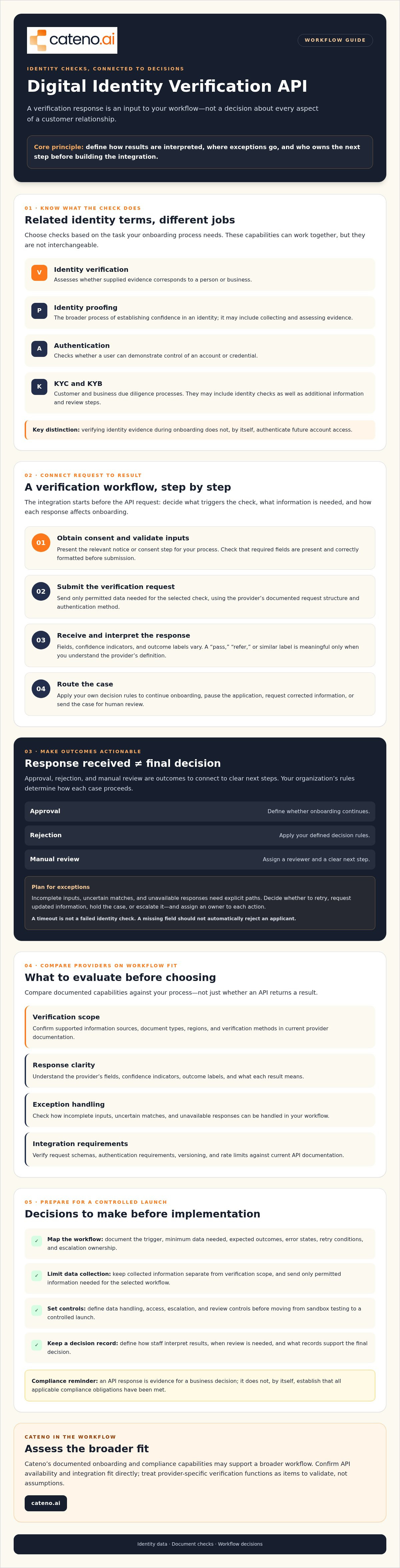
- Distinguish identity proofing, authentication, KYC, and KYB to identify which checks your onboarding process needs.
- Evaluate a digital identity verification api by its verification scope, response clarity, exception handling, and integration requirements.
- Map how consent, input validation, provider responses, and downstream decisions connect before you build the workflow.
- Set data handling, access, escalation, and review controls before moving from sandbox testing to a controlled launch.
- Assess how Cateno’s documented onboarding and compliance capabilities may support a broader workflow, and confirm API availability and integration fit directly.
Digital Identity Verification API in Onboarding Flows
A digital identity verification api is a software interface that lets an application request identity-related checks from a provider and receive results in a structured format. It can connect a check to a broader onboarding process: collect permitted information, submit a request, interpret the response, and route the case to an appropriate next step. For background on the concepts involved, see this overview of digital identity.
Identity terms are related, but describe different functions:
- Identity verification assesses whether supplied evidence corresponds to a person or business.
- Identity proofing is the broader process of establishing confidence in an identity, which may include collecting and assessing evidence.
- Authentication checks whether a user can demonstrate control of an account or credential.
- KYC and KYB refer to customer and business due diligence processes. They may include identity checks, but can involve additional information and review steps.
An API response is an input to a business decision, not a decision about every aspect of a customer relationship. A result alone also doesn’t establish that an organization has met all applicable compliance obligations. Define how your team interprets results, when staff review is needed, and what records support the final decision.
Identity verification API versus authentication API
Consider a new customer applying to open an account. During onboarding, the business may use identity verification to assess submitted evidence. Later, when the customer signs in, authentication checks whether they can prove control of the account. These capabilities can work together, but solve different problems: verifying identity evidence at entry does not, by itself, authenticate future access.
What information can an identity verification request involve?
Depending on the provider and configured check, a request may contain identity attributes, such as a name or date of birth, or details extracted from a document. These are possible input categories, not a promise that a provider accepts them or checks them in a particular way. Before designing intake, confirm supported sources, document types, regions, and verification methods in current provider documentation.
Keep data collection separate from verification scope. An application may collect information the provider doesn’t use, while a provider may perform checks beyond simple field comparison. Send only permitted information needed for the selected workflow, and map each response to a defined next step, such as continuing onboarding or requesting review.
How a Digital Identity Verification API Processes Requests and Results
A dependable integration starts before the request is sent. Define what triggers verification, which information is necessary, and how each possible response affects onboarding. This connects the API exchange to a controlled workflow instead of leaving staff to interpret results case by case.
- Obtain consent and validate inputs. Present the relevant notice or consent step for your process, then check that required fields are present and correctly formatted before submission.
- Submit the verification request. Send only permitted data needed for the selected check, using the provider’s documented request structure and authentication method.
- Receive and interpret the response. The provider returns results in a structured format, but fields, confidence indicators, and outcome labels vary. A “pass,” “refer,” or similar label is meaningful only when you understand the provider’s definition.
- Route the case. Apply your own decision rules to continue onboarding, pause the application, request corrected information, or send the case for human review.
An API response is evidence for a workflow decision, not the decision itself. Incomplete inputs, uncertain matches, and unavailable responses need explicit exception paths. Don’t treat a timeout as a failed identity check or automatically reject an applicant because a field is missing. Decide whether to retry, request updated information, hold the case, or escalate it, and assign an owner to each action.
Map request and response handling before development
Document the application event that starts verification and the minimum data required at that point. Then map expected outcomes, error states, retry conditions, and escalation ownership. Use the selected provider’s current API documentation to verify schemas, authentication requirements, versioning, and rate limits. Build against documented behavior, not assumptions based on sample responses or another provider’s API. For engineering teams simultaneously wiring verification checks into trading or financial services platforms, leveraging developer tools such as Siebly.io JavaScript SDKs can streamline API interactions and maintain reliable integration standards.
Connect verification results to KYC and KYB review
An identity result may inform customer or business onboarding checks, but it isn’t equivalent to completing KYC or KYB. A clear result can support an automated next step if your established rules allow it. Missing information or an uncertain match may require a pause and human review; a provider outage should follow a separate operational path. Set these rules before launch so a verification signal doesn’t silently become a broader compliance decision.
For a wider view of how identity checks fit into a customer review process, see this KYC verification guide. Teams assessing Cateno for coordinated intake, verification, and review should confirm whether its capabilities fit their specific API requirements and integration model.
How to Compare Digital Identity Verification API Providers
Compare providers against the same operational requirements, not just a feature list. A digital identity verification api may appear capable on paper yet create review delays if results are hard to interpret, exceptions don’t fit your process, or integration assumptions are unclear. Use a shared scorecard and test each provider against representative onboarding cases.
| Evaluation area | Questions to ask |
|---|---|
| Verification scope | Which identity evidence, checks, and jurisdictions are supported? Where is each capability documented? |
| Response clarity | Do response fields and outcome explanations help staff understand what passed, failed, or needs review? |
| Exception handling | How can your workflow handle incomplete inputs, uncertain matches, errors, and unavailable results? |
| Integration requirements | What authentication, versioning, sandbox access, dependencies, and operational support processes are documented? |
Evaluate verification coverage and decision transparency
Ask providers to specify supported evidence, checks, and jurisdictions, then verify those details in current documentation rather than relying on broad marketing descriptions. Examine sample responses and check whether operations staff can identify why a case needs attention. Provider capabilities describe what a check can return; your organization’s policy determines whether that result supports acceptance, further review, or escalation.
Compare integration, privacy, and total operating effort
Assess the full data lifecycle with qualified privacy, security, and contractual reviewers. Map what information leaves your systems, who can access it, how long it is retained, and how deletion requests are handled. Review security documentation and contract terms; don’t infer controls or responsibilities from an API’s technical features alone.
Test providers with consistent scenarios, such as complete inputs, missing fields, uncertain matches, and service errors. Record whether each case reaches the intended workflow state and how much staff intervention it requires. Compare observed outcomes and handling effort, not unsupported claims about accuracy or speed. For a related evaluation framework, see this bank account validation API guide. You can also explore industry-specific onboarding workflows to identify requirements tied to your operating context.
If you’re assessing whether Cateno’s documented onboarding and compliance capabilities fit a broader verification workflow, discuss your integration requirements and confirm the available integration model.
How to Integrate a Digital Identity Verification API Safely
A reliable integration requires more than connecting an application to a provider. Treat implementation as a controlled sequence: define requirements, map the workflow, test in a sandbox, launch gradually, and review performance over time. Before sending live requests, agree on consent, data minimization, access permissions, retention, and who owns exceptions.
Design the workflow and data controls
Map each API event to a user-facing step, a system action, and an accountable team. For example, if a response is incomplete, specify whether the applicant sees a request to correct information, the case is paused, or an operations team reviews it. Limit collected and transmitted information to what the documented use case requires, and confirm which roles need access to request data and results.
Have security, privacy, and compliance stakeholders review data flows, provider documentation, retention terms, and deletion procedures before production use. Clarify how consent is obtained and recorded, and assign responsibility for escalation and final workflow decisions. Define these controls in your requirements rather than waiting for an exception to expose a gap.
Test and monitor the integration after launch
Use the provider’s sandbox, where available, to test response mapping and exception routes before processing live requests. Include positive, negative, ambiguous, and incomplete cases, along with timeouts, retries, and duplicate submissions. Confirm that each scenario produces the intended user message, system state, and staff task. Pay particular attention to duplicate handling: a repeated request should not silently create conflicting records or decisions.
Move to production through a controlled launch with clear criteria for pausing or adjusting the workflow. After launch, review measures such as completion, exception volume, and manual review workload. These indicators help show whether the integration routes cases as intended; they aren’t proof of verification accuracy on their own. Set a governance schedule to review provider changes, API versions, access permissions, and workflow outcomes.
Every verification outcome needs an explicit owner and next action. This keeps an automated response from becoming an untracked handoff. If you’re evaluating how a customizable onboarding workflow could support verification and review, discuss your integration requirements with Cateno and confirm the available integration model.
Where Cateno Fits in a Digital Identity Verification Workflow
A digital identity verification process often sits within a larger onboarding operation. Information comes in through an intake experience, checks inform review, documents support the case, and outcomes feed subsequent workflow steps. Cateno’s documented capabilities include a customizable workflow engine, a self-service onboarding gateway, automated KYC and KYB checks, document management, and verification reports. These may be relevant when assessing how to coordinate onboarding and review beyond a single check.
That differs from providing a standalone identity verification API. The available information does not confirm that Cateno exposes a specific identity verification API or endpoint, or establish an API access model, supported methods, or integration requirements. Review Cateno’s documented workflow capabilities, then confirm technical fit directly before treating the platform as an API provider.
When a broader onboarding platform may fit better than a standalone API
A discrete API check may be sufficient if your application already manages intake, document handling, exception routing, and ongoing review. If those steps are spread across separate tools or manual handoffs, evaluate the complete operating flow instead. Map where information is collected, how verification results are reviewed, who handles exceptions, and how cases move forward. The aim is to determine whether you need one focused check or coordinated onboarding capabilities, not to add platform features without a clear workflow need.
Prepare a focused provider evaluation conversation
Bring a concise description of your use case and the process you want to support. Include the user journey, required data, expected verification outcomes, exception paths, and the teams responsible for decisions. Then ask specific questions about supported verification methods, integration mechanisms, security documentation, data handling, and implementation responsibilities. Request current documentation for any technical capability that will shape your architecture.
Ask Cateno about the commercial terms and capabilities that apply to your requirements. Don’t assume an API, endpoint, or particular verification coverage is included unless Cateno confirms it.
If you’re assessing whether Cateno’s documented capabilities fit your onboarding and review process, discuss your verification workflow and confirm the technical fit before planning an integration.
Build a Verification Workflow You Can Manage
Choosing a digital identity verification api is only one part of sound onboarding design. Compare providers on verification scope, result clarity, exception routes, and integration requirements. Then connect each response to a defined next step, with clear ownership for manual review, errors, and follow-up.
Keep the broader workflow in view, too. Cateno’s documented capabilities include a customizable onboarding workflow engine, a self-service gateway with automated KYC and KYB checks, document management, a branded portal, and advanced verification reports. These capabilities may support coordinated intake and review, but confirm Cateno’s specific identity verification API access and integration model before planning around them.
Bring your use case, data requirements, user journey, and exception paths into that discussion. Discuss your identity verification workflow with Cateno and confirm whether its documented platform capabilities fit your technical and operational needs. With clear requirements and accountable next steps, you can move toward an onboarding process that is controlled and manageable.
Frequently Asked Questions
What is a digital identity verification API?
A digital identity verification API is a software interface that lets an application request identity-related checks and receive structured results from a provider. Depending on the provider, requests may include identity attributes or document details, and responses may report outcomes or indicators for review. The API connects a check to your application, but your organization defines how results affect onboarding and what happens when a case needs attention.
How does a digital identity verification API work?
A digital identity verification API typically receives permitted information from an application, processes a request, and returns a structured response. Your system then interprets that response according to defined workflow rules. For example, a clear result might allow onboarding to proceed, while missing information could prompt a correction or review. Response fields and outcome labels differ by provider, so confirm their meaning in current documentation before implementation.
What is the difference between identity verification and authentication?
Identity verification assesses whether supplied evidence corresponds to a person or entity. Authentication checks whether someone can demonstrate control of an account or credential. A new customer may complete identity checks during onboarding, then authenticate with account credentials during later sign-ins. The two capabilities can complement each other, but a completed identity check doesn’t, by itself, prove that a returning user controls an account.
Can an identity verification API support both KYC and KYB workflows?
It may support checks used in both workflows, but confirm the provider’s actual capabilities and supported evidence. KYC focuses on customer due diligence, while KYB relates to business due diligence; identity verification can contribute to either without replacing the broader review. Map which checks your process requires, what the provider returns, and which additional information or staff decisions your KYC or KYB workflow needs.
How do I choose a digital identity verification API provider?
Compare providers against consistent requirements: supported verification scope, response clarity, exception handling, and integration needs. Check current documentation for supported evidence and jurisdictions, then test representative cases, including incomplete inputs and uncertain results. Review data flows, consent, retention, security documentation, and contract responsibilities with qualified internal reviewers. Also assess how each provider’s responses connect to your existing onboarding steps and manual review process.
Is a digital identity verification API enough to meet compliance requirements?
No. An API can provide identity-related results, but those results don’t automatically establish that your organization has met all applicable compliance requirements. Your responsibilities depend on your business context and the processes you operate. Define how results inform decisions, how exceptions are reviewed, and what records you need. Have qualified compliance, privacy, and security stakeholders assess the workflow and provider terms relevant to your use case.
What happens if an identity verification API returns an inconclusive result?
An inconclusive result should follow a predefined exception path rather than trigger an automatic approval or rejection. Depending on the reason, your workflow might request corrected information, pause the application, retry a request when appropriate, or route the case for human review. Assign an owner and next action for each scenario, and distinguish an uncertain match from a technical issue such as an unavailable response.


