

A successful bank check can still lead to the wrong onboarding decision. A bank account validation API may confirm that account details are correctly formatted, compare a name, or provide evidence of ownership, but those checks aren’t interchangeable.
When choosing a provider, find out exactly what its result proves, which institutions and account types it supports, and what happens when a response is inconclusive. Also consider how validation fits into the rest of onboarding, rather than adding another disconnected check for your team to manage.
This guide covers the main layers of bank account validation, the provider capabilities and integration requirements to assess, and ways to handle failed or uncertain results. It also explains how to connect validation with identity and business checks, workflow decisions, and compliance controls, so you can choose an approach suited to your use case and risk requirements.
Key Takeaways
- Distinguish checks for account format, status, ownership signals, and identity before deciding what evidence your onboarding process requires.
- Assess a bank account validation api by its coverage, response detail, integration requirements, and options for handling inconclusive results.
- Confirm provider-specific authentication, consent, input fields, and response schemas in the documentation before designing the integration.
- Build a workflow that routes successful, failed, and uncertain checks to appropriate next steps instead of treating every response as a final decision.
- Compare a focused validation service with broader onboarding orchestration based on the evidence you need and the operational effort your process can support.
What Does a Bank Account Validation API Actually Check?
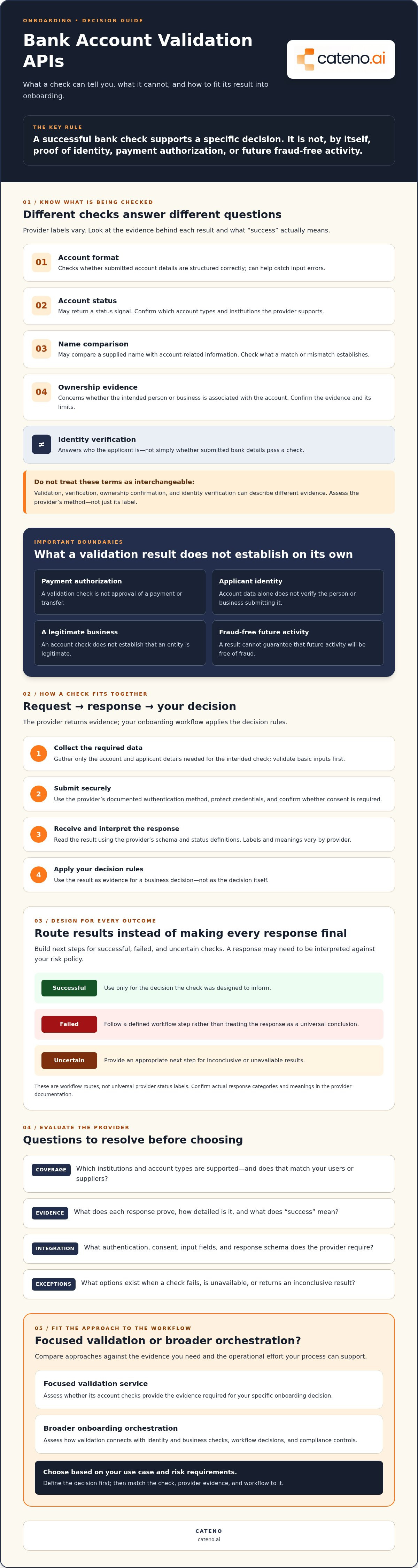
A bank account validation API checks submitted account details using one or more methods. Depending on the provider, it may assess whether an account number is correctly structured, return an account-status signal, compare a name, or provide evidence related to ownership. It does not, by itself, authorize a payment or verify the identity of the person or business submitting the details.
Bank account validation assesses specified account data or attributes, but its result alone does not necessarily prove account ownership, authorize a payment, verify an entity’s identity, or establish that future activity will be fraud-free. A successful response supports only the decision that the check is designed to inform.
Validation, verification, and account ownership are not interchangeable
Providers use these terms differently, so assess the evidence behind the label. Validation may mean checking an account’s format or comparing supplied details. Verification can refer to a broader set of checks, while ownership confirmation specifically concerns whether the intended person or business is associated with the account. Identity verification concerns who the applicant is, not just the bank details they submit.
Define what your use case requires before accepting an account. A correctly formatted number may help catch an input error, while payment setup may require stronger evidence that the account belongs to the intended party. Check each provider-specific claim against current documentation, including what “success” and each response status mean.
When businesses use bank account validation
Businesses may check bank details during customer or supplier onboarding, when setting up payments, or while collecting business account information. The method and coverage matter: a check available for one account type or institution may not apply to another. Confirm the supported population and the evidence returned before making a decision depend on the result.
Used at the right point in a workflow, validation can help identify avoidable data-entry issues before they create downstream review or payment work. It is not the same as initiating or approving a transfer. For U.S. electronic payments, the Automated Clearing House (ACH) network is a payment network. A validation result should not be mistaken for payment authorization or proof that a transaction will succeed.
Account checks may form one part of a broader business review, but they don’t establish that an entity is legitimate. If your process also needs entity-level checks, see this guide to digital KYB verification. Match each check to a defined onboarding decision rather than treating one account response as a complete assessment.
How a Bank Account Validation API Processes a Check
A bank account validation API typically sits between an onboarding application and a provider that evaluates submitted details. The application collects information, sends a request according to the provider’s requirements, receives a response, and applies its own decision rules. Depending on the provider and method, a connected financial institution may also contribute data. The exact process varies, so treat this as an illustrative model, not a specification.
What happens between the request and the response?
- Collect data. Gather only the account and applicant details required for the intended check. Validate basic inputs before submission so avoidable formatting issues don’t become provider errors.
- Submit securely. The application sends the request using the provider’s documented authentication method. Protect credentials and confirm whether consent is required for the chosen validation method.
- Receive a response. The provider returns a result in its defined format. Illustrative categories might include confirmed, not confirmed, unavailable, or requiring review, but actual labels and meanings vary.
- Apply decision rules. Your workflow interprets the response against your risk policy. A provider result is evidence for a business decision, not the decision itself.
Authentication, consent, input fields, and response schemas are provider-specific. Confirm each in current documentation before implementation, including what each status establishes and whether a result can be used for your intended account type. A response may help inform controls related to preventing payment fraud, but validation alone doesn’t guarantee ownership or prevent unauthorized activity.
How to handle errors and inconclusive results
Separate failure types instead of treating every unsuccessful response alike. An invalid input may call for customer correction; an unavailable service may call for a controlled retry; unmatched details may require another verification step; and an uncertain result may need review under your risk policy. Define limits and escalation routes in advance, and don’t turn technical errors into automatic approval or rejection.
Applications should route inconclusive responses separately from confirmed results, with explicit next steps defined by the business’s risk policy. This keeps clear evidence distinct from a check that could not reach a clear outcome.
For implementation, test each response path, record the reason for the outcome, and make the correction or review process clear to applicants and staff. When validation exceptions need to connect with other intake steps, see the business onboarding workflow engine guide.
How to Evaluate Bank Account Validation API Providers
Compare providers against the decision you need to make, not the number of checks listed in a feature description. A bank account validation API may assess account details, provide ownership signals, or support account linking, but these capabilities are not interchangeable. Ask what evidence each result represents and how it applies to your onboarding or payment setup.
Match verification depth to the business use case
Start with the evidence required at each stage. Onboarding may call for a basic account-detail check, while payment setup may require evidence that the account is associated with the intended party. Ongoing account maintenance may have different requirements. Confirm whether ownership signals are explicitly supported, and distinguish data access or account linking from a validation result.
Coverage is meaningful only when assessed against the institutions and account types used by your actual customer or business population. Ask for documentation or other evidence about coverage, supported account types, and performance claims. Don’t rely on broad percentages or provider rankings without knowing how they were measured and whether they reflect your population.
| Evaluation criterion | Questions to ask |
|---|---|
| Verification scope | What account attributes or ownership signals does each check assess? |
| Account types and coverage | Which account types, institutions, and regions are supported? How are gaps reported? |
| Response detail | Does the result explain its status and limits, or return only a broad outcome? |
| Exception paths | How are unmatched details, unavailable checks, and uncertain results represented? |
| Integration readiness | Are documentation, authentication guidance, testing support, sandbox access, and versioning information available? Confirm these directly with the provider. |
| Data handling and support | What data is collected and retained, what access controls are available, and how can implementation questions be raised? |
| Commercial fit | Is the pricing model based on usage, subscriptions, or another structure, and how do exceptions affect operational effort? |
Compare API readiness, coverage, and commercial fit
Test representative cases before committing. Include supported and unsupported account types, mismatched details, and unavailable responses where testing options permit. Review how provider changes are communicated and whether your team can adapt to schema or version updates. A polished demonstration is not a substitute for documentation and evidence that match your requirements.
If validation needs to sit within a wider onboarding process, consider Cateno’s platform capabilities as one option for coordinating bank account validation with broader workflow steps. Confirm the specific integration options and validation scope directly before making a provider decision.
How to Integrate a Bank Account Validation API into Onboarding
Start with the onboarding decision, not the technical request. A bank account validation API should inform a defined step in your process, with clear ownership for interpreting its result and handling exceptions. The integration is reliable only when data collection, decision rules, and follow-up actions work together.
Plan the integration around a defined decision
Map where account details enter your customer or business onboarding journey, what information the check needs, and how its response affects the next step. Decide who reviews uncertain cases and what evidence is needed before the applicant can proceed. Confirm required fields and other provider-specific requirements in current documentation instead of assuming they match your existing forms.
Before expanding use, run a pilot with representative cases and test at least four paths:
- Normal: expected details and a clear response.
- Invalid: missing or malformed input that should prompt correction.
- Unavailable: a check that cannot be completed, with a defined retry or alternative route.
- Inconclusive: a result that needs review rather than being treated as confirmed.
Use the pilot to check that each outcome reaches the right workflow step and that applicants and staff receive clear instructions. Have the appropriate privacy, security, and compliance professionals review consent, data minimization, access control, retention, and security. Applicable legal and compliance obligations depend on the business, its activities, and relevant jurisdictions, so obtain qualified review rather than treating API integration as a substitute for that assessment.
Operate the integration after launch
Set internal measures for errors, exception rates, and onboarding completion. Review them regularly to spot recurring input problems, coverage gaps, or workflow bottlenecks. Assign owners for provider changes, API version updates, and incident escalation, and document how the process should respond if a check becomes unavailable.
Include commercial fit in implementation planning: consider how the pricing model aligns with expected usage and the operational effort required to manage exceptions. Ask providers about the pricing structure that applies to your use case.
If you’re assessing how bank account validation could fit into a broader onboarding process, discuss your onboarding requirements with Cateno. Confirm available integration options and validation scope before making API-specific assumptions.
Choosing a Bank Account Validation API That Fits Your Workflow
The right choice provides evidence your business can use, for the accounts your customers actually hold, within a workflow your team can operate. Compare options against five factors: required evidence, population coverage, integration fit, exception handling, and total operational effort. A bank account validation API is only one part of the decision. Consider who reviews uncertain cases, how gaps are resolved, and which onboarding steps remain outside the check.
When a focused validation API may be enough
A focused service may suit a narrow process with defined inputs, a specific validation outcome, and a clear owner for exceptions. For example, a team may check submitted account details during payment setup, then route unmatched or unavailable results for correction or review. Before selecting a provider, confirm that its supported institutions and account types match your population and that its returned evidence meets your requirements. For teams building fintech solutions that require bank aggregation APIs to connect and verify accounts, visit Wealthreader to learn more about specialized aggregation services.
Keep the scope explicit. A focused account check shouldn’t be assumed to perform identity verification, KYC, KYB, or broader compliance work. Assess those as separate needs.
When validation belongs in a broader onboarding platform
If bank details are collected alongside business information and documents, coordinating those steps may reduce fragmented handoffs. A broader onboarding platform can structure intake, route checks, and keep exceptions connected to the overall process. It still doesn’t make a bank result proof of business legitimacy; each check contributes specific evidence to a wider decision.
Cateno offers bank account validation within a cloud-based onboarding and compliance platform, with a customizable workflow engine, self-service onboarding gateway, automated KYC and KYB checks, document management, and verification reports. These capabilities may be relevant when a business wants account validation to sit within entity onboarding. Confirm the available integration options and validation scope directly, and don’t assume a standalone API or specific technical features without verified documentation. For sector context, explore Cateno’s supported industries.
Make the final comparison on operational fit, not feature count: can your team interpret outcomes, manage exceptions, and maintain the process without adding unnecessary steps? Discuss your bank validation workflow to explore whether Cateno’s confirmed capabilities align with your use case.
Build Validation Into a Better Onboarding Decision
A bank account validation api is useful only when its result supports a clearly defined decision. Before choosing a provider, confirm what evidence it returns, whether it covers your customer and account population, and how it handles exceptions. Then test how those outcomes move through onboarding, including who reviews uncertain cases and what happens next.
For some businesses, a focused account check may be enough. If bank details sit alongside entity information, document collection, and other checks, a coordinated workflow may better fit the process. Cateno lists bank account validation alongside customizable workflows, self-service onboarding, automated KYC and KYB checks, document management, and verification reports. Consider these capabilities as part of a broader onboarding approach, but confirm the available integration options and validation scope for your use case.
Clear requirements make provider evaluation more practical. Discuss your bank validation workflow with Cateno to explore how its onboarding capabilities may align with your needs. With the right evidence and exception paths in place, validation can become a coherent part of the process.
Frequently Asked Questions
What does a bank account validation API verify?
A bank account validation API may check account details, account status, or ownership-related signals, depending on the provider and method. These checks are distinct from authorizing a payment, verifying an applicant’s identity, or linking an account to retrieve financial data. Before using a result, review the provider’s documentation to understand what it means, which account types it applies to, and what it cannot establish. A successful response doesn’t guarantee ownership, payment success, or fraud protection.
Is bank account validation the same as account verification?
Not always. Providers may use “validation” and “verification” differently, so compare the underlying check rather than relying on its label. One service may assess account details; another may return ownership-related signals or connect to an account. Document what evidence the service returns, which decision that evidence can support, and what remains outside its scope. This helps you select a check that fits your process without treating distinct capabilities as interchangeable.
Can a bank account validation API confirm account ownership?
It depends on the provider, data source, account type, and validation method. Some services may return ownership-related information or signals, while others may only assess account details or provide a different result. Check current documentation for the exact fields returned, supported coverage, consent requirements, and limitations. Don’t interpret a generic successful status as conclusive authentication of every account holder. If ownership evidence is essential to your decision, confirm that the provider explicitly supports the relevant check.
How does a bank account validation API work?
A bank account validation API typically receives information from an application, processes a request through a provider, and returns a response for the business to assess. The application then applies its own decision rules. Authentication, consent, required fields, response formats, and availability vary by provider, so confirm the implementation details in its documentation. Plan separate handling for invalid inputs, service unavailability, and inconclusive results; not every response should trigger the same next step.
What should I compare when choosing a bank account validation API?
Compare the evidence returned, supported account types and institutions, relevant use cases, integration documentation, and response handling. Also review security and data controls, support options, and the commercial model. Ask how the provider reports unavailable or uncertain results, then test representative cases in a sandbox if one is available. Assess coverage against the institutions and account types your own customers or business partners use, rather than relying on headline claims that may not match your population.
Does a bank account validation API prevent payment fraud?
No validation check can guarantee that an account is legitimate or prevent every form of fraud. Depending on its scope, the result may contribute evidence to a broader risk process, but its value depends on the checks performed and how your business uses the response. Treat validation as one input, define escalation paths for concerning or uncertain outcomes, and confirm provider limitations before making fraud-prevention claims. Maintain appropriate business controls rather than relying on a single result.
How do businesses handle an inconclusive validation response?
Handle an inconclusive response separately from confirmed or rejected outcomes. Define whether the next step is a controlled retry, a request for corrected information, or manual review, and assign an owner for unresolved cases. Don’t automatically approve or reject an applicant solely because the check could not reach a clear result. Record why the response was inconclusive and track recurring issues, so your team can refine its workflow and align decisions with documented business rules.


