

A completed identity check is not the same as a complete KYC program. KYC verification for crypto exchanges is a lifecycle: information is collected and checked at onboarding, exceptions are reviewed, and records support follow-up as customer risk changes.
If the boundaries between KYC, AML monitoring, and the Travel Rule feel unclear, you’re not alone. Document collection and manual reviews can slow onboarding, while inconsistent steps make decisions harder to explain and repeat. A sound process balances a clear customer experience with structured, risk-aware review.
This guide explains the stages of exchange KYC, distinguishes identity checks from related compliance controls, and shows how to map an onboarding process that is consistent, reviewable, and adaptable to risk. It also covers how workflow infrastructure, including configurable steps, self-service document intake, and organized follow-up, helps teams manage verification as an ongoing process rather than a one-time gate.
Key Takeaways
- Build KYC verification for crypto exchanges as a lifecycle, with clear stages for intake, assessment, exception handling, and ongoing review.
- Separate identity checks from AML transaction monitoring and Travel Rule controls so each process has a defined purpose and owner.
- Set onboarding policies, review responsibilities, and decision records before routing cases by risk.
- Use configurable workflows to organize document collection, verification, review, and follow-up consistently.
- Self-service intake and structured records can reduce avoidable onboarding friction while keeping decisions reviewable.
What KYC Verification for Crypto Exchanges Means, and Why It Matters
KYC identifies and assesses customers during exchange onboarding and throughout the customer relationship. In practice, KYC verification for crypto exchanges connects a person or business to the account they want to use, then gives the exchange information to support a customer-risk assessment. The appropriate steps depend on the exchange’s operating context and applicable obligations, so one checklist will not fit every platform or jurisdiction, ranging from traditional custodial models to non-custodial swap platforms like n.exchange.
Crypto’s pseudonymous features make this distinction especially relevant. A public blockchain address does not necessarily reveal who controls it, while an exchange account creates a direct customer relationship. An exchange may need to establish who is using its services and assess relevant risks, subject to the rules that apply to its activities and location. For a broader introduction to the term, see What is KYC Verification?
Identity verification establishes who a customer is; it does not, by itself, constitute a complete AML compliance program. It can inform customer due diligence, but other controls address separate risks and responsibilities. Treating a successful identity check as the end of compliance leaves important parts of the customer relationship outside the onboarding decision.
What information may an exchange collect during KYC?
Depending on the exchange’s policies and applicable requirements, information may include a customer’s name, date of birth, address, or other identifying details. Supporting evidence might include an identity document or materials that help verify a submitted detail. These are examples, not a universal checklist: requirements can differ by jurisdiction, customer type, service, and assessed risk.
Make each request understandable. If a document is needed, explain what information it should show, how the customer should submit it, and what may happen if the image is incomplete or a detail does not match. Clear instructions help customers respond accurately and give reviewers a consistent basis for assessing submissions.
Why does KYC matter to an exchange’s customer relationship?
Reliable identity information supports more than an initial account decision. It gives the exchange a documented basis for assessing customer risk, resolving inconsistencies, and deciding whether additional review is appropriate. A structured record can also help staff understand what was checked and why a decision was reached, rather than relying on fragmented notes or recollection.
Clarity matters to customers, too. Explain why information is requested, outline the next step, and make it clear when a submission needs correction or further review. This can reduce avoidable confusion without implying that every case follows the same path. For foundational KYC concepts, consult the KYC verification guide.
How the Crypto Exchange KYC Lifecycle Moves from Intake to Review
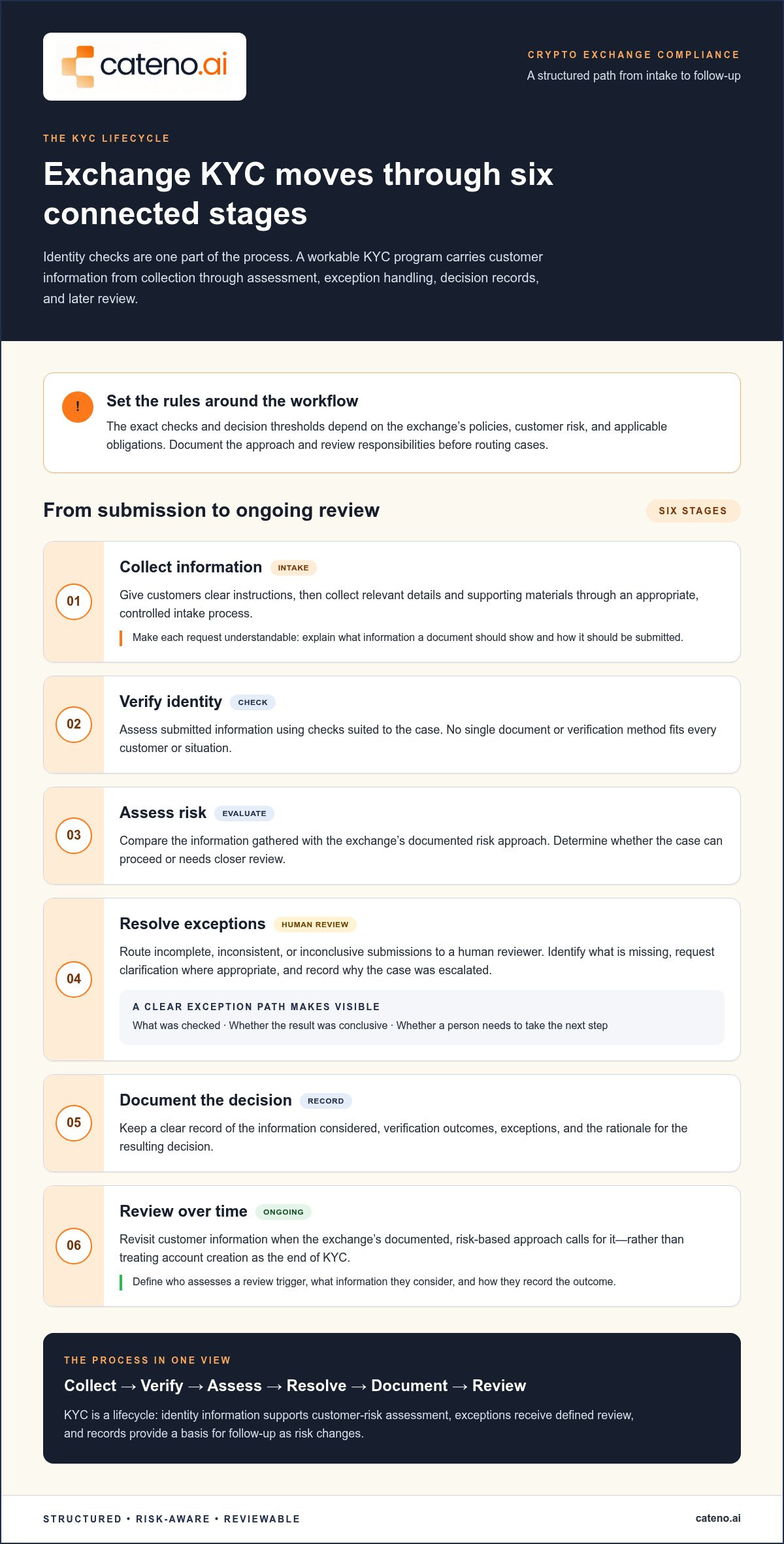
A workable KYC process needs a defined path from the first customer submission to later review. For KYC verification for crypto exchanges, that path should show what information is requested, how checks are assessed, who handles exceptions, and how decisions are recorded. The exact checks and decision thresholds depend on the exchange’s policies, customer risk, and applicable obligations.
- Collect information. Give customers clear instructions and collect relevant details and supporting materials through an appropriate, controlled intake process.
- Verify identity. Assess submitted information using checks suited to the case. No single document or verification method will fit every customer or situation.
- Assess risk. Compare the information gathered with the exchange’s documented risk approach to determine whether the case can proceed or needs closer review.
- Resolve exceptions. Route incomplete, inconsistent, or inconclusive submissions to a human reviewer. The reviewer can identify what is missing, request clarification where appropriate, and record why the case was escalated.
- Document the decision. Keep a clear record of the information considered, verification outcomes, exceptions, and rationale for the resulting decision.
- Review over time. Revisit customer information when the exchange’s documented approach calls for it, rather than treating account creation as the end of KYC.
From customer information to a verification decision
Good intake design reduces ambiguity before a case reaches review. Explain which details are needed, what supporting material may be suitable, and how customers should submit it. Then make each outcome visible in the workflow: what was checked, whether the result was conclusive, and whether a person needs to take the next step. If an automated check returns an unclear result, a defined human review path lets staff assess the evidence and document the reason for escalation instead of forcing every case into a simple pass-or-fail outcome.
When should an exchange revisit customer information?
Set review timing and triggers through a documented, risk-based approach. A changed customer profile or newly relevant risk information might prompt a review, but these are examples, not universal requirements. Define who assesses a trigger, what information they consider, and how they record the outcome. This makes follow-up more consistent and helps distinguish a genuine change in circumstances from an incomplete or outdated record that needs clarification.
Ongoing review extends KYC beyond account creation by keeping customer information and decisions responsive to relevant changes over the relationship. A workflow that connects intake, verification, exception handling, records, and follow-up gives each stage a clear place. For a broader look at how KYC fits into an ongoing process, explore this KYC lifecycle management guide.
KYC, AML Monitoring, and the Travel Rule: What Each Control Does
KYC, AML monitoring, and the Travel Rule all support a wider compliance framework, but each addresses a different question. KYC asks who the customer is and what risks are relevant to the relationship. Transaction monitoring examines activity for patterns that may require investigation. The Travel Rule concerns information associated with certain transfers. In the United States, the scope of controls depends on the exchange’s activities and applicable rules, so teams should define each control’s purpose rather than treat them as interchangeable.
| Control | Purpose | Information focus | Typical process owner |
|---|---|---|---|
| KYC | Identify the customer and assess relationship risk. | Customer details, identity evidence, and due diligence records. | Onboarding or customer due diligence team. |
| AML monitoring | Review activity for patterns that may warrant investigation or escalation. | Account and transaction activity, including relevant customer context. | AML operations or transaction monitoring team. |
| Travel Rule controls | Handle required originator and beneficiary information for covered transfers. | Transfer-related information about the parties involved. | Transfer operations or a designated compliance function. |
These are typical process owners, not a required organizational chart. A smaller exchange may assign multiple responsibilities to one team, but the purpose of each control should remain clear. A customer identity record does not assess every transaction or establish every transfer counterparty. Likewise, transaction monitoring does not replace the process for identifying a customer.
How is customer KYC different from transaction monitoring?
KYC verification for crypto exchanges focuses on the customer and the risks associated with the relationship. Transaction monitoring examines activity over time for patterns that may need investigation under the exchange’s procedures. A verified identity does not explain every later transaction, and monitoring does not establish who owns an account. These controls work alongside each other; neither replaces the other or guarantees an effective compliance program.
How does the Travel Rule relate to exchange KYC?
The Travel Rule is not simply another identity check at sign-up. At a high level, it concerns originator and beneficiary information connected to covered transfers. In the United States, the Travel Rule threshold remains $3,000 under 31 CFR 1010.410. Exchanges should assess how the rule applies to their activities and transfer processes using current authoritative guidance, rather than assume onboarding checks satisfy transfer-related requirements.
KYC also does not mean every crypto activity is anonymous or that every wallet has identical obligations. Public blockchain activity may be pseudonymous, but legal responsibilities depend on the services performed and the entities involved. Keep procedures and ownership distinct so staff can tell whether a case concerns customer identity, account activity, or transfer information. Industry-specific onboarding needs can shape how intake and review workflows are organized across different industries.
How to Design Exchange KYC That Balances Risk, Review, and Customer Experience
A well-designed KYC process makes the next step clear for customers and staff. For KYC verification for crypto exchanges, that means setting a documented policy, routing cases consistently, and making decisions reviewable without turning every application into the same manual process.
- Define the policy. Document what the exchange needs to establish, what factors shape customer risk, and which situations require additional review. Keep decision criteria aligned with applicable obligations and the exchange’s own risk approach.
- Map customer paths. Outline the routine journey from information submission to decision, along with paths for incomplete details, mismatched information, or inconclusive checks. Show customers what to provide and what happens next.
- Assign review ownership. Identify who handles routine processing, who investigates exceptions, and who can make or escalate decisions. Clear ownership prevents unresolved cases from sitting between teams.
- Record decisions. Capture relevant information, check outcomes, review notes, and the rationale for escalation or resolution. Limit access to records according to defined roles, and make each record easy to follow later.
- Test and refine. Walk through routine and exception scenarios before relying on the workflow. Review the process periodically to identify unclear instructions, avoidable handoffs, or policy changes that require updated steps.
Risk-based routing makes this structure practical. A case that meets documented criteria and has consistent information may follow a routine path; a case with missing details or an inconclusive result can move to human review. The exchange sets its own criteria and thresholds. The goal is not to guarantee a particular decision, but to make routing consistent and exceptions visible.
Customer experience depends on communication as much as process design. Use plain instructions, explain why a requested item is needed, and provide a meaningful status update when a case is waiting for review or further information. Customers are less likely to abandon an application because of uncertainty when they understand what is outstanding and what action to take.
Where can automation help without removing oversight?
Automation can organize repeatable intake, document handling, routing, and status changes so staff can focus attention where review is needed. A configurable workflow can move a case from submission to an assigned queue based on defined process rules. Keep human accountability visible for exceptions: record who reviewed the case, what evidence informed the decision, and why it was escalated or resolved. Automation supports the process; it does not replace judgment.
What should a KYC workflow record and measure?
Track operational signals such as completion, exception reasons, review outcomes, unresolved cases, and points where applications pause. These measures can reveal confusing instructions or a review bottleneck, but they should not replace compliance judgment or become decision rules by themselves. Automated onboarding workflows can connect process steps while preserving a record of how cases move through them.
For an example of how configurable workflows can connect onboarding, document collection, and review steps, see Cateno’s onboarding workflow options.
How Cateno Supports Structured KYC Onboarding Workflows
Putting KYC policy into practice requires more than collecting documents. Teams need a defined way to move information from intake through verification, review, and follow-up, while keeping outcomes and exceptions organized. Cateno provides workflow infrastructure for KYC and KYB intake, automated checks, document management, and ongoing compliance workflows. It structures processes while the exchange retains responsibility for determining its legal obligations and applying its compliance judgment.
For an exchange, KYC verification for crypto exchanges can involve different customer paths and review steps. Cateno’s customizable workflow engine and self-service onboarding gateway help organize those steps around the organization’s process. They support a consistent intake experience and route submitted information through configured stages without assuming every customer follows the same path.
Where Cateno fits in the onboarding process
A self-service gateway gives customers a structured way to submit information and documents. Configurable workflow stages can then organize document handling, automated KYC and KYB checks, review, and follow-up. A branded customer portal supports customer-facing intake, while advanced verification reports organize outcomes and records for review. These capabilities provide workflow structure, with the exchange defining how its policies and other compliance controls apply.
Autonomous compliance agents can support workflow management by coordinating defined process steps and follow-up. They do not replace accountable reviewers or make legal judgments. The exchange remains responsible for setting its policies, defining decision criteria, and determining how exceptions are assessed within its compliance context.
What to discuss when planning a workflow
Start with the customer paths the organization needs to support. Clarify what information each path collects, where automated checks fit, which cases need human review, and how the workflow records an outcome. Then consider how updates or relevant changes should trigger follow-up, and how teams will review unresolved cases. These decisions shape a consistent process without forcing every customer into an identical sequence.
Useful planning questions include:
- Which customer types and onboarding paths should the workflow accommodate?
- What information and documents are needed at each stage?
- How should incomplete or inconclusive submissions be routed for review?
- What records will support review of decisions and follow-up over time?
Implementation can be tailored to the organization’s workflow and compliance context. Mapping these elements before configuring stages connects self-service intake with structured review and ongoing records, while keeping decision ownership clear. The result is a process teams can assess and refine as their needs evolve, rather than a one-time identity gate.
Cateno’s configurable onboarding workflows support intake, review, and follow-up. Learn more through Cateno’s onboarding workflow information.
Make Your KYC Process Ready to Evolve
Turn your current onboarding approach into a process your team can explain, review, and refine. Map where customers encounter friction, where decisions need human judgment, and where handoffs or unclear ownership can leave cases unresolved. Use those observations to prioritize improvements, then revisit the workflow as your customer base and operating context change.
A well-structured approach to KYC verification for crypto exchanges is not defined by adding more steps. It is built by making each step purposeful, assigning responsibility, and ensuring the process can adapt without losing consistency. Start with the parts of onboarding that are hardest to manage today, and set a practical direction for improving them.
Cateno’s workflow platform helps structure onboarding around your process. Discuss your KYC onboarding workflow with Cateno to identify a clear next step for your team.
With a thoughtful design and a process that can evolve, you can move forward with greater clarity and control.
Frequently Asked Questions
Is KYC verification mandatory for every crypto exchange?
No single global checklist or rule applies to every exchange. Obligations depend on the exchange’s activities, jurisdiction, customer relationships, and applicable rules. An exchange should document how its KYC verification program applies to its business model and review that approach as its services or operating context change. For a specific determination, consult current guidance from the relevant authorities and applicable legal requirements.
Can customers use a crypto exchange without completing KYC?
It depends on the exchange, the services involved, the customer’s location, and applicable requirements. Some account functions may have different verification conditions, but customers should not assume an exchange offers access without KYC. Exchanges can reduce uncertainty by explaining verification requirements before onboarding begins, including which steps apply to a particular service and what could prevent access until a check is complete.
What documents do crypto exchanges ask for during KYC?
Requests vary, but an exchange may ask for identity details and supporting evidence, such as a government-issued identity document or information that helps verify submitted details. These are examples, not a universal checklist. Customers can help avoid delays by following the exchange’s instructions carefully, checking that submitted information is legible and consistent, and responding to requests for clarification through the exchange’s stated process.
How long does KYC verification take on a crypto exchange?
There is no single completion time that applies to every exchange or application. Timing can depend on whether the requested information is complete, which verification steps apply, whether details need clarification, and whether a case requires manual review. Exchanges should avoid implying a guaranteed turnaround when they cannot support it. Clear status messages, such as “more information needed” or “under review,” help customers understand the next step.
What happens if a customer fails KYC verification?
A failed or inconclusive check may lead to a request for clarification, additional review, or an outcome under the exchange’s documented policies. It does not automatically prove wrongdoing; an unreadable document or mismatched detail can have a straightforward explanation. Exchanges should record why a case was escalated, communicate requests privately, and provide a defined way to correct errors or resolve information gaps where their process allows.
Is crypto KYC the same as AML monitoring?
No. KYC concerns the customer relationship, while AML monitoring examines activity for potential risk indicators. The Travel Rule is separate again: it relates to specified transfer information, and its scope depends on applicable rules and circumstances. For example, a completed identity check does not determine whether a later transaction needs investigation. Exchanges should define these controls separately and verify current requirements in each relevant jurisdiction.
Do non-custodial crypto wallets need KYC?
There is no universal yes-or-no answer. A wallet software tool and a provider that performs intermediary or other services may have different legal treatment, depending on what the provider actually does and where it operates. The label “non-custodial” alone does not settle the question. Users and businesses should check current authoritative guidance for the relevant jurisdictions and activities rather than infer obligations from wallet design alone.


