

A valid bank account does not necessarily prove that it belongs to the business you’re onboarding. To verify business bank accounts effectively, understand what each check confirms and where its evidence stops. Account validation can help establish whether details are usable, but it may not verify the business’s legal identity or show that the account is under its control.
That distinction matters. Incorrect or mismatched details can disrupt payments, while manual checks can slow onboarding and leave teams with inconsistent records. A reliable process connects account evidence to the identity and ownership checks your workflow requires, with clear steps for handling mismatches and exceptions.
This guide explains what business bank account verification can and can’t confirm, how approaches such as bank connections, test deposits, database checks, and document review differ, and how to choose checks for your use case. You’ll also learn how to build consistent review and escalation steps into onboarding. Cateno’s configurable workflows, bank account verification, automated KYC and KYB checks, and verification reports can help coordinate these checks as part of a broader onboarding process.
Key Takeaways
- Account validation checks account details, but doesn’t by itself establish business identity, ownership, or authority.
- To verify business bank accounts, match the verification approach to the evidence and level of assurance your workflow needs.
- Routing lookups can help identify payment routes, but they don’t confirm account ownership or business authority.
- Set a consistent process for successful, incomplete, mismatched, and unavailable results so each case has a clear next step.
- Configurable workflows can coordinate bank account verification, KYC and KYB checks, and document intake within business onboarding.
Why verify business bank accounts, and what does the check establish?
A business may supply bank details for a payment, refund, or onboarding process. Those details alone don’t prove that the account belongs to the business named on the application, or that the person submitting them is authorized to act for it. Treating the details as proof can lead to payment delays, failed transfers, or records linked to the wrong entity.
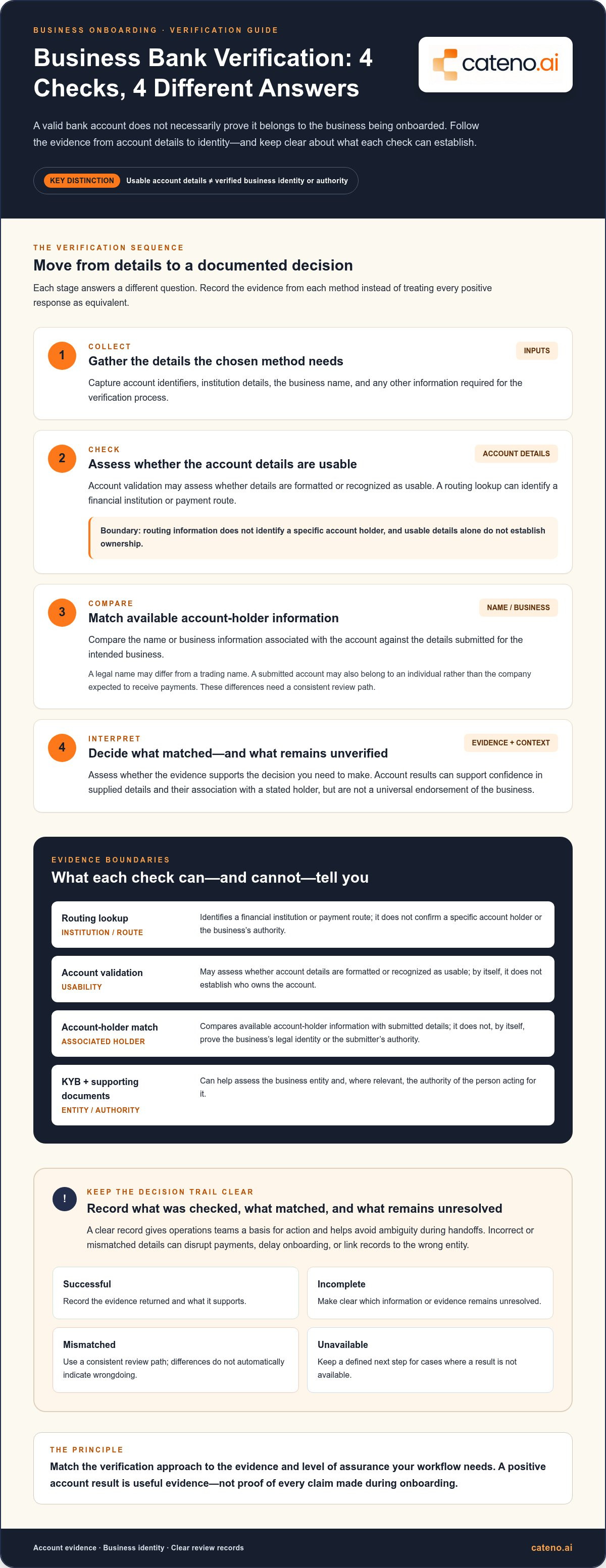
Business bank account verification means checking account details and assessing their relationship to the intended business. The depth of that assessment depends on the checks performed and the evidence available. To verify business bank accounts reliably, separate four questions: Which financial institution does the routing information identify? Do the account details appear valid for the intended transaction? Does the account-holder information match? And does separate evidence support the business’s identity and the submitter’s authority?
What does business bank account verification confirm?
Different checks establish different things. A routing number identifies a financial institution or payment route, not a specific account holder. Account validation may assess whether details are formatted or recognized as usable, but that alone doesn’t establish who owns the account. An account-holder match compares the name or business information associated with an account against the details supplied.
Account verification can support confidence that supplied account details are valid and associated with a stated holder, but it cannot, by itself, prove the business’s identity, the submitter’s authority, or every claim made during onboarding.
For example, an account name that matches a trading name may still need to be connected to the legal entity being onboarded. KYB checks and supporting documentation can help assess the entity and, where relevant, the authority of the person acting for it. A positive account result is useful evidence, not a universal endorsement of the business. KYC processes focus on identifying customers; the Know Your Customer (KYC) framework provides background on that broader identity-checking context.
Why account checks matter in business operations
Accurate account information supports payment setup and helps teams maintain dependable business partner records. A supplier’s name might differ from its legal entity name, for instance, or a submitted account might belong to an individual rather than the company expected to receive payments. Those differences don’t automatically indicate wrongdoing, but they do need a consistent review path before the details are used.
Incomplete information can stall onboarding while staff request clarification. Mismatches can prompt manual investigation, and incorrect details may cause a payment to fail or be directed incorrectly. Recording what was checked, what matched, and what remains unresolved gives operations teams a clearer basis for action and helps avoid ambiguity during handoffs.
This process is distinct from opening a business checking or savings account. A bank opening an account assesses its customer as part of that service. An organization verifying a partner’s supplied details is checking information for its own payment or onboarding process. Keeping those purposes separate helps teams choose appropriate evidence and avoid treating one check as proof of more than it establishes.
How business bank account verification works: checks and methods
A reliable check is a sequence, not a single lookup. First, collect the account and business details needed for the payment or onboarding decision. Then assess the account information, compare relevant identity data, and interpret the result in context. Each step answers a different question, so record the evidence returned by each method rather than treating every positive response as equivalent.
- Collect details: Capture the account identifiers, institution details, business name, and other information required by the chosen method.
- Check account information: Assess whether the details are recognized or can be used for the verification process.
- Compare identity data: Match available account-holder information against the business information submitted.
- Interpret results: Determine what matched, what remains unverified, and whether the case needs further review.
Available methods and evidence vary by financial institution, workflow, and verification provider. A method that returns account data may not return business ownership details. Define the decision you need to make first, then assess whether the evidence supports it.
Which details and identities may need to match?
Keep account identifiers, institution details, and business identity distinct. Account and routing details identify the destination and payment route; a business name identifies the entity expected to use or own the account. A legal name may differ from a trading name, while an authorized representative may submit details on the entity’s behalf. These differences can be legitimate, but collecting details alone doesn’t establish ownership or signing authority.
A routing lookup identifies a financial institution and payment route, not a specific account’s ownership or the authority of the business submitting it. Institution-level information can help check routing details, but it cannot replace account-specific evidence or business identity checks.
How do instant methods and micro-deposits differ?
An account-data connection approach typically asks the account holder to authorize access through a connection flow. Depending on the institution and method, the process may return account information for comparison without requiring the user to confirm a separate test payment. The data and identity evidence available can vary. For implementation considerations, see this bank account validation API guide.
Micro-deposit verification follows a different sequence: a small test deposit is sent to the account, and the user confirms information associated with that deposit, such as its amount or a verification code. This requires a follow-up action and a way to connect the confirmation to the onboarding record. It can add user effort and a waiting step, with timing dependent on the process and institution.
Neither approach proves every business claim. Compare the evidence each method provides, the actions required from the applicant, and how incomplete or mismatched results will be handled. Cateno’s configurable workflows can place bank account verification within a broader onboarding platform, alongside relevant business identity checks, while keeping each result tied to the question it answers.
How to compare business bank account verification approaches
The right approach depends on the decision you need to make, the evidence available, and how the check fits into payment setup or partner onboarding. Compare methods by what they can establish, what the applicant must do, and what happens when information is incomplete. A method that confirms one data point may still leave account ownership or business identity unresolved.
Routing lookup alone does not verify account ownership or business authority. It can help identify the financial institution associated with routing information, but it doesn’t confirm who owns a specific account or whether a representative can act for a business.
| Approach | Purpose and evidence | User effort and workflow fit | Limitations and exceptions |
|---|---|---|---|
| Manual review | Reviews submitted documents, such as a bank statement, for account details and business-name information. | Requires document intake and staff review. Fits cases where documentation is already collected during onboarding. | Evidence can be incomplete, outdated, or difficult to reconcile with a legal entity name. Mismatches need a documented review path. |
| Account-data connection | Uses a connection process to retrieve available account information for comparison. | May require the account holder to complete an authorization flow. Can fit a digital payment or onboarding process where supported. | Available information depends on the institution and verification provider. An unavailable connection or limited data may require another review method. |
| Micro-deposits | Sends a small test deposit to the account; the user confirms information associated with it. | Requires a follow-up action from the account holder, so teams need a way to track pending confirmations. | Unconfirmed deposits leave the check incomplete. The result concerns access to the account process and does not establish every business identity claim. |
| Routing lookup | Checks which financial institution or payment route corresponds to routing details. | Can help validate institution-level information during data entry or payment setup. | Does not verify a specific account, its owner, or the submitter’s authority. Treat it as a supporting check, not an ownership decision. |
Which approach fits your business workflow?
For payment setup, prioritize evidence tied to the specific account and intended payment process. For partner onboarding, consider how account checks align with KYB review and document collection. If you need to verify business bank accounts across repeat or high-volume intake, assess whether results can be recorded consistently and linked to the correct business record.
What evidence and limitations should teams compare?
Define result categories before deployment: a match, a partial match, unavailable data, or a failed check. Each has a different meaning and may call for a different next step. Unavailable information isn’t the same as a mismatch. Account evidence also has a limited scope, so business identity may need separate review. This digital KYB verification guide explores how identity checks fit into broader business verification.
A structured comparison helps teams select checks based on evidence and workflow needs, rather than assumptions about speed or coverage. Record the method used, the result returned, and any follow-up required so the decision is clear to the next person handling the case.
How to build a reliable business bank verification workflow
A dependable workflow makes each check purposeful and gives every result a clear next step. Before deciding how to verify business bank accounts, define what evidence your team needs and how account results relate to the wider onboarding decision. Then use the same review path across cases, so staff don’t have to improvise when information is incomplete or doesn’t match.
- Define policy. Specify which account details and identity data are required, what each check is expected to establish, and which outcomes need human review. Set decision criteria before processing applications.
- Collect details. Request only the information needed for the selected checks. Give applicants a clear intake path, and make it easy to associate submitted account details and supporting documents with the correct business record.
- Run checks. Apply the chosen account verification and business identity checks. Keep their results distinct, since evidence about account details doesn’t necessarily establish the business’s identity or a representative’s authority.
- Resolve exceptions. Route incomplete, mismatched, or unavailable results to a defined review process. Assign responsibility for follow-up and document what evidence or clarification is needed before the case can progress.
- Record outcomes. Store the check type, result, reviewer decision, and next action in a consistent record. This helps later reviewers understand the decision without repeating the entire investigation.
Build data minimization, access control, and retention into the policy. Limit collection to information relevant to the decision, restrict access according to staff responsibilities, and define how long records are retained under your organization’s procedures. These controls support disciplined handling of sensitive information; they don’t, by themselves, guarantee compliance or a particular verification outcome.
How should teams handle mismatches and unavailable results?
A name difference should trigger review, not an automatic conclusion of wrongdoing. A legal entity may use a trading name, or a representative may submit details on its behalf. A good exception path is a documented route from review, through resolution, to a recorded decision. Capture the discrepancy, supporting evidence, reviewer rationale, and next action. Keep technical failures or unavailable data separate from a verified negative finding. One means the check couldn’t provide a result; the other reflects an adverse result within that check’s scope.
How can account checks fit into business onboarding?
Position account verification alongside business identity and required document checks, not as a replacement for them. A self-service intake step can collect information and documents, automated checks can assess the submitted data, and human review can handle exceptions that need judgment. Clear handoffs prevent unresolved results from being treated as complete. The automated business onboarding workflow guide explores how coordinated stages can support that process.
See how Cateno’s onboarding process can incorporate account checks.
Bring business bank account verification into a coordinated onboarding platform
Account checks are more useful when their results sit alongside the business information and documents needed to make an onboarding decision. Cateno brings bank account verification, automated KYC and KYB checks, document management, and configurable workflows into a cloud-based onboarding platform. Teams can coordinate the steps around their process without treating an account result as a substitute for broader business review.
A self-service onboarding gateway and branded customer portal can support information intake, while workflow stages direct submitted information to relevant checks and document steps. Advanced verification reports provide a way to review recorded results. Ongoing monitoring can also form part of a broader process, without implying that any one check or platform guarantees a particular outcome.
What changes when verification is part of one workflow?
Instead of handling account information, business checks, and documents across disconnected steps, teams can organize them around a shared onboarding process. A single intake can provide information for relevant verification and document tasks, while workflow status helps staff see what is complete and what still needs attention. This can clarify handoffs, but teams still need to assign review ownership and resolve exceptions.
Configurable onboarding workflows let teams shape those stages around their process. The Cateno platform overview describes the platform’s configurable workflow capabilities.
How should teams plan their next implementation step?
Start with the business event that should trigger verification, such as onboarding a new partner or setting up payment details. Map the process before configuring automation. A clear design identifies the information to collect, which checks apply, who owns each decision, and how incomplete or mismatched cases move to review.
- Define the trigger: Specify when account verification enters the process and which business records it relates to.
- Map the inputs: Identify the account, identity, and document information needed for the intended checks.
- Assign decision owners: Clarify who reviews results and who can resolve exceptions.
- Set record requirements: Decide what results, supporting evidence, and decisions should be retained in the onboarding record.
This preparation helps teams introduce automation with a defined purpose and consistent handoffs. Cateno’s configurable workflows can coordinate bank account verification with KYC and KYB checks and document management, while keeping the process aligned with the organization’s onboarding requirements.
Explore how coordinated account checks can fit into your onboarding process.
Make verification part of your next process improvement
Decide where stronger account evidence would make the biggest operational difference: onboarding a new partner, setting up payment details, or another point where your team relies on supplied bank details. Use that moment to define the decision, the evidence it requires, and who should handle exceptions. That clarity turns an isolated check into a repeatable part of your organization’s process.
For teams ready to verify business bank accounts within a broader process, Cateno brings bank account verification together with configurable workflows, automated KYC and KYB checks, and advanced verification reports. The goal is a coordinated workflow that fits your requirements, not a one-size-fits-all decision rule.
Discuss your business verification workflow with Cateno to identify a practical next step for your onboarding process.
Frequently Asked Questions
Can you verify a business bank account without accessing its online banking credentials?
Yes. Some ways to verify business bank accounts don’t require online banking credentials, including reviewing account documents or using a micro-deposit process that asks the account holder to confirm a test deposit. Other approaches use an authorized account-data connection, which may involve a separate sign-in or consent flow. The method determines what evidence is available, so explain what information is needed before the applicant begins.
How long does business bank account verification take?
There isn’t one standard timeframe. The process depends on the method, the institution’s response, and whether the applicant must take a follow-up action. A check that returns information during an online interaction may follow a different process from micro-deposits, which require the account holder to confirm details later. For planning, distinguish completed checks from pending cases and define how your team handles unresolved submissions.
What should a company do if the bank account name does not match its legal business name?
Pause the decision and review the difference rather than rejecting the account automatically. The account may use a trading name, a parent company name, or another legitimate business designation. Compare the submitted name with relevant business records and supporting account evidence, then document the explanation and reviewer’s decision. If the discrepancy remains unresolved, keep payment setup pending under your organization’s review policy.
Is business bank account verification the same as KYB?
No. Business bank account verification focuses on account information and, depending on the method, whether available holder details correspond to the business. KYB assesses the business itself, which can include its identity and relevant ownership or control information. The checks can inform the same onboarding decision, but neither should substitute for the other. Define separately what evidence each check is expected to establish.
Can a business verify an account before sending its first payment?
Yes. A company can make account verification part of supplier setup or partner onboarding before scheduling an initial transfer. For example, collect and review the beneficiary details when creating the payee record, then hold payment setup until the required checks and any review are complete. This separates verification from payment execution and gives the team a chance to address unresolved information before relying on the new destination.
Do all banks support instant business bank account verification?
No. The availability of instant account-data checks can vary by financial institution, account type, and verification method. A connection may return limited information or be unavailable for a particular case. Build an alternative path into the process, such as requesting supporting documentation or assigning the case for review. Treat an unavailable response as an incomplete check, not as confirmation that the account is invalid.
How often should businesses reverify bank account details?
Set a policy based on risk and changes to the payment relationship rather than assuming one interval suits every account. Recheck details when a payee submits a change, when payment instructions are updated, or when an internal review identifies a reason to revisit the record. A change-control process should capture who requested the update and ensure the revised details are reviewed before they’re used for a payment.


