

What if the bank account details you validated are correct, but the account belongs to someone else? That distinction is central to bank account ownership verification: confirming that an account exists or can receive payments doesn’t, by itself, establish who owns or controls it.
This creates a practical onboarding challenge. You need evidence suited to the transaction and its risk, but each additional step can add friction. A name mismatch also doesn’t always mean a failed check. Joint accounts, trading names, and business structures can require context rather than an automatic rejection.
This 2026 guide explains what ownership verification can establish, where its limits lie, and how common methods differ, from micro-deposits and data matching to API-based verification. You’ll learn how to handle matched, unmatched, and inconclusive results in a consistent, documented workflow. Cateno brings bank account verification into configurable onboarding workflows alongside KYC and KYB checks, helping teams route results and exceptions in a structured way.
Key Takeaways
- Separate account existence, account status, and ownership as distinct verification questions before making an onboarding decision.
- Compare connected bank data, micro-deposits, and document review by evidence source, customer effort, automation potential, and exception handling.
- Choose bank account ownership verification that fits the party being assessed, the account type, the transaction context, and your evidence threshold.
- Set a consistent path for matched, mismatched, and inconclusive results, then record the evidence and decision.
- Integrate account checks into broader KYC or KYB onboarding when relevant, with workflows that route results and exceptions consistently.
What Bank Account Ownership Verification Confirms, and What It Does Not
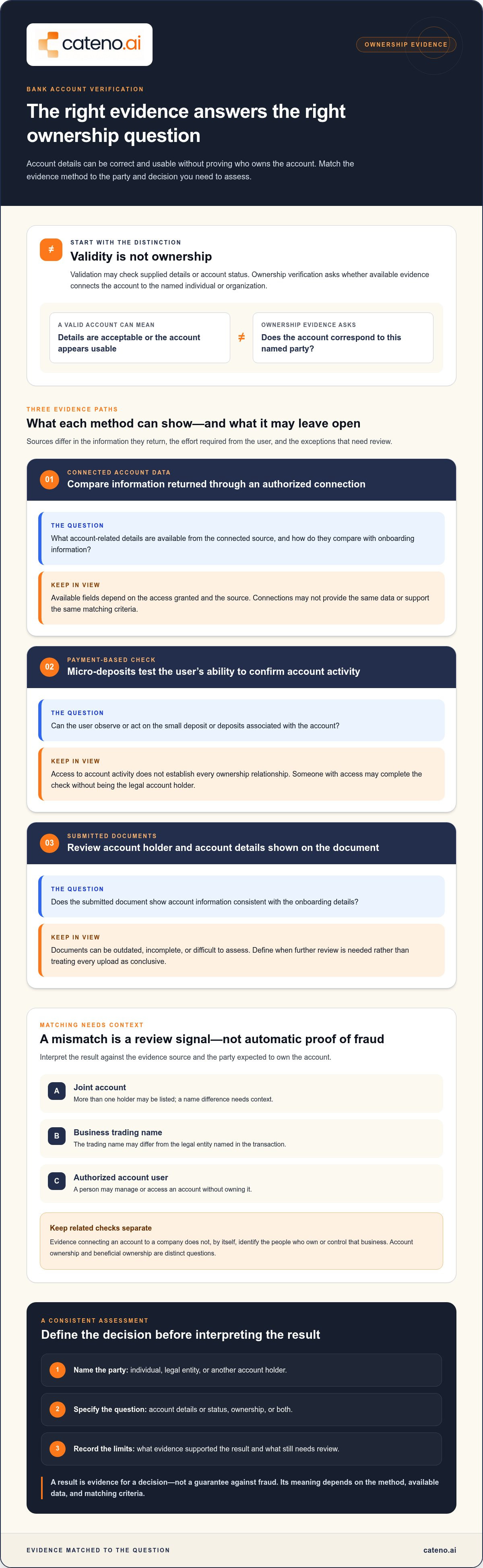
Bank account ownership verification evaluates whether available evidence connects an account to the individual or organization named in an onboarding or payment process. It differs from checking whether account details are formatted correctly or whether an account appears usable. Each check answers a different question, and a positive result on one does not automatically answer the others.
Treat the assessment as evidence for a decision, not a guarantee against fraud. What a result establishes depends on the verification method, the data available, and the matching criteria applied. A close name match, for example, may mean something different from evidence that directly associates the account with the named party. Define what you need to establish before interpreting the result.
Account validity versus account ownership
Account validation checks supplied details or account status, where the method supports those checks. Ownership verification evaluates whether available account evidence corresponds to a particular named party. The distinction matters: correctly entered details may identify a real, usable account without identifying its owner. A valid account number is not, on its own, proof that the person who submitted it owns the account.
For example, a customer might provide accurate details for an account held by a relative. A basic validation check could indicate that the details are acceptable, yet leave ownership unresolved. Interpret the result according to the question the method actually assessed, rather than extending it to claims it did not establish.
Whose ownership needs to be established?
For an individual, the relevant party may be the person expected to receive or make a payment. For a business, it may be the legal entity named in the transaction, rather than an employee who enters the details or is authorized to use the account. Identify the expected account holder before matching names. Otherwise, you could flag or approve a result against the wrong party.
Name differences need context. A joint account may list more than one holder, a business may use a trading name distinct from its legal name, and an authorized user may manage an account without owning it. These situations can explain a mismatch, but they don’t prove ownership. Route them for defined review rather than assuming fraud or silently overriding the result.
Business account ownership and beneficial ownership are related, but separate checks. The first asks whether the account is associated with the business. The second concerns the people who own or exercise control over that entity. Evidence connecting an account to a company doesn’t, by itself, identify those people. Keep the questions and resulting records distinct in your process.
Before acting on a verification result, establish:
- The party being matched: an individual, legal entity, or another account holder.
- The question assessed: account details or status, ownership, or both.
- The result’s limits: what evidence supported it and which exceptions still require review.
How Bank Account Ownership Verification Works: Evidence and Matching
Bank account ownership verification draws on evidence that may connect an account with a named individual or organization. Evidence can come from different sources, and each source answers the question in a different way. A sound process identifies what the evidence demonstrates, what it leaves unresolved, and how the submitted party will be matched against it.
Common evidence paths for bank account checks
Connected account data may provide account-related details through an authorized connection. The fields available depend on the access granted and the source. A workflow can compare returned information with details supplied during onboarding, but don’t assume every connection provides the same data or supports the same match criteria.
Payment-based checks, such as micro-deposits, use a small deposit or deposits that the user must confirm. This can demonstrate that the user can observe or act on activity associated with the account. It doesn’t establish every ownership relationship: someone with access may complete the check without being the legal account holder.
Submitted documents, such as a bank statement, offer another evidence path. Review the account holder and account details shown, and assess whether the document is current and consistent with the onboarding information. A document can be outdated, incomplete, or difficult to assess, so define when it needs further review instead of treating every upload as conclusive.
These approaches differ in source, user effort, and the detail they return. Consent requirements, completion time, data coverage, and result formats also vary by method and workflow. Choose a method for its fit with your needs, not on the assumption that it offers universal coverage or performance.
How matching and exceptions affect results
Matching may compare a name, account details, entity records, or other available attributes. An exact name match can support a straightforward review, while a partial match may reflect an abbreviation or a difference in how names are recorded. If no name match appears, treat it as a signal to investigate, not automatic proof of fraud. The reason depends on the evidence source and the parties involved.
For example, a company may submit an account under its legal name while onboarding under a trading name. A joint account may list another holder, and an authorized signer may transact for a business without being its owner. Decide in advance which names or relationships can explain a mismatch and what additional evidence is needed to resolve it.
A practical exception path can distinguish outcomes without forcing every case into a simple pass-or-fail decision:
- Consistent evidence: record the result and continue according to your organization’s decision criteria.
- Explainable difference: review the case in light of the account type and submitted context.
- Insufficient or conflicting evidence: request an appropriate next step or hold the decision for review.
Clear routing makes these distinctions easier to apply consistently. Cateno’s onboarding and verification platform brings bank account verification into configurable workflows, where teams can structure how results and exceptions move through onboarding.
Compare Bank Account Verification Methods by Assurance and Friction
Each verification method produces a different kind of evidence and places different demands on the customer and your operations team. The right choice depends on the risk you need to address, the customer journey, the account type, and the resources available to handle exceptions. For bank account ownership verification, compare what each method establishes, not just how quickly it appears to return a result.
| Method | Evidence source | User effort | Automation potential | Exception handling |
|---|---|---|---|---|
| Connected bank data | Account-related information available through an authorized connection | May be lower if the customer can connect an account | Can support automated checks, depending on available data and workflow | Connection failures, unavailable fields, or unclear matches may need another path |
| Micro-deposits | Customer confirmation of a small deposit or deposits | Requires the customer to monitor the account and report a detail | Some steps may be automated; customer confirmation remains part of the process | Unconfirmed deposits or incorrect details need a defined retry or review path |
| Document review | Submitted statement or other account document | Requires the customer to locate and submit evidence | Collection may be automated, while assessment can require review | Outdated, incomplete, or inconsistent documents may need clarification |
No method is universally strongest. A result’s value depends on the evidence it returns and the question your process asks it to answer. Keep account verification separate from payment authorization, too. Authorization concerns permission for a particular payment or transaction; it doesn’t automatically establish account ownership, and an ownership check doesn’t itself authorize a payment.
Which method fits the verification context?
For a lower-friction journey, assess whether an available data-based approach provides enough evidence for the decision. If a customer can’t use a connection, consider an alternative, such as a payment-based check or document review, when it meets the same defined need. For higher-risk or complex business cases, set additional review criteria in advance and assign clear responsibility for escalation.
Questions to ask when assessing verification evidence
Before adopting a method, clarify the exact result it returns and which account-holder attributes it evaluates. Consider whether its coverage suits business accounts, joint accounts, and nonstandard name formats. Then assess the customer consent involved, the information collected and retained, and applicable payment-network or legal requirements for your use case. Requirements vary, so establish them for the relevant context.
- Evidence: Does the result indicate account details, a name match, or another relationship?
- Coverage: What happens when the account holder is an entity, joint holder, or signer?
- Operations: Who reviews exceptions, and what alternative path can resolve them?
Documenting those answers helps teams apply results consistently and avoid treating a method’s output as broader proof than it provides. To see how verification can fit into a structured onboarding process, explore Cateno’s onboarding approach.
A Practical Bank Account Ownership Verification Workflow
A reliable process starts before an applicant submits account details. Define the decision the check must support, select evidence that fits that decision, and establish what happens when the result is unclear. This turns bank account ownership verification from a one-off check into a repeatable control with clear accountability.
Set the verification policy before collecting evidence
Specify whether each use case requires account validation, ownership matching, or both. Set proportionate acceptance, rejection, and review criteria based on the customer and transaction context. Before collecting information, determine what notices and consent apply, who can access the evidence, and how long records should be retained under relevant requirements.
Use this sequence to put the policy into practice:
- Define the purpose. State what decision the check supports, such as confirming an account for a payout or assessing account details during onboarding. Keep that purpose distinct from payment authorization or other checks.
- Identify the party. Record whether the expected account holder is an individual or a legal business entity. For a business, identify the name the evidence should be assessed against and account for relevant trading names or structures.
- Specify account and transaction context. Capture the account type and how it will be used. A consumer account used for one purpose may call for a different evidence threshold than a business account tied to a higher-risk transaction.
- Set the evidence threshold. Decide what result is sufficient, what requires review, and what is unacceptable. Define this before reviewing individual results to support consistent decisions.
- Select the method and fallback. Choose an evidence path that fits the required assurance and customer journey. Define an alternative route for unavailable, incomplete, or ambiguous evidence so cases don’t stall.
- Record the outcome. Capture the result, decision rationale, reviewer or workflow outcome, and any exception resolution. Preserve only relevant information in line with applicable retention and access requirements.
Resolve mismatches and document decisions
Give exceptions a consistent route and an accountable owner. Classify the issue first: a formatting difference, joint ownership, a business-name variation, missing information, or conflicting evidence may call for different follow-up. Set criteria for requesting additional evidence or escalating a case, and don’t treat an inconclusive result as a verified match.
For every reviewed case, record what differed, what evidence informed the decision, and why the case was accepted, declined, or left unresolved. This creates a decision trail that supports consistent handling across teams and makes policy gaps easier to identify. Configurable workflows can route results and exceptions through defined steps rather than relying on ad hoc handoffs.
Build a consistent verification process into your onboarding operations with Cateno’s onboarding platform.
Operationalize Bank Account Ownership Verification in Onboarding
Verification works best as a defined part of onboarding, not a disconnected task handled differently by each team. A configurable workflow can collect the information needed for a case, initiate checks at the appropriate stage, and route outcomes for completion, review, or follow-up. This structure helps teams apply bank account ownership verification consistently while keeping each decision connected to its onboarding purpose.
Connect verification decisions to the wider onboarding process
A self-service portal can give customers a clear place to provide information and submit documents. Workflow rules can then direct each case according to its status: continue when requirements are met, request follow-up when information is incomplete, or send an exception for review. Linking account checks with relevant KYC or KYB steps can help teams assess the right party in context rather than treating bank verification as an isolated result.
For API-led projects, define how account validation will fit into the technical workflow. The selected verification method and evidence remain important design choices; an API connection alone doesn’t determine what a result proves.
Cateno brings bank account verification together with a self-service onboarding gateway and customizable workflow engine. Teams can use workflow orchestration to organize onboarding activities and define how results move to the next step. Explore Cateno’s platform capabilities to see how verification can fit within a broader onboarding process.
Move from manual handling to a governed process
Manual handoffs can make it difficult to see whether a case is waiting for customer input, internal review, or a decision. A governed workflow makes those stages explicit. Set routing rules around your acceptance and review criteria, assign responsibility for exceptions, and maintain a clear distinction between completed, pending, and unresolved cases.
Advanced verification reports can support consistent review and operational visibility by bringing outcomes into a documented process. Use records to understand what happened in a case and how it moved through the workflow, without treating a report as a substitute for your organization’s decision criteria. Cateno combines verification with configurable workflows and document management to support a coordinated onboarding process without relying on a single manual handoff.
Before implementation, map the customer journey and identify where information is collected, when a check should run, and who owns follow-up. Then configure the workflow around those operational decisions. This keeps the process aligned with the onboarding team’s needs and gives customers a more organized path through required steps.
If you’re ready to structure account verification within your onboarding journey, discuss your verification workflow with Cateno.
Make Verification a Governed Part of Onboarding
Use your next process review to decide where account evidence belongs in the customer journey, who owns unresolved cases, and how teams will document their decisions. This gives bank account ownership verification a clear operational purpose instead of leaving it as a disconnected check. Start with one onboarding pathway, define its decision points, then refine the workflow as your needs evolve.
Cateno’s onboarding and compliance platform brings bank account verification together with customizable workflows, a self-service gateway, and verification reports. These capabilities help organize how information is collected, results are routed, and cases are reviewed within onboarding. The aim is a process that is clear to customers and consistently actionable for your team.
Plan your bank account verification workflow with Cateno and take the next step toward a more structured onboarding experience.
Frequently Asked Questions
What is bank account ownership verification?
Bank account ownership verification assesses whether evidence links an account to the individual or business presenting it. For example, a company onboarding a new supplier may need to establish that the account is associated with the supplier, not simply that the account details were entered correctly. Interpret the result in context: the evidence source, account type, comparison criteria, and intended decision all affect what it can support.
Is bank account validation the same as ownership verification?
No. Validation may assess whether submitted account details appear usable, while ownership verification concerns their association with a named party. A business might validate a supplier’s account details before setting up a payment, then separately assess whether the account is associated with that supplier. Keep these as distinct outcomes in your records. If a process only establishes account validity, don’t label the result as confirmed ownership.
Can a bank account be verified without making a payment?
Yes. Depending on the workflow, evidence may come from an authorized bank-data connection, a user-confirmed micro-deposit, or submitted documentation, rather than a completed payment. For instance, an organization may assess an account during onboarding before any funds are due to move. The available options depend on the use case and method. A successful payment or authorization shouldn’t, by itself, be recorded as proof that the named applicant owns the account.
How do businesses verify ownership of a bank account?
Businesses should first decide which party and account relationship they need to establish, then select evidence suited to that purpose. For a supplier, the relevant comparison might be between the supplier’s business details and the account-holder information available through the selected method. Keep outcomes distinct, such as matched, pending, or unresolved, and record the reason for the decision. Also establish how customer consent, data access, and record handling fit applicable requirements.
What happens if the bank account name does not match the applicant?
A name mismatch should trigger assessment, not an automatic fraud finding. A supplier may use a trading name on an invoice while the account appears under its legal entity name; a joint account may also show another holder. Apply your documented exception process to the specific case. You might request evidence that clarifies the relationship or send it for review. Record whether the case was resolved, declined, or remains inconclusive.
Is micro-deposit verification proof of account ownership?
Not on its own in every situation. A micro-deposit process can show that someone can access account activity and report the deposit detail, but access doesn’t necessarily establish legal ownership or authority to act for a business. For example, an employee who can view company banking activity may complete a confirmation without being an account owner. Set the meaning of this result in your policy, especially for business accounts or other cases with layered authority.


