

What if business verification could scale without turning every application into a manual case? Streamlined KYB for platforms isn’t just about making one check faster. It’s about coordinating intake, verification, exceptions, and ongoing review in a single operational workflow. When information sits across disconnected tools, teams can lose visibility, while business customers face repeated requests and avoidable delays.
That friction is familiar to platforms managing varied business profiles and incomplete records. A consistent process makes routine checks easier to route while keeping exceptions visible for review. It also gives customers a clear way to provide information without sacrificing internal oversight or useful records.
This article explains how to build a connected journey, from branded self-service intake and automated KYB checks to exception handling and ongoing monitoring. You’ll see how configurable workflows coordinate customer-facing steps with internal verification, while compliance agents and advanced verification reports support visibility throughout the relationship. The goal is a more consistent onboarding experience and a clearer view of each business customer over time.
Key Takeaways
- Map the full KYB journey, from business information intake through verification, exception routing, recordkeeping, and ongoing review.
- Use streamlined KYB for platforms to coordinate customer-facing intake with internal workflows and reduce avoidable information requests.
- Compare KYB approaches by workflow configuration, customer experience, review controls, record visibility, and integration fit.
- Define ownership for routine reviews, exceptions, and record updates so each case has a clear path forward.
- See how configurable workflows, a branded portal, and automated checks can support a more connected onboarding process.
Why streamlined KYB for platforms becomes an operational priority
As business intake grows, manual handoffs can turn a clear onboarding path into a series of separate queues. One team collects company details, another requests supporting documents, and a reviewer may need to reconcile information across different systems. Without a defined route between these steps, similar applications can receive different treatment, while staff spend time locating records instead of assessing them.
Streamlined KYB for platforms means coordinating business intake, verification, and review through a controlled workflow that records what happened and who handled each decision. That doesn’t mean removing checks. It means making each step visible, assigning the next action, and preserving a route for cases that need closer attention. Reducing friction is useful only when the platform can still understand how an outcome was reached.
KYB sits alongside identity and customer verification practices, with details shaped by the business model and applicable requirements. A general overview of Know Your Customer (KYC) and Know Your Business (KYB) provides context, but platforms still need to translate their own review needs into an operational process.
Where KYB friction appears in a platform journey
Friction can begin at registration, when a business enters entity details in an application form, then encounters a separate document request asking for some of the same information. If staff re-enter those details into a verification tool or case system, inconsistencies become harder to trace and customers may be asked to clarify information they have already supplied.
Incomplete records create a visibility problem, not proof that a business has failed a compliance check. A reviewer may be unable to tell whether a document is outstanding, a result needs examination, or a decision was recorded elsewhere. A connected workflow should show the case status, pending action, and relevant record to the people responsible for the next step.
Why more automation alone is not the objective
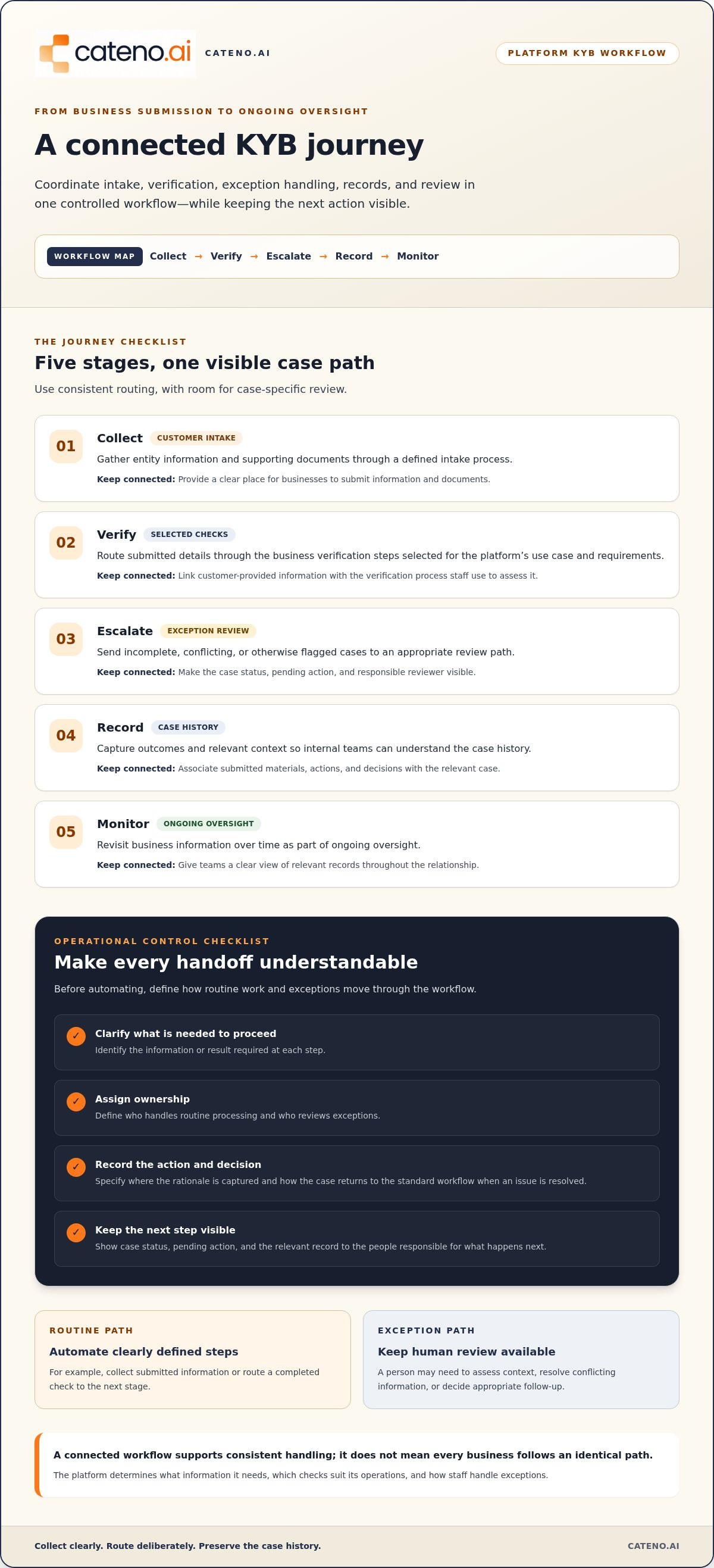
Automation can handle routine, clearly defined steps, such as collecting submitted information or routing a completed check to the next stage. An exception, however, may require a person to assess context, resolve conflicting information, or decide what follow-up is appropriate. A sound process distinguishes these paths instead of treating every case as suitable for automatic handling.
Define escalation routes and decision ownership before automating. Specify who reviews flagged or incomplete cases, where the rationale is recorded, and how a case returns to the standard workflow when an issue is resolved. Automation can support consistent handling, but it doesn’t guarantee a particular processing time or compliance outcome. For organizations evaluating how to integrate intelligent agents alongside human operators, discover Navo Inc. for consulting on AI agent deployment and synthetic workforce development.
Start with a simple workflow map. Identify where information is requested, checked, reviewed, and recorded. Then look for handoffs that create duplicate work or obscure case status. For each step, clarify:
- What information or result is needed to proceed?
- Who owns routine processing and exception review?
- Where will the action and decision be recorded?
These questions turn growth from a reason to add disconnected checks into an opportunity to build a more consistent, traceable operating process.
What streamlined KYB for platforms looks like from intake to review
A connected KYB journey gives each business submission a clear path from initial information to later review. The sequence is straightforward, but the checks and their order should reflect the platform’s use case and applicable requirements. One business may need different verification steps from another, so a useful workflow combines consistent routing with room for case-specific review.
- Collect: Gather entity information and supporting documents through a defined intake process.
- Verify: Route submitted details through the selected business verification steps.
- Escalate: Send incomplete, conflicting, or otherwise flagged cases to an appropriate review path.
- Record: Capture outcomes and relevant context so internal teams can understand the case history.
- Monitor: Revisit business information over time as part of ongoing oversight.
This is a framework, not a universal checklist. The platform should determine what information it needs, which checks suit its operations, and how staff handle exceptions. Clear sequencing helps teams understand what happens next without implying that every business follows an identical path.
Connect self-service intake to verification
A branded portal gives business customers a clear place to submit entity information and supporting documents. Configurable workflows can then direct submissions to relevant verification steps and make missing information or a need for review visible to the appropriate internal team. Connecting what customers provide with the process staff use to assess it can reduce avoidable back-and-forth.
A self-service submission should enter a controlled internal review with its information, verification steps, and next action connected. A business onboarding workflow engine can coordinate that handoff by aligning customer-facing intake with internal routing. Document management also helps keep submitted materials associated with the relevant case instead of scattered across separate exchanges. Because intake workflows aggregate sensitive corporate and financial data, platforms often secure their digital infrastructure with managed detection and cybersecurity monitoring from specialists like cyberone.security.
Carry decisions into ongoing oversight
Verification doesn’t end when an onboarding decision is recorded. Teams need a usable view of what was reviewed, what outcome was reached, and what may need attention later. Advanced verification reports organize information for internal review and support ongoing compliance monitoring. They provide context for oversight, while the platform’s own review process determines how that information is assessed.
Ongoing monitoring is a lifecycle activity, not a promise that every change will be detected or produce a specific alert. Establish how often records are revisited, who reviews relevant updates, and how the resulting action is documented. This provides a practical foundation for a digital KYB verification architecture: connected intake, verification, recorded decisions, and review over time.
When these steps work together, teams can follow a business record across the relationship and see where each case stands. That shared sequence supports consistency without removing the judgment or ownership needed for exceptions.
How to compare KYB approaches for a platform
A feature list doesn’t show whether a KYB approach will work inside your platform’s operating model. Compare how information moves from customer submission to verification, review, and recordkeeping. Workflow fit matters alongside individual verification features because even a capable check can create friction if its result has no clear route, owner, or record.
Use the criteria below to distinguish operating approaches. Treat listed capabilities as evaluation points, not assumptions. Confirm what a specific system supports, and separate that from claims about coverage, automated decisions, or business outcomes.
| Criterion | Disconnected or manual approach | Verification-focused approach | Orchestrated workflow approach |
|---|---|---|---|
| Workflow configuration | Staff move cases between tools or queues. | Checks may be grouped, but routing can remain separate. | Assess whether steps and handoffs can be configured for the platform’s process. |
| Customer experience | Requests may arrive through separate forms or follow-ups. | Information collection may be centralized for verification. | Look for self-service document collection connected to internal processing. |
| Review controls | Escalation and ownership may depend on manual coordination. | Results may identify cases for further attention. | Check how exceptions are assigned, tracked, and returned to the workflow. |
| Records | Information can be spread across systems. | Verification results may be available without the full case history. | Assess whether submitted information, outcomes, and review context stay together. |
| Integration fit | Staff may re-enter data between systems. | Verification may connect to selected process steps. | Determine how the approach fits existing platform operations and systems. |
Assess workflow control and exception handling
Compare how routine cases move and what happens when information is incomplete or results need examination. Look for configurable routing, a clear owner for escalation, and visibility into pending cases. Teams should be able to understand why a case entered review and what action remains. Automated processing can organize or route a result, but it isn’t the same as an automated final decision.
Assess customer experience and operational visibility
Consider whether businesses can submit information through self-service intake or must respond to separate manual requests. Then examine whether reports give reviewers useful verification context and support consistent recordkeeping. A branded portal, configurable workflows, automated KYB checks, and advanced verification reports are distinct capabilities, so evaluate how they connect in practice. See how platform capabilities for different industries can inform a workflow tailored to its use case.
For streamlined KYB for platforms, make the comparison operational: trace a routine case and an exception through each approach. Note where information is collected, who owns the next step, what decision is recorded, and how the record supports later review. This reveals gaps that a feature checklist alone can miss.
How to design a platform-ready KYB workflow
Define the operating process before choosing tools. Start with the business customer’s entry point, then map how information moves through verification, internal review, decision recording, and ongoing monitoring. This sequence exposes handoffs and unclear ownership early, so platform requirements reflect the work teams actually need to perform rather than just a list of features.
Map the workflow and its decision points
Document what the customer submits, which verification steps follow, and what outcomes each step can produce. For example, a complete submission might proceed to routine review, while a missing document triggers a targeted request and conflicting information goes to a human reviewer. Keep these operational paths distinct from jurisdiction-specific legal interpretation, which should inform the process rather than be inferred by software.
- Intake: Specify required business information and supporting documents, and identify how the customer provides them.
- Verification: Define which checks apply to the platform’s use case and what results need internal attention.
- Review and decision: Map routine processing, exception escalation, decision ownership, and the record each outcome should leave.
- Ongoing oversight: Decide how records are revisited and who reviews relevant information over the business relationship.
For each handoff, name the receiving role and the condition that moves a case forward. This makes “needs review” actionable: the team can see why the case stopped, what information is missing, and who owns the next step. A business onboarding workflow engine can support configurable entity onboarding when its design matches these defined steps.
Set controls, records, and operating measures
Assign clear ownership for routine processing, exceptions, and record review. Specify what reviewers should document, such as the outcome, relevant context, and follow-up action. Reports can help teams see case information across onboarding and ongoing monitoring, but the process should still define who interprets that information and when action is required.
Choose operational measures that reveal where the workflow needs attention. Define each measure consistently before tracking it:
- Completion: How many cases reach a recorded outcome within the period being reviewed?
- Rework: How often must a case return to an earlier step because information or handling was incomplete?
- Exception volume: Which types of cases require additional review, and how does that pattern change?
- Review backlog: How many cases await action, and how long have they remained in that state?
Use measures to identify bottlenecks and refine routing, not as universal pass-or-fail thresholds. No single metric proves compliance effectiveness. Operational data needs context, defined ownership, and appropriate review. To map a workflow around your platform’s intake and oversight needs, discuss your KYB workflow with Cateno.
How Cateno supports streamlined KYB for platforms
Once a platform has mapped its intake, verification, exception, and review requirements, it can evaluate technology against the actual operating process. Cateno brings customer-facing business information collection together with configurable internal workflows, automated KYC and KYB checks, and records that support ongoing oversight. The value lies in how these capabilities connect across the business relationship, rather than in treating each as a standalone feature.
Coordinate intake, verification, and internal review
Cateno’s self-service onboarding gateway provides a customer-facing route for submitting business information and supporting documents. A branded portal gives that intake a consistent experience, while the customizable workflow engine supports entity onboarding and directs submissions through relevant verification steps. Teams can shape the sequence around their platform’s process, including how routine cases and exceptions move through internal review.
Automated KYB checks form part of the configured journey, with document management keeping submitted materials organized in relation to onboarding activity. This connects what a business provides with the internal steps that follow, rather than leaving intake and verification as separate tasks. Explore Cateno platform capabilities to see how its onboarding, verification, and workflow functions fit together.
For example, a platform can use the portal to collect information and documents, then configure workflow steps for verification and internal handling. The workflow establishes where a case goes next, while staff retain responsibility for decisions that call for review. This supports coordination without suggesting that software replaces human judgment or determines every outcome automatically.
Extend the workflow beyond initial onboarding
KYB operations continue after an initial onboarding decision. Cateno’s advanced verification reports support ongoing compliance monitoring by organizing information for internal review. The platform also includes autonomous compliance agents. Teams should apply reports and agents according to their defined review process and oversight responsibilities, rather than assuming specific alert coverage or outcomes.
Cateno provides bank account verification within its platform. This can fit into the workflow when account validation is relevant to the platform’s business use case. Document management and reports also help teams maintain useful context as they review a business relationship over time. Together, these capabilities support visibility across intake and ongoing oversight, while the platform’s own process defines when information requires action.
For streamlined KYB for platforms, align Cateno’s configurable workflows and customer-facing intake with the steps, roles, and records established in your operating design. Explore Cateno’s platform capabilities to assess how those elements can support your business onboarding workflow.
Build the next stage of your platform workflow
The next step isn’t to automate every decision. It’s to make sure each business submission has a clear path, the right owner, and a useful record as your platform evolves. Treat streamlined KYB for platforms as an operating capability to review and refine, not a one-time technology rollout.
Start with a practical question: where does your current process make customers repeat information or leave teams unsure what should happen next? Use that point to shape a workflow connecting customer intake with internal verification and review. Cateno’s customizable workflow engine, branded self-service gateway, automated KYB checks, bank account verification, and advanced reports can support that design, with the configuration aligned to your platform’s needs.
Progress comes from clear ownership and deliberate iteration. As teams learn where cases stall or require added review, they can adjust routing and improve visibility without losing human oversight.
Plan a connected KYB workflow with Cateno and take a practical next step toward a more coordinated business onboarding experience.
Frequently Asked Questions
How long does KYB verification take for a platform?
KYB verification timing depends on the entity, the information supplied, the checks in scope, and whether additional review is needed. A complete submission on a routine path differs from a case with missing details or information requiring human attention. Track status at each handoff, including requests awaiting a business response and cases awaiting internal review. This gives teams visibility without promising a universal completion time or treating automation as a time guarantee.
Is automated KYB enough for a platform?
No. Automation supports KYB operations but doesn’t replace governance or accountable review. It can help collect information, coordinate verification steps, and support monitoring. Teams still need clear ownership for decisions and exceptions. The right balance depends on the platform’s activities, risk approach, and applicable requirements. For streamlined KYB for platforms, use automation to make process steps more consistent and visible, while ensuring people retain appropriate oversight and software isn’t treated as a substitute for legal judgment.
What documents are typically requested during KYB?
Requests vary according to the entity type, jurisdiction, and purpose of verification. Depending on the workflow, a business may be asked for formation or registration information, ownership details, or other supporting business documents. Avoid treating any list as universal: determine what the specific case requires, and don’t ask customers to resubmit information already available in the intake record. Clear portal instructions can explain what to provide and reduce confusion about incomplete submissions.
Can a platform use KYB for business partners as well as customers?
Yes. A platform can design KYB workflows for customers, business partners, or other entity relationships when its operating needs call for them. A partner relationship may require different information, review steps, or internal decision owners than a customer relationship. Define the purpose of each workflow before configuring it. For example, identify the team accountable for partner approval separately from the team handling customer onboarding, then tailor the information request and case routing accordingly.
How often should a platform review an onboarded business?
There isn’t one review interval that fits every platform. Set cadence in line with platform policy, risk assessment, changes to business information, and applicable obligations. Ongoing monitoring and scheduled reviews serve different roles: monitoring can inform teams of information that may merit attention, while a periodic review provides a planned opportunity to reassess a record. Assign an owner to assess relevant changes and document the resulting action consistently.
Does KYB include bank account verification?
Bank account verification can support business onboarding, but it addresses account validation rather than establishing the identity or status of a legal entity. Decide where account validation belongs in the workflow and which business use cases call for it. Cateno provides bank account verification as part of its platform. It should complement, not replace, the platform’s KYB checks and review process.
How can a platform measure whether its KYB workflow is improving?
Track operational indicators such as completed cases, rework, exception volume, pending reviews, and customer follow-up. Define each measure first: for example, specify what counts as rework and when a case enters the pending-review measure. Consistent definitions make trends more useful across teams or workflow changes. Interpret indicators alongside record quality and oversight needs. Faster completion alone doesn’t establish that controls are effective, and no single measure proves compliance effectiveness.


