

What happens after a customer passes initial verification? Too often, identity records sit apart from later reviews, supporting documents become outdated, and manual handoffs make it hard to see who owns outstanding actions. KYC lifecycle management closes that gap by treating verification as the start of an ongoing, risk-informed relationship, not a one-time check.
Onboarding can establish a customer’s identity, but it doesn’t keep information current or determine when new evidence is needed. A consistent lifecycle connects those responsibilities, making review triggers, decisions, and follow-up actions visible as the relationship evolves. The goal isn’t to automate judgment. It’s to make the process structured and accountable.
This guide covers the stages from identification and due diligence through enhanced review and ongoing monitoring. You’ll learn how to assign ownership, define practical review triggers, and keep records connected across handoffs. You’ll also see how configurable workflows, document collection, and automated checks can support continuity while people remain responsible for complex cases and final decisions.
Key Takeaways
- Map the full customer journey, including relationship closure, so information and responsibilities don’t stop at onboarding.
- Use risk and relevant customer changes to inform review timing, guided by your organization’s policies and applicable rules.
- Make kyc lifecycle management measurable by tracking queue age, completion time, rework, overdue reviews, and unresolved exceptions.
- Clarify who owns each decision, system update, and handoff before redesigning workflows.
- Use automation to coordinate intake, document requests, checks, and reports while keeping policy ownership and accountable decisions with people.
What KYC lifecycle management means beyond initial identity verification
KYC lifecycle management is the coordinated process of establishing, maintaining, reviewing, and closing a customer identity and risk record throughout the business relationship. It connects the information a firm collects at the start with later decisions about whether that information remains accurate and whether the customer’s risk profile has changed. The approach builds on the fundamentals of Know Your Customer (KYC), extending them into an operating model that keeps tasks, records, and accountability connected.
The specific checks and review controls depend on the institution, customer, product, and applicable rules. A practical lifecycle therefore needs clear ownership and adaptable procedures, rather than one timetable assumed to fit every relationship. For businesses managing statutory obligations under specific regimes, end-to-end AML/CTF platforms like trancher.global help operationalize compliance across the entire customer lifecycle.
KYC lifecycle management versus one-time verification
At onboarding, a firm collects identity details, verifies information, and forms an initial view of customer risk. That is a starting point, not a permanent conclusion. A customer may update their details, a business may change ownership, or supporting evidence may need review under the firm’s policy.
Identity verification assesses whether information can be substantiated at a particular point in time. The wider lifecycle determines how the record is maintained, what changes prompt follow-up, who reviews exceptions, and how decisions are documented. When these responsibilities sit in separate processes, onboarding results can become disconnected from later reviews. A connected process gives teams a consistent way to carry relevant records and open actions forward.
Who uses a KYC lifecycle model?
Compliance teams define risk controls and review expectations. Onboarding and operations teams collect information, manage exceptions, and update records. Product teams help ensure customer-facing forms and internal systems support the process. Clear handoffs matter: a change captured by one team should reach the people responsible for assessing it, rather than remaining in an isolated queue.
For an individual, KYC commonly centers on identity and information needed to understand the relationship. For a business, KYB may involve the entity’s details, ownership information, and people authorized to act on its behalf. The lifecycle should account for these differences without treating every business or individual as the same risk. For an overview of verification methods, see the KYC Verification Guide: Modernizing Compliance for 2026.
The model works when each customer record has a clear path from intake to review and, eventually, relationship closure. A configurable workflow can coordinate document requests, checks, and follow-up tasks along that path, while staff interpret policy and make accountable decisions. This structure helps teams handle volume consistently without confusing automated processing with compliance judgment.
The KYC lifecycle stages from onboarding through relationship closure
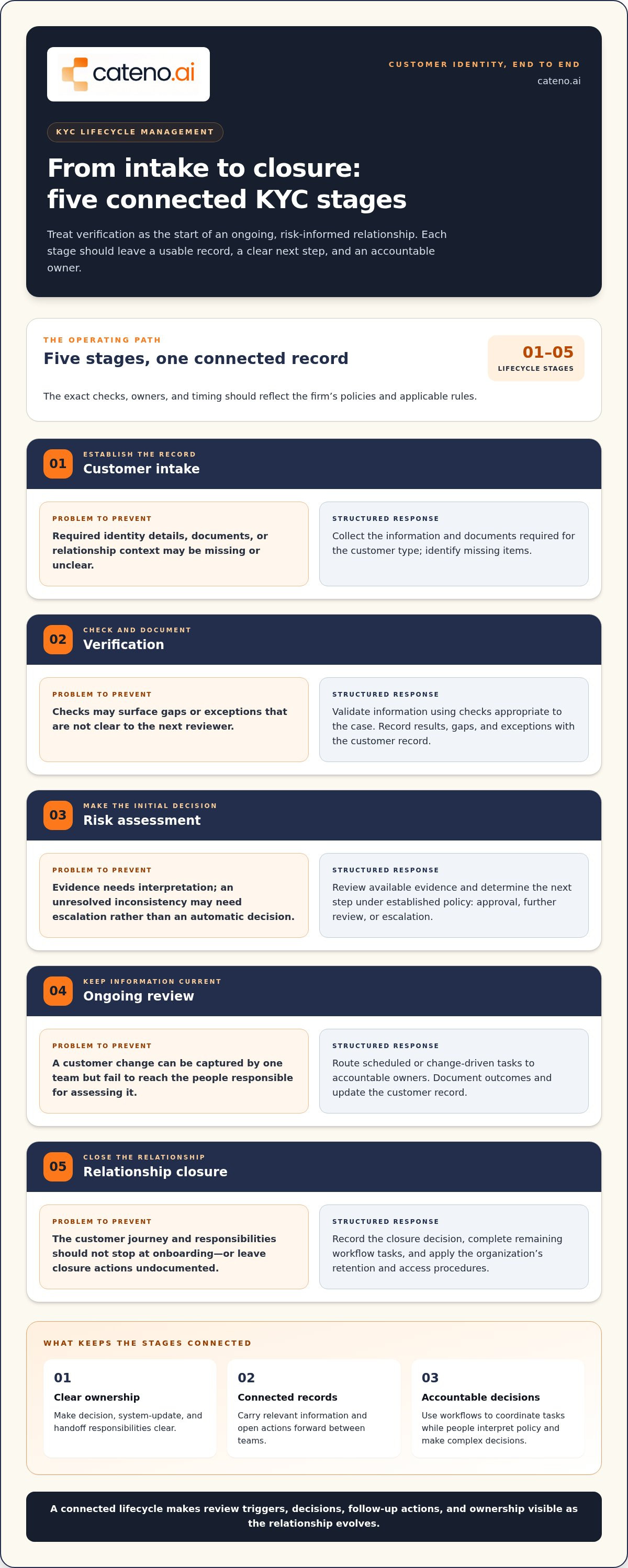
A KYC lifecycle moves from customer intake and verification to risk assessment, ongoing review, and controlled relationship closure. Each stage should leave a usable record and a clear next step. The exact checks, owners, and timing should reflect the firm’s policies and applicable rules. For high-volume teams, this structure makes handoffs visible instead of scattering follow-up work across queues.
From customer intake to an initial risk decision
Start with a structured intake that captures the identity details, documents, and relationship context required for the customer type. For a business, that may include entity and ownership details. For an individual, it may include relevant identity evidence and account purpose. Clear requests help customers submit usable information and give reviewers a consistent record to assess.
- Intake: Collect required information through a defined form or portal, and identify missing items.
- Verification: Validate submitted information using checks appropriate to the case. Record results, gaps, and exceptions.
- Risk assessment: Review the available evidence and determine the next step under established policy, such as approval, further review, or escalation.
- Ongoing review: Route scheduled or change-driven tasks to accountable owners, then update the customer record with outcomes and supporting context.
- Relationship closure: Record the closure decision, complete remaining workflow tasks, and apply the organization’s retention and access procedures.
These stages are connected, but not interchangeable. A failed document check might prompt a request for clearer evidence. An unresolved inconsistency may require escalation rather than an automatic decision. In either case, the result should stay with the record so the next reviewer can see what was checked and what remains open. Teams refining request design can use the same structured approach described in How to Automate the Document Collection Process: A Practical Guide.
Ongoing review, updates, and relationship closure
Customer information can change after onboarding. A new address, revised business ownership, or shift in business activity may warrant an update or review, depending on the firm’s policies and applicable rules. The operational steps are to capture the change, route it to the right owner, document the decision, and update the record so later teams work from current information.
Closure is also a workflow outcome, not an assumption that all information should be deleted immediately. Record the status and relevant decisions, complete remaining tasks, and apply retention and access controls according to the jurisdictions and policies that govern the relationship. Avoid building a universal retention period into the process.
Connected workflow tools can coordinate document requests, validation, review tasks, and reports while preserving human ownership of exceptions and decisions. If your team is mapping these handoffs, discuss your KYC workflow requirements.
How risk changes, review triggers, and controls shape ongoing KYC
Ongoing KYC needs a reasoned way to decide which customer records to revisit and what to do when new information arrives. A calendar can organize work, but it may not capture a relevant change between scheduled reviews. A change alert can also fall short if no one owns the assessment or records its outcome. Effective kyc lifecycle management connects review criteria, evidence, decisions, and follow-up.
Scheduled reviews and event-driven reassessment
Scheduled reviews place records into a queue based on the firm’s risk categories and review policy. This creates a predictable workload and helps teams see upcoming tasks. Event-driven reassessment starts when relevant information changes, such as a customer updating identity details, a business reporting a change in ownership, or activity shifting from the profile recorded earlier.
These approaches can work together. A firm might use scheduled reviews as a baseline and route selected changes for earlier assessment. A trigger should prompt a review, not predetermine its result. Risk classifications, escalation thresholds, and reassessment cadence require institution-specific governance that accounts for applicable rules and the firm’s own policies. There is no universal interval or trigger list for every customer and institution.
To make triggers operational, define what happens at each step:
- Capture: Record the change, its source, and the affected customer or business record.
- Route: Assign the task to an owner based on its type and priority.
- Assess: Compare the new information with the existing profile and determine whether more evidence or escalation is needed.
- Resolve: Document the decision, update the record, and track remaining actions to completion.
Evidence, decisions, and accountable oversight
A review record should let another authorized reviewer understand what changed and how the team responded. Capture the source of new information, relevant evidence, review outcome, date or timestamp, assigned owner, and any unresolved task. If an identity detail conflicts with existing documentation, preserve the discrepancy and its resolution rather than silently replacing the earlier entry.
Set escalation paths before cases arrive. Missing information may lead to a request for additional evidence. Conflicting data may require investigation. A case outside defined decision criteria should reach a designated human reviewer. Workflow automation can identify incomplete fields, route tasks, assemble relevant records, and summarize prior actions. It supports consistency, but shouldn’t make accountable risk decisions by default.
At high volume, controls also need to address duplicate alerts and stalled work. Assign an owner to each open review, track its status, and make overdue or unresolved exceptions visible to the appropriate team. Configurable workflows can carry tasks between operations and compliance without replacing policy oversight. Apply regulatory references only within their actual scope: a rule or guidance relevant to one jurisdiction or institution shouldn’t be treated as a universal KYC requirement.
How to make KYC lifecycle management measurable and operational
Measurement starts with a clear picture of how work moves. Before changing workflows, map each lifecycle stage, its owner, the decisions made, the systems involved, and the handoffs between teams. Note where information is entered, where evidence is stored, and how an exception reaches someone authorized to resolve it. This baseline helps distinguish delays caused by workload, duplicate handling, missing information, or unclear responsibility.
Then define a small set of measures teams can calculate consistently. Useful indicators include queue age, time to complete a review, repeat information requests, overdue reviews, and unresolved exceptions. Give each metric a shared definition. For example, decide when the completion clock starts and stops, and whether time waiting for customer documents is counted separately from internal processing time.
Controls and indicators to monitor
Pair workflow performance measures with evidence that controls are operating. Check whether required steps, supporting evidence, approvals, and exceptions have recorded owners and outcomes. Review backlog by status and age, and track repeat requests to identify unclear instructions or incomplete intake. Faster processing is useful only when required review and documentation remain intact.
Lifecycle performance is meaningful only when efficiency measures are read alongside evidence of control, ownership, and sound decisions.
Common design failures and how to avoid them
Fragmented systems can split customer information across forms, case tools, and spreadsheets. Staff may enter the same data more than once, while unclear ownership leaves follow-up unassigned. These gaps make it difficult to distinguish work in progress from a stalled review or determine whether an exception has been resolved.
Set one authoritative workflow status for each case, define escalation routes, and specify who updates the record after a decision. Where separate systems remain necessary, document how status and relevant evidence move between them. Review the process with the teams who use it, then test representative cases, including incomplete submissions and conflicting information, before expanding a workflow change. Broader automation guidance can help teams assess where orchestration supports control and where human oversight remains essential.
For a useful operating baseline, compare the same measures across customer types or review categories only when their definitions and processes are comparable. Interpret trends alongside risk and case complexity: longer review times may reflect more thorough handling of exceptions, not a process failure. Likewise, a low backlog doesn’t prove that important tasks are complete if cases are closed without the necessary evidence or approvals.
Configurable workflows can make ownership, task status, and review outcomes easier to coordinate across teams. Discuss a connected KYC workflow to explore how structured automation can support measurement while keeping decisions accountable.
Where KYC lifecycle automation fits, and what it should not replace
Automation is most useful when it connects work that would otherwise depend on separate queues, inboxes, and manual reminders. In kyc lifecycle management, a workflow can coordinate customer intake, document requests, verification checks, follow-up tasks, and review reports. It can also make case status visible as work passes between onboarding, operations, and compliance.
That orchestration is different from setting policy or interpreting legal requirements. Teams remain responsible for defining which evidence is needed, how risk is assessed, what requires escalation, and who can approve an outcome. Automation can route a case based on configured rules, but incomplete information, conflicting evidence, or an unusual risk profile may call for human judgment. Good process design makes those boundaries explicit.
Cateno’s configurable workflow engine supports KYC and KYB workflows, including document collection, automated checks, and ongoing compliance tasks. A self-service gateway and branded customer portal support information intake, while advanced verification reports help teams review case results. Explore how a customizable compliance workflow platform can connect these steps. Broader considerations, including appropriate limits on automation, also belong in the discussion of Automated Regulatory Compliance: Trends, Workflows, and Practical Limits in 2026.
Automation benefits and limitations
Standardized routing can reduce fragmented handoffs and repeated manual coordination. For example, a configured workflow can request missing documents, assign a review task, and keep case status visible as it moves to an owner. Automation still depends on the quality of input data and the suitability of configured rules. Governance remains necessary for exceptions, policy changes, and decisions that require interpretation.
A practical starting point for lifecycle improvement
Begin with one handoff or review queue that creates avoidable friction. Map the current steps, identify the accountable owner, define required evidence and escalation paths, and select measures that show both process performance and control completion. Test the workflow with routine and exception cases before extending the design to other stages.
Review the results with the teams who handle the work. Look for missing status updates, repeated requests, cases that stall at handoffs, and exceptions without a clear owner. Use those findings to refine routing or instructions, while keeping policy choices and approvals under accountable human oversight. Expand only when the first workflow is understood and its measures are applied consistently. This creates a practical improvement cycle: map, configure, review, and adjust.
To connect a specific handoff or review queue into a broader lifecycle process, Discuss your KYC lifecycle workflow.
Turn your next KYC improvement into a practical first step
The next step doesn’t need to be a full-process redesign. Choose one handoff or review queue, agree on what a well-managed case looks like, and use that definition to guide a focused improvement. As teams learn from real cases, they can refine the workflow and extend what works. That steady cycle helps kyc lifecycle management mature alongside changing customer needs and operational priorities.
Connected tools can support that progress by carrying information and tasks from onboarding into ongoing review. Cateno brings configurable KYC and KYB workflows together with a self-service onboarding gateway, branded customer portal, and advanced verification reports for ongoing monitoring. This gives teams a more coherent operating structure while preserving human accountability for policy and decisions.
Ready to identify a practical starting point for your team? Plan your KYC lifecycle workflow. Start with one handoff or review queue and build from there.
Frequently Asked Questions
Is KYC lifecycle management different from customer onboarding?
Yes. Onboarding is the initial phase, while KYC lifecycle management covers how customer information and review responsibilities are handled after an account or relationship begins. For example, a firm might mark onboarding complete once required checks are finished, yet use a separate process to record a later change to the customer’s contact details. Distinguishing these statuses helps teams avoid treating completed onboarding as proof that every future review is complete.
Can KYC lifecycle management include business customers and KYB?
Yes. A lifecycle model can cover both individual KYC and business KYB, with different information and relationships represented in the records. A business file, for example, may link to records for owners and authorized representatives. Keeping those connections clear helps teams identify which entity or person a document relates to when company information changes. The precise checks depend on the organization’s policies, the customer relationship, and applicable rules.
How often should a customer’s KYC information be reviewed?
There is no single review interval for every customer or institution. Organizations should set schedules through documented policies that account for their risk approach and applicable requirements. Define how review dates are assigned, who can approve exceptions, and how schedule changes are recorded. This makes the cadence explainable to staff and reviewers instead of leaving an inherited calendar rule without a visible rationale.
What events can trigger a KYC review?
Potential triggers include a reported name or address change, new information about a business’s ownership, or a material shift in the activity the organization understood at onboarding. These examples prompt assessment, but aren’t universal legal triggers or automatic evidence of increased risk. Define which sources can create an alert, how staff validate it, and what happens if the information is unconfirmed before changing a customer’s record or risk treatment.
Can KYC lifecycle management be automated without human review?
Automation can handle defined process tasks, such as collecting information, running configured checks, routing cases, and organizing results. It shouldn’t remove accountable human review from exceptions or decisions that require interpreting policy and context. For instance, a system may flag a discrepancy between submitted details and existing records, but an authorized reviewer should determine how to resolve it. Cateno supports configurable KYC and KYB workflows, with human ownership remaining important.
What happens when a KYC review identifies missing or conflicting information?
The case should move into a defined exception path rather than being treated as complete. The assigned owner can identify the missing item or discrepancy, request relevant information, and record the response and decision. If two sources disagree, retain enough context to show what was compared and how the issue was resolved. Clear status labels, such as “awaiting information” or “under review,” help prevent unresolved cases from appearing finished.
How should organizations measure KYC lifecycle management performance?
Use a balanced set of measures and define each calculation before comparing results. For example, distinguish internal review time from time waiting for customer information, and report rework alongside completion time. Segmenting results by customer type or workflow can reveal where delays concentrate, provided the groups are meaningfully comparable. Pair operational indicators with checks that required evidence and approvals are recorded, so faster processing isn’t mistaken for effective control.


