
What if the fastest way to streamline business partner intake isn’t to reduce scrutiny, but to make each partner’s path through the process clear and consistent? When information arrives through different channels and formats, teams lose time chasing missing documents, repeating requests, and deciding who owns the next step. The checks matter. Avoidable handoffs don’t have to.
A repeatable intake path makes information collection, verification, and approval easier to coordinate while still adapting to different partner types and review needs. This article explains how to define ownership, make status visible, set escalation points, and build appropriate identity, business, and account checks into the workflow. You’ll find practical ways to reduce friction without putting every partner through the same review, plus guidance on using configurable workflows and self-service tools.
Key Takeaways
- Map the full intake journey before changing forms, systems, or responsibilities. This helps pinpoint where delays and repeat requests begin.
- Set clear stages for initiation, information collection, validation, routing, decisions, and recordkeeping, with an owner for each handoff.
- Automate routine collection and checks, while reserving human review for exceptions and decisions that require judgment.
- Track completeness, follow-up volume, time in each stage, and exception rates to identify where you can streamline business partner intake.
- Use configurable workflows to coordinate document collection, KYC and KYB checks, and bank account validation across different partner paths.
Why business partner intake slows down, and what a better process changes
A prospective supplier sends registration details by email. A business customer uploads documents through a form. Someone copies the information into a spreadsheet, asks for a missing ownership record, and waits while another team decides who should review it. The friction often comes not from the checks themselves, but from having no consistent path for information to move from submission to decision.
Business partner intake is the process of collecting, validating, routing, and tracking the information needed to establish a business relationship. An efficient process makes those steps complete, visible, and coordinated. It doesn’t simply ask for fewer documents. The scope is external: it concerns information submitted by a prospective or existing business partner, a term that can describe a range of business relationships, as outlined in Business Partner. This differs from internal service requests, customer onboarding, and partner recruitment. Those processes may share tools or teams, but they serve different purposes and follow different decision paths.
To streamline business partner intake, clarify where the journey begins and what outcome it supports. A recruitment program selects organizations to join a partner network; intake gathers and evaluates the business information needed to establish a working relationship. Customer onboarding focuses on a customer relationship, while an internal request routes work among employees. Defining these boundaries helps prevent forms and approvals from collecting information that doesn’t support the intake decision.
Where partner intake friction starts
Email, web forms, spreadsheets, and disconnected handoffs can leave teams with partial records. A partner may submit information through one channel and send supporting documents through another. If required fields or instructions are unclear, staff have to follow up, and the partner may not know whether the submission is waiting for review or has stalled.
Fragmented evidence also creates duplicate work. When one team can’t see what another has verified or decided, it may repeat a check or request a document that was already provided. A shared workflow gives teams a common view of submissions, outstanding items, ownership, and decisions.
What streamlined intake should accomplish
A well-designed process clarifies what information is needed, who owns each review, and what happens when a submission is incomplete or needs escalation. Teams should be able to follow a consistent review path and trace the reason for a decision without piecing together scattered email threads.
Speed should come from reducing avoidable waiting and rework, not bypassing appropriate verification. Define the checks and escalation points that apply, then make routine information collection and routing more consistent. Intake is one part of broader business onboarding workflow orchestration. It establishes the information and decision path that downstream teams can use to manage the relationship.
Design a business partner intake workflow around clear stages
A reliable workflow gives each submission a defined path, even when partners need different checks. Separate the stages from the rules that determine which information or review applies. A supplier, for example, may need different evidence from a business customer, while both can move through the same core sequence.
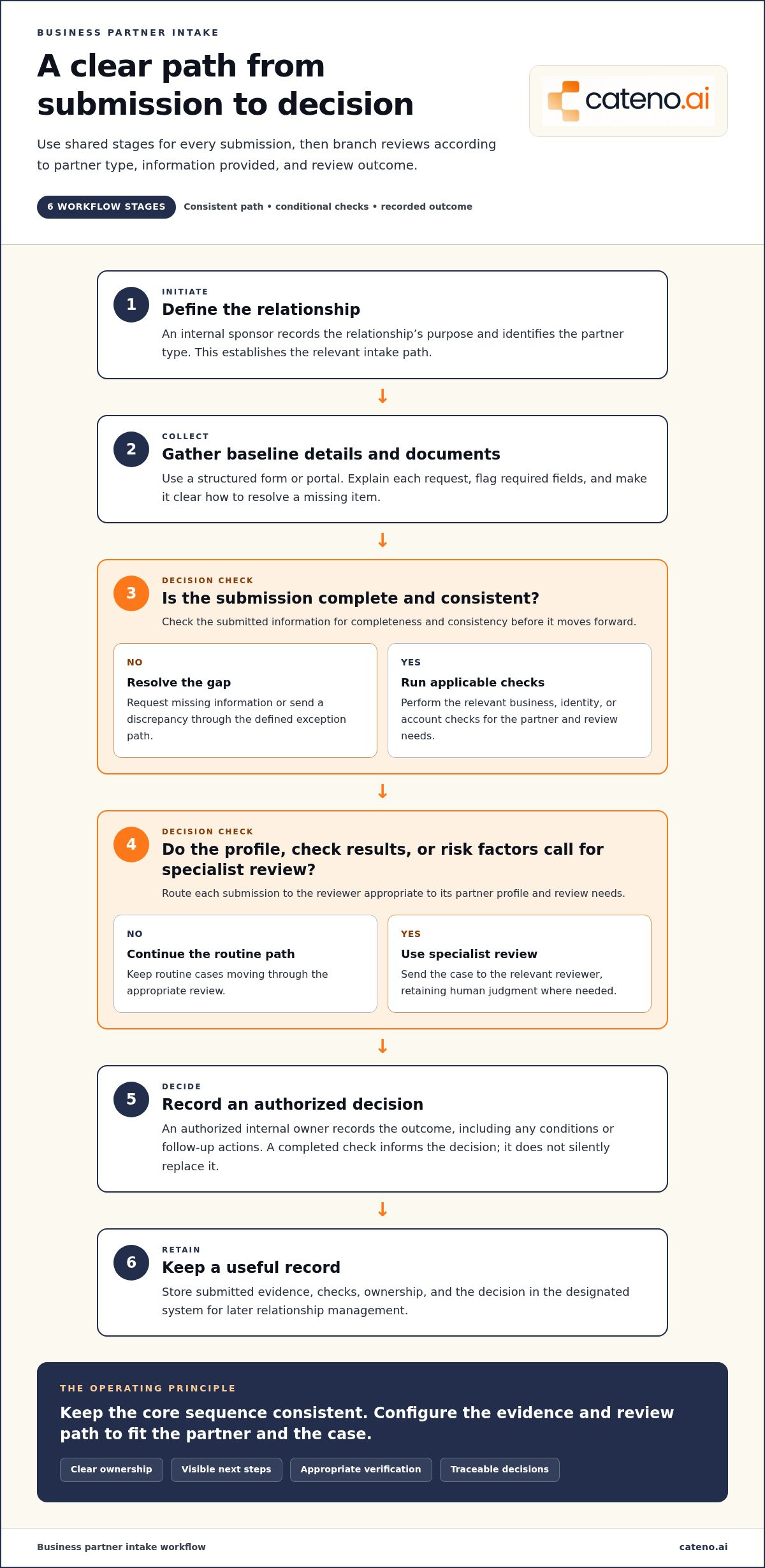
Workflow stages define ownership, evidence, and next actions from initial submission to recorded decision. Use the following sequence as a foundation, then configure conditional steps for partner type, information provided, or review outcome.
- Initiate: An internal sponsor records the relationship’s purpose and identifies the partner type. This starts the process and helps determine the relevant intake path.
- Collect: The partner submits baseline details and documents through a structured form or portal. Explain each request and flag required fields so the partner can address gaps before submitting.
- Validate: An operations or compliance team checks information for completeness and consistency, then performs applicable business, identity, or account checks. Send discrepancies through a defined exception path.
- Route: Direct the submission to the appropriate reviewer based on partner profile, check results, or identified risk factors. Keep routine cases moving while retaining specialist review where needed.
- Decide: An authorized internal owner records the outcome and any conditions or follow-up actions. A completed check should inform the decision, not silently replace it.
- Retain: Keep an appropriate record of submitted evidence, checks, ownership, and the decision in the designated system. This gives teams a useful reference for later relationship management.
Make the first submission clear and proportionate
Design the partner-facing step around a clear purpose. Ask for baseline information needed to identify the entity and understand the relationship. Request additional evidence only when the partner type or review outcome calls for it. For every field or document, provide plain-language instructions that explain what to submit and how to resolve a missing item.
A self-service portal gives partners a structured route for submitting details and documents, instead of splitting them across email threads and files. Process improvement guidance, such as HEFLO’s Streamlining Business Processes, also emphasizes making process steps and responsibilities explicit.
Route submissions to the right review path
Assign owners for completeness checks, verification, exceptions, and final decisions. Partners need a clear view of information requests and submission status. Internal teams need to see the current owner, completed checks, and next action. Use status labels that describe actual states, such as “information requested,” “under review,” “exception review,” and “decision recorded.” Define what moves a case between states so the labels stay meaningful.
Cateno’s customizable workflow platform coordinates distinct intake paths, information collection, checks, and handoffs. Discuss your intake process with Cateno.
Balance streamlined intake with KYB checks and human review
Verification is easier to manage when the process distinguishes repeatable tasks from decisions that need context. Know Your Business (KYB) checks help verify a business entity. Know Your Customer (KYC) checks verify individuals involved in the relationship, such as owners or directors where relevant. The appropriate checks depend on your organization’s process, the partner profile, and the information needed to establish the relationship.
Automation can organize checks and surface exceptions, but accountable people remain responsible for decisions. This distinction helps streamline business partner intake without treating a completed check as automatic approval or assuming a system can detect every risk.
| Workflow task | Automation can support | Human responsibility |
|---|---|---|
| Collection and completeness | Gather information and documents through a structured intake route, then flag missing fields or files. | Clarify unusual responses and decide whether requested evidence is appropriate or sufficient. |
| Repeatable verification | Run defined KYB or KYC checks and, when relevant, validate bank account details. | Interpret results in context, investigate discrepancies, and determine necessary follow-up. |
| Routing and exceptions | Apply configured rules to direct submissions to a standard path or a designated review queue. | Assess escalated cases and record the rationale for the next step or decision. |
| Final decision | Present check results, evidence, and workflow status together for review. | Make and document the decision through the organization’s authorized process. |
Which intake tasks can be standardized or automated?
Start with tasks that follow clear, repeatable rules: checking required fields, collecting documents, routing submissions to the right team, and initiating defined verification steps. Rules can direct a submission based on stated information, such as entity type or whether required evidence is present. For example, a missing ownership document can trigger a request for information instead of sending an incomplete case straight to final review.
When business ownership is relevant, collect and verify the information needed to understand the entity’s ownership structure. Validate bank account details when that is part of your organization’s process. These steps support review. They don’t guarantee approval or establish that every risk has been identified.
When should a submission move to human review?
Define escalation conditions before automating the route. Incomplete evidence, conflicting details, an unclear ownership structure, or a verification result that needs interpretation may call for a reviewer. A system flag is a prompt to investigate, not a final risk classification or compliance determination. Give reviewers access to the evidence and a way to document what they considered and why they escalated, cleared, or returned the case.
Organizations examining how verification fits into a broader technical design can consult this digital KYB architecture guide. The practical principle is simple: automate consistent steps, define exception paths, and preserve accountable review wherever judgment is required.
Implement partner intake improvements with ownership, measures, and feedback
Before changing forms, rules, systems, or team responsibilities, map how a submission moves today. Follow a representative case from the partner’s first interaction through review and decision. Note where information is entered, who handles each handoff, where work waits, and what triggers follow-up. This current-state view helps teams improve the actual process rather than automate an unclear one.
Establish a baseline with measures that reveal friction:
- Submission completeness: How often does information arrive ready for review without missing fields or documents?
- Follow-up volume: How many requests for clarification or additional evidence does a submission generate?
- Time in each stage: Where do cases wait longest? Is the delay due to workload, missing information, or unclear ownership?
- Exception rates: How often do cases leave the standard path, and which conditions tend to trigger that route?
Use these measures to diagnose the process, not to reward speed at any cost. Shorter review time isn’t an improvement if it results from weaker checks, rushed decisions, or unresolved exceptions. Interpret efficiency measures alongside review quality, decision traceability, and whether teams follow the intended escalation path.
A controlled rollout can follow six steps: establish a baseline, prioritize bottlenecks, configure the workflow, test representative scenarios, review the results, and refine the process. Start with a clear source of rework, such as repeated requests for the same missing information. Where practical, change one part of the journey at a time so teams can see what improved and what still needs attention. This measured approach helps streamline business partner intake without sacrificing oversight.
Assign process ownership and exception paths
Name accountable owners for intake design, verification, final decisions, and workflow changes. Document who receives an escalated case, what information must accompany the handoff, and how unresolved cases stay visible instead of disappearing into an inbox. Partner-facing status messages should explain what is happening and give a specific next step, such as submitting a requested document. Internal statuses should identify the current owner and action required.
Use feedback to refine the workflow
Recurring questions and incomplete submissions are useful signals. Review them for unclear instructions, ambiguous fields, or document requests partners may misunderstand. Test revised wording and rules against representative scenarios, including incomplete and exception cases, before a broader rollout. For additional process-design context, see this guide to the automated partner onboarding process.
Bring process owners and reviewers together regularly to examine measures, partner feedback, and exception patterns. Talk with Cateno about your partner intake workflow.
How Cateno supports a more coordinated business partner intake process
A defined intake model needs a way to connect partner submissions with the checks, handoffs, and decisions that follow. Cateno provides a configurable workflow engine and self-service onboarding gateway to coordinate those steps. Instead of treating each submission as a separate email thread, teams can manage information collection and review through a structured process that reflects their partner types and requirements.
Coordinate intake, verification, and information collection
Cateno’s branded portal gives partners a structured place to provide business information and supporting documents. This makes the submission route clear and gives internal teams a consistent starting point for review. Document collection is part of the workflow, connecting submitted materials to the next steps the team has defined.
Different business entities may need different paths. A configurable workflow can direct a submission through relevant collection and review steps, including automated KYC and KYB checks or bank account validation when those checks fit the organization’s process. This helps distinguish routine cases from those that need additional review, while leaving decision authority with the appropriate people.
Advanced verification reports organize results for review and give teams a reference within their workflow. Autonomous compliance agents support intake and ongoing monitoring activities, helping coordinate defined tasks as a partner relationship continues. These capabilities support oversight. They don’t guarantee a particular outcome, identify every risk, or replace accountable teams. Staff still need to assess exceptions, interpret information in context, and record decisions through the organization’s process.
For organizations working to streamline business partner intake, the practical value is coordination: collection, verification, and workflow steps can follow a consistent structure, while configurable paths preserve distinctions between entity types and review requirements. Cateno’s configurable workflow platform brings these capabilities into a coordinated intake process.
Choose a practical next step for your intake process
Start with one specific bottleneck, such as repeated requests for missing documents, uncertainty about case ownership, or submissions waiting between checks. Define the outcome you want to improve, then identify the process step, handoff, or information request contributing to the problem. A focused starting point makes it easier to define workflow requirements without assuming every part of intake needs to change at once.
With Cateno, you can discuss how your partner types, information requirements, verification steps, and review responsibilities fit into a configured workflow. Discuss your partner intake workflow.
Make your next intake improvement deliberate
You don’t need to redesign every partner journey at once. Choose one recurring point of friction and define the change you want partners and internal teams to experience. A focused objective gives you a practical way to assess whether a workflow adjustment addresses the cause while keeping review responsibilities clear.
Cateno supports this work with configurable workflows for business-entity onboarding, self-service information and document collection through a branded portal, and coordinated KYC and KYB checks, bank account validation, and verification reports. Configure the process around how your organization needs to collect, review, and act on partner information. Keep the intended outcome specific and use it to guide the discussion.
Start with the intake challenge you want to resolve, then explore how a coordinated workflow could support it. Explore your intake requirements with Cateno and take a considered next step to streamline business partner intake. A clearer process can begin with one well-defined improvement.
Frequently Asked Questions
Can business partner intake be automated?
Yes. Organizations can automate repeatable steps such as collecting standard fields, checking whether required entries are present, routing cases by documented criteria, and initiating defined verification tasks. To streamline business partner intake safely, specify which rule triggers each action and what happens when data is missing or inconsistent. Assign people to assess exceptions and make final decisions. Automation should support those responsibilities, not approve every submission by default.
What information should a business partner provide during intake?
Request information that matches the relationship and the review required. It may include the business’s legal name and registration details, an authorized contact, supporting records, ownership information, or payment account details when relevant. For example, a process that validates payment instructions may need account details, while another relationship may not. Explain the purpose of each request, identify baseline fields, and make additional requirements conditional on the partner profile or review.
How can a company reduce incomplete partner submissions?
Make each request easy to understand and complete: use concise questions, explain acceptable document types, and show partners which items remain outstanding. Conditional fields can keep irrelevant questions from obscuring what a particular partner needs to provide. Review omissions regularly. If partners repeatedly misunderstand a field or submit the wrong document, revise the prompt or guidance. Removing fields alone won’t ensure complete submissions or provide sufficient evidence for review.
What is the difference between partner intake and KYB verification?
Partner intake is the broader process for receiving and organizing information needed to establish a business relationship. KYB, or Know Your Business, is a verification activity within that process, focused on checking business information. Intake may collect an entity’s details, supporting records, and account information, then route them to relevant reviewers. KYB contributes verification evidence, but it doesn’t cover every collection step, handoff, internal decision, or follow-up the relationship may require.
How do you measure whether business partner intake is improving?
Compare current results with a baseline using measures such as complete submissions, follow-up frequency, time spent at each stage, exception volume, and partner inquiries about status. Consider patterns together: fewer follow-ups may indicate clearer requests, while longer review time may reflect more complex cases rather than process failure. Assess speed alongside evidence quality and review consistency. No single measure proves that verification is effective or that a process meets every internal requirement.
When should a partner intake submission be escalated for human review?
Escalate according to criteria your organization has defined, such as missing evidence that prevents review, inconsistent business details, or a verification flag requiring interpretation. A system alert identifies something to examine. It isn’t a final risk or compliance decision. Assign an owner, record the next action, and keep the case visible until resolved. A reviewer might request clarification, document why evidence is acceptable, or route the case to another authorized decision-maker.


