

What if making B2B intake easier didn’t mean lowering the bar for verification? A frictionless B2B intake process removes unnecessary effort while keeping the checks and decisions that protect your business. Yet applicants often face repeated requests, unclear instructions, and delays, while operations teams chase documents across disconnected handoffs. Simplifying the experience shouldn’t mean sacrificing oversight.
The solution is to structure the work, not strip it away. Give applicants a clear self-service path, explain what information and documents they need, and route each submission to the right checks and reviewers. When applicants and teams can see what’s required and what happens next, there’s less time spent coordinating and more time available for informed decisions.
This guide shows how to design an intake process that’s easier to complete and manage. You’ll learn how to map each stage, collect relevant information in an organized workflow, reduce avoidable follow-ups, and preserve appropriate verification and compliance review. You’ll also learn how to measure progress and refine the experience without losing control of the decisions that matter.
Key Takeaways
- Identify avoidable effort in your intake journey, such as unclear requests, repeated submissions, and unnecessary waiting.
- Build a frictionless B2B intake process around clear stages, with defined applicant actions, workflow steps, and internal ownership.
- Reduce redundant steps without removing relevant checks by distinguishing operational friction from purposeful controls.
- Establish a baseline and track completion, stage timing, repeated requests, exceptions, and applicant drop-off to guide improvements.
- Use configurable workflows and self-service document collection to coordinate intake, verification, and review in one structured process.
What Makes a B2B Intake Process Frictionless, and Where Does Friction Begin?
A business relationship often starts with information: who the applicant is, what organization they represent, and what the business needs to establish the relationship. B2B intake is the structured collection and handling of that information so an organization can assess a request and decide what should happen next. Because business-to-business (B2B) relationships involve organizations rather than individual consumers, intake may need to account for both a business entity and the people authorized to act for it.
A frictionless B2B intake process makes necessary information and checks easier to complete, understand, and route without adding avoidable effort. It doesn’t mean zero verification, instant decisions, or removing controls. It means applicants can follow a clear path, provide relevant information once where practical, and understand what’s expected of them. Internally, teams can see where a request stands and who owns the next action.
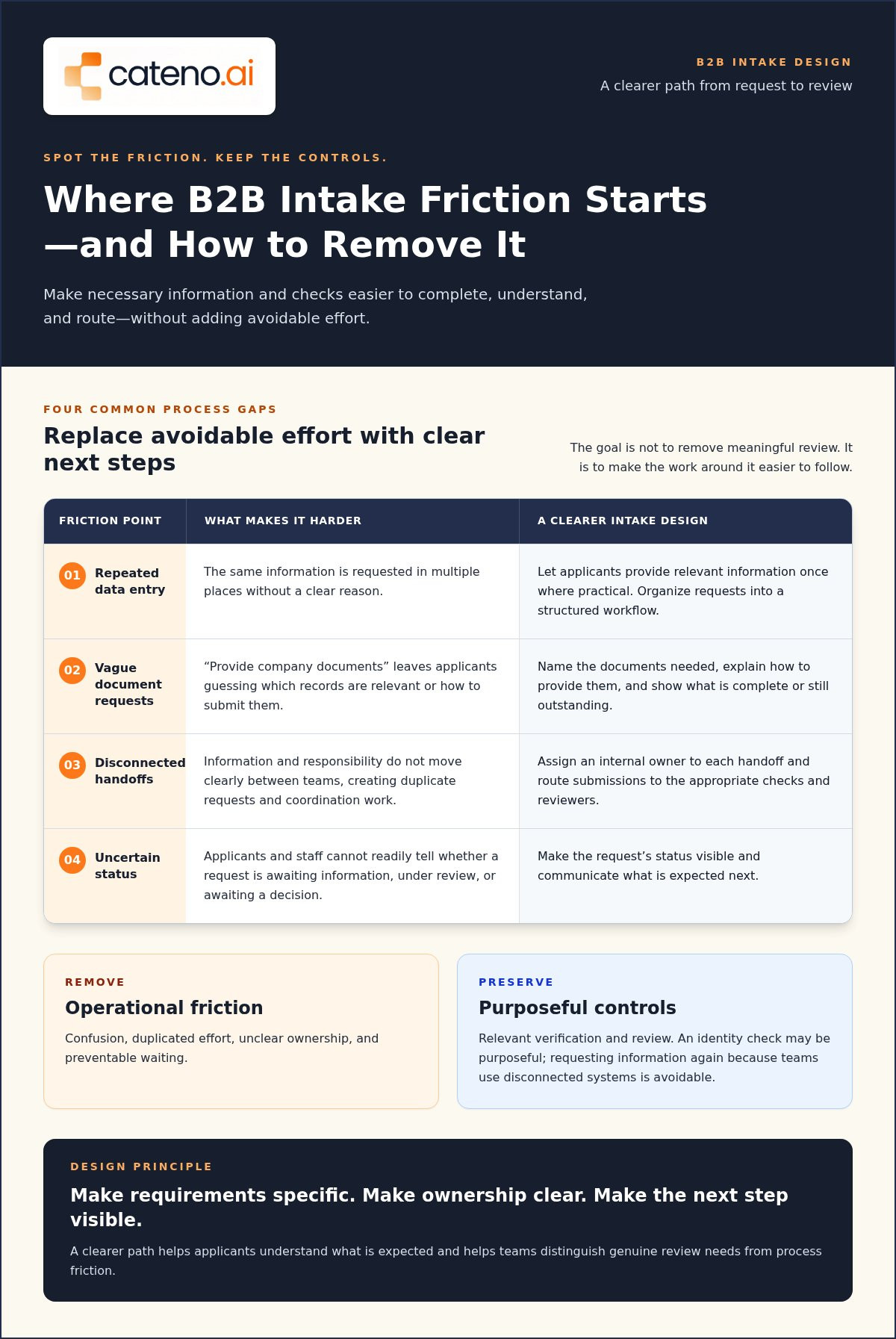
Friction begins when the work around a legitimate requirement is harder than it needs to be. An identity check may be purposeful; asking an applicant to resubmit information already provided because teams use disconnected systems is avoidable effort. Process improvement should preserve meaningful review while removing confusion, duplication, and preventable waiting.
Intake, onboarding, and verification: how the terms differ
Intake is the initial capture and organization of information needed to start a business relationship. Onboarding is broader: it can include intake, account or partner setup, internal approvals, and preparation for ongoing work, such as configuring partner data exchange with 123 EDI. Relationship management continues after setup as teams maintain records and respond to changing information. Verification is a set of checks within this wider sequence, not a synonym for the entire intake experience. The stages depend on the business model, risk, and operational requirements.
Common sources of friction in business intake
Small process gaps can compound. An applicant may enter company details in a form, repeat them in a document, then answer the same question in an email because each team works from a different handoff. A request to “provide company documents” creates uncertainty if it doesn’t specify what’s needed or how to submit it. After submission, silence can leave the applicant unsure whether the file arrived, whether anything is missing, or what happens next.
- Repeated data entry: The same information is requested in multiple places without a clear reason.
- Vague document requests: Applicants have to guess which records are relevant or how to provide them.
- Disconnected handoffs: Information and responsibility don’t move clearly between teams.
- Uncertain status: Applicants and staff can’t readily tell whether a request is awaiting information, review, or a decision.
These symptoms often reflect internal process design, not applicant error. A clear intake flow makes requirements specific, assigns ownership for each handoff, and communicates the next step. That gives applicants a more predictable experience and helps teams distinguish a genuine review requirement from friction caused by unclear coordination.
How to Structure a B2B Intake Workflow: Request to Review
A well-designed workflow makes each handoff explicit: applicants know what to provide, and internal teams know what to do with it. A practical sequence moves from a defined trigger to a documented outcome, with decision points that route routine submissions and exceptions appropriately. This structure helps make a frictionless B2B intake process consistent without assuming every applicant follows the same path.
Designing one clear applicant path
Start with one clear route for submitting information, even if requirements vary by entity type or use case. Explain each request in plain language, group related fields and documents, and show what remains outstanding. A self-service gateway can organize submissions and make the next applicant action clear. Keep reusable requests consistent, and add conditional requirements only when they serve a defined operational need.
Use this sequence as a blueprint. At every stage, assign an internal owner so work doesn’t stall between teams.
- Define the intake trigger. Applicant action: Begin a request or respond to an invitation. Workflow action: Create a record and identify the relationship type or business need. Owner: The relationship owner or intake coordinator confirms the request is ready to enter the process.
- Request information. Applicant action: Provide requested business details and supporting documents. Workflow action: Present grouped fields, explain why information is requested, and indicate what is complete or outstanding. Owner: The intake team maintains the request and follows up on incomplete submissions.
- Run relevant checks. Applicant action: Provide any additional information needed to support a check. Workflow action: Initiate applicable KYC, KYB, or bank account verification at the appropriate point. Owner: The verification or risk team reviews results and identifies any item requiring attention.
- Route exceptions. Applicant action: Clarify a discrepancy or submit a missing item when asked. Workflow action: Send incomplete records, exceptions, or cases requiring further review to a defined queue while preserving the submission context. Owner: The designated reviewer resolves the issue or identifies the next decision point.
- Record outcomes. Applicant action: Respond to any final request communicated through the established channel. Workflow action: Record the decision, supporting information, and status against the relevant business record. Owner: The authorized decision-maker records the outcome and signals the next operational step.
Routing verification and review without losing context
Place checks where their results can inform a decision, rather than treating them as disconnected tasks. Define how a failed or inconclusive check returns to the workflow, who reviews it, and what information the applicant may need to supply. Keep status and verification outcomes attached to the relevant business record so each reviewer can understand the submission history. For supply-chain relationships, NIST Supply Chain Management offers context on managing supply-chain considerations; the checks in an intake workflow should still reflect the organization’s own requirements.
A configurable workflow can help teams organize stages, route submissions, and preserve context as a request moves through review. Cateno’s workflow and onboarding platform brings intake, document collection, and verification into a structured process that can be tailored to different entity types.
Can You Reduce B2B Intake Friction Without Weakening Controls?
Yes. Reducing applicant effort doesn’t require removing relevant verification or review. Identify which steps support a clear decision and which exist because information is duplicated, requests are poorly coordinated, or ownership is unclear. Simplifying the intake experience means making required reviews easier to complete and manage, not bypassing them.
Controls should reflect the business relationship, the information involved, and the organization’s operational requirements. A workflow that suits one entity type or use case may not fit another. This isn’t a legal assessment or a universal checklist; teams should define their review criteria with the appropriate internal expertise. Once those criteria are clear, process design can make their execution more consistent.
Remove repetition, not relevant information
Compare the information requested across forms, document lists, and team handoffs. If the same company detail is repeatedly collected, determine whether teams can rely on one organized record instead. Structured document management can keep submitted materials associated with the relevant intake, making them easier for authorized reviewers to locate and assess. This can reduce duplicate collection, but it won’t eliminate every follow-up: a document may be incomplete, unclear, or require additional review.
Make exceptions visible and actionable
Automation can move routine submissions through defined steps, but exceptions need a clear route rather than a dead end. Specify which team owns cases that can’t proceed automatically, what information the reviewer needs, and how the next action is communicated. Record whether a case is awaiting applicant information, internal review, or a decision. A consistent status trail helps teams understand what remains unresolved without treating an unfinished check as complete.
A frictionless B2B intake process preserves decision quality while removing avoidable coordination. The standard is simple: each request has a purpose, each check has an owner, and each exception has a visible next step.
How to Measure and Improve Your B2B Intake Process
Improvement starts with evidence, not assumptions. Before changing a form, handoff, or verification step, record how the current process performs. That baseline gives your team a fair comparison later and helps distinguish a genuine improvement from a change that simply shifts work to another stage. Don’t rely on universal targets: interpret results in the context of your workflow, applicant types, and review requirements.
Choose measures that reflect both experience and process quality
Pair applicant journey measures with operational signals. Completion and applicant drop-off can show where people leave the process; stage-to-stage time and queue time can reveal where requests wait. Repeated requests indicate possible rework, while exception volume helps show how often cases need a path beyond routine processing. Read these measures together. A faster process isn’t necessarily better if submissions are less complete or reviewers have more corrective work.
Define each measure before collecting it. For example, decide whether stage time begins when a submission arrives or when a team starts reviewing it, then apply that definition consistently. Where the data allows, segment results by relevant workflow or entity type. This can reveal that a particular request or handoff creates friction for one group without treating every applicant journey as identical.
Turn process signals into controlled improvements
Use direct signals to locate likely problems. Frequent questions about a document request may point to unclear instructions. Incomplete submissions can indicate that required fields or supporting materials aren’t explained well. Long waits between stages may reflect a queue, a handoff without a clear owner, or a decision that needs human review. Investigate the underlying step before adding fields or automation.
Then make one focused change and observe its effect against the baseline. If you revise a document prompt, for instance, check whether repeat requests and incomplete submissions change while monitoring review workload and decision quality. Changing one workflow element at a time makes results easier to interpret. If multiple changes are introduced together, it’s harder to tell which one helped or created a new bottleneck.
- Locate the friction: Identify a specific point using workflow data, applicant questions, or staff feedback.
- Form a testable adjustment: Change one instruction, handoff, or routing rule tied to that point.
- Review the results: Compare the same measures with the baseline and check for effects on completeness, rework, and workload.
- Keep or refine the change: Retain it if it improves the experience without weakening the quality of review; otherwise, adjust and reassess.
A self-service onboarding gateway can make applicant submissions more organized, while a configurable workflow can connect those submissions to review stages. Cateno provides self-service onboarding tools and workflow capabilities to support a measurable intake journey. Information about discussing your intake process with Cateno is available through this contact page.
How Cateno Supports a More Frictionless B2B Intake Process
A practical intake design needs more than a digital form. It needs a way to connect applicant submissions with the checks, routing, and internal review that follow. Cateno provides this operational layer through a cloud-based onboarding and compliance platform. Its customizable workflow engine can organize intake steps around different entity types, helping teams structure the process without assuming every business relationship follows the same path.
Bring self-service collection and verification into one workflow
A branded customer portal and self-service onboarding gateway give applicants an organized place to provide information and documents. Teams can configure workflow steps to request relevant materials, route submissions, and place checks where they support review. Cateno’s customizable onboarding workflow platform brings these activities into a defined process that can be shaped around the organization’s needs.
For applicable workflows, automated KYC and KYB checks and bank account verification are available as platform capabilities. Their results inform the workflow and review; they don’t guarantee identity, data accuracy, a particular decision, or compliance. Teams remain responsible for setting appropriate requirements and handling cases that need additional attention. The aim is to reduce disconnected coordination, not remove meaningful review.
Extend intake into ongoing business-partner oversight
The relationship doesn’t end when initial intake is complete. Verification reports can support business-partner lifecycle management and ongoing compliance monitoring by keeping review information useful beyond the initial submission. Autonomous compliance agents can also support compliance workflows. Together with configurable orchestration, these capabilities connect initial collection and verification to subsequent oversight, while the organization defines the relevant processes and decisions.
This structure is most useful when it reflects the real work: which information is reusable, which checks apply to a given entity or use case, where exceptions go, and who owns each decision. A workflow engine can coordinate those steps, while the portal gives applicants a clear submission path. Configuring both around the organization’s requirements helps avoid forcing distinct relationships into a single rigid intake sequence.
As you assess the fit, consider how a self-service gateway, applicant-facing portal, verification capabilities, and workflow routing could support the process you’ve designed. Cateno connects these operational components in configurable workflows, with accountable review remaining part of the process. To explore how the platform could support your process, discuss your intake workflow.
Make Intake Improvement an Ongoing Practice
Choose one live intake journey and examine it from both sides: what an applicant must do and what your team must coordinate. Identify a point where instructions, handoffs, or waiting create effort, then decide how you’ll know whether a change helped. A frictionless B2B intake process is built through deliberate refinement, not a one-time redesign.
Keep the review practical. Set an owner for the workflow, revisit applicant feedback and process measures, and adjust the experience as business needs evolve. Cateno’s configurable workflows and connected onboarding and verification capabilities help teams shape an operational process around their requirements.
Ready to make your intake journey clearer and easier to manage? Discuss your B2B intake workflow with Cateno and identify a focused first improvement.
Frequently Asked Questions
Can a B2B intake process be frictionless and still include verification?
Yes. A frictionless B2B intake process can keep relevant verification while removing effort that doesn’t improve a decision. For each check, document its purpose, where it belongs in the workflow, and who reviews the result. For example, if a check applies only to a particular relationship type, make that condition explicit rather than requesting it from every applicant. This keeps the process focused without treating oversight as optional.
What should a business do when an applicant submits incomplete information?
Identify the specific gap and give the applicant a direct way to resolve it. “Please clarify the ownership information in section two” is more actionable than asking them to resubmit the entire application. Distinguish missing information from a mismatch or an unclear document, since each may need a different response. Keep the submitted record intact, assign an internal owner to assess the reply, and clarify whether other workflow steps can continue in the meantime.
Which metrics can show whether B2B intake is improving?
Use measures that reveal both applicant progress and internal effort. Define completion as a consistent event, such as reaching submission, and specify which workflow events start and stop elapsed-time measures. Track repeat requests, rework, exceptions, and time spent awaiting action alongside completion. Compare similar applicant or workflow groups over time where the records support it. A shorter cycle alone isn’t proof of improvement if submissions become less complete or review work increases.
Does self-service intake remove the need for human review?
No. Self-service organizes how applicants provide information; it doesn’t mean every submission is suitable for automatic handling. A workflow might move a complete routine submission to its next step while sending a conflicting detail or unclear document to a reviewer. Define which outcomes can advance automatically and which require human judgment. Record the reviewer’s decision and rationale in the appropriate business record so speed doesn’t obscure accountability.
How can a company handle different types of business applicants in one intake process?
Use a shared starting point for information common to all applicants, then branch only where the relationship or entity type changes what’s needed. For instance, a workflow can request a different supporting record when an applicant’s organization type makes it relevant. Keep the reason for each branch clear to applicants and staff. Periodically check whether branches collect information that supports a real operational decision, rather than preserving differences out of habit.
Can bank account verification be part of a B2B intake workflow?
Yes, if validating a bank account is relevant to the business relationship. Treat it as a defined step with a clear purpose, rather than adding it automatically to every intake. Decide which business record should hold the result, who handles a result requiring closer review, and whether other workflow activity can proceed while that review is pending. This gives teams a consistent way to handle the check without treating it as a universal requirement.
What is the difference between B2B intake and business onboarding?
B2B intake usually describes the information-gathering portion of starting a business relationship; onboarding can include that work plus subsequent verification, internal decisions, and operational setup. Organizations sometimes use the terms differently, so define them in process documentation and applicant instructions. For example, clarify whether “submitted” means information has been received or the broader onboarding sequence is complete. Precise labels help teams report progress consistently and reduce confusion about what remains.


