

What if compliance automation could move work forward without making consequential decisions on its own? Autonomous compliance agents can handle bounded tasks such as organizing intake information, supporting KYC and KYB checks, and routing exceptions, while people retain authority over sensitive outcomes. That boundary is central to understanding what these agents can do and how to use them without losing control.
Manual reviews and fragmented workflows make compliance difficult to scale. At the same time, “AI agent” can describe systems with very different capabilities, from fixed rules to tools that interpret information and take actions. Knowing the difference helps you decide where an agent can reduce repetitive work, where conventional automation is enough, and where human review should remain part of the process.
This guide explains how autonomous compliance agents work, how they differ from rules-based automation and general-purpose AI, and which compliance tasks may suit them. It also covers practical approval boundaries and a controlled path from a narrow pilot to broader use. You’ll see how agents can operate within governed workflows supported by clear permissions, review points, and accountability.
Key Takeaways
- Set clear boundaries for agent autonomy: completing a task doesn’t grant independent authority over consequential compliance decisions.
- Match each onboarding step to the right level of automation, from fixed rules to human-supported copilots and bounded agents.
- Use autonomous compliance agents for defined, repeatable tasks with permitted information, recorded activity, and clear escalation paths.
- Start with a narrow workflow and a measurable objective, then review access controls, testing, and oversight before expanding.
- Connect agents to intake, document management, verification checks, and workflow routing so they operate within a governed process.
What Are Autonomous Compliance Agents, and What Problem Do They Address?
Autonomous compliance agents are software systems that complete defined tasks toward a compliance workflow goal, using permitted information and actions within set boundaries. Autonomy describes how an agent carries out assigned work, not whether it has independent authority to make every compliance decision. A person or governed process can retain approval over consequential outcomes.
Onboarding often involves repeated handoffs: collecting information, checking documents, identifying missing details, and routing applications to the right queue. When these steps rely on manual review across fragmented systems, staff spend time moving work forward instead of focusing on exceptions and judgment. Agents can coordinate bounded tasks, while clear controls keep decisions and accountability in the right place. For a broader foundation, see What is an AI Agent?
How are agents different from rules-based compliance automation?
Rules-based automation follows predefined conditions. For example, it can flag an application with a blank required field or send a case that meets a specified condition to a designated queue. This approach is predictable and useful for repeatable checks and deterministic controls.
An agent can interpret more context and select among permitted next steps. If a business application appears incomplete, for instance, it might identify the missing information and route the case for follow-up. The agent should act only within its defined permissions. The workflow can still require a person to review an exception or approve a sensitive decision.
Which compliance tasks can agents support?
Agents can assist with document intake, extracting information for review, checking whether required materials appear complete, and routing work to the next step. In onboarding workflows, they can support KYC and KYB checks and bank account verification by coordinating tasks and directing results for appropriate review. Assistance doesn’t guarantee that information is correct or that a case meets a particular standard.
The practical boundary is between preparing work and owning the decision. An agent may organize evidence, flag a discrepancy, or send a case for human review. Accountable staff should retain oversight of decisions that require interpretation, exception handling, or approval under the organization’s process. Agents are most useful as part of a governed workflow, not as isolated decision-makers.
How Autonomous Compliance Agents Work Across an Onboarding Workflow
An onboarding agent works best when it has a specific assignment, access only to information and tools permitted for that task, and a workflow that defines what happens next. The surrounding process connects customer-submitted information, verification services, routing rules, and human approvals. Each step should leave a clear record so staff can understand what the agent did and why a case moved forward or stopped.
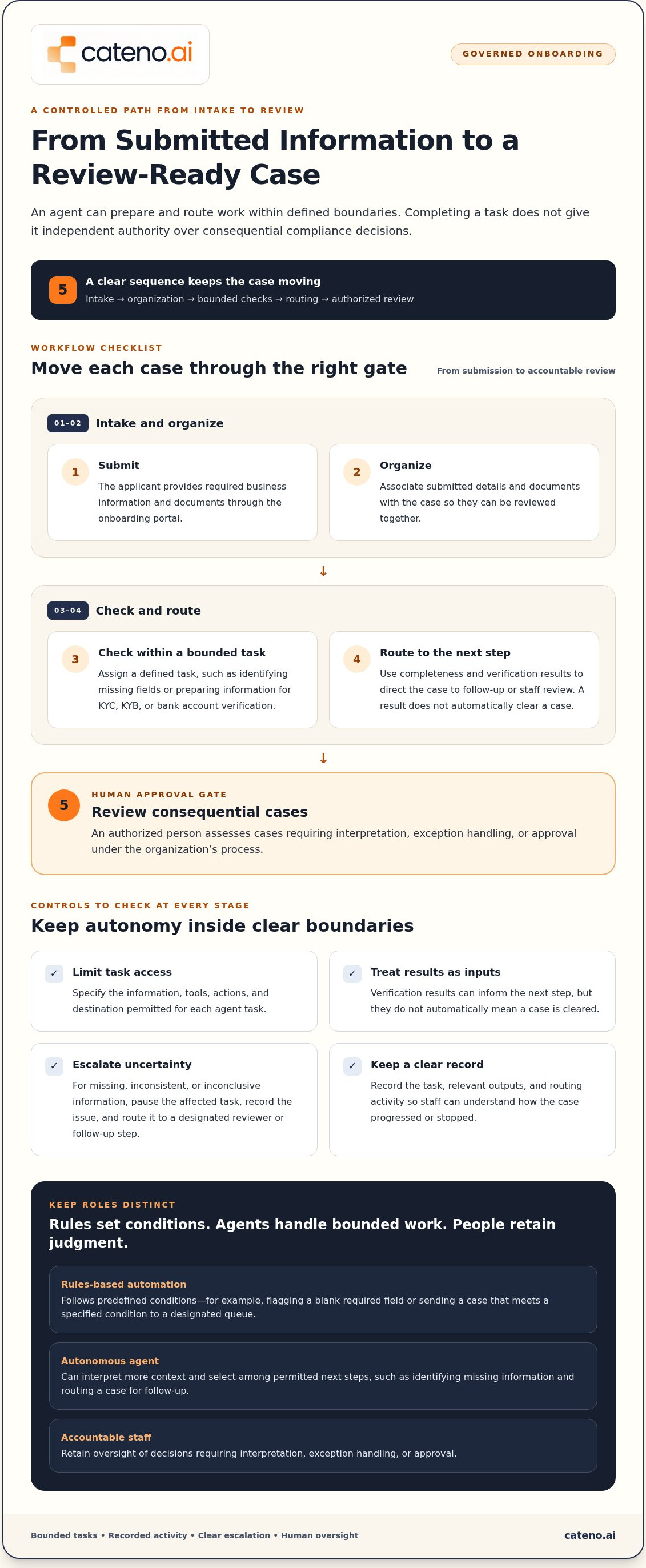
From submitted information to a review-ready case
A typical sequence moves from intake to checks, routing, and review. A self-service portal can collect business details and documents, while document management organizes submissions and supports completeness checks. Verification results can inform the next step, but they don’t automatically mean a case is cleared.
- Submit: The applicant provides required business information and documents through the onboarding portal.
- Organize: Documents and submitted details are associated with the case so they can be reviewed together.
- Check: The agent receives a bounded task, such as identifying missing fields or preparing information for KYC, KYB, or bank account verification.
- Route: Workflow rules use completeness and verification results to direct the case to the next appropriate step, such as follow-up or staff review.
- Review: An authorized person assesses cases that require interpretation, exception handling, or approval.
At each stage, rules can enforce predictable conditions, verification services can return results for consideration, and human approval can remain a required gate. Specify the data, actions, and destination permitted for each agent task. The process should also record the task, relevant outputs, and routing activity, creating a traceable account of how the case progressed.
How agents handle exceptions and keep work moving
Exceptions are normal workflow outcomes, not reasons for an agent to improvise beyond its role. A missing document may trigger a follow-up request; inconsistent information may send a case to a review queue; an unclear verification result may require further assessment. Workflow design should identify who owns each queue, what status the applicant sees, and which conditions require escalation.
When an agent encounters missing, inconsistent, or inconclusive information, it should pause the affected task, record the issue, and route the case to a designated reviewer or follow-up step. This keeps work moving without treating uncertainty as approval. Activity records and verification reports can help staff understand what information was considered and what action followed. They support operational review without replacing human judgment.
See how intake, verification, and routing can work together in a compliance workflow platform.
Autonomous Agents vs. Rules and Copilots: Choosing the Right Level of Automation
Compliance work doesn’t need one universal form of automation. A fixed rule may be the clearest choice for a stable check, while an AI copilot can help staff interpret information without taking action. A bounded agent may suit a repeatable, multi-step task when its permissions and escalation routes are defined. More autonomy isn’t automatically better, especially when a decision is ambiguous or consequential.
| Approach | Task flexibility | Predictability | Human involvement | Evidence needs | Suitable use cases |
|---|---|---|---|---|---|
| Rules-based automation | Low; follows specified conditions | High for defined inputs and outcomes | People set rules and handle exceptions | Rule logic, inputs, and outcome records | Required-field checks and consistent routing |
| AI copilot | Moderate; can assist with varied information | Variable; outputs need assessment | Staff review suggestions and control actions | Source information, output, and reviewer action | Summarizing submitted material or preparing a case for review |
| Bounded autonomous agent | Higher within defined permissions and tasks | Depends on task, inputs, and controls | People define boundaries and take escalations | Task, permitted data and actions, activity, and handoff | Coordinating repeatable intake or routing steps |
When should compliance teams use rules, copilots, or agents?
Use rules when criteria are stable and outcomes are clear, such as routing an application with a missing required field. Choose a copilot when staff need help reviewing or summarizing information but should approve each action themselves. Use autonomous compliance agents for multi-step, repeatable work only when permissions, expected outcomes, and escalation paths are explicit. Choose based on the task, not the label attached to the technology.
Match autonomy to task risk, data quality, and reversibility. If an action is difficult to undo, information is uncertain, or consequences are substantial, constrain automation and strengthen human review. A task that can be safely paused or corrected may be a better candidate for a bounded agent than a final decision with lasting impact.
What decisions should remain under human oversight?
Define approval thresholds and assign clear ownership before deployment. Cases involving conflicting information, disputed results, exceptions, or material uncertainty should have a clear route to a responsible reviewer. Decide which actions an agent can take independently and which require approval. These boundaries preserve accountable human judgment: an agent can support a compliance workflow, but it doesn’t assume an organization’s responsibility for its decisions.
How to Deploy Autonomous Compliance Agents with Practical Guardrails
Start with one narrow, repeatable workflow and a measurable operational objective, such as reducing manual handoffs during document intake. Define what the agent can do, what it must never do, and when it must stop for human review. A pilot should test whether the agent improves the process without weakening evidence quality or accountability. For broader workflow context, see this automated regulatory compliance guide.
What controls should be in place before a pilot?
Test representative cases, edge cases, and failure scenarios before production use. Check how the workflow responds to incomplete documents, inconsistent information, unavailable verification results, and unexpected inputs. Confirm that the agent pauses or escalates rather than taking an unapproved action.
Assign an owner to monitor performance, review activity, and coordinate incident escalation. Define how the team will assess and approve changes to the agent, its instructions, permissions, or workflow. These controls help keep the pilot reviewable as the system evolves.
How can teams measure whether an agent is helping?
Establish a baseline before the pilot so results can be compared with the existing process. Track measures such as cycle time, manual touchpoints, rework, and unresolved exceptions. Then assess accuracy against reviewed outcomes, exception rates, staff review effort, and workflow completion. Define each measure clearly so changes can be interpreted consistently.
Balance efficiency with quality. Faster processing or a higher volume of automated tasks isn’t enough if errors, rework, or unresolved cases increase. Review a sample of completed work and examine exceptions to see where the agent performs reliably and where a person needs to intervene. Use those findings to refine boundaries before expanding the pilot.
Orchestration matters too: clear stages, owners, and handoffs make results easier to assess. For more process-design context, read the business onboarding workflow engine guide. Cateno’s workflow and onboarding capabilities support a governed implementation, with details at the Cateno team’s contact page.
Where Autonomous Compliance Agents Fit in a Governed Cateno Workflow
Autonomous compliance agents are most useful when they work within a defined onboarding process rather than as isolated decision-makers. Cateno combines agent activity with a customizable workflow engine and self-service onboarding gateway, bringing submitted information, verification steps, routing, and review into a coordinated process. The Cateno platform overview describes the capabilities behind this approach.
How workflow orchestration keeps agent activity bounded
A customizable workflow can set the task sequence, specify required information, and establish where a case moves next. For example, an applicant can submit business details and documents through a self-service portal. Document management can organize the materials, while KYC and KYB checks or bank account verification provide results to inform the next workflow step. An agent can coordinate permitted intake or routing tasks within those boundaries.
If information is incomplete or a result needs interpretation, the workflow can direct the case to follow-up or human review rather than treating it as cleared. A branded customer portal can provide a consistent intake experience, while verification reports can support ongoing monitoring and staff review. For background on identity checks and their role in a process, see the KYC verification guide.
Technology can organize tasks and evidence, but the organization remains responsible for its policies, approval thresholds, and final decisions. Reflect that accountability in workflow ownership and handoff points.
What a practical next step looks like
Choose one repetitive intake task to map before expanding automation. Identify the information it requires, the agent actions that would be permitted, the exceptions that could arise, and who owns each approval or follow-up. Define a success measure, such as fewer manual handoffs, alongside quality checks that show whether cases are routed and reviewed appropriately.
This focused mapping gives teams a concrete basis for evaluating whether an agent fits the task and where human oversight belongs. Learn more about how Cateno’s onboarding and compliance workflows can support your process through a discussion with the team.
Build a More Controlled Path to Compliance Automation
Autonomous compliance agents can reduce repetitive work, but their value depends on clear boundaries. Match each task’s autonomy to its risk, data quality, and reversibility, and keep accountable people involved in consequential or ambiguous decisions. Start with a narrow workflow, define permissions and escalation paths, then assess quality as well as efficiency before expanding.
Cateno brings these principles into a connected onboarding process. Its customizable workflow engine and self-service KYC and KYB intake coordinate agent tasks with document management, verification checks, and human review. Verification reports can support ongoing monitoring and help teams understand case activity. The aim isn’t to remove human judgment, but to make routine work more structured and reviewable.
Start by identifying one repetitive intake task and mapping its required information, exceptions, approval boundaries, and success measures. With a defined starting point, your team can assess where automation fits and how to govern it. Discuss a governed compliance workflow with Cateno.
Frequently Asked Questions
What are autonomous compliance agents?
Autonomous compliance agents are software systems that complete defined, multi-step tasks within a compliance workflow. Depending on their configuration, they can help collect information, organize documents, coordinate verification checks, and route exceptions. Their autonomy should be limited by approved data access, permitted actions, monitoring, and escalation rules. They support operational processes, but they don’t remove organizational accountability or guarantee that an outcome is compliant.
How are autonomous compliance agents different from workflow automation?
Conventional workflow automation follows predefined rules and paths, while autonomous compliance agents can interpret context and select among permitted actions to progress a defined task. The two approaches can work together: workflows set the sequence, permissions, and handoffs, while agents support flexible tasks within those boundaries. Use deterministic rules for stable criteria and predictable outcomes. Reserve agent autonomy for suitable work that can be monitored, reviewed, and escalated.
Can autonomous compliance agents make KYC or KYB decisions?
Agents can support KYC and KYB processes by collecting information, organizing documents, coordinating checks, and routing results. Whether a particular decision can be automated depends on the organization’s policies, risk tolerance, applicable requirements, and controls. Define which outcomes require human review, maintain records of the information and actions involved, and don’t treat an agent’s output as a substitute for accountable decision-making.
What happens if an autonomous compliance agent makes a mistake?
A sound operating model should make errors detectable and provide a path to investigate and respond. Testing, activity records, exception queues, human review, and escalation procedures can help teams identify what happened and which information informed an action. Where appropriate, staff can correct affected workflow records and address the underlying issue. The response depends on the circumstances and the organization’s procedures; automation should never be treated as error-proof.
Do autonomous compliance agents replace compliance professionals?
No. Agents can support repetitive administrative tasks, but people remain responsible for setting policies, interpreting ambiguous cases, reviewing exceptions, and owning organizational decisions. Treat agents as workflow support with defined permissions and escalation paths, not as replacements for accountable staff. Before deployment, specify which tasks an agent may complete independently and which require review or approval from a designated person.
How should a company start using autonomous compliance agents?
Start with one repeatable, bounded task and document its current steps, data sources, exceptions, and approval requirements. Set a baseline, define permitted actions, test edge cases, and assign someone to monitor the pilot before production use. Evaluate quality and operational impact alongside processing speed. Cateno’s customizable workflow engine, self-service onboarding gateway, verification checks, and document management can support a structured onboarding process as teams assess where agent assistance fits.


